

58,196 results in 0.08 seconds

Trotskyism Counter-Revolution in Disguise
A reprint of the classic 1935 publication. M.J. Olgin was born near Kiev in 1878 and came to the United States in 1915. A long-time member of the Communist Party, Olgin was the founder and editor of the Yiddish-language paper, Freiheit, as well as a frequent contributor to the Daily Worker until his death in 1939. Once more the name of Trotsky cropped up in connection with an attack on the Bolshevik Revolution. Once more Zinoviev (and his old associate, Kamenev) appeared as collaborating with Trotsky. This time it was no mere word barrage. A great hero was destroyed. New Russia was robbed of a talented, courageous and universally beloved working-class builder of the Socialist system. The blow was aimed at the very heart of the Revolution. "The dregs of the Trotsky-Zinoviev opposition." . . . This is how the Soviet masses termed the band of plotters. And once more a gigantic surge of hatred rose among the millions of friends of the Soviet Union the world over for this man, Trotsky.

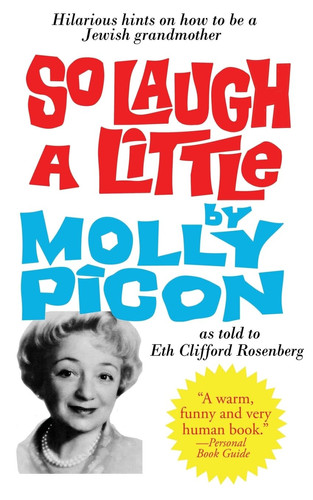
So Laugh a Little
Molly Picon began as a child actor in the Yiddish Theatre at age six. Picon went on to appear in many films, beginning with silent movies. In 1934, Picon had her own musical comedy radio show, Picon went on to appear in many TV shows and her final role was as Roger Moore's mother in cameo appearances in the comedies Cannonball Run and its sequel Cannonball Run II. In "So Laugh a Little" the famous Yiddish actress, has written a funny and poignant book describing her life journey all the while paying homage to the many life lessons learned from her grandmother. Molly's grandmother came to Philadelphia from Russia and helped raise Molly and encourage her in her career in show business. Part autobiography, part common-sense wisdom, this book will engage and entertain you through every chapter. Starting with Molly's early start in Yiddish to her later success in her own stage show and on to many TV and film roles, Molly shares life advice that is just as important to hear today as it was when the book was originally published in 1962.
When the grey Beetles took over Baghdad
Depicts life in Baghdad as only an insider can - very accurately and very beautifully

Enchantment

Joy and Josephine

Last year when I was young

Man overboard
Lieutenant-Commander, the hero of this novel, is axed from the Navy at the age of 36, one of many thousands obliged to re-plan their lives as the result of cuts in the armed services. A widower with a small daughter, he has no experience or knowledge outside submarines and the Royal Navy. His whole life had been that of a sailor since he joined up direct from school at the beginning of the war. This is not only the story of his struggles and adventures when he tries to find some way of earning his living; it is the story of his difficulty in adjusting himself to an unfamiliar civilian world. Monica Dickens's novel is the story of all such men in any of the services who find themselves so rudely thrust into the ordinary life of their country which, though they have served unselfishly, they find they are ill-equipped to live in. Written with the lighter humorous touch of some of her earlier books, it is a sympathetic presentation of the human side of one of those mass adjustments forced on society by the changing nature of the world and its affairs. Great granddaughter to Charles Dickens, Monica (1915-1992) was born into an upper middle class family. Disillusioned with the world she was brought up in—she was expelled from St Paul's Girls School in London for throwing her school uniform over Hammersmith Bridge—Dickens then decided to go into service, despite coming from the privileged class; her experiences as a cook and general servant would form the nucleus of her first book, One Pair Of Hands in 1939. Dickens married an American Navy officer, Roy O. Stratton, and spent much of her adult life in Massachusetts and Washington D.C., but the majority of writing continued to be set in Britain. Her book of 1953, No More Meadows, reflected her work with the NSPCC and she later helped to found the American Samaritans in Massachusetts. Between 1970 and 1971 she wrote a series of children's books known as The Worlds End Series which dealt with rescuing animals, and to some extent children. After the death of her husband in 1985, Dickens returned to England where she continued to write until her death aged 77.

No more meadows
'Times are changed with him who marries; there are no more bypath meadows where you may innocently linger, but the road lies long and straight and dusty to the grave.' So wrote Robert Louis Stevenson. Christine feels bound to agree. 'My wife can do anything,' Vinson says. Struggling to comply with this statement, Christine has to adjust to life in America, whilst catering to Vinson's idea of a good spouse. She must force a sycophantic smile for the wife of Admiral Hamer (who wears patent-leather shoes like bananas) in an effort to ease his promotion. There must be a cold Turkey and a cold ham at every party and she must suffer her ridiculous mother-in-law. Bitter arguments are relieved by bleak silences. As the realities of married life wash away her rosy dream of it, Christine begins to wonder if Vinson is really what she wants. First published in 1953, No More Meadows unravels the threads of a very real marriage. Full of her inimitable warmth and sense of idiosyncratic character, Monica Dickens explores Christine's heart-warming – and at times heart- breaking – search for happiness.

The haunting of Bellamy 4

The landlord's daughter

The messenger

The Greater Judaism in the Making A Study of the Modern Evolution of Judaism

Belling the Cat Essays, Reports & Opinions
"More than forty years of scribble, scribble, scribble, and I have been sued only once..." But this collection of essays is no less a pleasure to read for all that. Mordecai Richler is an exuberant essayist, with a combative wit and sharp eye, regularly offending some, endearing himself mightily to others, and always hugely entertaining. Like all great satirists, he is passionate about the world in which we live; it's that appetite for life and friendship, his love of sanity and common sense as much as his hatred for sacred cows, that lies at the heart of this irresistible book.

Images of Spain
The color, history and spirit of Spain with added notations from enthusiastic visitors and citizens from Cervantes to Hemingway. Excellent color and black/white photgraphy. More than a "coffee table" book.

Oh Canada! Oh Quebec! Requiem for a Divided Country
Good; has some light wear creases in spine.

Oh Canada! Oh Quebec!
Good; has some light wear creases in spine.

Dreams and nightmares: science and technology in myth and fiction
"This book studies written treatment of science and technology from ancient myths to current works. Works studied include the Bible, Greek mythology, tales from the Middle Ages, Gulliver's Travels, Frankenstein, Dr. Jekyll and Mr. Hyde, and works by Jules Verne, H.G. Wells, George Orwell, Bertrand Russell, and Aldous Huxley, among others"--Provided by publisher.

Hearing the voice of God: in search of prophecy
In Hearing the Voice of God: In Search of Prophecy, Mordecai Schreiber examines the roots of the prophetic tradition in Judaism and demonstrates how it has influenced the prophets of later religions, how its tenets have been replicated by major social and political figures of recent centuries, and how it ultimately has the power to define each person’s understanding of his or her responsibilities as a member of the human race. This is an important text for anyone who wishes to understand the Jewish prophetic tradition that has informed the development of today’s world religions and societal laws.

In pursuit of peace: a history of the Israeli peace movement
When the Israeli prime minister and the PLO chairman shook hands on the White House lawn in 1993, Israeli peace activists had good reason to celebrate this major step on the long road to peace. This book tells the story of the Israeli peace movement and the role it played in that pursuit of peace. It is an eloquent, fascinating account of a remarkably diverse and determined cast of activists: from war-weary soldiers to hard-headed politicians, careful scholars to impassioned artists. Drawing on his experience in the peace movement, Bar-On provides intimate portraits of groups like Peace Now, Yesh Gvul, and the Women in Black. He also provides a sweeping historical synthesis of the course of the Israeli-Arab conflict, especially between 1967 and 1993.
