715 results for "Jewish History"

˜Theœ rise of modern Judaism: an intellectual history of German Jewry 1650-1942

Graupe, Heinz Mosche
This book illustrates the rise of modern Judaism through the social and intellectual history of the Jews in Germany. It covers three centuries, up until the violent suppression of the last spark of visible Jewish spiritual-intellectual life in Germany during the Second World War. As a background understanding of this intellectual development, the political, economic, and social events of this three-century-long development are repeatedly drawn upon. This book shows the significance of German Jewry in Jewish history.
Krieger 1978 329 pages

Jewish emancipation: a history across five centuries

Sorkin, David Jan
The first comprehensive history of how Jews became citizens in the modern world For all their unquestionable importance, the Holocaust and the founding of the State of Israel now loom so large in modern Jewish history that we have mostly lost sight of the fact that they are only part of—and indeed reactions to—the central event of that history: emancipation. In this book, David Sorkin seeks to reorient Jewish history by offering the first comprehensive account in any language of the process by which Jews became citizens with civil and political rights in the modern world. Ranging from the mid-sixteenth century to the beginning of the twenty-first, Jewish Emancipation tells the ongoing story of how Jews have gained, kept, lost, and recovered rights in Europe, North Africa, the Middle East, the United States, and Israel. Emancipation, Sorkin shows, was not a one-time or linear event that began with the Enlightenment or French Revolution and culminated with Jews' acquisition of rights in Central Europe in 1867–71 or Russia in 1917. Rather, emancipation was and is a complex, multidirectional, and ambiguous process characterized by deflections and reversals, defeats and successes, triumphs and tragedies. For example, American Jews mobilized twice for emancipation: in the nineteenth century for political rights, and in the twentieth for lost civil rights. Similarly, Israel itself has struggled from the start to institute equality among its heterogeneous citizens. By telling the story of this foundational but neglected event, Jewish Emancipation reveals the lost contours of Jewish history over the past half millennium.
Princeton University Press 2021-09-14 511 pages

The New standard Jewish encyclopedia

Geoffrey Wigoder
Since its original publication in 1958, The New Standard Jewish Encyclopedia has been acknowledged as the authoritative sourcebook of information about all aspects of Jewish life. Its entries cover not only Jewish history and religion, but also current political events, personalities, traditions, archaeological findings and culture. This is the most comprehensive, one-volume Jewish reference book available, spanning all things Jewish from Biblical times to the present era. In the three decades that have passed since the first publication of The New Standard Jewish Encyclopedia, major world events, such as the Six Day War, the Camp David Accords and the dissolution of the Soviet Union, have wrought changes that affect Jewish life everywhere. This edition has been continually and thoroughly updated to incorporate this new information. Its timeliness is best illustrated by the inclusion of articles on the mass exodus of Ethiopian and Soviet Jews to Israel, and the latest statistics available about Jewish populations in the Commonwealth of Independent States. Here also is a wealth of information about Jews who have affected our cultural lives: Woody Allen, Leonard Bernstein, Albert Einstein, Chaim Potok, to name but a few of the more than 8,000 entries that comprise this massive endeavor. The revisions of existing entries and the inclusion of new articles make The New Standard Jewish Encyclopedia not only one of the most comprehensive reference works available but also the most current. This edition also contains a complete list of Jewish Nobel Prize winners. Prepared in Jerusalem by a team of 200 scholars and the staff of the Encyclopedia Hebraica, this edition was completed by an editorial board headed by the highly regarded Geoffrey Wigoder, also general editor of the universally acclaimed Encylopaedia Judaica, working in concert with the American Advisory Board headed by I.J. Carmin Karpman, chief editor of Who's Who in World Jewry. Authoritative, comprehensive and up-to-date, this work belongs on the shelves of everyone who is interested in all things Jewish.
Facts on File 1992 1001 pages

Emancipation through muscles: Jews and sports in Europe

Michael Brenner,Gideon Reuveni
Although the study of Jewish identity has generated a growing body of work, the topic of sport has received scant attention in Jewish historiography. Emancipation through Muscles redresses this balance by analyzing the pertinence of sports to such issues as race, ethnicity, and gender in Jewish history and by examining the role of modern sport within European Jewry. The accomplishments of Jews in the intellectual arena and their notable presence among Nobel Prize recipients have often overshadowed their achievements in sports. The pursuit of sports among Jews in Europe was never a marginal phenomenon, however. In the first third of the twentieth century numerous Jewish sport organizations were founded throughout Europe, and prowess in the realm called "muscle Jewry" by the Zionists was a symbol of widespread pride among European Jews. Some Jewish teams were remarkably successful: the legendary Austrian soccer champion Hakoah Vienna was arguably the most visible Jewish presence in interwar Vienna, and many readers will be surprised to learn that outstanding soccer teams such as Ajax Amsterdam and Tottenham Hotspur are still considered "Jewish teams." The contributors to this volume, an international group of scholars from a variety of fields, explore the diverse relationships between Jews and modern sports in Europe.
University of Nebraska Press 2006 277 pages

The road to September 1939: Polish Jews, Zionists, and the Yishuv on the eve of World War II

Reinharz, Jehuda,Shaviṭ, Yaʿaḳov
In European and Holocaust historiography, it is generally believed that neither the Zionist movement nor the Yishuv were mindful of the plight of European Jews in the face of the Nazi threat during the 1930s. Drawing on a wide variety of memoirs, letters, and institutional reports by people from all walks of life, this volume sheds new light on a troubled period in Jewish history. Jehuda Reinharz and Yaacov Shavit trace Jewish responses to developments in Eastern and Central Europe, as well as reactions to British policy on the question of a Jewish homeland, to show that Zionists in the Yishuv worked tirelessly on the international stage on behalf of their coreligionists in Europe. Nevertheless, their efforts were all too often shattered by the realities of their powerlessness and lack of resources. Piercing to the heart of conversations about how or whether to save Jews in an increasingly hostile Europe, this volume provides a nuanced assessment of what could and could not be achieved in the years just prior to World War II and Holocaust.
Brandeis University Press 2020-03 432 pages

If I am not for myself: journey of an anti-Zionist Jew

Marqusee, Mike
This is an eloquent and deeply felt memoir exploring the author's complex relationship with his Jewish identity. "If I Am Not Myself" is a passionate, thought-provoking exploration of what it means to be Jewish in the twenty-first century. It traces the author's upbringing in 1960s Jewish-American suburbia, his anti-war and pro-Palestinian activism on the British Left, and life as a Jew among Muslims in Pakistan, Morocco, and Britain. Interwoven with this are the experiences of his grandfather's life in Jewish New York of the 1930s and '40s, his struggles with anti-Semitism and the twists and turns that led him from anti-Fascism to Militant Zionism. In the course of this deeply personal story, Marqusee refutes the claims of Israel and Zionism on Jewish loyalty and laments their impact on the Jewish Diaspora. Rather, he argues for a richer, more multi-dimensional understanding of Jewish history and identity, and reclaims vital political and personal space for those castigated as self-haters by the Jewish establishment.
Verso 2008 307 pages

Embracing exile: the case for Jewish diaspora

Kraemer, David Charles
"Embracing Exile is a comprehensive history of Jewish responses to and conceptions of their exiles/diasporas. Jews have, since their beginnings, been a wandering people. According to their origin story, they wandered from Ur of Chaldees to Canaan to Egypt and then back to Canaan. From there, they were exiled to Babylon, where they built their longest-lived home, one that survived until the twentieth century. Over the span of centuries, they resettled in Persia, Egypt, Morocco, Spain, Italy, Turkey, Poland, Ukraine, and the United States, often flourishing. Thanks to these experiences, Diaspora became "natural" to Jews, and though they may have hoped for a return to their Promised Land at the End of Days, they made sense of their many homes, defending Diaspora as the realm where Jewish life could grow and Jews fulfill their covenantal obligations in the company of their God. The texts and expressions the volume documents in Defending Diaspora include biblical and rabbinic texts, philosophical treatises, Kabbalah, Hasidism, and a multiplicity of modern expressions. The book offers revised readings of the book of Esther and other biblical texts, a survey of Talmudic treatments of exile, an in-depth analysis of the thought of the Maharal of Prague, analyses of works by Philip Roth, and other modern authors, and much more. The book shows that lament has not been the most common Jewish response to diaspora and that Zionism is not the natural outcome of either Jewish ideology or history"-- Provided by publisher.
Oxford University Press 2025 234 pages

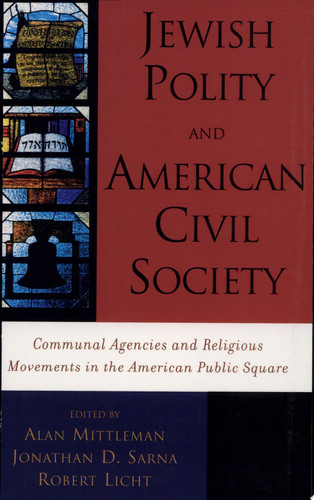
Jewish polity and American civil society: communal agencies and religious movements in the American public sphere

Alan Mittleman,Robert Licht,Jonathan D. Sarna
Jewish Polity and American Civil Society is a study of the civic and political engagements of American Jews as mediated by their communal and denominational institutions. The book explores how the various branches of the organized Jewish community seek to influence public affairs. Over the course of the last century, Jewish agencies and religious movements have tried to shape public debate and public policy on such issues as civil rights, church-state relations, and American foreign policy. The book sets the history of Jewish engagement in these areas into historical context; analyzes the motives, strategies, and tactics of various Jewish groups, and evaluates their successes and failures. The book also explores the underlying idea-the public philosophy-that informs American Jews' understanding of civic and political engagement.
Rowman & Littlefield 2002-07-23 420 pages

The enduring community: the Jews of Newark and MetroWest

Helmreich, William B.
From its founding in the late seventeenth century, Newark, New Jersey, was a vibrant and representative center of Jewish life in America. Geographically and culturally situated between New York City and its outlying suburbs, Newark afforded Jewish residents the advantages of a close-knit community along with the cultural abundance and social dynamism of urban life. In Newark, all of the representative stages of modern Jewish experience were enacted, from immigration and acculturation to upward mobility and community building. The Enduring Community is a lively and evocative social history of the Jewish presence in Newark as well as an examination of what Newark tells us about social assimilation, conflict and change. Grounded in documentary research, the volume makes extensive use of interviews and oral histories. The author traces the growth of the Jewish population in the pre-Revolutionary period to its settlement of German Jews in the 1840s and Eastern European Jews in the 1880s. Helmreich delineates areas of contention and cooperation between these groups and relates how an American identity was eventually forged within the larger ethnic mix of the city. Jewish population in politics, the establishment of Jewish schools, synagogues, labor unions, charities, and community groups are described together with cultural and recreational life. Despite the formal and emotional bonds that formed over a century, Jewish neighborhoods in Newark did not survive the postwar era. The trek to the suburbs, the erosion of Newark's tax base, and deteriorating services accelerated a movement outward that mirrored the demographic patterns of cities across America. By the time of the Newark riots in 1967, the Jewish presence was largely absent. This volume reclaims a lost history and gives personalized voice to the dreams, aspirations, and memories of a dispersed community. It demonstrates how former Newarkers built new Jewish communities in the surrounding suburbs, an area dubbed "MetroWest" by Jewish leaders. The Enduring Community is must reading for students of Jewish social history, sociologists, urban studies specialists, and readers interested in the history of New Jersey. The book includes archival photographs form the periods discussed.
Transaction Publishers 1999 373 pages

In the days of Simon Stern: a novel

Cohen, Arthur A.
Nathan, a blind Jewish scribe, tells the story of the coming of the Messiah in the person of one Simon Stern—from his birth on the Lower East Side, through his career as a millionaire dealer in real estate, to his building of a refuge for the Jewish remnant of World War II. "A majestic work of fiction that should stand world literature's test of time, to be read and reread. A masterpiece."— Commonweal "This book ensnares one of the most extraordinarily daring ideas to inhabit an American novel in a number of years. For one thing, it is that risky devising, dreamed of only by the Thomas Manns of the world, a serious and vastly conceived fiction bled out of the theological imagination. For another, it is clearly an 'American' novel—altogether American, despite its Jewish particularity: it is not so much about the history of the Jews as it is about the idea of the New World as haven. . . . In its teeming particularity every vein of this book runs with a brilliance of Jewish insight and erudition to be found in no other novelist. Arthur Cohen is the first writer of any American generation to compose a profoundly Jewish fiction on a profoundly Western theme."—Cynthia Ozick, New York Times Book Review "This stately, ambitious amalgam of Jewish myth, history, theology, and speculations on the Jewish soul is like an enormous Judaic archeological ruin—often hard for the uninitiated to interpret, but impressive. . . . Intelligent, inventive, fascinating."— New Yorker
University of Chicago Press 1988 464 pages

The jewelers of the Ummah: a potential history of the Jewish Muslim world

Azoulay, Ariella
"In a series of letters to her father, her great-grandmothers, and her children-and to thinkers such as Frantz Fanon, Hannah Arendt, Ghassan Kanafani, and Sylvia Wynter-Ariella Aïsha Azoulay examines the disruption of Jewish Muslim life in Algeria and broadly in the Maghreb and the Middle East by two colonial projects: French rule and the Zionist colonization of Palestine, which provoked the departure of Jews from these areas"--
Verso Books 2024-09-24 646 pages

Jewish Bible translations: personalities, passions, politics, progress

Greenspoon, Leonard J.
"Jewish Bible Translations is the first book-length history and analysis of Jewish Bible translations from the third century BCE to our day. Greenspoon delves into the historical, cultural, linguistic, and religious contexts of translations in eleven languages: Arabic, Aramaic, English, French, German, Greek, Hungarian, Italian, Russian, Spanish, and Yiddish"--
The Jewish Publication Society 2020-11 298 pages

The dispersion of Egyptian Jewry: culture, politics, and the formation of a modern diaspora

Beinin, Joel
Egypt's indigenous Jewish population comprised Arabic-speaking Rabbanite and Karaite Jews, some of whom had been in the country since the early Islamic era. Jews expelled from Spain in 1492 took refuge in Egypt, and their numbers were augmented in the mid-nineteenth century by Sephardic immigrants. Originally welcomed elsewhere in the Ottoman Empire, these Spanish Jews came to Egypt seeking economic opportunity in the era of Suez Canal construction and the cotton boom. The late nineteenth century brought Ashkenazi Jews fleeing persecution in Eastern Europe. The different groups formed a heterogeneous community of cosmopolitan hybrids, which was both an element of strength and a factor in its eventual demise. The Dispersion of Egyptian Jewry examines the history of the Egyptian Jewish community after 1948, focusing on three major areas: the life of the majority of the community, which remained in Egypt from the1948 Arab-Israeli War until the aftermath of the 1956 Suez/Sinai War; the dispersion and reestablishment of Egyptian Jewish communities in the United states, France, and Israel; and contested memories of Jewish life in Egypt since President Anwar al-Sadat's visit to Jerusalem in 1977. Beinin argues that the experiences of Egyptian Jews cannot be adequately accounted for by either Egyptian nationalist or Zionist narratives. Fusing history, ethnography, literary analysis, and autobiography, Joel Beinin conducts an interdisciplinary investigation into identity, dispersion, and the retrieval of identity that is relevant for anyone interested in Egypt, the Jewish diaspora, or the formation of cultures and identities.
American University in Cairo Press 2005 329 pages

Diaspora: Jews amidst Greeks and Romans

Gruen, Erich S.
Gruen (history and classics, Berkeley) explores four centuries of Jewish life within the dominant classical civilization, from Alexander the Great's conquest of the Near East to the Roman destruction of the Jewish Temple in 70 C.E. He begins with an investigation of "the conspicuous absence of a philosophy of Diaspora" and attempts very capably to identify the traces of the concept among Jews ... More under Roman rule. He looks at the cultures of the Jews living in Rome, Asia, and Alexandria, finding very vibrant communities in all three places. In exploring Jewish views of the Diaspora, Gruen offers up two chapters on Diaspora humor, one about the way biblical tales were retold and the lessons they could convey and the other about creating fanciful yet didactic stories. Then the author looks at the evidence about the Jewish image of the Greeks and Romans, a subject usually investigated from the opposite viewpoint. This leads into his final chapter on the Jewish view of the homeland during the period, a view not much different from today's. Gruen admits that his work is far from exhaustive, but it is certainly substantial, fascinating, and scholarly
Harvard University Press 2004-10-25 400 pages

The Jew and the other

Benbassa, Esther
In the current situation of polarization in the Middle East, it is easy to lose sight of the fact that a long tradition of dialogue and openness toward the "Other" exists in many strands of Jewish thought. Himself or herself the quintessential Other in a world in which she or he has existed dispersed, in exile, as a minority, the Jew has consistently envisioned the self in relation to surrounding societies. Esther Benbassa and Jean-Christophe Attias show that alterity is a useful and morally compelling notion with which to structure Judaism's historically specific and politically charged encounters with deity, femininity, the Christian West, and the Muslim East. In Benbassa and Attias's view, the Other may be rejected, but it is also a mirror, both reminding the Jew of ethical duties and constituting a source of temptation and danger. Sometimes, the authors find, the Other is the enemy. They note that it is with the enemy that peace is made, peace with the Other and peace with the self. The Jew and the Other , which is an extended commentary on a dozen Biblical verses and which follows the five books of the Pentateuch, offers the history of that encounter as an inextricable part of the Jewish condition and is itself a meditation on this encounter.
Cornell University Press 2004 157 pages

Jewish families

Boyarin, Jonathan
From stories of biblical patriarchs and matriarchs and their children, through the Gospel’s Holy Family of Jesus, Mary, and Joseph, and to modern Jewish families in fiction, film, and everyday life, the family has been considered key to transmitting Jewish identity. Current discussions about the Jewish family’s supposed traditional character and its alleged contemporary crisis tend to assume that the dynamics of Jewish family life have remained constant from the days of Abraham and Sarah to those of Tevye and Golde in Fiddler on the Roof and on to Philip Roth’s Portnoy’s Complaint . Jonathan Boyarin explores a wide range of scholarship in Jewish studies to argue instead that Jewish family forms and ideologies have varied greatly throughout the times and places where Jewish families have found themselves. He considers a range of family configurations from biblical times to the twenty-first century, including strictly Orthodox communities and new forms of family, including same-sex parents. The book shows the vast canvas of history and culture as well as the social pressures and strategies that have helped shape Jewish families, and suggests productive ways to think about possible futures for Jewish family forms.
Rutgers University Press 2013-07-23 185 pages

Future hope: a Jewish Christian look at the End of the World

Brickner, David
Everywhere you turn, people are wondering about the future and the end of the world as we know it. While conversations of doom and gloom are pervasive, what Christians have to offer is a message of a future and a hope. Future Hope by David Brickner, executive director of Jews for Jesus, is written in an easy to understand format and offers insights into the Bible prophecies. The book also includes helpful charts and appendices. Great for both Christians interested in a Jewish perspective on end time prophecy and Jewish people that are curious about what Christians have to say about the end of history.
Purple Pomegranate Productions 1999 153 pages

Jewish communities of the world

Avi Beker
More than just a guide to centers of Jewish populations throughout the world, this comprehensive work provides facts about the demography and history of these important communities, as well as a listing and description of community organizations, religious life, local Jewish culture, and educational facilities. Introductory sections include information on the founding of Israel, population statistics, and thoughts on topics ranging from the Diaspora to the founding of the Jewish state.
Lerner Publications 1998 256 pages

German, Jew, Muslim, gay: the life and times of Hugo Marcus

Baer, Marc David
"German, Jew, Muslim, Gay offers an astonishing perspective on the history of modern Germany through the vantage point of a man with multiple identities who devoted his life to religious utopias, fought for homosexual rights, wrote gay fiction, converted from Judaism to Islam (one of the few of any faith to do so), and considered himself part of a spiritual elite that held the key to Germany's salvation. Born in Posen in 1880, the son of a Jewish industrialist, Hugo Marcus converted to Islam and chose the name Hamid; he became the most important convert in Germany while retaining his membership in the Jewish community. He was renamed Israel by the Nazis and sent to the Sachsenhausen concentration camp in 1938, where he was in the unique position of Muslim witness to the Holocaust. The imam of his mosque gained his release and he escaped to Switzerland, where he wrote gay fiction under the pen name Hans Alienus. He died in Basel in 1966. The book challenges deeply ingrained perceptions of Muslim-Jewish relations during World War II and illuminates their interconnected histories in modern Europe. It also tells the unknown story of Marcus' orientalized Islam that, in echoing Goethe's, revitalized an essential strand of Germany's spiritual heritage"--
Columbia University Press 2020 300 pages