492 results for "Leadership"

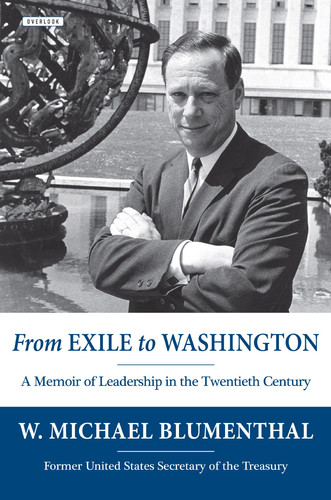
From Exile to Washington

Michael W. Blumenthal
In a life that has spanned nearly nine decades and has taken him across the world and back, W. Michael Blumenthal has borne witness to the worlds convulsions and transformations during the twentieth century. Born in Germany between the two world wars, Blumenthal narrowly escaped the Nazi horror, when, in 1939, he and his family fled to Shanghais chaotic Jewish ghetto, where they spent the entirety of the Second World War. From these fraught and humble beginnings, Blumenthal would emerge as a major leader in American business and politics. In the second half of the century, Blumenthal headed two major American corporations Bendix and Burroughs (later Unisys) served as a United States trade ambassador in the State Department and the White House, advising John F. Kennedy and Lyndon Johnson, and served under Jimmy Carter as the Secretary of the Treasury. After his retirement from business and politics, he began an entirely new chapter in his career, when he conceived and became director of Europes largest Jewish museum the Jewish Museum of Berlin a position he still holds today. An essential autobiography by one of Americas great political figures, From Exile to Washington is an engaging chronicle of the twentieth centurys greatest upheavals, and a tribute to a lifetime of courage, leadership and decisiveness.
Duckworth Publishers 2014-09-25 448 pages

A history of Palestine, 634-1099

Gil, Moshe
This is the first comprehensive history of Palestine from the Muslim conquest in 634 to that of the Crusaders in 1099. It is a translation and revised version of volume I of Palestine during the first Muslim period which was published in Hebrew in 1983 and presents an authoritative survey of the early mediaeval Islamic and Jewish worlds. Professor Gil begins by reviewing the political and military events in Palestine before and after the Arab invasion. Later chapters explore the Abbasid, Tulunid, Ikhshidid and Fatimid periods, during which time Palestine was an almost perpetual battlefield for states, armies and factions. Against this backdrop of conflict and administrative changes, the author portrays the everyday life of Palestine and its inhabitants. He looks at the economic history of Palestine--its agriculture, transport facilities, exports and systems of taxation--as well as the religious status of Jerusalem, the nature of Islam's tolerance towards Jews and Christians and the status, leadership and customs of the Christian populace. Specific attention is paid to the history of Palestinian Jews under Muslim rule. Professor Gil details their topography, economic activities and religious life; he explores the Karaite and Samaritan communities and discusses the role of the most prominent Jewish institution, the yeshiva. A history of Palestine, 634-1099 is based on an impressive array of sources. Professor Gil has put to use more than one thousand documents of the Cairo Geniza collection and these are paralleled by Arabic, Syriac, Latin and Greek material. This monumental study will be an essential resource for students and specialists of mediaeval Islamic and Jewish history andreligious studies and for anyone interested in the history of the Holy Land.
Cambridge University Press 1992-02-20 968 pages

Turbulent times: the British Jewish community today

Kahn-Harris, Keith
The first book-length study of contemporary British Jewry, 'Turbulent Times: The British Jewish Community Today' examines the changing nature of the British Jewish community and its leadership since 1990. Keith Kahn-Harris and Ben Gidley contend that there has been a shift within Jewish communal discourse from a strategy of security, which emphasized Anglo-Jewry's secure British belonging and citizenship, to a strategy of insecurity, which emphasizes the dangers and threats Jews face individually and communally. This shift is part of a process of renewal in the community that has led to something of a 'Jewish renaissance' in Britain. Addressing key questions on the transitions in the history of Anglo-Jewish community and leadership, and tackling the concept of the 'new antisemitism', this important and timely study addresses the question: how has UK Jewry adapted from a shift from monoculturalism to multiculturalism?
Continuum 2010 237 pages

The United Nations High Commissioner for Human Rights: conscience for the world

Felice D. Gaer,Christen Broecker
In this first systematic examination of the role of the top United Nations human rights official, editors Felice Gaer and Christen Broecker analyze the achievements, leadership styles of, and obstacles encountered by the UN High Commissioner for Human Rights, and propose recommendations for the future. The editors are joined by 18 expert contributors including present and former UN policymakers, human rights practitioners, legal scholars, and current High Commissioner Navi Pillay. The United Nations High Commissioner for Human Rights: Conscience for the World examines how the six individuals who have served in this post have worked to end atrocities, hold perpetrators of abuses to account, promote equality and justice, and provide protection and redress to victims.
Martinus Nijhoff Publishers 2014 398 pages

Ruminations and Reflections - The Musical Journey of Dave Liebman and Richie Beirach

Dave Liebman,Richie Beirach,Kurt Renker
The Jazz Book of Two Lifetimes NEA Jazz Master saxophonist Dave Liebman and pianist Richie Beirach have enjoyed a fifty-year friendship on and off the bandstand. They've performed with Miles Davis, Elvin Jones, Stan Getz, Chet Baker, Freddie Hubbard, and their own bands. Ruminations and Reflections takes readers on a rollicking journey through their musical lives. Along the way, they share their views on jazz education, prominent musicians, and musical preparation. Liebman and Beirach pay tribute to their musical mentors, tour their discography, and suggest essential recordings to study. The book's conversational style will delight students, professionals, and music lovers alike. "We really don't have an exact name for musicians like Dave and Richie. Across decades of recordings and concerts, their aspirations obliterate the definitions of any single genre. This volume reveals the deep insight and wisdom required to resolve their shared quest for meaning in music. Both are master players who continue to strive for what goes beyond and what lies beneath. Reading their words and following their stories in this wonderful book affirms the feeling that they share on the bandstand as one of the great long-term partnerships in this music." - Pat Metheny A masterclass in the art and skill of jazz Ruminations and Reflections is more than just a jazz biography, it is a masterclass in how to improvise, jazz theory, how to listen to jazz, and the business of being a musician in today's world. Never shy, these two friends share fascinating and revealing stories of growing into their musical selves, late night hangs with legendary musicians, and the jazz life. Known for their virtuosity and playing free, Liebman and Beirach share their secrets for preparing for the ultimate exercise of musical improvisation. Both musicians use their deep devotion to classical music as a basis for improvisation, crossing genres and boundaries to create spontaneous and beautiful musical experiences. As veteran educators, Dave and Richie share their wisdom and life lessons to keep the legacy of jazz improvisation and free jazz alive. Jazz musicians and students will find value in their masterful analysis of duo playing, comping, and musical leadership. For fans of jazz masters and legends Ruminations and Reflections showcases never before told anecdotes and opinions about musical legends including, John Coltrane, Bill Evans, McCoy Tyner, Jack DeJohnette, Wayne Shorter, Michael Brecker, Randy Brecker, Chick Corea, Lee Konitz, Sonny Rollins, Herbie Hancock, and Wynton Marsalis. Jazz fans will delight in the in-depth analysis of over twenty of this duo's best recordings, providing insight and history to this important discography. A journey through modern jazz history Jazz aficionados will enjoy the personal accounts of their formative years in Brooklyn, developing a passion for music that has lasted a lifetime. A road trip through Brooklyn and Manhattan sets the scene for reminiscences about the New York City jazz scene today and in days gone by. Jazz clubs like Birdland and the Village Vanguard come to life with tales of the musicians who played there. Ruminations and Reflections chronicles the intersection of jazz and rock and roll in the fertile early 1970's New York loft scene. Beirach and Liebman were pioneers in the jazz fusion era and recount tours, jam sessions, and recordings with their bands Lookout Farm and Quest. They continue to marvel audiences in any musical setting. Along their journey, Liebman and Beirach have created a legacy of excellence and dedication to fans, fellow musicians, and the music. This book is a celebration of musical lives well-lived and a gift to us all.
Cymbal Press 2022-09 314 pages

From Protest to Power Personal Reflections on a Life in Politics

Bob Rae
In January of 1996, when Bob Rae declared he was stepping down as the leader of the Ontario New Democratic Party, the media was full of praise for the former premier of Ontario. In From Protest to Power , Rae provides a surprising, frank look back at his time in politics. Shedding light on his rise to power from radical student politics to becoming the leader of the first NDP government to hold power in Ontario. He takes a look at his incredible life from Rhodes Scholar at Oxford and studying with philosopher Isaiah Berlin to his life as a family man.In the fall of 2006, with Bob Rae running for the federal leadership of the Liberal Party, it is time for us to examine his remarkable life once more. A life that has been motivated by the belief that politics and public service matter.As he says in the new introduction, ?I am running because I care deeply about my country. I want it to stay strong. I want it to stay together. And I want to play whatever part I can to help make those things happen.?Learn more about what makes Bob run.
Penguin Group (Canada) 1997 366 pages

The Conservative effect, 2010-2024: 14 wasted years?

Anthony Seldon,Tom Egerton
"What has changed for the better or worse during fourteen years of Conservative government? Anthony Seldon and his team explore the 'Conservative Effect', analysing the ultimate impact of their leadership on the UK. This intriguing read offers powerful insights and fresh perspectives on the full scope of the Conservative government's influence"--
Cambridge University Press 2024-06-27 549 pages

Playbook for progressives: 16 qualities of the successful organizer

Mann, Eric
An organizing manifesto for the twenty-first century, Playbook for Progressives is a must-have for the activist’s tool kit. This comprehensive guide articulates pragmatically what is required in the often mystifying and rarely explained on-the-ground practice of organizing. Here, Eric Mann distills lessons he learned from over forty years as an organizer, as well as from other organizers within the civil rights, labor, LGBT, economic justice, and environmental movements.
Beacon Press 2011-08-09 207 pages

A Year at Hartlebury, Or, The Election

Benjamin Disraeli,Sarah Disraeli
The revelation that a long forgotten novel first published anonymously in 1834 is the work of Benjamin Disraeli and his sister Sarah is an exciting literary event. Newly discovered letters between brother and sister prove without doubt that it was written jointly by them. We do not have to look far for the reason for their secrecy. The vividly described election which forms the centrepiece of the story is clearly based on Disraeli's recent experiences as an unsuccessful candidate in two elections at High Wycombe. His political career had a long way to go and the last thing he wanted was to jeopardize it by revealing his motives in the past or his hopes for the future. The hero, Aubrey Bohun, has, like Disraeli, recently returned from mysterious travels in the East, but unlike him has his own castle and an income of £30,000 a year. Bohun obviously contains an element of wish fulfilment and allows the authors to incorporate in the novel elements of wish fulfilment and allows the authors to incorporate in the novel elements of a popular genre known in its day as 'silver fork' fiction – revelations of high life. Although there is much of this and of melodrama too, there is also some splendid social irony. Michael Foot says 'the volume is quite fit to takes its place in the true Disraeli canon and contains many gems which add fresh gleams to the portrait of Disraeli himself.' Two appendixes explain the literary detection that proved the book's authorship and the parallels between the politics of Aubrey Bohun and Disraeli.
University of Toronto Press 1983-12-15 230 pages

The Apocryphal Acts of Paul, Peter, John, Andrew, and Thomas

Pick, Bernhard
The publication of the apocryphal Acts of the Apostles has unveiled a vast yet unexplored domain in ancient Christian literature. These Acts, particularly the oldest ones, provide insights into second-century Christianity. They are vital for understanding early Christian worship practices and offer a glimpse into divine services held in homes, complementing the Acts of the Apostles. They also hold significance in the history of Christian poetry, notably within Gnostic circles. Despite their mix of fact and fiction, these Acts are relevant to educators, preachers, missionaries, and historians. The oldest and most significant Acts are presented in this volume. These Acts are crucial for early Church literature and provide valuable insights into Christian history. Bernhard Pick (1842–1917) was a German-American Lutheran pastor and prolific scholar, studied at New York City's Union Theological Seminary. He contributed extensively to theological encyclopedias, provided critical indexes, and delved into hymnology. This Reader's Edition is based on a public domain text. This text has been thoroughly spellchecked and proofread to correct errors that appear in the public domain edition. The formatting has also been altered to provide a cleaner, more readable experience. Introductions and footnotes not native to the text have been removed to avoid interruptions to and distractions from the text. Many readers find that this allows them a greater ability to focus on the text itself. It is our hope that this Reader's Edition will provide you with the best possible reading experience of this classic text. Our mission is to breathe new life into the pages of the past by removing barriers between the reader and the text.
Independently published 2023-09-18 237 pages

Apogee of empire: Spain and New Spain in the age of Charles III, 1759-1789

Stein, Stanley J.
"In Apogee of Empire, the authors argue that the inability to renovate the Hapsburg legacies reflected reluctance to undertake radical changes first at home, then in Spain's relationship with its colonies." "The Steins trace in detail efforts to reform the Spanish establishment in the early 1760s, initially under the leadership of the marques de Esquilache, who accompanied Charles from Naples. Reformers had to determine which adjustments could be made without risking radical innovation. The ensuring seven-year conflict between reformers and traditionalists ended in a coup that outsted Esquilache. The authors then analyze the shift in focus to the colonies and the emphasis on incrementally modifying a key element of Spanish colonialism, transatlantic trade, via so-called free trade within the imperial system. Comercio libre, like most Bourbon reformism in general, neither realized a colonial pact nor improved Spain's competitive position in the Atlantic trading system. At the time of Charles III's death, the authors conclude, Spain had only made superficial changes, rather than the profound transformation the situation demanded, and by 1789 Spain and its wealthiest colony, New Spain, would be ill-prepared for the coming decades of upheaval in Europe and America."--Jacket
Johns Hopkins University Press 2003-11-04 464 pages

Poison: modern manifestations of a blood libel

Israeli, Raphael
In March 1983 a mass poisoning was reported in the girls' middle school of Arrabeh, a village near Jenin in the West Bank. The malaise recurred in the following weeks in Jenin, Hebron, and other towns in the West Bank. All the sufferers, mainly young Arab women, were hospitalized, but soon released. The toxic agent which allegedly caused the malaise was not found; Israeli authorities concluded that the attacks were caused by mass hysteria. Nonetheless, both local Palestinian authorities and the PLO leadership accused Israel of an attempt of mass poisoning, aiming to affect the women's reproductive system and thus to tamper with the natural growth of the Palestinian population. The accusation was taken up by the media, not only Arab but also in the West (French, British, German, etc.). Once the hoax became apparent, the whole affair disappeared from the media. Compares the "poisoning affair" to blood libels in the past. Raises questions regarding the strange credulity of the Western press, otherwise very cautious in presenting similar affairs in other countries, its anti-Israeli disposition, and its disproportionally great interest in the Palestinian-Israeli conflict. Contends that the media's incrimination of Israel is a manifestation of its latent antisemitism. Where the Arabs incriminate the Jews as a people, the Westerners, reluctant to look ethnophobic, incriminate the Jewish state. Includes many quotes from the press.
Lexington Books 2002-01-01 250 pages

The politics of national security

Raskin, Marcus G.
The evolution of the national security state in the United States can be traced from the political, military, and economic dimensions of American power in the postwar world. In Raskin's view, the United States emerged from the Second World War with tremendously increased prestige and material power, and American leadership created a national security apparatus as a planning instrument to ensure national stability, to mute class conflicts, and to secure the domestic economy. This state then became the basis around the world for covert and overt imperialism.The consensus that developed served to maintain stability at home and to guide the modern empire abroad. This development required a state that was orderly and that was predicated on modern bureaucracy, which operated within the values and assumptions of the ruling elites.The national security state system was successful primarily in the economic sphere, with bipartisan foreign-policy decision making aimed at ensuring a stable business climate at home and abroad. Military involvement in Indochina evidenced the decline of American hegemony; the genocidal nature of the arms race and the questions raised by protestors of the sixties signaled the break up of the national security consensus.Raskin concludes the book with an examination of alternative directions, especially regarding the need and the possibilities for renewed public debate of national policy and purpose.
Transaction Books 1979 211 pages

Shiloh: a narrative play

Rubenstein, Howard S.
SHILOH is a narrative play on important events in the battle of Shiloh, the first great battle of the U.S Civil War. The play shows a stunning failure of military leadership, which led to extraordinary gore and carnage and cowardice. The play is presented largely from the soldier's point of view, and the dialogue is based mostly on original eyewitness documents--soldiers' letters, diaries, and notebooks, and rarely on their commanders' memoirs, which tend to be embellished, glorified or otherwise distorted, to justify the commanders' decisions.
Granite Hills Press 2015 145 pages

Dissenter in Zion From the Writings of Judah L. Magnes

Arthur A. Goren
For nearly half a century, until his death in October 1948, Judah Magnes occupied a singular place in Jewish public life. He won fame early as a preacher and communal leader, but abandoned these pursuits at the height of his influence for the roles of political dissenter and moral gadfly. During World War I he became an outspoken pacifist and supporter of radical causes. Settling permanently in Palestine in 1922, he was a founder and the first president of the Hebrew University. Increasingly, he viewed rapprochement with the Arabs as the practical and moral test of Zionism, and the formation of a bi-national state of Arabs and Jews became his chief political goal. His life interests thus focused on the core issues that confronted and still confront the Jewish people: group survival in democratic America, the direction and character of the return to Zion, and the reconciliation of universal ideals with Jewish aspirations and needs. Dissenter in Zion draws upon a rich corpus of private letters, personal journals, and diaries to offer a moving account of an eloquent and sensitive person grappling with the great questions of the day and of an activist striving to translate private moral feelings into public deeds through politics and diplomacy. We see Magnes disagreeing with Brandeis over the leadership and direction of American Zionism and with Weizmann and Ben-Gurion over ways to achieve peaceful relations with the Arabs; defending himself against charges by Einstein that he was mismanaging the affairs of the Hebrew University; and persistently negotiating with Arab leaders, trying to reach a compromise on the eve of the establishment of the State of Israel. Dissenter in Zion also contains a biographical essay on Magnes by Arthur Goren, assessing his ideas and motives and placing him in the context of his times. It shows Magnes's profundity without covering up his weaknesses, his lifelong tactic for courting repeated defeat in favor of long-term goals that could not come to pass in his lifetime.
Harvard University Press 1982-02-05 569 pages

Oliver Tambo's dream: four lectures

Sachs, Albie
"If a paternity test were done on South Africa's widely admired Constitution, whose DNA would come up? Is the Constitution just a beautiful piece of paper? If Oliver Tambo were alive today, walking around South Africa, would he be pleased with what he saw? In this riveting, direct account of the genesis of South Africa's Constitution, former Justice Albie Sachs answers these crucial questions. In Oliver Tambo's Dream, Sachs writes about the years he spent working under Tambo's leadership in exile preparing for a post-apartheid constitutional order in South Africa and about the extreme crises that were overcome during the post-1990 constitution-making process to arrive at the document we have today. Tackling the burning issues that face our country today, he argues that the Constitution is a framework for struggle and decolonization that can be used to bring about land reform and true equality"--
African lives 2017 142 pages

How global currencies work: past, present, and future

Eichengreen, Barry J.,Mehl, Arnaud,Chitu, Livia
"This book will come to be known as the one that challenged the old, winner-takes-all view of international currency competition and established the new view. Barry Eichengreen and his coauthors present thorough and telling evidence that the historical reality is that multiple currencies play consequential roles in international trade and finance--and that lock-in effects and persistence are not as strong as traditionally assumed. In short, this is a must-read for all economists interested in international macroeconomics and finance." --Richard Baldwin, Graduate Institute of International and Development Studies, Geneva "Barry Eichengreen, our pre-eminent international monetary historian, and his coauthors have written a great book around the central theme that there have almost always been multiple rival international currencies and that the advantages of being the world's lead currency are not as marked as traditionally argued. The book is lucidly written, eschewing mathematical technicalities, though the background scholarship is deeply impressive. It should be read by everyone interested in the monetary history of the past two centuries." --Charles Goodhart, London School of Economics and Political Science "This eloquent and learned book will become the standard--perhaps one should say the gold standard--for discussions of international currency regimes, and for the analysis of the uncertainties that accompany changing global leadership." --Harold James, Princeton University "The authors put the plural back into global currencies, for good reason. As their historical but highly topical research establishes, there can be more than one global (or 'reserve') currency at any one time, as has often been the case in the modern world. This is an important corrective to the recurring oversold yen then euro then yuan will rival the dollar litany. But it is also a reminder that there is more to a stable global financial system than how many currencies there are, but how the leaders of those currencies take responsibility and interact." Adam S. Posen, President, Peterson Institute for International Economics "Drawing on new data, this book provides a rich contextual and historical analysis of reserve currencies in the global economy. This is very welcome, indeed." --Sebastian Edwards, University of California, Los Angeles
Princeton University Press 2018 250 pages

Workers of wonders: a model for effective religious leadership from Scripture to today

Sherwin, Byron L.
Why do people follow a leader, particularly a religious leader? And why, given that Americans are still an overwhelmingly religious people, is the clergy declining in influence? Byron Sherwin argues that what is missing is the perception that religious leaders today are capable of working wonders. Sherwin leads the reader through five periods of Jewish history: the era of biblical prophets, Jesus and first-century Israel; Babylonian rabbis of the third and fourth centuries; the east European Hasidic Masters of the eighteenth and nineteenth centuries, and twentieth century North African rabbis. In all cases, the moral authority of the leaders came primarily from popular belief in their power to work wonders for the people. Sherwin applies history to the current situation. If the clergy is to be re-empowered, to reclaim leadership and authority as holy people, they must reassert the ability to work wonders. This is a book that every member of the clergy and every religious leader should read, ponder and take to heart.
Rowman & Littlefield Publishers 2004-09-24 168 pages