533 results for "World History"

The culture of forgetting: Helen Demidenko and the Holocaust

Manne, Robert
The storm of controversy over Helen Demidenko and her novel, 'The Hand that Signed the Paper,' raised huge cultural and political questions. Robert Manne, the influential historian and commentator, was a key participant in that debate. In 'The Culture of Forgetting, Manne tells the fascinating story of Demidenko's triumphal march into the honors list of Australian literature, the furious argument she provoked, and her astonishing unmasking as Helen Darville, the daughter of English immigrants. In his pursuit of the truth, Manne is driven by one inescapable question: what is the relationship between 'The Hand that Signed the Paper' and the greatest tragedy of twentieth-century Europe, the Holocaust? 'The Culture of Forgetting' is a powerful and moving book about fiction and free speech, a deeply personal response to the Demidenko puzzle, and a brilliant account of the history at the heat of the affair.
Text Pub. Co 1996 196 pages

The Jewish women prisoners of Ravensbrück: who were they?

Buber Agassi, Judith
A study based on ca. 700 personal stories of Jewish survivors of Ravensbrück, including ca. 200 testimonies held in the Yad Vashem archives; information from memoirs; and interviews conducted with survivors after the war or during 1997-2005 by Agassi and the team of scholars from Israel and Germany who worked with her, as well as with relatives of survivors who are no longer alive. The percentage of Jews among Ravensbrück prisoners was small, thus this camp was sometimes neglected by scholars of the Holocaust. Divides the history of the Ravensbrück camp (1939-45) into five periods, and presents a sociological portrait of the Jewish population in each period. Gives the distribution of the Jewish prisoners by countries of origin, reasons for arrest and incarceration, age, marital status, etc. Dwells on the prisoners in the satellite camps, the evacuation marches in the last stage of the war, and the rescue of some of the prisoners by Count Bernadotte in February-March 1945. Notes manifestations of antisemitism on the part of some non-Jewish prisoners. There was little group-wide social organization among non-political Jewish prisoners in Ravensbrück, only small group relationships. Resistance was limited to small-scale sabotage at in work places. Nonetheless, the very survival in Ravensbrück constituted a type of heroism.
Texas Tech University Press 2014 334 pages

Writing as resistance: four women confronting the Holocaust : Edith Stein, Simone Weil, Anne Frank, Etty Hillesum

Brenner, Rachel Feldhay
Examines the personal values and philosophies of Edith Stein, Simone Weil, Anne Frank, and Etty Hillesum in relation to the pressures and conditions under which they lived in the Nazi era. All had "strong Christian affinities." Under the challenge of terror they were "Christians by choice, Jews by decree." Each responded to her Jewishness in a distinct way: Stein felt close to the Jews; Weil had a hateful attitude toward them and tried to obliterate herself as a Jew; Frank and Hillesum both affirmed their Jewish identities. In the face of Hitler, each, in her own way, resisted.
Pennsylvania State University Press 1997 216 pages

Secret city: the hidden Jews of Warsaw, 1940-1945

Paulsson, Gunnar S.
Ca. 28,000 Jews went into hiding in Warsaw during the Nazi occupation - some refused to move into the ghetto in 1940, while others fled from the ghetto at various stages or came to Warsaw from other towns. Ca. 70,000-90,000 Poles were involved in their rescue. In this way, a secret city which consisted of hidden Jews, their helpers, and those who preyed on them on the "Aryan side" (blackmailers, "blue police", etc.) came into being. Describes escapes of Jews from the ghetto, the network of rescue and accommodation on the "Aryan side", and the problems and dangers which the fugitives encountered. Jewish-Polish relationships on the "Aryan side" were complex and multifaceted, and the line between Polish helpers and enemies was not always clear. The Warsaw uprising of 1944 marked the end of the "secret city". 5,400 Jews perished in the uprising and its aftermath, some of them killed by the insurgents - fighters of the Armia Krajowa. Contends that flight and life in hiding presented the best chances for survival for the Jews; despite all odds, more than 60% of the Jewish fugitives in Warsaw survived the war.
Yale University Press 2002-01-01 298 pages

Fascist in the family: the tragedy of John Beckett M.P.

Beckett, Francis
John Beckett was a rising political star. Elected as Labour's youngest M.P. in 1924, he was constantly in the news and tipped for greatness. But ten years later he was propaganda chief for Mosley's fascists, and one of Britain's three best known anti-Semites. Yet his mother, whom he loved, was a Jew. Her ancestors were Solomons, Isaacs and Jacobsons, originally from Prussia. He successfully hid his Jewish ancestry all his life - he said his mother's family were "fisher folk from the east coast." His son, the author of this book, acclaimed political biographer and journalist Francis Beckett, did not discover the truth until John Beckett had been dead for years. He left Mosley and founded the National Socialist League with William Joyce, later Lord Haw Haw, and spent the war years in prison, considered a danger to the war effort. For the rest of his life, and all of Francis Beckett's childhood, John Beckett and his family were closely watched by the security services. Their devious machinations, traced in records only recently released, damaged chiefly his young family. This is a fascinating and brutally honest account of a troubled man in turbulent times.
Routledge, an imprint of the Taylor & Francis Group 2017 388 pages

Haunted in the New World: Jewish American culture from Cahan to The Goldbergs

Weber, Donald
Discusses Jewish identity in America as reflected in the culture of immigrants and descendants of immigrants. Self-hatred or, at least, ambivalence about oneself in the face of native American values is one theme. Ch. 5 (pp. 98-125), "To Make 'a Jew': Projecting Antisemitism in Post-War America", analyzes two novels - Arthur Miller's "Focus" and Saul Bellow's "The Victim" - that explore the psychosocial dimensions of postwar antisemitism. They raise the question whether possibilities of Jewish-Gentile relations might lead to personal and social renovation. In "Focus", a crypto-fascist antisemite who has internalized racist stereotypes finally identifies symbolically as a Jew. In "The Victim", both Jew and Gentile partially overcome their mutual stereotyping. The main Jewish protagonist also overcomes some negative aspects of his self-image.
Indiana University Press 2005-06-08 250 pages

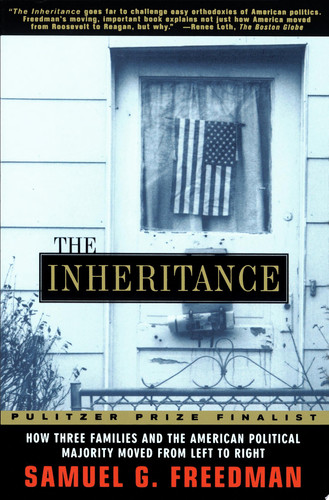
The inheritance: how three families and America moved from Roosevelt to Reagan and beyond

Freedman, Samuel G.
Orphan in the new world (Silvio Burigo) -- Liverpool on the Hudson (Lizzie Sanford Garrett) -- The dreamer and his son (Joseph Obrycki) -- The sewing room (Lizzie Garrett) -- The physics of cynicism (Joseph Obrycki) -- Worth two (Silvio Burigo) -- Voices from downstairs (Richie Garrett) -- Recessive genes (Silvio Burigo/Lorraine and Frank Trotta) -- Address as destiny (Vilma and Jack Maeby) -- Fence and basement (Silvio Burigo/Lorraine and Frank Trotta) -- Senator Clearwater (Richie Garrett) -- Uncle Paulie's Porch (Frank Trotta Jr.) -- The State Street Gang (Leslie Maeby) -- Poor snob (Tim Carey) -- Enchantment and its opposite (Frank Trotta Jr.) -- Incumbent protection (Leslie Maeby) -- Red suspenders (Tim Carey).
Simon & Schuster 1996 464 pages

The New Anti-Semitism

Chesler, Phyllis
"Anyone who wants to understand the connection between anti-Semitism, Islamic terrorism, the role of propaganda and appeasement must read this book." -Natan Sharansky, author, The Case for Democracy: The Power of Freedom to Overcome Tyranny and Terror "I admire the courage of this vision and the power of the writing." -Rabbi Lord Dr. Jonathan Sacks "Passionate and beautifully written.... This book will make you weep. It will also make you angry and frightened." -Alan Dershowitz, Harvard Law School; author, The Case for Israel "Absolutely amazing...An indispensable guide to the apocalyptic sandstorms our world now faces." -Erica Jong, poet and novelist, Fear of Flying A dangerous worldwide coalition of Islamic terrorists, well-intentioned but misinformed students, right-wing fascists, left-wing ideologues, academics, feminists, European politicians, journalists, and international human rights organizations have joined together to again scapegoat the Jews and the Jewish state for crimes they did not commit and for whatever ails the world. In this intensely passionate and compelling book, the best-selling and prize-winning Jewish feminist author Dr. Phyllis Chesler demonstrates how old-fashioned anti-Semitism - now often seen in the form of anti-Zionism - has become fashionable and even politically correct, and how this plague threatens the Jews of the world, Israel, America, and Western civilization.
Gefen Publishing House 2015 263 pages

The life of metrical and free verse in twentieth-century poetry

Silkin, Jon
In a wide-ranging and compelling account of the life of metrical and free verse in the twentieth century, poet and critic Jon Silkin deepens our understanding of the way poetry works on us. He begins from the premiss that two modes of verse, free and metrical, engage the creative energies of poetry now, creating a rich, fertile environment capable of yielding work valuable to poetry itself and to the society which has given it life. With a practitioner's empathy Silkin reads the poetry of Whitman, Hopkins, Eliot, Pound, Lawrence, Dylan Thomas, Bunting and eight British poets from the post-second World War period to illustrate how free and metrical verse create, separately or together, a poetic harmony. Additionally, he includes crucial statements on modern poetry from poets themselves, concluding with a fine memoir of Basil Bunting by Connie Pickard, published in book-form for the first time.
Macmillan 1997 423 pages

Vladimir's carrot

Peter, John
What is modern in modern drama? What defines it, unmistakably, as being of our time? This quality if the subject of John Peter's inquiry.For Peter, Beckett's Waiting for Godot makes such a radical break with dramatic tradition that it prompts the question: Is this play the single most important event in the theater since Aeschylus? Or is it the fulfillment of forces at work long before Beckett wrote it? Peter shows how Beckett's work represents a change in the very subject matter of drama, a fundamental revision of concepts of character, plot, and meaning, which in turn requires a new way of responding to drama. Where plays have traditionally engaged audiences in critical and moral dialogue, theater like Beckett's, according to Peter, is closed to questioning; it presents a vision of the world which can only be accepted or rejected. As such, it not only signals a new form of drama, but also posits a fundamentally changed audience.Peter views this change—essentially, a change of mind—in its wider context. The times and the thought that contribute to the modern imagination are represented here by novels, paintings, and music—works by Wagner, Kafka, Proust, Picasso, and Braque—as well as plays. Peter shows how the depiction of the world by these artists echoes—and is echoed by—the work of modern thinkers such as Schopenhauer, Nietzsche, and Freud.Vladimir's Carrot will provoke and stimulate readers who find themselves either lost or perfectly at home in "modern" culture.
Methuen 1988 372 pages

Conversations with Chaim Potok

Potok, Chaim
One of America's most popular Jewish writers, Chaim Potok (b. 1929) is the author of such novels as The Chosen (1967), The Promise (1969), The Book of Lights (1981), and Davita's Harp (1985). Each of his novels explores the tension between tradition and modernity, and the clash between Jewish culture and contemporary Western civilization, which he calls "core-to-core culture confrontation." Although primarily known as a novelist, Potok is an ordained Conservative rabbi and a world-class Judaic scholar who has also published children's books, theological discourses, biographies, and histories. Conversations with Chaim Potok presents interviews ranging from 1976 to 1999. Potok discusses the broad range of his writing and the deep influence of non-Jewish novels-in particular, Evelyn Waugh's Brideshead Revisited and James Joyce's Portrait of the Artist as a Young Man -on his work. Interviews bear witness to Potok's many other influences-Orthodox Jewish doctrine, Freudian psychoanalytical theory, Picasso's Guernica, and Jewish kabbalah mysticism. Though labeled an American Jewish writer, Potok argues that Flannery O'Connor should then be called an American Catholic writer and John Updike an American Protestant writer. "In his mind," editor Daniel Walden writes, "just as Faulkner was a writer focused on a particular place, Oxford, Mississippi, . . . so Potok's territory was a small section of New York City." Potok often explores conflict in his writings and in his interviews. Strict Jewish teachings deem fiction an artifice and therefore unnecessary, yet since the age of sixteen Potok has been driven to write novels. At the root of all of these conversations is Potok's intense interest in the turmoil between Jewish culture, religion, and tradition and what he calls "Western secular humanism." As he discusses his work, he continually includes broader issues, such as the state of Jewish literature and art, pointing out with pride and enthusiasm his belief that Jewish culture, in the twentieth century, has finally begun to have a significant role in producing and shaping the world's art and literature. Whether discussing the finer details of Talmudic textual analysis or his period of chaplaincy during the Korean War, Potok is articulate and philosophical, bringing deep consideration into what may seem small subjects. Although his novels and histories take place primarily in the recent past, the Chaim Potok that emerges from this collection is a writer deeply rooted in the tensions of the present. Daniel Walden is Professor Emeritus of American Studies, English and Comparative Literature at Penn State University. He has written or edited several books, including On Being Jewish (1974), Twentieth Century American Jewish Writers (1984), The World of Chaim Potok (1985), and American Jewish Poets: The Roots and the Stems (1990).
University Press of Mississippi 2001 181 pages

Odessa, 1941-1944: a case study of Soviet territory under foreign rule

Dallin, Alexander
Based on American, German and Soviet sources, this book provides an in-depth study of the Romanian administration in Odessa and Transnistria. It draws a sharp contrast between the relatively more successful occupation policies of the Romanian administration in Odessa and Transnistria and those of the Germans in occupied areas of the Soviet Union. Alexander Dallin, formerly president of the American Association for the Advancement of Slavic Studies, presents an essential text for anyone interested in the occupation of Soviet Territory during World War II and its consequences
Center for Romanian Studies 2020 296 pages

The family tree: an illustrated novel

Glantz, Margo
Publisher's description: At the heart of this... Mexican novel lies the search for a family history. Using ancestral recollections, flashbacks through history, and personal memory, the author traces her family roots from pre-Revolutionary Russia to contemporary Mexico. Margo Glantz's Mexico is a mysterious world-- a cultural carnival where Flash Gordon crosses paths with Columbus: a Mexico of Diego Rivera, Leon Trotsky and Frida Kahlo, hijacked by Dracula and King Kong, filled with the aromas of a kosher bakery and the echoes of jokes, some corny, some not.
Serpent's Tail 1991 186 pages

Contemporary Jewish theology: a reader

Rabbi Elliot N Dorff, PhD
Preface Acknowledgments I. Introduction 1. An Incessantly Gushing Fountain: The Nature of Jewish Theology, Byron Sherwin II. Classical Theologians in the Twentieth Century: Approaches to God 2. Religion of Reason Out of the Sources of Judaism, Hermann Cohen 3. The Star of Redemption, Franz Rosenzweig 4. I and Thou 5. A Thirst for the Living God; and The Pangs of Cleansing, Abraham Isaac Kook 6. God as the Power that Makes for Salvation, Mordecai Kaplan 7. God in Search of Men, Abraham Joshua Heschel III. Contemporary Reflections on Traditional Themes A. God 8. Belief in a Personal God: The Position of Liberal Supernaturalism, Louis Jacobs 9. In Search of God, Elliot N. Dorff 10. From God to Godliness: Proposal for a Predicate Theology, Harold M. Schulweis 11. Toward a Feminist Jewish Reconstruction of Monotheism; and Further Thoughts on Liturgy as an Expression of Theology, Marcia Falk 12. Jewish Feminist Theology, Ellen M. Umansky B. Creation 13. The Wings of the Dove: Jewish Values, Science, and Halachah, David W. Weiss 14. Seek My Face, Speak My Name, Arthur Green C. Revelation 15. Revelation in the Jewish Tradition, Emanuel Levinas 16. Sacred Fragments: Recovering Theology for the Modern Jew, Neil Gillman D. Redemption 17. The Natural and the Supernatural Jew, Arthur A. Cohen 18. On Jewish Eschatology, Steven Schwarzschild E. Covenant/Chosenness 19. Renewing the Covenant, Eugene Borowitz 20. The Election of Israel, David Novak 21. The Body of Faith, Michael Wyschogrod 22. Standing Again at Sinai, Judith Plaskow 23. A Jewish Theology of Jewish Relations to Other Peoples, Elliot N. Dorff F. Law 24. Halakhic Man, Joseph Soloveitchik 25. Some Criteria for Modern Jewish Observance, Jakob J. Petuchowski 26. Dynamics of Judaism, Robert Gordis 27. Engendering Judaism, Rachel Adler IV. Two Pivotal Experiences in the Twentieth Century A. The Holocaust 28. Faith after the Holocaust, Eliezer Berkovits 29. After Auschwitz, Richard Rubenstein 30. The Jewish Return into History; and To Mend the World, Emil Fackenheim 31. Cloud of Smoke, Pillar of Fire: Judaism, Christianity, and Modernity after the Holocaust, Irving Greenberg B. The State of Israel 32. Exile as a Neurotic Solution, A.B. Yehoshua 33. The Third Jewish Commonwealth, David Hartman 34. The Religious and Moral Significance of the Redemption of Israel. Yeshayahu Leibowitz 35. Beyond Innocence and Redemption, Marc Ellis V. Looking Toward the Future of Jewish Thought: A Symposium 36. New Directions in Jewish Theology in America, Arthur Green 37. Another Perspective on Theological Directions for the Jewish Future, Rebecca T. Alpert 38. The Nature and Direction of Modern Jewish Theology: Some Thoughts Occasioned by Arthur Green, David Ellenson 39. B'nei Ezra: An Introduction to Textual Reasoning, Peter Ochs Suggestions for Further Reading Biographical Sketches.
Oxford University Press 1999 522 pages

The Western Mind in Transition An Eyewitness Story

Franz Alexander
The Western Mind In Transition: An Eyewitness Story is a book written by Franz Alexander, a renowned psychoanalyst and psychiatrist. The book is a first-hand account of the intellectual and cultural changes that swept across Western society in the early 20th century. Through his personal experiences and observations, Alexander traces the evolution of Western thought from the rationalism of the Enlightenment to the existentialism and psychoanalysis of the 20th century. He discusses the impact of World War I, the rise of fascism, and the disillusionment of the post-war generation on the Western psyche.The book also delves into the role of psychoanalysis in shaping the modern Western mind. Alexander explores the theories and practices of Sigmund Freud and his followers, as well as his own contributions to the field.Overall, The Western Mind In Transition: An Eyewitness Story is a thought-provoking and insightful examination of the intellectual and cultural changes that have shaped the Western world. It is a must-read for anyone interested in the history of ideas and the evolution of the human mind.This scarce antiquarian book is a facsimile reprint of the old original and may contain some imperfections such as library marks and notations. Because we believe this work is culturally important, we have made it available as part of our commitment for protecting, preserving, and promoting the world's literature in affordable, high quality, modern editions, that are true to their original work.
Literary Licensing, LLC 2012-04 318 pages

The marginalization of poetry: language writing and literary history

Perelman, Bob
Language writing, the most controversial avant-garde movement in contemporary American poetry, appeals strongly to writers and readers interested in the politics of postmodernism and in iconoclastic poetic form. Drawing on materials from popular culture, avoiding the standard stylistic indications of poetic lyricism, and using nonsequential sentences are some of the ways in which language writers make poetry a more open and participatory process for the readers. Reading this kind of writing, however, may not come easily in a culture where poetry is treated as property of a special class. It is this barrier that Bob Perelman seeks to break down in this fascinating and comprehensive account of the language writing movement. A leading language writer himself, Perelman offers insights into the history of the movement and discusses the political and theoretical implications of the writing. He provides detailed readings of work by Lyn Hejinian, Ron Silliman, and Charles Bernstein, among many others, and compares it to a wide range of other contemporary and modern American poetry. A variety of issues are addressed in the following chapters: "The Marginalization of Poetry," "Language Writing and Literary History," "Here and Now on Paper," "Parataxis and Narrative: The New Sentence in Theory and Practice," "Write the Power," "Building a More Powerful Vocabulary: Bruce Andrews and the World (Trade Center)," "This Page Is My Page, This Page Is Your Page: Gender and Mapping," "An Alphabet of Literary Criticism," and "A False Account of Talking with Frank O'Hara and Roland Barthes in Philadelphia."
Princeton University Press 1996-07-28 187 pages

Forevermore Three Documented Stories of Jewish Historical Figures Overcoming Oppression

Shlomo Kalo
Jacob Lipschitz was only fourteen when he had to endure the harsh realities of World War II and the horror of the Holocaust. He lost his parents to Treblinka extermination camp, and wandered the streets of the starving Warsaw Ghetto with some friends, sneaking in and out of the guarded walls, searching for any food to support his life, eventually joining Jewish fighters underground. During this desperate time, he must elude a revengeful Nazi solidier who had a personal vendetta against him and unceasingly hunts him. Jacob told his harrowing experience to Nobel nominee Shlomo Kalo when they were university students. His intelligence and resourcefulness would help him survive, showing the astonishing strength, perseverance, and spirit that many in Jewish history have exhibited. However, Jacob's choice as a young man is unexpected and this is one of the highlights of the book. Forevermore skillfully brings to life three masterful tales of loyalty, subjugation, and strength in human history, which also include the fateful encounters between Jewish nobleman Zabir Ben Bata and Muhammad, and of Rabbi Aaron and his Polish allies who betrayed him and his community during the Cossack rebellion. Forevermore was praised by the media, recommended by Israeli Ministry of Education and also by Shimon Peres: "An original style of writing and a look at events from an interesting perspective!." Scroll up and order your copy of Forevermore today!
DAT Publications 2016-02-23 166 pages

Hatred of capitalism: [a reader

Chris Kraus,Sylvere Lotringer
Jean Baudrillard meets Cookie Mueller in this gathering of French theory and new American fiction. Compiled in 2001 to commemorate the passing of an era, Hatred of Capitalism brings together highlights of Semiotext(e)'s most beloved and prescient works. Semiotext(e)'s three-decade history mirrors the history of American thought. Founded by French theorist and critic Sylvere Lotringer as a scholarly journal in 1974, Semiotext(e) quickly took on the mission of melding French theory with the American art world and punk underground. Its Foreign Agents, Native Agents, Active Agents and Double Agents imprints have brought together thinkers and writers as diverse as Gilles Deleuze, Assata Shakur, Bob Flanagan, Paul Virillio, Kate Millet, Jean Baudrillard, Michelle Tea, William S. Burroughs, Eileen Myles, Ulrike Meinhof, and Fanny Howe. In Hatred of Capitalism, editors Kraus and Lotringer bring these people together in the same volume for the first time.
Semiotext(e) 2001 421 pages

In the aftermath of genocide: Armenians and Jews in twentieth-century France

Mandel, Maud
France is the only Western European nation home to substantial numbers of survivors of the World War I and World War II genocides. In the Aftermath of Genocide offers a unique comparison of the country’s Armenian and Jewish survivor communities. By demonstrating how—in spite of significant differences between these two populations—striking similarities emerge in the ways each responded to genocide, Maud S. Mandel illuminates the impact of the nation-state on ethnic and religious minorities in twentieth-century Europe and provides a valuable theoretical framework for considering issues of transnational identity. Investigating each community’s response to its violent past, Mandel reflects on how shifts in ethnic, religious, and national affiliations were influenced by that group’s recent history. The book examines these issues in the context of France’s long commitment to a politics of integration and homogenization—a politics geared toward the establishment of equal rights and legal status for all citizens, but not toward the accommodation of cultural diversity. In the Aftermath of Genocide reveals that Armenian and Jewish survivors rarely sought to shed the obvious symbols of their ethnic and religious identities. Mandel shows that following the 1915 genocide and the Holocaust, these communities, if anything, seemed increasingly willing to mobilize in their own self-defense and thereby call attention to their distinctiveness. Most Armenian and Jewish survivors were neither prepared to give up their minority status nor willing to migrate to their national homelands of Armenia and Israel. In the Aftermath of Genocide suggests that the consolidation of the nation-state system in twentieth-century Europe led survivors of genocide to fashion identities for themselves as ethnic minorities despite the dangers implicit in that status.
Duke University Press 2003-07-04 317 pages