58,196 results in 0.07 seconds

Tide and wreck: history of the Jews of Vardar Macedonia

Lebl, Ženi
Pp. 243-359 deal with the Holocaust in Yugoslavian Macedonia and in the town of Pirot (southeastern Serbia). These territories were annexed to Bulgaria in 1941, and it was the Bulgarian authorities who carried out the annihilation of local Jews. Discusses the Bulgarian Law for the Protection of the Nation, as well as other anti-Jewish laws, and their implementation in Macedonia. In contrast to the Macedonians and the Slavs in Pirot, Jews were denied Bulgarian citizenship; their property was pillaged and they were subjected to humiliating restrictions. In March 1943, 7,358 Jews of Macedonia and 187 Jews of Pirot were deported to Treblinka. Only a small number of Jewish physicians were exempted from deportation. Some Macedonian Jews took part in the resistance movement. Some Jews were rescued by righteous Macedonians and Albanians, as well as by the Spanish Consulate in Skopje. Discusses, also, the dubious role of King Boris of Bulgaria - whether he was a savior of Bulgarian Jews or a hangman of Macedonian Jews.
Avotaynu 2008 404 pages

Until "the final solution": the Jews in Belgrade 1521-1942

Lebl, Ženi
Pp. 264-338 discuss the Holocaust period, beginning with anti-Jewish laws in Yugoslavia restricting Jewish economic activity, as well as a numerus clausus, in October 1940. Notes that these laws were passed under German pressure, that protests made by the Jewish leadership were to no avail, and that many Jews thereafter converted. With the German occupation and division of Yugoslavia in April 1941, the Nazis took over control of Belgrade and instituted further anti-Jewish measures. During fall 1941 all Jewish men were arrested; they were sent to nearby labor camps, and many were killed. In December all of the remaining Jews, mostly women and children, were interned at Sajmište, and during spring 1942 they were killed in a gassing truck. Provides details concerning the Final Solution in Belgrade, which was carried out with the collaboration of local authorities and police. Estimates that 94% of the ca. 11,870 Jews living there in 1941 were killed. Only a few of the Nazi perpetrators were tried and sentenced in Yugoslavia after the war; the others either fled or returned to Germany, where some received light sentences.
Avotaynu 2007 456 pages

Ron Paul America's Most Dangerous Nazi

A. Weberman,MR A J Weberman
Ron Paul is no libertarian; he is a crypto-Nazi. Crypto-Nazism is a term implying a secret support for, or admiration of, the genocidal political and economic system invented by Adolf Hitler. The term is used to imply that an individual or group keeps this support or admiration hidden in order to avoid political prosecution or, in Ron Paul's case, political suicide. Crypto-Nazis maintain covers such as "libertarian" and "populist" to disguise a hidden agenda. They use code words e.g. "Goldman-Sachs" means Jews. This book rips the cloak of deception off of Ron Paul and exposes his true pathological genocidal self, a Nazi without a swastika. Revised Edition
CreateSpace Independent Publishing Platform 2012-03-12 560 pages

Latchkeys Splinters

Steven Savile,Robert Greenberger,Debbie Viguié,Paul Kupperberg,Kris Katzen,James Reasoner,Aaron Rosenberg
On a quiet, dead-end residential street on the outskirts of Omaha, Nebraska sits an old house called Tanglewood. In its front yard a large old ash tree casts its shadow across shrubs and flowerbeds and a lawn that have all long ago surrendered any pretense of life. But inside the House are the Doors. Doors too numerous to count. Doors made of the wood from Yggdrasil, the great Norse World Tree that stands at the center of the universe. Doors that lead to every time and every place that ever was-or ever could be. Provided you are one of the rare few with the gift, a child with the ability to step through such Doors to the other side. Provided you are a Latchkey, capable of becoming one of the Wardens, the protectors of Tanglewood and its Doors. Then-disaster! Tanglewood's connection to the World Tree is somehow broken. And many of its Doors disappear, sent spinning out across time and space with no rhyme or reason, leaving behind only the flimsiest of shadows. Now the young Wardens must find and return the missing Doors. But many of them have splintered from the impact. Those missing pieces must be restored before the Doors can be returned. And Splinters can be anywhere and assume any form. Almost like they don't want to be found. Read all about the Latchkeys and their exciting, thrilling, spooky adventures to places that were, places that might have been, and places that almost could be!
Clockworks 2013-01-25 280 pages

The question of the animal and religion: theoretical stakes, practical implications

Gross, Aaron S.
The book began with a detailed account of the scandals at Agriprocessors (located in Postville, Iowa, one of the largest kosher slaughterhouses) and their significance for the American and international Jewish community. The author argued that without a proper theorization of "animals and religion," we cannot fully understand religiously and ethically motivated diets and how and why the events at Agriprocessors took place. Subsequent chapters recognize the significance of animals to the study of religion in the work of Ernst Cassirer, Emile Durkheim, Mircea Eliade, Jonathan Z. Smith, and Jacques Derrida and the value of indigenous peoples' understanding of animals to the study of religion in our daily lives and self-imagination through animals.
Columbia University Press 2014 292 pages

Comparison: a critical primer

Hughes, Aaron W.
Comparison is held to be one of the central methods of the academic study of religion. While many ostensibly engage in the comparative act, often overlooked is what it actually means to do this. What is comparison? Why engage in it and for what purposes? Can there be such a thing as a valid or invalid comparison? Can comparison itself be compared to anything? This book starts with the premise that while there are good comparisons and bad comparisons, what is common to both is the sheer artificiality of the enterprise and develops an analytical framework for using the method in the context of religious studies. After briefly tracing the history and genealogy of the category, Hughes draws on his own extensive work in Judaism and Islam to argue that comparison can be a useful method, but only under strictly controlled conditions.
Equinox 2017 129 pages

New methods in the study of Islam

Abbas Aghdassi,Aaron W. Hughes
New Methods in the Study of Islam offers an international perspective on the field of Islamic studies. It seeks to push the study of Islam to the forefront of methodological considerations by revisiting classical topics for example the Qur'an, hadith and kalam using new lenses, as well as new subjects, such as lived Islam and Islamic critiques of the West. Taken as a whole, the collection provides new perspectives on the role and place of the academic study of Islam in contemporary scholarship --
Edinburgh University Press 2022 332 pages

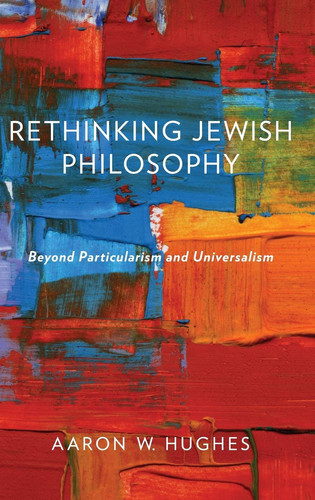
Rethinking Jewish philosophy: beyond particularism and universalism / Aaron W. Hughes

Hughes, Aaron W.
Breaking with received opinion, this book seeks to challenge the exclusionary, essentialist, and even totalitarian nature that is inherent to the practice of what is problematically referred to as 'Jewish philosophy'. Hughes begins with the premise that Jewish philosophy, as it is presently conceived, is impossible. He then begins the process of offering a sophisticated and constructive rethinking of the discipline that avoids the traditional extremes of universalism and particularism.
Oxford University Press 2014-04 170 pages

Somewhere between Islam and Judaism: critical reflections

Hughes, Aaron W.
"Somewhere Between Islam and Judaism is of interest to scholars and students of religion concerned with comparison and those studying Islam, Judaism and Jewish-Muslim relations. The essays collected in this volume provide a set of critical reflections on what it means to study these two religious traditions within the larger context of the academic study of religion"--
Equinox Publishing Ltd 2021 203 pages

Hey, Big Boy!

Abe Segal
Abe Segal was of the post war generation that knew the meaning of deprivation. How he ever made it to the top of the international tennis circuit as an uneducated, penniless teenager is a miracle in itself. But apart from his raw talent honed from playing tennis in the streets of Doornfontein, his greatest weapon was his indomitable ability to laugh at life and himself. As one of South Africa's most charismatic tennis players, he attracted other great sporting characters and sports aficionados across the globe from George Best to Kirk Douglas and Sean Connery. And behind every encounter there was a story - a very funny story.
Paul, Beth and Montague 2008 354 pages

The Jewish Quarterly Review; Volume 2

Cyrus Adler,Solomon Schechter,Abraham Aaron Neuman
This work has been selected by scholars as being culturally important, and is part of the knowledge base of civilization as we know it. This work was reproduced from the original artifact, and remains as true to the original work as possible. Therefore, you will see the original copyright references, library stamps (as most of these works have been housed in our most important libraries around the world), and other notations in the work. This work is in the public domain in the United States of America, and possibly other nations. Within the United States, you may freely copy and distribute this work, as no entity (individual or corporate) has a copyright on the body of the work. As a reproduction of a historical artifact, this work may contain missing or blurred pages, poor pictures, errant marks, etc. Scholars believe, and we concur, that this work is important enough to be preserved, reproduced, and made generally available to the public. We appreciate your support of the preservation process, and thank you for being an important part of keeping this knowledge alive and relevant.
Creative Media Partners, LLC 2019-03-27 642 pages

Two Lectures On The Life And Writings Of Maimonides

A. Benisch
This work has been selected by scholars as being culturally important, and is part of the knowledge base of civilization as we know it. This work was reproduced from the original artifact, and remains as true to the original work as possible. Therefore, you will see the original copyright references, library stamps (as most of these works have been housed in our most important libraries around the world), and other notations in the work. This work is in the public domain in the United States of America, and possibly other nations. Within the United States, you may freely copy and distribute this work, as no entity (individual or corporate) has a copyright on the body of the work. As a reproduction of a historical artifact, this work may contain missing or blurred pages, poor pictures, errant marks, etc. Scholars believe, and we concur, that this work is important enough to be preserved, reproduced, and made generally available to the public. We appreciate your support of the preservation process, and thank you for being an important part of keeping this knowledge alive and relevant.
Creative Media Partners, LLC 2015-12-28 68 pages