7908 results for "Science"

Symmetry and the beautiful universe

Lederman, Leon M.
When scientists peer through a telescope at the distant stars in outer space or use a particle-accelerator to analyze the smallest components of matter, they discover that the same laws of physics govern the whole universe at all times and all places. Physicists call the eternal, ubiquitous constancy of the laws of physics symmetry. Symmetry is the basic underlying principle that defines the laws of nature and hence controls the universe. This all-important insight is one of the great conceptual breakthroughs in modern physics and is the basis of contemporary efforts to discover a grand unified theory to explain all the laws of physics.Nobel Laureate Leon M. Lederman and physicist Christopher T. Hill explain the supremely elegant concept of symmetry and all its profound ramifications to life on Earth and the universe at large in this eloquent, accessible popular science book. They not only clearly describe concepts normally reserved only for physicists and mathematicians, but they also instill an appreciation for the profound beauty of the universe's inherent design.Central to the story of symmetry is an obscure, unpretentious, but extremely gifted German mathematician named Emmy Noether. Though still little known to the world, she impressed no less a scientist than Albert Einstein, who praised her "penetrating mathematical thinking." In some of her earliest work she proved that the law of the conservation of energy was connected to the idea of symmetry and thus laid the mathematical groundwork for what may be the most important concept of modern physics.Lederman and Hill reveal concepts about the universe, based on Noether's work, that are largely unknown to the public and have wide-reaching implications in connection with the Big Bang, Einstein's theory of relativity, quantum mechanics, and many other areas of physics. Through ingenious analogies and illustrations, they bring these astounding notions to life. This book will open your eyes to a universe you never knew existed.
Prometheus Books 2004 363 pages

Spoilt Rotten

Theodore Dalrymple
In this perceptive and witty book, Theodore Dalrymple unmasks the sentimentality that is suffocating modern life. Under the multiple guises of raising children well, caring for the under-privileged, fighting poverty, assisting the less able, and doing good generally, we are achieving quite the opposite. Drawing on his long experience as a doctor, as well as work with thousands of criminals and the mentally disturbed as a prison psychiatrist, Dalrymple shows what happens if we feel our way rather than think well.
Gibson Square Books, Limited 2024-09-05 160 pages

Marxism Unmasked From Delusion to Destruction

Ludwig Von Mises
We can't sit under Mises at his famous Vienna private seminar. We can't go back in time and attend his New York seminar, or follow him to his speaking engagements that he held in the 50s and 60s.But thanks to this second volume in a thrilling series (here is volume one), we do have access to what he said. He is warm, funny, passionate, and learned. This book provides a candid look at the man and his teaching style. It demonstrates his dazzling command over the material, and teaches in a breezier way than his treatises.This volume contains nine lectures delivered over one week, from June 23, to July 3, 1952, at the San Francisco Public Library. Mises was at his prime as a teacher and lecturer. He shares a lifetime of learning on topics that were (and remain) central to American public life.As the title indicates, his main focus is on Marxism. He discusses Marx and his place in the history of ideas, the destruction wrought by his dangerous ideology, the manner in which his followers have covered up his errors, and how the Marxists themselves have worked for so long to save Marxism from itself. He discusses Marxist claims about history and refutes the smear of the industrial revolution.The approach is systematic but casual. So the reader encounters wonderful insights in the form of short asides. For example: "The worst thing that can happen to a socialist is to have his country ruled by socialists who are not his friends."As a lecturer, he is steady and relentless. The reader can nearly "hear" him speaking through the prose. And there are times when Mises reveals a level of rhetorical passion that you would never encounter in print. That's because what is printed here are not pre-prepared lectures in the sense that they were written out. They were transcribed by Bettina Bien Greaves from what he actually said.Thus can we hear this passage:It is not true, as Marx said, that the improvements in technology are available only to the exploiters and that the masses are living in a state much worse than on the eve of the Industrial Revolution. Everything the Marxists say about exploitation is absolutely wrong! Lies! In fact, capitalism made it possible for many persons to survive who wouldn't have otherwise.Some readers of Mises's larger works have said that while his rigor is dazzling, the man himself can seem remote. Whether or not you agree with this observation, Mises comes across in these lectures as brilliant but very warm and charming in an old world sense.This approach is particularly fruitful in the last four of the lectures, which cover topics such as savings, interest, inflation, profit and loss, and the place of foreign investment. The lecture on interest rates, for example, must surely rank as one of the best explanations of this complicated topic. He recounts the history of the attempt to suppress interest rates, from the ancient world to the modern period. He explains why this cannot work because interest is merely the objective sign of a phenomenon that is integral to human action. As he moves on to money, Mises reveals himself to be tougher on the issue of fiduciary media than he was when he wrote his 1912 book The Theory of Money and Credit.In response to a question Mises says: "In the future no additional banknotes should be issued, no additional credit should be entered on a bank subject to check, unless there is 100 percent coverage in money."Also not to be missed is Mises's wry defense of "money cranks": at least they were only more consistent than the advocates of Keynesian and monetarism.Mises was clearly pressed for time, so he had to be at once thorough and move quickly through the material. It's still not "light reading" by the normal standards, but for people who want to see a great mind at work, this has a wonderful element of spontaneity about it that attracts and teaches at the same time.
Ludwig von Mises Institute 2019 110 pages

The Last Resistance:

Jacqueline Rose
A bravura exploration of politics and writing in dark times. In "The Last Resistance," Jacqueline Rose explores the power of writing to create and transform our political lives. In particular Rose examines the role of literature in the Zionist imagination: here, literature is presented as a unique form of dissidence, with the power to expose the unconscious of nations, and often proposing radical alternatives to their dominant pathways and beliefs. While Israel-Palestine is the repeated focus, "The Last Resistance" also turns to post-apartheid South Africa, to American national fantasy post-9/11, and to key moments for the understanding of Jewish culture and memory. Rose also underscores the importance of psychoanalysis, both historically in relation to the unfolding of world events, and as a tool of political understanding. Examining topics ranging from David Grossman, through W. G. Sebald, Freud, Nadine Gordimer, the concept of evil, and suicide bombers, "The Last Resistance" offers a unique way of responding to the crises of the times.
Seagull Books Pvt. Limited 2008 224 pages

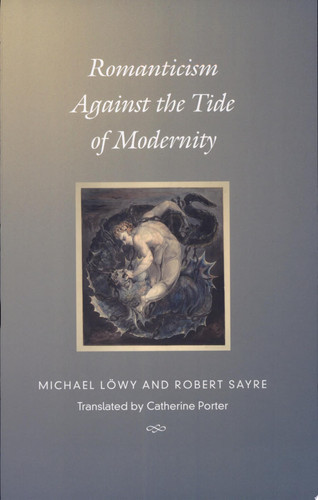
Romanticism against the tide of modernity

Löwy, Michael
Romanticism is a worldview that finds expression over a whole range of cultural fields—not only in literature and art but in philosophy, theology, political theory, and social movements. In Romanticism Against the Tide of Modernity Michael Löwy and Robert Sayre formulate a theory that defines romanticism as a cultural protest against modern bourgeois industrial civilization and work to reveal the unity that underlies the extraordinary diversity of romanticism from the eighteenth to the twenty-first century. After critiquing previous conceptions of romanticism and discussing its first European manifestations, Löwy and Sayre propose a typology of the sociopolitical positions held by romantic writers-from “restitutionist” to various revolutionary/utopian forms. In subsequent chapters, they give extended treatment to writers as diverse as Coleridge and Ruskin, Charles Peguy, Ernst Bloch and Christa Wolf. Among other topics, they discuss the complex relationship between Marxism and romanticism before closing with a reflection on more contemporary manifestations of romanticism (for example, surrealism, the events of May 1968, and the ecological movement) as well as its future. Students and scholars of literature, humanities, social sciences, and cultural studies will be interested in this elegant and thoroughly original book.
Duke University Press 2001 317 pages

Hidden Histories of Science

Robert B. Silvers
We often think of science as continuously advancing. In this collection of essays, five world-renowned writers explore obscure and neglected episodes in the history of science which suggest instead that the process of understanding the significance of scientific discoveries can be erratic, contradictory, even irrational. Jonathan Miller, Oliver Sacks, and Daniel Kevles show how promising new ideas may at first fail to be noticed or accepted, and then, years after they have been dismissed or forgotten, are recognized in a different form as important. R.C. Lewontin and Stephen Jay Gould discuss the ways that words and images used by scientists and popularizers alike, from the murals on the walls of natural history museums to such ubiquitous terms as "adaptation" and "environment," reflect serious and often unacknowledged distortions in the way we conceive of both individual organisms and the natural history of the world. These essays demonstrate that science is, in the words of Oliver Sacks, "a human enterprise through and through, an organic, evolving, human growth, with sudden spurts and arrests, and strange deviations, too. It grows out of its past, but never outgrows it, any more than we outgrow our childhood."
New York Review of Books 1995 193 pages

I wish I'd made you angry earlier: essays on science, scientists, and humanity

Perutz, M. F.
This delightful collection of essays by Nobel Laureate Max Perutz explores a wide range of scientific and personal topics with great insight and lucidity. The pages of the book are filled with stories of some of the intellectual giants of twentieth century science -- Pauling, Meitner, Medawar, Krebs and Jacob, among others.
Oxford University Press 1998 354 pages

An introduction to science studies: the philosophical and social aspects of science and technology

Ziman, J. M.
The purpose of this book is to give a coherent account of the different perspectives on science and technology that are normally studied under various disciplinary heads such as philosophy of science, sociology of science and science policy. It is intended for students embarking on courses in these subjects and assumes no special knowledge of any science. It is written in a direct and simple style, and technical language is introduced very sparingly. As various perspectives are sketched out in this book, the reader moves towards a consistent conception of contemporary science as a rapidly changing social institution that has already grown out of its traditional forms and plays a central role in society at large. It will appeal to students in a wide range of scientific disciplines and complement well Professor Ziman's earlier books.
Cambridge University Press 1984 203 pages

Knowing and being: essays

Polanyi, Michael
"Knowing and Being: Essays by Michael Polanyi," edited by Marjorie Grene, is a collection of fourteen essays that showcase the evolution of Polanyi's theory of knowledge. The first part addresses the tension between the pursuit of truth and the nature of truth itself, advocating for a redefined epistemology that acknowledges the inherent 'groping' involved in problem recognition. The second section critiques the incompatibility of centralization with scientific practice and examines the roles of tradition and authority in science. The third part delves into the concept of tacit knowing, emphasizing its fundamental role in all intelligent behavior. The final section explores the relationship between mind and living organisms, proposing a theory that bridges the gap between internal clues and external evidence. This compilation reflects Polanyi's significant contributions to philosophy, particularly in epistemology and the philosophy of science.
University of Chicago Press 1969 246 pages

Isoperimetric Inequalities in Mathematical Physics

George Polya,G. Szegö
Pólya and Szegö’s classic treatment of isoperimetric inequalities in mathematical physics from the acclaimed Annals of Mathematics Studies series Princeton University Press is proud to have published the Annals of Mathematics Studies since 1940. One of the oldest and most respected series in science publishing, it has included many of the most important and influential mathematical works of the twentieth century. The series continues this tradition as Princeton University Press publishes the major works of the twenty-first century. To mark the continued success of the series, all books are available in paperback and as ebooks.
Princeton University Press 1951-08-21 279 pages