

58,196 results in 0.07 seconds

On semantic poetry

Stefan and Friderike Zweig: Their correspondence, 1912-1942
Anfang 1920 wird Friderike von Winternitz, die zwei Romane geschrieben hat, Stefan Zweigs Frau, eine resolute, wie aus den Ehebriefen hervorgeht. Sie bekundet stets regen Anteil an seinen literarischen Arbeiten und erteilt ihm hin und wieder auch einen Tadel: »Mir ist es traurig zu denken, daß ein Mensch, der wie Du so besonders glückliche Gaben besitzt, der also den Göttern immerzu danken müßte, auch mit Zufriedenheit und Ausgeglichenheit, so unbedenklich ist, Menschen in seiner nächsten Umgebung so schwer zu verkränken und zu demütigen ...« Stefan Zweig hingegen übt gelegentlich Kritik an Friderikes Erziehung ihrer schwierigen Töchter: »Lass sie schwimmen! Einen Schwimmgürtel hat man ihnen umgetan, dass sie nicht untergehen können, also in Not geraten – um alles andere kümmere Dich nicht, dann werden sie selbst genötigt sein, sich durchzuschlagen.« Bis Anfang 1934 lebt das Paar samt Töchtern in Salzburg, dann getrennt, er in London, wo er und seine Sekretärin Lotte Altmann einander schätzen und lieben. Nach der Auslöschung Österreichs 1938 erfolgt die Scheidung von Friderike, bei Kriegsbeginn die Heirat Lottes und Stefans. Ihre Exilbriefe an Friderike spiegeln den Leidensweg wider bis zum selbstgewählten Ende. Die Neuausgabe der Korrespondenz zwischen Friderike und Stefan ist als Erzählung konzipiert und enthält revidierte und bislang unveröffentlichte Briefe, auch einige von Lotte Zweig.

Grassroots charisma: Four local leaders in China
This book relates the stories of four leaders under very different political regimes: colonial, Nationalist and Communist. The result is an insight into the relationship between religious and political authority in a changing world.

Lessons of the golden age of capitalism

Recovery

Poetry Since 1939

The destructive element: a study of modern writers and beliefs

The Thirties and After Poetry, Politics, People(1933–75)

Salt and His Circle

Postcards from print: 75 timeless covers from the archives of Print magazine
A COLLECTION OF VINTAGE INSPIRATION Print magazine turns 75 in 2015. In celebration of one of the world's most revered graphic design publications, AIGA medalist Steven Heller curated a collection of 75 Print magazine covers straight from the archives. In this book, we've shrunk the covers down to postcard size to make sharing, enjoying and reminiscing easy and fun. You'll hold this book dear if you're a designer, illustrator, artist or typography enthusiast who appreciates striking work from celebrated designers and illustrators. These iconic cover postcards, dating as early as 1940, are yours to mail, frame or display in book form. Treat yourself and your friends to the brilliant covers preserved in this collection, and take part in celebrating Print magazine's most historic year yet.

The worlds of S. An-sky: a Russian Jewish intellectual at the turn of the century
Shloyme-Zanvl Rappoport, known as An-sky (1863-1920), the author of the best known play in the Hebrew and Yiddish languages, "The Dybbuk,” was a figure of immense versatility and also ambiguity in Russian and Jewish intellectual, literary, and political spheres. He was a leading Russian populist; he was the author of the poem adopted as the anthem of the Jewish Socialist Labor Bund; he is credited with being the founder of the field of Jewish ethnography; and he wrote one of the most influential works of Jewish catastrophe literature in modern times, his masterpiece "Hurbn Galitsye,” on the travails of East European Jews in the First World War. This volume is the most complete examination of An-sky ever produced. It draws together leading historians, ethnographers, literary scholars, and others in a far-ranging, multidisciplinary exploration. It also contains numerous photographs culled from archives in the former Soviet Union, a superb English translation of an early Russian draft--among the very first--of "The Dybbuk,” and a timeline that covers all of An-sky’s peripatetic life. Finally, it includes a compact disk combining material drawn from An-sky’s own 1912-14 field recordings of Jewish songs, together with contemporary renditions, recorded at Stanford, of the Russian and Yiddish music that An-sky wrote, collected, and heard. Includes a CD of An-sky’s music,, in Russian and Yiddish

The Jews of Odessa: a cultural history, 1794-1881
Founded in 1794 as a frontier city on the Black Sea, Odessa soon grew to be one of Russia's busiest seaports. Settlers of all nationalities went there to seek their fortune, among them Jews who came to form one of the largest, wealthiest, and most culturally fertile Jewish communities in Europe. This history of Jewish Odessa traces the rise of that community from its foundation in 1794 to the pogroms of 1881 that erupted after the assassination of Alexander II. Zipperstein emphasizes Jewish acculturation: changes in behavior, attitude, and ideology as reflected in schools, synagogues, newspapers, and other institutions of the period. The patterns set then affected the community's cultural development well into the second decade of the twentieth century. More a modern metropolis than any other Russian city with a significant Jewish population, Odessa offers a window into the diversity of Russian Jewish experience.

Dam Duchess
When she met the best engineer of dams at the railway station, her inside pleasantly warmed to medium rare. At the end of a two-minute small talk, she sensed that Mr. Winter, skipping the intermediate phases, was already overcooked.

The Oolah: As Played By Francis Wilson And Company At The Broadway Theatre, New York...
This is a reproduction of a book published before 1923. This book may have occasional imperfections such as missing or blurred pages, poor pictures, errant marks, etc. that were either part of the original artifact, or were introduced by the scanning process. We believe this work is culturally important, and despite the imperfections, have elected to bring it back into print as part of our continuing commitment to the preservation of printed works worldwide. We appreciate your understanding of the imperfections in the preservation process, and hope you enjoy this valuable book. ++++ The below data was compiled from various identification fields in the bibliographic record of this title. This data is provided as an additional tool in helping to ensure edition identification: ++++ The Oolah: As Played By Francis Wilson And Company At The Broadway Theatre, New York Charles Lecocq, Sydney Rosenfeld R. A. Saalfield, 1889 Music; Genres & Styles; Opera; Music / Genres & Styles / Opera; Operas

Signs & relics
Signs & Relics is an exploration of the world from a photographer's point of view -- in this case, noted Village Voice photographer Sylvia Plachy. Her engaging images -- some light and humorous, some somber -- show particular people and places at precise moments of synchronicity. Plachy draws telling metaphors from the photographs, which are grouped into nineteen thematic sections. "Sit," for example, shows images ranging from a wood chair in a Parisian window to a woman perched in a tree to Barbie atop a pair of high-heeled legs. Fragments of dreams and memories coexist with images from the streets of the world and photographs of people, from Plachy's family to viewers at an art exhibition. The text suggests the ties that draw the views together and simultaneously offers insights into the photographer's personal philosophy. The various sections form a mosaic in which the pieces refer to each other and to the notion that the present is rooted in the past and that any view of the world -- photographic or theoretical -- is part of an unseen ensemble.

Decades of crisis: Central and Eastern Europe before World War II
Only by understanding Central and Eastern Europe's turbulent history during the first half of the twentieth century can we hope to make sense of the conflicts and crises that have followed World War II and, after that, the collapse of Soviet-controlled state socialism. Ivan Berend looks closely at the fateful decades preceding World War II and at twelve countries whose absence from the roster of major players was enough in itself, he says, to precipitate much of the turmoil. As waves of modernization swept over Europe, the less developed countries on the periphery tried with little or no success to imitate Western capitalism and liberalism. Instead they remained, as Berend shows, rural, agrarian societies notable for the tenacious survival of feudal and aristocratic institutions. In that context of frustration and disappointment, rebellion was inevitable. Berend leads the reader skillfully through the maze of social, cultural, economic, and political changes in Hungary, Czechoslovakia, Yugoslavia, Poland, Romania, Bulgaria, Albania, Austria, Latvia, Lithuania, Estonia, and the Soviet Union, showing how every path ended in dictatorship and despotism by the start of World War II.

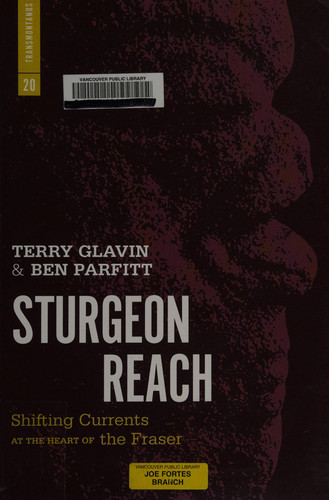
Sturgeon Reach: shifting currents at the heart of the Fraser
Sturgeon Reach is the name some have given to a stretch of the Fraser River between Hope and Pitt Meadows, where its flow slows, and it deposits the gravel it's been carrying from the province's interior. Its story is one of rocks and stones, from its geological origins, from the mythic beginnings of human settlement, and from the arrival of Simon Fraser through to the onslaught of dykes and roads and bridges and foundations that today threaten the river's essential nature. Sturgeon Reach hosts an incredible array of life, from giant black cottonwoods to a creature that dates from the age of dinosaurs –– the remarkable white sturgeon. This stretch of river is the spawning ground for major salmon runs. And for millennia, it has also been the home of the Sto:lo Indians. How can we now live well along a river that has a ceaseless desire to overflow its banks and set its own course? How can we allow the life that the river's character fosters to persist in the face of overwhelming development? In the 20th book in the Transmontanus series, Terry Glavin and Ben Parfitt explore Sturgeon Reach — its geography, its history, its critical role in the coastal ecosystem, and the compelling story it tells about competing human needs.
Prisms
1967. No Edition Remark. 272 pages. Pictorial dust jacket over black cloth. Well bound and clean pages, with mild tanning to text block edges. Some rub-marking and tanning to pastedowns and endpapers. Boards have mild shelf wear with light rubbing and corner bumping. Some light marking and sunning. Boards are slightly bowed. Clipped jacket has light edge-wear with minor tears and chipping. Mild rubbing and marking.

