898 results for "Evolution"

With roots in heaven: one woman's passionate journey into the heart of her faith

Firestone, Tirzah
"A riveting story of how one brave and adventurous woman turned her life upside down for God. Firestone teaches us, through the joys and sorrows of her life, how our ancient traditions are calling out to us for renewal, and how, through faith, honesty, and struggle, we are learning to respond. At age seventeen, Tirzah Firestone left the oppressive home of her Orthodox Jewish parents and set off on a spiritual odyssey. With Roots in Heaven is the story of that journey, a fascinating and moving account of her evolution from rebellious young seeker to renegade rabbi. This is an inspiring, true account of a courageous woman with strong convictions and a passion to know and feel God. It is also a book that goes beyond one person's story of wandering and redemption to explore the dangers of modern religion and the joys and conflicts of intermarriage and raising interfaith children. An unforgettable story of love, sacrifice, and transformation-of grace sought and found-With Roots in Heaven offers hope, wisdom, and encouragement to anyone seeking deeper spiritual meaning in today's world"--
Monkfish Book Publishing Company 2024

From alchemy to quarks: the study of physics as a liberal art

Glashow, Sheldon L.
A Nobel Laureate who is committed to scientific literacy, Glashow brings his intelligence and vast understanding of the subject to a text geared to liberal arts students. Combining fascinating literary and historical references with a vigorous, whimsical, and often humorous writing style, Glashow traces the evolution of physics and chemistry from ancient to modern times and explains not only what we know about matter and the universe, but how we came to know it, and why it is important.
Brooks/Cole Pub 1994 692 pages

Totempole

Friedman, Sanford
"Totempole is Sanford Friedman's radical coming-of-age novel, featuring Stephen Wolfe, a young Jewish boy growing up in New York City and its environs during the Depression and war years. In eight discrete chapters, which trace Stephen's evolution from a two-year-old boy to a twenty-two-year-old man, Friedman describes with psychological acuity and great empathy Stephen's intellectual, moral, and sexual maturation. Taught to abhor his body for the sake of his soul, Stephen finds salvation in the eventual unification of the two, the recognition that body and soul should not be partitioned but treated as one being, one complete man"--
New York Review Books 2015 419 pages

Revolutionary Immortality: Mao Tse-Tung and the Chinese Cultural Revolution.

Lifton, Robert Jay
Robert Jay Lifton offers a new conceptual framework for our understanding not only of Chinese convulsion, its causes, its surprising potency and its consequences, but of evolution in general and the strange urgency, which can become paramount, of revolution never to proclaim itself successful, never to say its job is done and its goals attained. . . . [Dr. Lifton] has made a signal contribution to the understanding of the relationship of individual psychology to historical change, and especially of the vicissitudes of human continuity . . . .Revolutionary Immortality is, I would judge, an essential study of Communist China; more than that, it is an original, intellectually exciting, gracefully written and wholly accessible essay on an aspect of human individual and mass psychology as it operates in contemporary revolutionary circumstances around the world. Eliot Fremont-Smith, New York Times
Random House 1968 224 pages

Medieval stereotypes and modern antisemitism

Chazan, Robert
A study of the 12th-century evolution of innovative anti-Jewish stereotypes and their impact on subsequent Western thought. The 12th century was a period of significant change and dislocation in the West; it witnessed the interaction of new societal circumstances and a prior ideational legacy, similar to events in the 19th-20th centuries. This interaction produced an innovative view of Jews which was fated to influence anti-Jewish perceptions up to the present. In the period of societal change, persecutory patterns emerged, directed at diverse societal outgroups, among them the Jews. The 12th-century stereotypes were permanently absorbed into the historic legacy of Christian anti-Jewish thinking. These stereotypes were based on a perception of Jewish hatred of Christianity and Christians, and that Jews commit acts of anti-Christian violence generated by this purported hatred (e.g. ritual murder, abuse of Christian symbols, moneylending abuses). The most pernicious anti-Jewish imagery involves stereotypes alleging mortal threats posed by Jews. States that every new stage in the evolution of anti-Jewish thinking is marked by dialectical interplay between a prior legacy of negative stereotypes and the realities of a new social context.
University of California Press 1997 189 pages

Humanity on a Tightrope Thoughts on Empathy, Family, and Big Changes for a Viable Future

Paul R. Ehrlich,Robert E. Ornstein
When we think of family, we most often think of our sisters and brothers, our cousins and grandparents, rather than our world family or even our community connections. We still identify with our differences more than our similarities, unless it's convenient to do otherwise. Here, two seasoned authors tackle the question of family and what it means to us now and how it might change to help us address the problems that affect us all. Using specific examples throughout the work, they present a unique approach to what it means to belong to one human family. Beginning with a consideration of how the family unit has begun to be defined by allegiances, by common ties and empathy, the authors then discuss the evolution of the family unit and how the "us" vs. "them" mentality gave way to a way of life that separated peoples rather than brought them together. They consider family values, how they arose, developed, were perverted or perfected to suit the family unit's needs, and the confusion that followed. Humanity on a Tightrope focuses on what families and family values are, and how they often create an "us versus them" mentality that is at the root of many of today's most crucial problems from terrorism, racism, and war to the failure of humanity to come to grips with potentially lethal global environmental problems. The book underlines a basic element for solving the human predicament - quickly spreading the domain of empathy. It takes a close look at how we can do that, building on the findings of both social and natural science and using tools ranging from brain imaging to the internet. It explains how civilization is unlikely to persist unless many more people learn to put themselves in the shoes of others to keep society balancing on the tightrope to sustainability - a tightrope suspended over the collapse of civilization.
Bloomsbury Academic 2012-03-16 210 pages

Gothic architecture

Frankl, Paul
"This study of Gothic architecture traces the meaning and development of the Gothic style through medieval churches across Europe. Ranging geographically from Poland to Portugal and from Sicily to Scotland and chronologically from 1093 to 1530, the book analyzes changes from Romanesque to Gothic as well as the evolution within the Gothic style and places these changes in the context of the creative spirit of the Middle Ages. This book is a history - a view of things created, and more than that, an analysis of the essence of the Gothic style and of the ideas that inspired its development."--Jacket
Yale University Press 2000 408 pages

Endless Universe (Abandoned): Rewriting Cosmic History

Steinhardt, Paul J. & Neil Turok
Two world-renowned scientists present an audacious new vision of the cosmos that “steals the thunder from the Big Bang theory.” — Wall Street JournalThe Big Bang theory—widely regarded as the leading explanation for the origin of the universe—posits that space and time sprang into being about 14 billion years ago in a hot, expanding fireball of nearly infinite density. Over the last three decades the theory has been repeatedly revised to address such issues as how galaxies and stars first formed and why the expansion of the universe is speeding up today. Furthermore, an explanation has yet to be found for what caused the Big Bang in the first place.In Endless Universe , Paul J. Steinhardt and Neil Turok, both distinguished theoretical physicists, present a bold new cosmology. Steinhardt and Turok “contend that what we think of as the moment of creation was simply part of an infinite cycle of titanic collisions between our universe and a parallel world” ( Discover ). They recount the remarkable developments in astronomy, particle physics, and superstring theory that form the basis for their groundbreaking “Cyclic Universe” theory. According to this theory, the Big Bang was not the beginning of time but the bridge to a past filled with endlessly repeating cycles of evolution, each accompanied by the creation of new matter and the formation of new galaxies, stars, and planets.Endless Universe provides answers to longstanding problems with the Big Bang model, while offering a provocative new view of both the past and the future of the cosmos. It is a “theory that could solve the cosmic mystery” ( USA Today ).
Doubleday 2006 224 pages

History of Zionism

Nahum Sokolow,S. (Stephen) Pichon,Israel Solomons
Delve into the formative years of a pivotal political movement with Nahum Sokolow's "History of Zionism, Vol. 2 of 2: 1600-1918." This meticulously researched historical text explores the evolution of Zionism from its early roots to the end of World War I, providing crucial context for understanding the creation of modern Israel. Spanning centuries of Jewish history, this volume examines the key figures, events, and intellectual currents that shaped Zionist thought and action. Sokolow's work illuminates the complex interplay of European and Middle Eastern politics surrounding the movement, offering insights into the dynamics of colonialism and post-colonialism in Palestine. A vital resource for anyone seeking a comprehensive understanding of Zionism, its origins, and its enduring impact. This book remains an essential contribution to the study of 19th-century political thought, Jewish history, and the ongoing story of Israel. This work has been selected by scholars as being culturally important, and is part of the knowledge base of civilization as we know it. This work is in the public domain in the United States of America, and possibly other nations. Within the United States, you may freely copy and distribute this work, as no entity (individual or corporate) has a copyright on the body of the work. Scholars believe, and we concur, that this work is important enough to be preserved, reproduced, and made generally available to the public. We appreciate your support of the preservation process, and thank you for being an important part of keeping this knowledge alive and relevant.
Creative Media Partners, LLC 2025-03-29 658 pages

The theory of revolution in the young Marx

Löwy, Michael
"This book is brilliant, incisive, honest and deserves to be read with attention. It is an important event in the Marxist theoretical production." -- Politique Hebdo "A remarkable essay, whose merit is not only theoretical, but also historical, because it examines unknown aspects of the evolution of young Marx's thinking."-- Politis In the 1840s, the young German journalist Karl Marx developed ideas about modern society that remain as relevant today as when they were first developed. Here Löwy shows the lasting force of Marx's early writings on alienation and emancipation. Michael Löwy is research director in sociology at the Centre National de la Recherché Scientifique, Paris. He is the author of many books, including Romanticism Against the Tide of Modernity .
Haymarket Books 2005 205 pages

Believers: faith in human nature

Konner, Melvin
"An anthropologist examines the nature of religiosity, and how it shapes and benefits humankind. Believers is a scientist's answer to attacks on faith by some well-meaning scientists and philosophers-- a firm rebuke of the "Four Horsemen": Richard Dawkins, Daniel Dennett, Sam Harris, and Christopher Hitchens, known for writing about religion as something irrational and ultimately harmful. Konner, who was raised as an Orthodox Jew but has lived his adult life without such faith, explores the psychology, development, brain science, evolution, and even genetics of the varied religious impulses we as a species experience. Conceding that faith is not for everyone, he views religious people with a sympathetic eye; his own upbringing, his apprenticeship in the trancedance religion of the African Bushmen, and his friends in Christian, Buddhist, Hindu, Muslim, and other faiths have all shaped his perspective. He concludes that religion does much good as well as undoubted harm, and that for at least a large minority of humanity, the belief in things unseen neither can nor should go away"--
W. W. Norton & Company 2019-09-10 244 pages

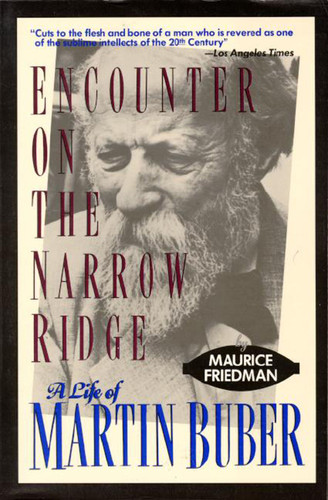
Encounter on the Narrow Ridge A Life of Martin Buber

Maurice Friedman
Martin Buber's stature as the most significant Jewish religious philosopher of the twentieth century is reinforced by his accomplishments and renown in areas as diverse as Hasidism, psychotherapy, education, folklore, and politics. His classic, I and Thou, is known and studied all over the world. In this complete and masterful biography, Maurice Friedman traces the interweaving of Buber's wholehearted engagement with world events and crises and the evolution of his unique and influential philosophy. We see the impact of World War I on the young thinker; his work in education, community, and politics between the wars; his leadership of the spiritual resistance to the Nazis in Hitler's Germany; and his more than forty years of fighting for Jewish-Arab understanding. In addition, we see Buber interact with Heidegger, Sartre, Jung, Ben Gurion, Hesse, Rosenzweig, and Hammarskjold. Through his close relationship with Buber and recent access to forty-five thousand unpublished letters, Maurice Friedman recreates Buber's vitality, his philosophy of dialogue, and his spirituality based on a personal relationship with God. Encounter on the Narrow Ridge delivers the essential spontaneity of a great man who saw in every encounter a focal point for human growth.
Paragon House 1998-06-15 496 pages

Luminous traitor: the just and daring life of Roger Casement, a biographical novel

Duberman, Martin B.
"Roger Casement was an internationally renowned figure at the beginning of the 20th century, famous for exposing the widespread atrocities against the indigenous people in King Leopold's Congo and his subsequent exposure--for which he was knighted in 1911--of the brutal conditions of enslaved labor in Peru. An Irish nationalist of profound conviction, he attempted, at the outbreak of World War I, to obtain German support and weapons for an armed rebellion against British rule. Apprehended and convicted of treason in a notorious trial that captured worldwide attention, Casement was sentenced to die on the gallows. A powerful petition drive for the commutation of his sentence was inaugurated by George Bernard Shaw and a host of other influential figures. A gay man, Casement kept detailed diaries of his sexual escapades, and the British government, upon discovering the diaries, circulated its pages to public figures, thereby crippling what had been a mounting petition for clemency. In 1916, he was hanged. In this gripping reimagining, acclaimed historian Martin Duberman paints a full portrait of the man for the first time. Tracing his evolution from servant of the empire to his work as a humanitarian activist and anti-imperialist, Duberman resurrects and recognizes all facets--from the professional to the personal--of the fantastic life of this pioneer for human rights"--Provided by publisher.
University of California Press 2019 279 pages

Mathematics and logic

Kac, Mark
A description of the historical development of mathematics with a brief survey of high points and trenchant influences, originally published in 1986 by Praeger. A remarkable bargain. Fascinating study considers the origins and nature of mathematics, its development and role in the history of scientific thinking, impact of high-speed computers, 20th-century changes in the foundations of mathematics and mathematical logic, mathematization of science and technology, much more. Compelling reading for mathematicians, physicists, students₇anyone interested in the evolution of mathematical thought. 34 illustrations. 1968 edition.
Dover 1992 170 pages

Darwin's Cipher

M. A. Rothman
Juan Gutierrez, a cancer researcher, has spent years studying the genome of animals that exhibit immunity to some types of cancer. Over the course of his study, Juan discovers a pattern that allows him to predict the course of a species' evolution across thousands of generations. Using the algorithm he's developed from the pattern, Juan uncovers what he believes to be the key to conquering humanity's susceptibility to cancer. Others are interested in using what Juan has dubbed "Darwin's Cipher," however, instead of cancer research, they see very different applications for the new genetic algorithm. Nate Carrington, an FBI forensic analyst has been struggling with several cold cases when he's alerted to an incident at a nearby ranch. It's a case of a newborn calf who is found in the middle of a herd of dead cattle. It provides a single link to Nate's other cold cases: the DNA analysis of the calf doesn't match anything in the FBI's database. Somewhere in a rural hospital in West Virginia, four hospital workers are dead and a newborn child has been transported to the NIH's level-4 bio-containment unit. It's only when the NIH sends out an alert to all hospitals and law enforcement agencies that the world realizes the danger that faces them.
Primordial Press 2019-02-15 350 pages

Creative Nonfiction The Final Issue: The Best of Thirty Years of Creative Nonfiction

Lee Gutkind,Leslie Rubinkowski
The very best writing from one of America's most groundbreaking literary magazines. When Creative Nonfiction debuted in 1994, the literary genre it championed was largely the target of skepticism or downright ridicule. But at a time when few editors were interested in the personal essay, the magazine doggedly explored new ideas and fresh modes of expression, and over the next three decades, its contributors pioneered what would come to be known as the "fourth genre." The thirty-two essays collected here bring together some of the finest work Creative Nonfiction published over its seventy-eight issues. Read Pulitzer Prize-winner Charles Simic's boyhood remembrances of the bombing of Belgrade, Carolyn Forche's haunting, lyric catalog of her daily life as she faced down a cancer diagnosis, and John Edgar Wideman's meditation on the photo of a murdered boy his same age--Emmett Till--and how the image haunted him forever. Here, you'll find work by such luminaries as Adrienne Rich and John McPhee, but also essays from more contemporary voices like Brian Broome, Elizabeth Fortescue, and Anne McGrath. With an introduction by Lee Gutkind, Creative Nonfiction's founder and editor, this collection captures the evolution of a genre and the amazing work of the little magazine that helped make it all happen.
Belt Publishing 2024 375 pages

Psychoanalysis and psychoanalytic therapies

Safran, Jeremy D.,Hunter, Jennifer (Psychologist)
"As the original theory of psychotherapy, psychoanalysis is often presented as a starting point in psychology theory courses. Yet, many people's understanding of psychoanalysis is limited to the classic Freudian approach. Psychoanalysis and Psychoanalytic Therapies, Second Edition provides an overview of the historical evolution of, and recent advancements in this vital group of theories and approaches to psychotherapy, that have been refined over more than a century of international work by key theorists, researchers, and clinicians. This primer to psychoanalytic approaches, including clinical strategies and case examples illustrating short and long term psychoanalytic treatment, is an essential resource for students and trainees interested in learning about psychoanalysis, as well as experienced clinicians seeking to refresh their knowledge. This new edition has been updated to include more contemporary perspectives on identity, diversity, and intersectionality in the context of psychoanalysis, as well as an expanded discussion of defenses, dream interpretation, recent research, and ongoing developments in the field"--
American Psychological Association 2020 211 pages

The sea hawk

Koch, Howard
This 1940 swashbuckler is one of the best examples of the old Hollywood studio system at work. Scholars and film buffs will learn much about collaborative filmmaking on an exceptionally large scale as Rudy Behlmer traces step-by-step the evolution of The Sea Hawk . The very anti-thesis of an auteur film, The Sea Hawk illustrates the ways in which creative input from just about everyone on the Warner Brothers lot—producers, writers, art directors, director, cameraman, special effects team, editor and composer-conductor—resulted in a film in the familiar Warners house style. This book includes the complete screenplay.
Published for the Wisconsin Center for Film and Theater Research by the University of Wisconsin Press 1982 222 pages

The dwarfs: a novel

Pinter, Harold
Originally written in 1950, then revised and first published in 1992, The Dwarfs is Harold Pinter's only novel. Set in postwar Britain, The Dwarfs describes the intertwined lives and concerns of four young Londoners: Len, working at the Euston train station but fascinated by abstract mathematics; Mark, a sometime actor; and Virginia and Pete, a young couple trying to define their relationship amid the powerful, sometimes destructive forces at work among the four. In the evolution of this quadrilateral friendship and the strains it creates, Harold Pinter explores how ordinary lives are molded by the limitations and boundaries of sexuality, intimacy, and mortality. It is a world populated by dwarfs -- young people who have departed, only to leave emptiness. Funny, vivid, and haunting, The Dwarfs is a brilliantly intriguing and chillingly perceptive novel by a writer whose imagination has shaped our lives.
Grove Weidenfeld 1991 183 pages

A discipline divided: schools and sects in political science

Almond, Gabriel A.
In this collection of essays, eminent scholar Gabriel Almond describes the ways in which the discipline of political science has become divided against itself. "The various schools and sects of political science," writes Almond, "now sit at separate tables, each with its own conception of proper political science, but each protecting some secret island of vulnerability." In his overview, Almond examines the "hard" versus "soft" science approaches, as applied by scholars of both the left and the right. In Part I, he explores the history of model-fitting in communism studies, the strengths and weaknesses of the rational choice movement, and the historical forces and processes that have shaped political culture theory. In Part II, Almond addresses the problem of the transmission of methods and findings within the discipline. He discusses the current emphasis on pluralism among political theorists in Communist countries while a corresponding devaluation of this concept is occurring in the West. He concludes with an evaluation of the neo-statist movement and the evolution of political development studies. With this book, Professor Almond crowns a lifetime achievement, and makes final his case for the study of political culture. "It is a most interesting book. For what it′s worth, I think this book will be a successful one. This is not because of the talent and eminence of the author, but because I think there are lots of political scientists who will enjoy reading about these continuing struggles. In sum, I think the book will be a hit." --Aaron Wildavsky, University of California, Berkeley "Judged by the breadth of his professional knowledge and the depth of his command of the literature, Gabriel A. Almond is the most learned political scientist of today. In these wise and erudite essays he provides careful documentation of where the discipline is and what those who went before really said. Hereafter, no graduate student should feel prepared for general examinations in any field of political science without carefully reading A Discipline Divided, and taking to heart its lesson that getting the record straight is a necessary foundation for advancing social science knowledge." --Lucian W. Pye, Massachusetts Institute of Technology "Who better to provide a prospect and retrospect on the social sciences than a 1938 University of Chicago Ph.D.; a pupil of Frank Knight, Harold Lasswell, and G. H. Mead; and a fellow graduate student with Herbert Simon, George Stigler, Edward Shils, V.O. Key, and others? This book shows that he is still a pioneer in the social sciences, and even prepared to explore ideas that are nowadays fresh because they have been around so long that they are forgotten. The result is a book that is of interest to every social scientist." --Journal of Public Policy
Sage Publications 1990 348 pages