715 results for "Jewish History"

Chinese and Jews: encounters between cultures = [Zhonghua yu youtai]

Eber, Irene
This book deals with the large variety of contacts that constitute intercultural relations. These studies suggest the different areas - literature, history, society - research can take to discover the interaction of ideas and peoples. It furthermore illustrates how widely disparate cultures can communicate over time and space as well as the different means that are employed in cultural adjustment. Contents include: Jewish Communities in China: A Brief Overview --- Kaifeng Jews: Sinification and the Persistence of Identity and History --- Destination Shanghai, Permits, and Transit Visas, 1938-1941 --- Translating the Ancestors: SIJ Schereschewsky's 1875 Chinese Version of Genesis --- Notes on the Early Reception of the Old Testament --- Several Psalms in Chinese Translation --- Translation Literature in Modern China: The Yiddish Author and his Tale --- Martin Buber and Daoism
Vallentine Mitchell 2008 187 pages

Reimagining the Bible: the storytelling of the rabbis

Schwartz, Howard
Reimagining the Bible collects a dozen essays by Howard Schwartz. Together the essays present a coherent theory of the way in which each successive phase of Jewish literature has drawn upon and reimagined the previous ones. The book is organized into four sections: The Ancient Models; The Folk Tradition; Mythic Echoes; Modern Jewish Literature and the Ancient Models. Within these divisions, each of the essays focuses on a specific genre, ranging from Torah and Aggadah to Kabbalah, fairy tales, and the modern Yiddish stories of S.Y. Agnon and Isaac Bashevis Singer. Arguing the important thesis that there is a continuity in Jewish literature which extends from the Biblical era to our own times, over a period of more than 3,000 years, this collection also serves as a guide to the history of that literature, and to the genres it comprises.
Oxford University Press 1998 289 pages

The election of Israel: the idea of the chosen people

Novak, David
The view of themselves as the chosen people of God has been maintained by Jews from the beginnings of their history to the present. The author explores the development of this idea in Jewish theology and law, and essays a contemporary retrieval of the classical doctrine of election. Through an examination of the philosophical implications of the idea, he argues for the correlation of election and revelation, and shows both what the notion of election should mean for Jews today, and how non-Jews can better understand it.
Cambridge University Press 2007-11-05 304 pages

The Blood libel legend: a casebook in anti-Semitic folklore

Alan Dundes
Alan Dundes, in this casebook of an anti-Semitic legend, demonstrates the power of folklore to influence thought and history. According to the blood libel legend, Jews murdered Christian infants to obtain blood to make matzah. Dundes has gathered here the work of leading scholars who examine the varied sources and elaborations of the legend. Collectively, their essays constitute a forceful statement against this false accusation. The legend is traced from the murder of William of Norwich in 1144, one of the first reported cases of ritualized murder attributed to Jews, through nineteenth-century Egyptian reports, Spanish examples, Catholic periodicals, modern English instances, and twentieth-century American cases. The essays deal not only with historical cases and surveys of blood libel in different locales, but also with literary renditions of the legend, including the ballad “Sir Hugh, or, the Jew’s Daughter” and Chaucer’s “The Prioress’s Tale.” These case studies provide a comprehensive view of the complex nature of the blood libel legend. The concluding section of the volume includes an analysis of the legend that focuses on Christian misunderstanding of the Jewish feast of Purim and the child abuse component of the legend and that attempts to bring psychoanalytic theory to bear on the content of the blood libel legend. The final essay by Alan Dundes takes a distinctly folkloristic approach, examining the legend as part of the belief system that Christians developed about Jews. This study of the blood libel legend will interest folklorists, scholars of Catholicism and Judaism, and many general readers, for it is both the literature and the history of anti-Semitism.
University of Wisconsin Press 1991-10-15 385 pages

Insider/outsider: American Jews and multiculturalism

David Biale,Michael Galchinsky,Susannah Heschel
Twelve distinguished historians, political theorists, and literary critics present new perspectives on multiculturalism in this important collection. Central to the essays (all but one is appearing in print for the first time) is the question of how the Jewish experience can challenge the conventional polar opposition between a majority "white monoculture" and a marginalized "minorities of color multiculture." This book takes issue with such a dichotomy by showing how experiences of American Jews can undo conventional categories. Neither a complaint against multiculturalism by Jews who feel excluded from it, nor a celebration of multiculturalism as the solution to contemporary Jewish problems, Insider/Outsider explores how the Jews' anomalous status opens up multicultural history in different and interesting directions. The goal of the editors has been to transcend the notion of "comparative victimology" and to show the value of a narrative that does not rely on competing histories of persecution. Readers can discover in these essays arguments that will broaden their understanding of Jewish identity and multicultural theory and will enliven the contemporary debate about American culture generally. Twelve distinguished historians, political theorists, and literary critics present new perspectives on multiculturalism in this important collection. Central to the essays (all but one is appearing in print for the first time) is the question of how the Jewish experience can challenge the conventional polar opposition between a majority "white monoculture" and a marginalized "minorities of color multiculture." This book takes issue with such a dichotomy by showing how experiences of American Jews can undo conventional categories. Neither a complaint against multiculturalism by Jews who feel excluded from it, nor a celebration of multiculturalism as the solution to contemporary Jewish problems, Insider/Outsider explores how the Jews' anomalous status opens up multicultural history in different and interesting directions. The goal of the editors has been to transcend the notion of "comparative victimology" and to show the value of a narrative that does not rely on competing histories of persecution. Readers can discover in these essays arguments that will broaden their understanding of Jewish identity and multicultural theory and will enliven the contemporary debate about American culture generally.
University of California Press 1998 280 pages

Judaism and the challenges of modern life

Moshe Halbertal,Donniel Hartman
Much more than a particular period in world history, modernity has fundamentally transformed how we think and live, and especially how we understand and relate to religious traditions. As the 'ghetto walls' have fallen, both empirically and metaphorically, Judaism is compelled to compete in an open marketplace of ideas. Jews can no longer count on an assumedly necessary Jewish identity or commitment, nor on the rallying force of anti-Semitism to ensure an individual and collective sense of belonging. Rather Jewish moral, spiritual and historical values and ideas must be read with new eyes and challenged to address modernity's proliferating array of questions and realities. The pertinent questions modern Jewry faces are how to embrace modernity as Jews and what such an embrace means for the meaning and future of Jewish life. This collection of essays, authored by scholars of the Shalom Hartman Institute, addresses three critical challenges posed to Judaism by modernity: the challenge of ideas, the challenge of diversity, and the challenge of statehood, and provides insights and ideas for the future direction of Judaism. Providing readers with new insights into Judaism and the Jewish people in contemporary times, the collection explores a wide range of issues that includes: the significance of Israel for the future of Judaism; the Jewish people as a people; the relationship between monotheism and violence; revelation and ethics; Judaism and the feminist challenge; and Judaism and homosexuality.
Continuum 2007-12-11 192 pages

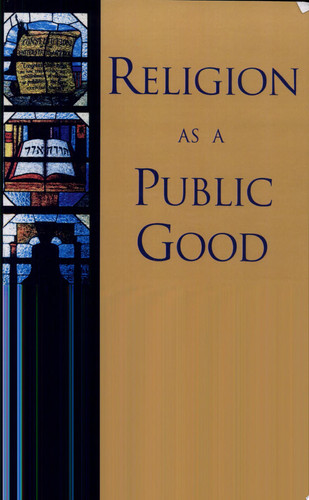
Religion as a public good: Jews and other Americans on religion in the public square

Alan Mittleman
Religion as a Public Good: Jews and Other Americans on Religion in the Public Square explores the often controversial topic of how religion ought to relate to American public life. The sixteen distinguished contributors, both Jewish and Christian, reflect on the topic out of their own disciplines-social ethics, political theory, philosophy, law, history, theology, and sociology. and take a stand based on their religious convictions and political beliefs. The volume is at once scholarly and committed, polemic and civil, reflective and activist. Written in the shadow of 9/11, it invites a new consideration of how religion enhances democratic public life with full awareness of the dangers that religion can sometimes pose. The volume is polemical, as befits the topic, but also civil, as befits a dialogue about an issue of profound significance for democratic citizenship.
Rowman & Littlefield 2003-12-09 336 pages

The Jewish question: a Marxist interpretation

Léon, Abraham
During the opening years of the 21st century, anti-­Semitic venom and incidents of violent assault on Jews have begun spreading. They are not a historical aberration. They are fueled by today's capitalist crises and fracturing of the post-World War II imperialist "order," described in recent decades as "globalization." At every turning point in history-from antiquity through feudalism, to capitalism's rise and the imperialist death throes of the past century-Jews have been targets of persecution. Including the genocide cold-bloodedly touted by Hitler as the "Final Solution." Why is Jew-hatred still raising its ugly head? What are its class roots? Why is there "no solution to the Jewish question under capitalism, just as there is no solution to other problems before humanity," without revolutionary struggles that transform us as we fight to transform our world? Abram Leon was killed in October 1944, at age 26, in the Nazi gas chambers at Auschwitz. He left us this book to help answer those questions.
Pathfinder 2020 346 pages

The Dreyfus affair: a trilogy

Whyte, George R.
The cause celebre of the 19th century, the Dreyfus Affair destabilized French society (1894-1906) and reverberated across the world. Its repercussions continue to this day. A deliberate miscarriage of justice, the public degradation of an innocent Jewish officer and his incarceration on Devil's Island, espionage, intrigue, media pressure, vehement antisemitism and political skulduggery--all these elements, based on historical records, are contained in George R. Whyte's trilogy of plays which also focuses on Emile Zola's letter to the President of France, J'Accuse, arguably history's most famous plea for human rights.
Oberon Books 2010 126 pages

Dominican haven: the Jewish refugee settlement in Sosúa, 1940-1945

Kaplan, Marion A.
Discusses the generous proposal of the Dominican government to the Jewish refugees from Germany and Austria to settle in Sosúa against the background of the reluctance of most American countries to take in Jewish refugees. Notes that the USA not only put up "paper walls" in the way of Jewish refugees eager to enter the country, but from April-May 1940 (when the war broke out in Europe) tried to impede Jewish immigration into the Dominican Republic.
Museum of Jewish Heritage 2008 255 pages

Prologue to annihilation: ordinary American and British Jews challenge the Third Reich

Norwood, Stephen H.
"American and British appeasement of Nazism during the early years of the Third Reich went far beyond territorial concessions. In Prologue to Annihilation: Ordinary American and British Jews Challenge the Third Reich, Stephen H. Norwood examines the numerous of ways that the two nations' official position of tacit acceptance of Jewish persecution enabled the policies that ultimately led to the Final Solution and how Nazi annihilationist intentions were clearly discernible even during the earliest years of Hitler's rule. Further, Norwood looks at the nature and impact of American and British Jewish resistance to Nazi persecution and the efforts of Jews at the grassroots level to press Jewish organizations to respond more forcefully to the Nazi menace. He examines the worldwide protest and boycott movements against Germany and German goods as well as mass demonstrations by working-class and lower-middle-class Jews in many American and British cities. Prologue to Annihilation details how the events of 1930-1936 tested American and British societies' willingness to accept Nazism and its anti-Jewish philosophy and illuminates the divisions that existed even within the Jewish community about how best to challenge Nazi antisemitic policies and atrocities"--
Indiana University Press 2021 347 pages

Ben-Gurion and the Holocaust

Teveth, Shabtai
After World War II a flow of literature written by both Orthodox and left-wing Jewish writers, as well as academic works, appeared, defaming the attitude of Ben-Gurion and the Jewish Agency Executive toward the rescue of Europe's Jews during the Holocaust. The most slandering works were those by Rabbi M.D. Weissmandel and "The Seventh Million" by Tom Segev. Shows that Ben-Gurion, as early as 1932, foresaw the genocide of the Jews. He never favored the Zionist cause over the rescue of diaspora Jews, and did all he could for their rescue. However, he understood that little could be done by the Jewish Agency because it had no governmental authority. Ben-Gurion believed that the only way to save European Jews was to encourage immigration to Eretz Israel; therefore, most of his energy was directed to this cause. Examines Segev's book, as well as some other works, criticizing them for twisting the facts. Maintains that Weissmandel's rescue plan and other plans proposed by Zionist and non-Zionist leaders in Europe were not viable; therefore, their activities should not be juxtaposed with the alleged inactivity of the Yishuv and the JAE leadership.
Harcourt Brace & Company 1996-11 310 pages

The Auschwitz Reports and the Holocaust in Hungary

Randolph L. Braham,William J. Vanden Huevel,William Jacobus Vanden Heuvel
Foreword / William J. vanden Heuvel, Robin Vrba. - Introduction / Randolph L. Braham, William J. vanden Heuvel. - Hungary and the Jewish question / Istvań Deák. - Hungary : the controversial chapter of the Holocaust / Randolph L. Braham. - America and the Holocaust in Hungary / Richard Breitman. - The Auschwitz Reports : who got them and when? / Zoltán Tibori Szabó. - When the veil was rent in Twain : Auschwitz, the Auschwitz Protocols, and the Shoah testimony of Rudolf Vrba / Robert Jan Van Pelt. - Rudolph Vrba and the Auschwitz Reports : conflicting historical interpretations / Ruth Linn. - The Kasztner affair : a reappraisal / Eli Reichenthal. - Confronting the Holocaust : an eyewitness account / George Klein. - Hungarian Holocaust : after 50 years / Donald Blinken.
Social Science Monographs 2011 291 pages

Heroines of Vichy France: rescuing French Jews during the Holocaust

Bartrop, Paul R.,Lakin, Samantha J.
"This book tells the largely unknown story behind the rescue activities of several remarkable young Jewish women in Vichy France during World War II and their role in the resistance against Nazi and Vichy France deportation policies. Few studies of Vichy France and the Holocaust have looked at the rescue of Jews by those prepared to risk everything to escort them to safety in the border regions, and even fewer have considered Jewish rescue of Jews, specifically of Jewish children by women. This work will be arguably the first book in which the experiences and efforts of a number of female rescuers—all of whom knew or knew of each other—have been brought together in a single volume, with the object of honoring their memory and showing how the value of human life was sustained through the Holocaust. Focusing on a number of young Jewish women who defied the Nazis, this narrative highlights their courage and sacrifice in their efforts to rescue Jews in France during World War II. Additionally, it shows how these French women responded to Nazi and Vichy France policies of deportation through resistance activities. This is a story that will captivate anyone with an interest in the innate goodness of human beings that can shine even when confronted with the darkest expressions of depravity that occurred during the Holocaust." -- From publisher's website.
Praeger, an Imprint of ABC-CLIO, LLC 2019 173 pages

Hate: The Rising Tide of Anti-Semitism in France (and What It Means for Us)

Weitzmann, Marc
"From an award-winning journalist, a provocative, deeply reported expose of the history and present crisis of anti-Semitism in France--and its dire consequences for the rest of Europe. Hate explores the alarming history and present predicament of anti-Semitism in France. By examining the issue at local, international, and personal levels--interviewing everyday French men and women as well as powerful leaders such as National Front president Marine Le Pen--Weitzmann attempts to understand how nine Jews have been murdered by French citizens in the last eight years, and how France has become the number one country from which Western jihadists flee to join ISIS and other extremist Middle Eastern organizations. How do contemporary French Jews grapple with these troubling facts, and with the historical legacies of the French Revolution, the Holocaust, and the Gaullist "Arab-French policy"? While internationally minded consumers of the news may have some knowledge of the events Weitzmann describes--including the 2013 "Day of Anger" and the rise of France's popular, and famously anti-Semitic, comedian Dieudonne M'bala M'bala--these controversies are largely unknown in the States, and utterly shocking in the unity Weitzmann gives them here. In his hands, these events are not just the story of French anti-Semitism, but that of the breakdown of a major Western power, of the dark side of our global age"--
Houghton Mifflin Harcourt 2019 290 pages

In the shadow of the crescent: the Arabs, the Holocaust and beyond

Cooper, Leo
Argues against the myth of Jews and Arabs living peacefully side by side before the advent of Zionism and the creation of Israel. The enmity of Arabs and Muslims dates from the time of Muhammad, and the inequality of Jews in Muslim societies is embedded in Islamic law. It is not only the Covenant of Omar which has determined the Jews' inferior status, but also local laws and customs of Islamic societies. The rise of Arab nationalism and the beginning of the Jewish settlement in the Land of Israel exacerbated Arab-Jewish relations. Argues that, initially, the Nazis and the antisemites in other European countries favored the idea of Jewish mass emigration from Europe to Palestine; however, the Nazis abandoned this idea for the sake of an alliance with the Arab nationalists. During the Holocaust, the Land of Israel could have become a refuge for Jews, but this possibility was thwarted by British restrictions of Jewish immigration. Contends that Arab pressure on British authorities prevented the immigration of hundreds of thousands of European Jews to the Land of Israel. After the establishment of the State of Israel, Arab antisemitism reached a peak. In the present-day Arab and Muslim world, anti-Zionism, traditional Muslim anti-Judaism, modern antisemitism, and Holocaust denial (while extolling Hitler for the Holocaust) have merged together into one dangerous complex.
Hybrid Publishers 2010 279 pages

The lion and the star: gentile-Jewish relations in three Hessian communities, 1919-1945

Friedman, Jonathan C.
A survey of Jewish-Gentile relations in Frankfurt am Main, Giessen, and Geisenheim on the eve of and during the Nazi dictatorship. Gives a demographic, social, and historical portrait of the three Jewish communities and a picture of Jewish-Gentile interaction in the Weimar years. Even in these years some anti-Jewish tendencies became evident, e.g. hostility toward the "Ostjuden, " broad popular indifference toward the Jews in the of the growing Nazi movement. Ch. 5-7 present a case study of Nazi anti-Jewish policy in Hesse, focusing on Jewish-Gentile relations there in the Nazi period. States that the persecution of Jews was facilitated by the indifference and passivity of ordinary Germans. A latent antisemitism (though not "eliminationist") combined with apathy and acquiescence to a brutal dictatorship in the conditions of war and paved the way to the mass murder. Dwells on the legal exclusion of Jews in 1933-38, on the "Kristallnacht" pogrom, and on the deportations of Hessian Jews in 1941-43.
University Press of Kentucky 1998 292 pages