4889 results for "Love"

The Disunited States

Pozner, Vladimir
""By dint of names, dates, and figures, of classified ads, of sundry facts, of statistics, of the confessions of great writers and of anonymous passersby, of quotations from small-town newspapers and from official discourses, Vladimir Pozner reconstructs, vibrantly, so terribly vibrantly and magnificently, the American civilization." --Les Lettres Françaises Vladimir Pozner--influential French novelist, screenwriter, pioneer in literary genre and Oscar nominee, came to the United States in the 1930's. He found the nation and its people in a state of profound material and spiritual crisis, and took it upon himself to chronicle the life of the worker, the striker, the politician, the starlet, the gangster, the everyman; to document the bitter, violent racism tearing its society asunder, the overwhelming despair permeating everyday life, and the unyielding human struggle against it all. In the spirit of Tocqueville's Democracy in America, Pozner writes about America and Americans with the searing criticism and deep compassion of an outsider who loved the country and its people far too much to render anything less than a brutally honest portrayal. Recalling Agee's Let Us Now Praise Famous Men, he shatters the rules of reportage to create a complete portrait of America, enduring and profound"--
Seven Stories Press 2014 302 pages

French Without a Master

Bernard, Tristan,Clark, Barrett H (Barrett Harper)
"French without a master: A farce in one act" by Tristan Bernard offers a delightful dose of classic French humor. This one-act play, a brilliant example of the farce genre, presents a timeless comedic situation sure to entertain. A master of witty dialogue and absurd scenarios, Bernard crafts a lighthearted exploration perfect for students of French language and lovers of comedy. This meticulously prepared print edition preserves the original charm and wit of the work, offering readers a glimpse into the rich tradition of French theatre. Enjoy a quick and hilarious escape with this enduring example of the one-act play form. A perfect addition to any drama or language study collection, "French without a master" promises laughter and amusement with every read. This work has been selected by scholars as being culturally important, and is part of the knowledge base of civilization as we know it. This work is in the public domain in the United States of America, and possibly other nations. Within the United States, you may freely copy and distribute this work, as no entity (individual or corporate) has a copyright on the body of the work. Scholars believe, and we concur, that this work is important enough to be preserved, reproduced, and made generally available to the public. We appreciate your support of the preservation process, and thank you for being an important part of keeping this knowledge alive and relevant.
Anson Street Press 2025-03-29 24 pages

Plotting temporality: poems

Roberts, Suzanne
Review "There is a lovely and unexpected alchemy in these verses that veer from the stars to suburbia, from the sublime to sweaty reality, and leave traces of each in the other. Roberts has a powerful range: equally adept at ferocity and fragility, and a host of other apparent opposites, she is a borderless writer and an absolute joy to read." - June Sylvester Saraceno"Suzanne Roberts' poems in Plotting Temporality are songs of the body, the erotic imperative of flesh, the brutal finality of bone. Roberts' poems forcefully invoke "our night, our moon, but never, / never our dawn," their language striving to shape and illuminate our haunted movements--a caress, a spouse's hand pushed away, a figure approaching from the shadows, embraced with fateful longing." --Gaylord Brewer Product Description Suzanne Roberts is the author of three previous books of poetry, Shameless (2007), Nothing to You (2008), and Three Hours to Burn a Body: Poems on Travel (2011). She is also the author of a memoir, Almost Somewhere: 28 Days on the John Muir Trail (University of Nebraska Press, 2012). She holds a doctorate in literature and the environment from the University of Nevada-Reno and currently teaches at Lake Tahoe Community College in South Lake Tahoe, California. For more information, please visit her website at www.suzanneroberts.org From the Back Cover The poems in Plotting Temporality are songs of the body, the erotic imperative of flesh, the brutal finality of bone. These poems flicker with shadow and light, sometimes igniting into bold vision, sometimes mapping what is missing, drawing new shapes from the natural world, giving the familiar a new dimension, a mystery that compels us to follow. About the Author Suzanne Roberts is the author of the memoir Almost Somewhere: Twenty-Eight Days on the John Muir Trail, as well as three previous collections of poetry: Shameless, Nothing to You, and Three Hours to Burn a Body: Poems on Travel. She teaches at Lake Tahoe Community College and for the low residency MFA in creative writing at Sierra Nevada College.
Pecan Grove Press 2012 65 pages

The Osier Cage Rhetorical Devices in Romeo and Juliet

Robert O. Evans
By studying the diction of Romeo and Juliet , Robert O. Evans examines this, the most rhetorical of Shakespeare's plays, in terms of an Aristotelian critical category, which has been neglected in modern times. Inherent in his methodology is the assumption that Romeo and Juliet is best regarded as drama, not as pure poetry, though essentially it is the rhetorical brilliance of the poetry that is considered. Evans begins with an analysis of the important speeches of Romeo and Juliet and defines the controlling devices Shakespeare wove into them, especially oxymoron. He then follows with a discussion of the role of Friar Laurence, whom the author finds is a catalyst between the warring houses and between the lovers and the outer world of Verona. Evans concludes with an examination of Mercutio's famous Queen Mab speech, which, he points out, has an integral relationship to the structure of the tragedy as a whole. An analysis of the rhetorical devices of the play, Evans believes, demonstrates the thesis that the tragic effect of Romeo and Juliet is one of fulfillment, with the tragedy arising from the character of the protagonists rather than from circumstance.
University Press of Kentucky 2014-07-07 120 pages

Zero Mostel reads a book

Frank, Robert
A delightful moment of slapstick in Robert Frank's oeuvre The female subject absorbed in a book has prompted masterworks from Vermeer, Monet, Vuillard and Matisse, among many others. Less often portrayed are men in the act of reading--even Manet's portrait of Émile Zola depicts the writer staring away from his open volume. Is it the supposed passivity of this act that has discouraged men from modeling it? This mini-genre remains even less explored yet by photographers, though it surely offers the supreme opportunity for coaxing subjects of either sex into unself-consciousness, if not outright reverie. In Zero Mostel Reads a Book , Robert Frank takes a male comic actor for his subject but flouts the genre's quietist sobriety in every way possible. Mostel is depicted in cartoonish dimensions, bemused, baffled and apoplectic, as he makes his way through an unidentified hardback volume, while seated at a table or on a sofa in a large lounge area. First published in 1963 by The New York Times "for the fun of it" and a collector's item ever since, this lovely publication relates a series of theatrical and playful vignettes in which Mostel's most famous roles--Tevye in Fiddler on the Roof , Pseudolus in A Funny Thing Happened on the Way to the Forum and Max Bialystock in The Producers --are clearly signaled. It is a delightful moment of slapstick in the Frank oeuvre.
Steidl 2008 40 pages

Islands - The Epidemic

Patricia Smith
'Islands - The Epidemic' is the first in the Islands series. Six months into an experiment to prove self-sufficiency is possible at the bottom of the sea, a war breaks out and, soon after, the five hundred specialists lose contact with the surface.****Palov Kilchinski stared the length of the room, his eyes fixed on the top of the stairs.Seconds earlier the whole world had seemed to momentarily jump and, as his senses tingled painfully on high-alert, an explosion followed by a rolling roar impacted the twin doors leading into the basement. Triggered by a sharp shot of adrenaline, his blinkered, tunnelled vision focused on the timber. As the wood visibly billowed, swelling and straining against the lock and hinges, Palov instinctively stepped away - but it did not crack and the frame held. Fine dust escaped the base as the doors shuddered back into their seating, ballooning down the stairs to amass in a slow moving eddy until a dense shard-filled fog blocked the exit.Escape was not Palov's concern; nor were the alarms which warned the building was ablaze, or the screams of survivors from the floor above.He scanned the basement for structural damage. At the far end of the room two wide cracks had appeared. One snaked down the wall to almost floor level; the other ran the length of the concrete ceiling, splitting the basement in two. He turned to his colleague. "Check the seals are intact." Mikile Brunev - the only other in the building who was privy to the true nature of the facility - crossed to a touch screen on the right of a heavily fortified metal door and studied the readings. Positioned at eye level it was equipped with a line of LEDs, all of which were mute - bar one. This single red light, glowing like a ripe autumn berry, indicated that the internal pressure within the chambers had fluctuated slightly. It happened from time to time and was not an automatic alert that something was faulty, since even a minuscule change would be registered. The noise upstairs intensified as the search for survivors began. Muffled calls, stifled by the basement's extraordinarily thick walls, intermingled with screams when limbs were released and the injured moved. Equipment, upended then dropped, loosened more dust from the ceiling and widened the fracture further. The two men, focusing on their task, were oblivious to the chaos above. Mikile entered a string of commands on the screen. He hoped to balance the pressure and extinguish the LED, but instead it seemed to have an adverse effect when a second diode began to glow, followed immediately by a third. He looked over his shoulder. "There are three lights on," he gasped. "It's all right," Palov replied, the calmness in his voice hiding a barely-controlled terror. "Anything less than five means the chambers remain hermetically sealed."When Mikile returned his attention to the screen he found a further LED had sprung to life. "There's now..." he stopped as another lit. "No!" then a sixth and a seventh, "Please God! No!"By now Palov could see for himself the string of pulsating red beads that adorned the safety panel and, as his self-preservation shut down, his thoughts went immediately to his family and loved ones. He knew what had to be done and it had to be done fast. Prompted into action, he crossed the room to the phone."Go and see what's happening upstairs," he instructed as he dialled an outside line, but when his colleague never moved, he screamed: "Mikile!. No-one must be allowed to leave; you know what you must do!"Mikile was also ex-army and it was only discipline that kept him going now. Tearing his eyes away from the safety panel, he grabbed an Uzi and two spare clips from a cupboard then hurriedtowards the stairs.****Also by Patricia Smith: Time Split, Time Split-Briggs Distant Suns, Distant Suns-The Journey Home, Distant Suns-The Silexous, Distant Suns-Mettle and Nebathan.
CreateSpace Independent Publishing Platform 2014-06-29 170 pages

The geisha

Jones, Sidney,Hall, Owen,Greenbank, Harry
Title: The geisha : Publisher: British Library, Historical Print Editions The British Library is the national library of the United Kingdom. It is one of the world's largest research libraries holding over 150 million items in all known languages and formats: books, journals, newspapers, sound recordings, patents, maps, stamps, prints and much more. Its collections include around 14 million books, along with substantial additional collections of manuscripts and historical items dating back as far as 300 BC. The POETRY & DRAMA collection includes books from the British Library digitised by Microsoft. The books reflect the complex and changing role of literature in society, ranging from Bardic poetry to Victorian verse. Containing many classic works from important dramatists and poets, this collection has something for every lover of the stage and verse. ++++ The below data was compiled from various identification fields in the bibliographic record of this title. This data is provided as an additional tool in helping to insure edition identification: ++++ British Library Jones, Sidney; Hall, Owen; Greenbank, Harry; 1897. 31 p. ; 22 cm. X26/4868
British Library, Historical Print Editions 2011-02-15 46 pages

Favorite songs

Rothenberg, Michael
Review "For sheer scope and clarity there's nothing like Favorite Songs, the poems range from a fantasy for the American Surfer to an elegy for an extinct sparrow. In these poems there's a fine interlinking of autobiographical perceptions with accurate imagery and, at the same time, the author is engaged sending his rhizomes into the broad world of thought and travel." -- Michael McClure"Michael Rothenberg has one of those genius takes on language. A lot of this is the relish with which he lays out lines of poems like a master chef might produce an intricate, fine meal. But there's a restraint too, that of the practical botanist (he's that-- I have no idea how or if he cooks), so that: the poems are exciting and physical but also slow. Michael has wit and wordlove, enough to move mountains, chip by chip. (They're not too slow-- the mountain's there before you know it.) -- Jack Collom Product Description "From the Heart is where Michael tests his sincerity, indeed where else? This thoughtful, heartful, plant lover and naturalist expresses himself with `no pretense to divine', just women and a hundred thousand sea birds in the pages of this poetry, `finding time to consult the better part' of himself." Joanne Kyger About the Author Michael Rothenberg lives in Pacifica, CA. He is a poet, songwriter and publisher of Big Bridge Press and Big Bridge, a webzine of poetry and everything else. His poems have appeared in Berkeley Poetry Review, Exquisite Corpse, Jacket, Sycamore Review, Zyzzyva and many other publications. Most recently he is editor of Overtime, Selected Poems by Philip Whalen. His book of poems "The Paris Journals" will be published (Fish Drum Press) in the year 2000. His novel Punk Rockwell (Tropical Press) will be on the shelves in March 2000.
Big Bridge Press 1990 66 pages

Jordan A Whole New World Airports Only

Katie Price
Following the surprise smash hit of last year, Being Jordan, comes the next instalment in the life of Katie Price, aka, Jordan, one of the most notorious celebrities in Britain today.Piers Morgan has described her as 'The biggest driver of sales of tabloid newspapers in the country.' A top glamour model since the age of 16, she was an instant hit as a Page 3 girl, was the F1 Jordan team mascot for four years and even spent 3 weeks with Hugh Hefner at the Playboy mansion. Yet behind Jordan lies Katie - the regular girl who likes to stay at home, ride her horses and play with her children - and her husband to be.This book takes up where the last ended, detailing what she really made of her jungle experiences, the truth behind the romance with Peter Andre, her excitement over their new baby, the glamour behind their up-coming wedding, and her heartbreak over the continuing medical traumas concerning her oldest son Harvey.This book promises to be by turns funny, biting, glamorous, disarmingly honest and utterly frank. This is the one celebrity autobiography of the year that promises you the no-holds barred truth from the woman who loves to speak her mind.
Penguin Random House 2006-05 272 pages

The Occident, and American Jewish advocate, ed. by I. Leeser

Leeser, Isaac
This historic book may have numerous typos and missing text. Purchasers can download a free scanned copy of the original book (without typos) from the publisher. Not indexed. Not illustrated. 1865 Excerpt: ...coldness of the Rabbi was changed into a loving attachment and paternal tenderness towards the youth. One day a stranger came to Jochanan. "What doest thou want of me?" asked the Rabbi of him, "tell me quickly, in what I can render thee a service; for thou seemest to stand in need of it." "Yes, Rabbi," replied the stranger earnestly, "that Ido; and still I find it difficult to express myself freely of my affairs." "Be it what it may, that lies heavily on thy heart, God will give me strength that I may afford thee help and consolation." "Listen then, Rabbi," said the unknown. "I am a countryman of Judaea; God has amply blessed me with worldly goods; he gave me fields and vineyards, oxen and sheep in abundance; he also granted me a wife and two children." "Andthou hast cause to complain?" eagerly interrupted him the Rabbi. "And two children," repeated the man after a somewhat long and distressing pause; "but of one of them, my son, has become rebellious to me, he is a disobedient son, he it is who has changed for me all the sweet gifts which Heaven has bestowed on me, into naught but wormwood." "What is the guilt of thy son?" inquired Jochanan. "Has he proved himself ungrateful towards thee? has he raised his hand against thee?" "He has dug my grave," answered the stranger, gloomily. "I loved him in a manner God demands it from parents. I bestowed on him every care from his first infancy. I already derived joy from the thought to behold in him a man who, with skilful and industrious hands, and with a pious and virtuous heart, could administer and increase the estates, which his father had acquired, while thinking of him, hones...
RareBooksClub.com 2012-03-06 62 pages

Sabbath thoughts and sacred communings [ed. by S. Aguilar].

Grace Aguilar
This historic book may have numerous typos and missing text. Purchasers can download a free scanned copy of the original book (without typos) from the publisher. Not indexed. Not illustrated. 1853 Excerpt: ...in sacred awe, but my soul feels as I think on death, a longing after Heaven! There is nought yet in this world to dim the bright picture of Heaven:--as long as it pleases my Heavenly Father to guard me in this world I am content to live; but when it is His pleasure to remove me hence, I have no dread of death; I know not what it is to feel-that fondness for a passing world to live in dread of death, and "die a thousand deaths in fearing one." We lament over the departed, but we lament our loss; surely not that they have quitted a world where joy and sorrow mingle, to enter one of eternal bliss! We mourn, for perchance a family circle is deprived of one of its loved supporters; we feel their absence, we miss their affection, their council, we weep for we can see them not again, at least not in this life, and there is a blank where they have been. Perchance a friend long loved and dear has gone to her last home, and we weep over her tomb, for there is a void within our hearts which no one else can fill--the joys of this world once enjoyed with her are joys no longer. Perchance a fond mother weeps over her child, cut off in the spring of life: she looks in vain for the endearing smile, she can no longer watch the dawning mind, the rise to fame; and a parent's grief no human skill can cure. But, can we weep for the fate of the departed--weep, that they are removed from a chequered world where perfect happiness is not. When we see those in the early bloom of youth cut off, we may sympathise with their mourning friends and weep for them, that those so dear to us are gone; but not for the released one, whom God has taken to Himself, ere the troubles of this world are his, whilst yet the pleasure of an earthly world have been his lot, alone, and ere sin ...
Rarebooksclub.com 2012 44 pages

Zimzum

Gordon Lish
Call it zimzum : how we manage the scandal of our progress from desire to the void, through contraction and distractedness. In this perilously original work, composed of six rigorously crafted parts—and informed by a desperately libidinous, grotesquely comic rage—one of the most controversial figures in contemporary American letters brilliantly captures our humanity and Zeitgeist . Central to the novel is the ravishing shriek of a man who seeks to preserve what little there is left to him. It is as if his head were in an ever-tightening vise as he frantically seeks connection with others, knowing all the while the futility of the enterprise. He yearns for some carnal knowledge. He is obsessed with the successful operation of a sexual device. His lover is insensitive, self-absorbed. What is he—a former insane asylum inmate, whose motto used to be "share and share alike," but is now "fair is fair"—supposed to do? Exuberant in the music of its ordinary utterances, anguished and poignant in its declaration of the facts of life, Zimzum is Lish's most compelling novel.
Westview Press 2005-11-10 96 pages

Tales of innocence and experience: an exploration

Figes, Eva
Tales of Innocence and Experience is a captivating exploration of the relationship between a grandmother and her granddaughter as a second baby is about to be born. Alive to the special sweetness of the relationship, Figes also explores the darker side of childhood. How in fairytales such as 'Snow White', 'Little Red Riding Hood' and 'Hansel and Gretel' difficult emotions like jealousy and anger, fear of death and abandonment are evoked and transformed by the storyteller's art. It is at this point that the author evokes a fairy tale of her own privileged Berlin childhood which was brutally shattered when her family escaped from the Nazis to England, leaving behind her much loved grandparents, who later perished in Dachau. As Eva Figes says, 'Women lose their innocence, not with loss of virginity, but with childbirth', but a new child around allows the grandmother the chance we all seek to sneak back into the garden of innocence.
Bloomsbury 2003 183 pages

Ghosts

Figes, Eva
As spare and elegant as her highly praised short novels Light and Waking , Eva Figes's Ghosts captures the experience of aging. In prose that seems to measure the very beat of passing time, we follow her heroine, an unnamed woman, through four seasons of a single year and watch her come to terms with her former lover, her grown children, and, finally, the ghostly self that she is slowly becoming. She moves through streets that have changed their contours, landscapes in constant flux, in a body slowly turning into her mother's.As her character poignantly lets go of possessions, memories, and all that she holds dear, Figes turns the ordinary occurrences of daily life – eating breakfast, having tea, weeding a garden – into luminous events through the clarity and beauty of her writing.
Ballantine Books 1990-11-13 144 pages

I'm a Changeling See Me Change The Eddie Fisher Story

Eddie Fisher
Introduction I was born in the fifties and Life Began idyllic. I was young and happy my parents were kind and loving. I was raised in a Christian school and have no regrets about that it was a good way to live. But as I got older I began to rebel against everything and everyone who ever tried to tell me what to do and my path begins to change to one of danger, excitement, sometimes fun and sometimes very injurious to myself and to those around me. As you read in this book, you will see details of what happened during this period of time. Completely destroyed my life and alienated everyone around me. I was moving from city-to-city, lover to lover, bar to bar, job to job. About the author I was blessed with good schooling and became a certified court reporter at the age of 21 and worked hard all my life. Also helping to develop real-time closed captioning equipment for the hearing impaired and working on the many high-profile jobs. During this period of time my drinking took me to places that took away any promise of a good life or a marriage or children which I have never had to this day. Thankfully, on April 10th 1997 a new chapter in my life begin a journey which changed my life 100% where I began to live with some Integrity, clean and sober and respectful. I was able to build a new life with the help of so many others for whom I will be grateful for as long as I live. I was able to heal with my parents and sister. My gratitude extends to friends all over the globe. If reading this book helps one person it has been worthwhile to publish it. I hope the details revealed in this book are not too distasteful and that you enjoy the read of the good, the bad, the ugly and the miraculous. Blessings and peace to all
CreateSpace Independent Publishing Platform 2016-11-30 272 pages

Reporting live from the end of the world

Shukman, David
When frontline BBC news reporter David Shukman switched beat from world affairs to environment in 2003, he feared he might be in for a dull life. He couldn't have been more wrong. His new job has taken him to every corner of the earth: journeying up the fabled North West Passage in the Arctic, chasing after loggers in the Amazon and battling through plastic waste in the Pacific Ocean, getting trapped in Siberian blizzards along the way. Reporting Live from the End of the World charts Shukman's extraordinary adventures, in the process providing a fascinating eye-witness account of the state of the planet. Wonderfully written and often very funny, the book will be loved by travel, science or environment readers alike.
Profile 2010 307 pages

Shadowing the ground

Ignatow, David
The character of a person, and the worth of a poet, may be judged by how he or she comes to terms with death. David Ignatow, not in his late 70s, faces the prospect of death squarely and speaks with quiet authority of his puzzlement, anger, grief, and ultimate acceptance. In 66 short poems, that together form one monumental work, Ignatow describes what it is to grow old--the isolation, loss of loved ones, idle hours, long walks --and ponders the elemental conundrum of ceasing to exist: "Why was I born if I have to die,/ buzzed the fly, and buzzed and buzzed." He demonstrates his greatness as a poet when he moves beyond somberness to turn the awe of death into a heightened awareness of life and a force that clarifies how we should spend our brief time on this earth. Divided into three sections, Ignatow's conversational meditations are at first ironic and humorous as he addresses "you fool of a cosmos." He then becomes more personal, considering what his dead parents would think of him as a white-haired old man, recalling the "silent company" of the last years with his aging wife, realizing that "it is death to be alone." Ultimately, he finds solace in the natural world--the sound of rain, smell of grass, warmth of sunshine. Without becoming sentimental or mystical, he sees that death is much the glory and handiwork of god (if there be one) as are the mountains and the flowers, which will also die. The poet turns from self-absorption, sadness and regret to see death's power as a reflection of life's wonder: "I look/ out upon the dark, knowing/ death as one form/ of transcendence, but/ so is life."
Wesleyan University Press 1991-05 68 pages

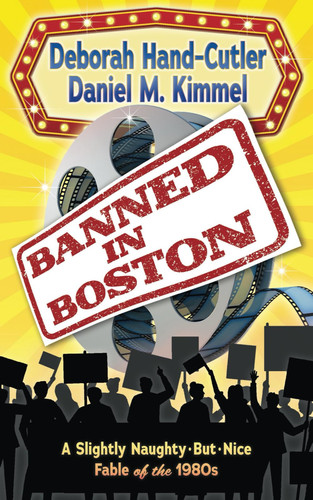
Banned in Boston A Slightly Naughty-But-nice Fable of The 1980s

Daniel Kimmel,Deborah Hand-Cutler
Ben Porter is an MBA student unsure what his future holds. Franklin Abbott is a Boston Brahman, wanting to use his "old money" to do some good for the city he loves. Margaret O'Leary is a widowed Irish matron from South Boston who is indignant about most everything except her numerous friends and relations. This unlikely trio heads up Decency and Morality Now! (which has the unfortunate acronym of D.A.M.N!) This antipornography organization has seen its funding dwindle with the advent of the VCR, as well as the city's indifference to the issue. They come up with a way to "fight fire with fire" in order to increase their revenue stream. It's foolproof - unless they get caught, that is. Revisit Boston in the 1980s, a time of relative innocence, in this "slightly naughty-but-nice" fable, in which "things are not always what they seem." You never know what might get "Banned in Boston."
Black Horse Press 2021-08-21 167 pages