

541 results for "Jewish History"

Jewish education and learning: published in honour of Dr. David Patterson on the occasion of his seventieth birthday
First published in 1994. This volume takes as its theme Jewish education and learning throughout the ages. The essays explore the nature and function of the 'Jewish Academies' in the broadest sense, the leading personalities associated with them and their social, cultural and moral effect on the Jewish communities of their day.

History and Torah
Book by Neusner, Jacob

Glory and agony: Isaac's sacrifice and national narrative
Glory and Agony is the first history of the shifting attitudes toward national sacrifice in Hebrew culture over the last century. Its point of departure is Zionism's obsessive preoccupation with its haunting "primal scene" of sacrifice, the near-sacrifice of Isaac, as evidenced in wide-ranging sources from the domains of literature, art, psychology, philosophy, and politics. By placing these sources in conversation with twentieth-century thinking on human sacrifice, violence, and martyrdom, this study draws a complex picture that provides multiple, sometimes contradictory insights into the genesis and gender of national sacrifice. Extending back over two millennia, this study unearths retellings of biblical and classical narratives of sacrifice, both enacted and aborted, voluntary and violent, male and female—Isaac, Ishmael, Jephthah's daughter, Iphigenia, Jesus. Glory and Agony traces the birth of national sacrifice out of the ruins of religious martyrdom, exposing the sacred underside of Western secularism in Israel as elsewhere.

Sephardi Religious Responses to Modernity
First Published in 1995. Throughout the nineteenth century the entire structure of the Ashkenazi world crumbled. What remains of Ashkenazi Jewry today is split into irreconcilable religious camps on the one hand, and a large body of secularized Jews of greater or lesser ethnicity on the other. The Sephardi and Oriental Jews, who form the other great branch of world Jewry, had a very different encounter with the forces of modernity. This book examines some of their responses to its challenges. The Sephardi religious leaders, who had been historically more open to general culture, reacted with neither the anti-traditionalism of Reform Judaism nor the Ashkenazi ultra-Orthodox 's uncompromising rejection of everything new. Their response was rather one of active and creative halakhic engagement coupled with a tolerant attitude toward the growing secularized elements of their communities. Much has been written on the social, economic, and political transformation of Sephardi and Oriental Jewry in the modem era. However, this is the first book in English devoted to the religious changes taking place in this important segment of Jewry which now constitutes the majority of Jews in the Jewish state.

Along the path: studies in Kabbalistic myth, symbolism, and Hermeneutics
This book explores the fundamental issues in Jewish mysticism and provides a taxonomy of the deep structures of thought that emerge from the texts.

Halakhic theology: a sourcebook
Laws, or Halakhah, and narratives, or Aggadah, comprise the Torah. Halakhah, normative law, makes the same statement in terms of behavior that Aggadah, in its systematic and abstract mode, makes in terms of beliefs. The Halakhic theology focuses on the interior existence of Israelite. In this sourcebook, author Jacob Neusner derives from details of legal expositions some of the Halakhah's theological propositions, in order to show how normative laws of conduct express the narrative monotheism of the Torah. An introductory overview of the Halakhic theological program, seen through topical expositions of law, briefly compares Halakhic texts with Aggadic theological programs.

Judaism in the matrix of Christianity

The renewal of Palestine in the Jewish imagination
"Beyond the immediate issues of politics and economics lie the larger and deeper realities of history and fidelity. As a Jew I am asking in these essays traditional religious questions in light of our present circumstances: What does it mean to be Jewish after the Holocaust and the consolidation of our empowerment in Israel/Palestine? Coming from a situation of oppression, what does it mean for Jewish history and theology to continue oppressing the Palestinian people? Has our empowerment in Israel brought us the freedom we so urgently needed, or has our abuse of power in Israel brought us a new enslavement and ghettoization which we did not seek, but now pursue almost blindly? Can we be healed of our trauma of Holocaust by finalizing the trauma of the Palestinian people which we as Jews have inflicted? At the lighting of the Shabbat candles, shall we bless our endeavor and thank God for making us into a warrior people?"--

Truth and compassion: essays on Judaism and religion in memory of Rabbi Dr. Solomon Frank
These essays represent a multidisciplinary approach to the study of religion and, especially, Judaism. Setting aside common scholarly concerns with source criticism and history of interpretation, Shimon Levy argues that in Numbers 11 the redactor has forged diverse elements into a unity. Observing that much of what is said about Second Commonwealth Judaic culture is speculative, Jack Lightstone calls for radical revision of accepted portrayals of the period. Ira Robinson's study of al-Kirkisani's effort to differentiate magic and miracle while demonstrating the rationality of belief in miracle locates his thoughts in the context of Rabbinic and Muslim treatments of the subject. While historians of modern Judaism have acknowledged in the influence of Kant and Hegel, Rousseau, contends Michel Despland, is often overlooked; he opened the way for changes in social and religious life. In Walter Benjamin's philosophy of history Charles Davis finds a significant combining of elements from Kabbalistic and Marxist thought. Michael Oppenheim finds a common core of concerns addressed by modern Jewish philosophers: a struggle with modernity, identification with Jewish thought and values, and commitment to their Jewish communities. Gershon Hundert's "Reflections on the 'Whig' Interpretation of Jewish History" argues--vis-à-vis the Jerusalem school of Zionist historians--that the responsibility of national historians to their community can be fulfilled only by repudiating ideologies that may stand in the way of the search for truth. Howard Joseph's survey of teh extensive literature on the Holocaust indicates the options the authors find most worthy of continued focus. Jerome Eckstein critically examines one of the few published pieces by Joseph Soloveitchik, who combines the Talmudic genius of the Lithuanian Yeshiva world with mastery of the Western intellectual tradition. B. Barry Levy's study of the Artscroll series of translations of and commentaries on biblical literature examines the assumptions and methodology of the series and the hidden agenda that emerges. Frederick Bird's comparison of charity ethics in Judaism and Christianity draws attention to the imprint on these ethics of the formative period of each religion. The volume will be of interest to student of the Bible, Judaism, and Christianity.

The Blackwell dictionary of Judaica
The Blackwell Dictionary of Judaica contains more than 7,000 concise entries and nearly half a million words on every aspect of Jewish history, civilization and religion. It will prove invaluable not only for students and teachers, but also for everyone who is interested in the fascinating richness of the Jewish tradition. In a single volume, the wealth of the Jewish heritage is uncovered in direct and simple words. This is a vital reference work for everyone who wishes to know about the development of Judaism from ancient times to the present day, and it deserves a place in every library and every Jewish home.

Aspects of Judaism: selected essays
Addressed to Jews and non-Jews alike, though aware that these two reader groups were likelyn to approach the book with very different presuppositions, Daiches sets out to define Judaism in relation to philosophy, to explain Kant's philosophy through the superiority of halakhah, defend a biblically based Jewish interpretation of history, and champion Judaism as a religion of freedom guaranteed by halakhah (Jewish law).

Warsaw. The Jewish Metropolis Essays in Honor of the 75th Birthday of Professor Antony Polonsky
Warsaw was once home to the largest and most diverse Jewish community in the world. It was a center of rich varieties of Orthodox Judaism, Jewish Socialism, Diaspora Nationalism, Zionism, and Polonization. This volume is the first to reflect on the entire history of the Warsaw Jewish community, from its inception in the late 18th century to its emergence as a Jewish metropolis within a few generations, to its destruction during the German occupation and tentative re-emergence in the postwar period. The highly original contributions collected here investigate Warsaw Jewry's religious and cultural life, press and publications, political life, and relations with the surrounding Polish society. This monumental volume is dedicated to Professor Antony Polonsky, chief historian of the new Warsaw Museum for the History of Polish Jews, on the occasion of his 75th birthday. This book is also available in hardcover.

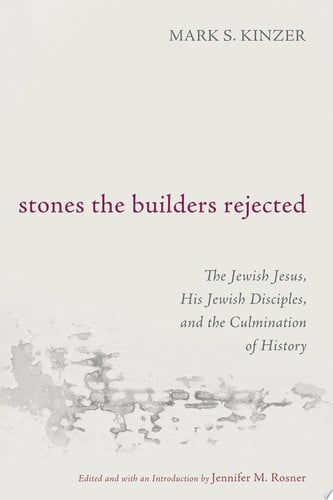
Stones the builders rejected: the Jewish Jesus, his Jewish disciples, and the culmination of history
"Since the groundbreaking publication of Postmissionary Messianic Judaism (2005), Mark Kinzer has challenged theologians and religious leaders to consider the essential ecumenical vocation of Jewish disciples of Jesus. Proposing a bilateral ecclesiology in solidarity with Israel, he argued that the overcoming of Christian supersessionism required a robust affirmation of the distinctive calling of Jews within the community of Jesus the Messiah. In this way, Kinzer's work put the issue of Jewish followers of Jesus on the theological agenda for those seeking a reparative reconfiguration of the relationship between the church and the Jewish people. In recent years, Kinzer has attended to the theological implications of this perspective and has widened his focus to include not only the Messianic Jewish movement but also Jews within Catholic, Orthodox, and Protestant churches. The present collection of essays reflects this wider concern. According to Kinzer, the theological stones of contention are Christology conceived of as Messianology, ecclesiology understood as Israelology, and eschatology imagined as Zionology. Moreover, it is the presence of Jewish disciples of Jesus that concretizes these theological abstractions in the form of Jewish flesh and blood, summoning Jews and Christians to rethink their relationship to one another in ways that express their essential mutual dependence." --
The Jewish Publication Society Of America Twenty-fifth Anniversary
This volume commemorates the twenty-fifth anniversary of the Jewish Publication Society of America, celebrated in Philadelphia on April 5th and 6th, 1913. It offers a glimpse into the society's early history and its role in promoting Jewish culture and literature in America. Founded in 1888, the Jewish Publication Society aimed to disseminate religious, historical, and scientific works in the English language. This anniversary publication provides insights into the organization's activities, including its publications, membership, and contributions to Jewish intellectual life in the United States. "The Jewish Publication Society Of America Twenty-fifth Anniversary" serves as a valuable historical record for scholars and anyone interested in the development of Jewish institutions in America. This work has been selected by scholars as being culturally important, and is part of the knowledge base of civilization as we know it. This work was reproduced from the original artifact, and remains as true to the original work as possible. Therefore, you will see the original copyright references, library stamps (as most of these works have been housed in our most important libraries around the world), and other notations in the work. This work is in the public domain in the United States of America, and possibly other nations. Within the United States, you may freely copy and distribute this work, as no entity (individual or corporate) has a copyright on the body of the work. As a reproduction of a historical artifact, this work may contain missing or blurred pages, poor pictures, errant marks, etc. Scholars believe, and we concur, that this work is important enough to be preserved, reproduced, and made generally available to the public. We appreciate your support of the preservation process, and thank you for being an important part of keeping this knowledge alive and relevant.

Jews of the American West
In a series of nine original essays, the editors and other leading American historians bring dramatically new perspectives to bear on our understanding of the West, its Jews, and other Americans, both old and new. Whether comparing the history of the Jews of the West with the Jewish experience in the older regions of the country or bringing attention to the uniquely local aspects of the western experience, the contributors to this landmark volume perceive the West as an increasingly important and vital presence in the nation's history. The agrarians of Utah's Clarion and the cureseekers of Denver, no less than the boomers of Tucson, have been representative Americans, Jews, and westerners. Essays on the role of intermarriage, the shared encounter of immigrants and migrants, and the response to the founding of the State of Israel by western pioneer families, tell us much about the interaction of the West with our American world nation.

Poverty and charity in the Jewish community of medieval Egypt
What was it like to be poor in the Middle Ages? In the past, the answer to this question came only from institutions and individuals who gave relief to the less fortunate. This book, by one of the top scholars in the field, is the first comprehensive book to study poverty in a premodern Jewish community--from the viewpoint of both the poor and those who provided for them. Mark Cohen mines the richest body of documents available on the matter: the papers of the Cairo Geniza. These documents, located in the Geniza, a hidden chamber for discarded papers situated in a medieval synagogue in Old Cairo, were preserved largely unharmed for more than nine centuries due to an ancient custom in Judaism that prohibited the destruction of pages of sacred writing. Based on these papers, the book provides abundant testimony about how one large and important medieval Jewish community dealt with the constant presence of poverty in its midst. Building on S. D. Goitein's Mediterranean Society and inspired also by research on poverty and charity in medieval and early modern Europe, it provides a clear window onto the daily lives of the poor. It also illuminates private charity, a subject that has long been elusive to the medieval historian. In addition, Cohen's work functions as a detailed case study of an important phenomenon in human history. Cohen concludes that the relatively narrow gap between the poor and rich, and the precariousness of wealth in general, combined to make charity "one of the major agglutinates of Jewish associational life" during the medieval period.

Conveying a Heritage A Messianic Jewish Guide to Home Practice
Throughout history the heritage of faith has been conveyed within the family and the congregation. In the New Covenant, the primary expression of spiritual life is the congregation, under godly elders, teaching, exhortation, and discipline. However, the first institution in the Bible is the family and only the family can raise children with an adequate appreciation of our faith and heritage. This guide exists to help families learn how to pass on the heritage of spiritual Messianic Jewish life. It is not an exhaustive or fully adequate guide, but is one that each family should complement with their own creativity.

Reform Judaism and Darwin: how engaging with evolutionary theory shaped American Jewish religion
Darwin provoked Jews as well as Christians, and this book examines leading nineteenth- and early twentieth-century American progressive Jewish thinkers who wrestled with evolutionary theories. In particular there was a widespread commitment to the application of biological evolutionary theory to history and cosmology, and a fascination with the evolution of ethical systems within human societies, bearing in mind mankind's bestial origins and new challenges for understanding religious traditions. It is argued that Reform Jewish discussions about the nature of God have been more profoundly shaped by engagement with evolutionary theory than has been recognized before and that, in fact, evolutionary thought provides the key conceptual framework for understanding the distinctive development of Reform Judaism in North America. --

About Hebrew Manuscripts
Delve into the fascinating world of ancient Jewish texts with this groundbreaking study from renowned scholar Elkan Nathan Adler. Drawing on his extensive knowledge of Hebrew language and culture, Adler offers insightful commentary on the significance and history of these rare and valuable documents. This work has been selected by scholars as being culturally important, and is part of the knowledge base of civilization as we know it. This work is in the "public domain in the United States of America, and possibly other nations. Within the United States, you may freely copy and distribute this work, as no entity (individual or corporate) has a copyright on the body of the work. Scholars believe, and we concur, that this work is important enough to be preserved, reproduced, and made generally available to the public. We appreciate your support of the preservation process, and thank you for being an important part of keeping this knowledge alive and relevant.
