549 results for "Public Policy"

Alternatives to Economic Globalization

John Cavanagh and Jerry Mander,Mander Jerry,Cavanagh John
The definitive document of the anti-corporate globalization movement-the consensus report of an alliance of leading activists, scholars, economists, researchers, and writers Offers a constructive, coherent, positive alternative to globalization-the very thing that the anti-corporate globalization movement is always accused of not putting forward The International Forum on Globalization consists of the leaders of over 60 organizations in 25 countries -including such prominent organizations as Friends of the Earth, the Third World Network, the Sierra Club, the Institute for Policy Studies, Public Citizen, Rainforest Action Network, and Food First Written by a premier group of 21 thinkers from around the world, the second edition of Alternatives to Economic Globalization lays out democratic, ecologically sound, socially just alternatives to corporate globalization more fully, specifically, and thoughtfully than has ever been done before. Focusing on constructive, achievable goals, the authors present ten governing principles for establishing truly sustainable societies and describe alternatives to the World Bank, the IMF, and the WTO that would better serve the needs of the planet. They offer detailed proposals for protecting vital goods and services from corporate exploitation, limiting corporate privileges and power, rebuilding economies to make them more responsive to human needs, and more. This revised and expanded edition features a new opening chapter on the global balance of power, a new section on the media and globalization, and a new final chapter on what ordinary citizens can do to fight the injustices of globalization. It also includes many new charts, sidebars, and other updated information.
ReadHowYouWant.com 2010-06 744 pages

Imperial Russia's Jewish question, 1855-1881

Klier, John Doyle
The reform era in Russia (1855-1881) witnessed the emancipation of the serfs, economic and social change, the reform of all imperial institutions, and the growth of national identity among Russians and the Empire's expanding Jewish population. Consequently, the 'Jewish Question' became one of most hotly debated topics in Russia. Attitudes toward the Jews which evolved during this period persisted up to the Revolution and beyond. This book, based on exhaustive archival research of materials published during the period, studies the interplay of public opinion and official policy. The author examines the attitudes of all sectors of Russian educated society towards the Jews. He also explores how a new group, the Russian Jewish intelligentsia, sought to define a modern Jewish identity in the midst of a multi-ethnic Empire.
Cambridge University Press 1995 534 pages

Social injustice and public health

Levy, Barry S.,Sidel, Victor W.
Public health professionals as well as students need to have a clear understanding of social injustice in order to address these problems, but relatively few books address the wide range of issues involved. This book will enable readers to understand social injustice and its underlying mechanisms, and as a result, will prepare them to recognize, document, investigate, and prevent social injustice and its effects on health. This book is organized so that health professionals, students in the health professions, and others will find it of practical value in public health and medical practice, research, education, policy development, and advocacy.
Oxford University Press 2006 529 pages

Lessons from deregulation: telecommunications and airlines after the crunch

Kahn, Alfred E.
Over the last several years, the value of stocks in both the airline and the telecommunications industries have dropped catastrophically. Since these industries were among the most important --and most visible --to have been unleashed from regulation in recent decades (albeit in widely differing degree), their difficulties have raised the question of whether their deregulation should be reconsidered or even reversed.Alfred E. Kahn, one of the foremost authorities on deregulation, argues in this book that every passing year demonstrates the superiority of the road chosen for the airlines. He contrasts the financial meltdowns of both the airline and telecommunications industries with others taking place at the same time, particularly in technology-related stocks and "dot.coms," pointing out that these sectors were also relatively free of direct economic regulation. Their experience provides a useful counter to the natural tendency to blame all the woes of aviation and telecommunications on government policy.This book provides a valuable and accessible guide to unraveling the complex world of network deregulation. It will serve as a reference point for practioners and policymakers, as well as an important introduction for the general public.
AEI-Brookings Joint Center for Regulatory Studies 2004 88 pages

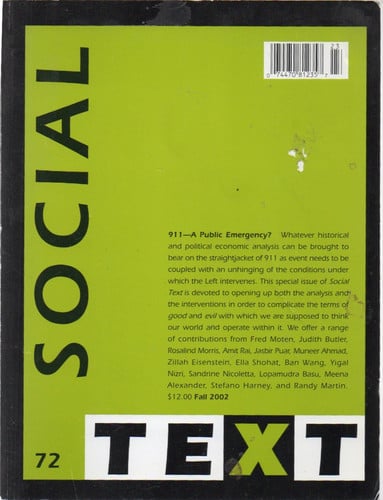
911 a Public Emergency?

Brent Hayes Edwards,Stefano Harney,Randy Martin,Ella Shohat,Timothy Mitchell,Fred Moten
Since September 11, public discourse has often been framed in terms of absolutes: an age of innocence gives way to a present under siege, while the United States and its allies face off against the Axis of Evil. This special issue of Social Text aims to move beyond these binaries toward thoughtful analysis. The editors argue that the challenge for the Left is to develop an antiterrorism stance that acknowledges the legacy of U.S. trade and foreign policy as well as the diversity of the Muslim faith and the dangers presented by fundamentalism of all kinds. Examining the strengths and shortcomings of area, race, and gender studies in the search for understanding, this issue considers cross-cultural feminism as a means of combating terrorism; racial profiling of Muslims in the context of other racist logics; and the homogenization of dissent. The issue includes poetry, photographic work, and an article by Judith Butler on the discursive space surrounding the attacks of September 11. This impressive range of contributions questions the meaning and implications of the events of September 11 and their aftermath. Contributors . Muneer Ahmad, Meena Alexander, Lopamudra Basu, Judith Butler, Zillah Eisenstein, Stefano Harney, Randy Martin, Rosalind C. Morris, Fred Moten, Sandrine Nicoletta, Yigal Nizri, Jasbir K. Puar, Amit S. Rai, Ella Shohat, Ban Wang
Duke University Press 2002-09-20 208 pages

Europe in crisis: bolt from the blue?

Berend, T. Iván
This book analyzes the European Great Recession of 2008-12, its economic and social causes, its historical roots, and the policies adopted by the European Union to find a way out of it. It contains explicit debates with several economists and analysts on some of the most controversial questions about the causes of the crisis and the policies applied by the European Union. It presents the cases of Iceland, Greece, and Ireland, the countries that first declined into crisis in Europe, each of them in a different way. Iceland is a case study for reckless banking practices, Greece of reckless public spending, and Ireland of reckless household indebtedness. At least seven other countries, mostly from the peripheries of Europe, had similarly reckless banking and spending practices. In the center of the book are the economic and social causes of the crisis. Contemporary advanced capitalism became financialized, de-industrialized and globalized and got rid of the "straitjacket" of regulations. Solid banking was replaced by high-risk, "casino-type" activity. The European common currency also had a structural problem - monetary unification without a federal state and fiscal unification. The other side of the same coin is European hyper-consumerism. A new lifestyle emerged during two super-prosperous periods in the 1950s to 1960s, and during the 1990s to 2006. Trying to find an exit policy, the European Union turned to strict austerity measures to curb the budget deficit and indebtedness. This book critically analyzes the debate around austerity policy. The creation of important supranational institutions, and of a financial supervisory authority and stability mechanisms, strengthens integration. The correction of the euro's structural mistake by creating a quasi-fiscal unification is even more important. The introduction of mandatory fiscal rules and their supervision promises a long-term solution for a well-functioning common currency. These measures, meanwhile, create a two-tier European Union with a fast-track core. This book suggests that the European Union will emerge stronger from the crisis. This book will be of particular interest to students and researchers of economics, history, political science and international finance, but will also prove profitable reading for practitioners and the interested public. Book jacket.
Routledge 2013 169 pages

Whither the child? causes and consequences of low fertility

Eric P. Kaufmann,William Bradford Wilcox
Birth rates are falling and fertility rates are well below replacement levels. At the same time, the economic crisis has forced governments to scale back public spending, reduce child support, and raise the retirement age, causing immense social conflict. Taking a step outside the disciplinary comfort zone, Whither the Child? asks how demography affects individuals and society. What does it feel like to live in a low fertility world? What are the consequences? Is there even a problem - economically, culturally and morally? No other book confronts so many dimensions of the low fertility issue and none engage with the thorny issues of child psychology, parenting, family, and social policy that are tackled head-on here.
Paradigm Publishers 2013 253 pages

Catalytic Diplomacy Russia, China, North Korea and Iran

Jeremy J. Stone
"Having known and observed Jeremy for almost half a century, I have no doubt that his influence has been as great as that of all but the most senior figures in government. In his second book ... Jeremy continues the recounting of his life's work, which he began in his early volume, Every Man Should Try: Adventures of a Public Interest Activist. ... Jeremy has devoted his life to conflict resolution and to ending the nuclear arms race. He has, at the same time, gotten involved constructively in a surprising range of interesting issues involving human rights and foreign policy. ...The conflicts that Jeremy sought to mitigate in the second work-US-Russian nuclear relations, China's relation with Taiwan, North Korea's relations with its neighbors, and U.S.-Iranian relations-have all been affected for the better by Jeremy's efforts. ...Readers less familiar with international diplomacy may be surprised and perhaps even incredulous that a private citizen can have such an impact on the thinking and behavior of governments." -From the preface by Morton H. Halperin, Director of the Policy Planning Staff, Department of State (1998-2001)
CreateSpace Independent Publishing Platform 2010-01-04 424 pages

Communists in closets: queering the history 1930s-1990s

Aptheker, Bettina
"Communists in Closets: Queering the History 1930s-1990s explores the history of gay, lesbian and non-heterosexual people in the Communist Party in the United States The Communist Party banned LGBT people from membership beginning in 1938 when it cast them off as "degenerates." It persisted in this policy until 1991 when the Party split apart in the wake of the collapse of the Soviet Union and the socialist countries of Eastern Europe. During this 60- year ban, gays and lesbians who did join the Communist Party were deeply closeted within it, as well as in their public lives as both queer and Communist. By the late 1930s the Communist Party had a membership approaching 100,000 and tens of thousands of more people moved in its orbit through the Popular Front against fascism, anti-racist organizing, especially in the south, and its widely read cultural magazine, The New Masses. Based on a decade of archival research, correspondence, and interviews, Bettina Aptheker explores this history, also pulling from her own experience as a closeted lesbian in the Communist Party in the 1960s and 70s. Ironically, and in spite of this homophobia individual Communists laid some of the political and theoretical foundations for lesbian and gay liberation, and contributed significantly to peace, social justice, civil rights, Black and Latinx liberation movements. This book will be of interest to students, scholars, and general readers in political history, gender studies and the history of sexuality"--
Routledge Taylor & Francis Group 2023 255 pages

Israel and the American national interest: a critical examination

Rubenberg, Cheryl A.
"Israel's special relationship with the united States has come under close public scrutiny in recent months following revelations about Israeli involvement in the Iran-Contra and Jonathan Pollard spy scandals. Cheryl Rubenberg's controversial new book traces the evolution of that relationship from the Truman through the Reagan administrations and challenges the widely held view that close ties between Tel Aviv and Washington have served U. S. interests well in the Middle East. Indeed, she makes a convincing case that, in the two decades since 1967, U.S. policymakers have tended to confuse what is best for Israel with what is best for the United States and to ignore what she regards as the most pressing problem in the Middle East, the quest for a Palestinian homeland." -- Douglas Little, International History Review
University of Illinois Press 1986 446 pages

Reinventing Education Entrepreneurship in America's Public Schools

Louis V. Gerstner
Entrepreneurship in schools means bypassing elephantine bureaucracies to focus on the place where the educational product is actually delivered: the school. In Boston a school offers evening classes to students who have to work days: one in Georgia intimately involves parents in their children's classwork: in the Bronx a dedicated principal has to keep his innovations a secret from the central board of education. We see how schools can make themselves part of the computer revolution, how they can free themselves of the tyranny of the traditional school year, how educators can be held responsible for their failures and be properly rewarded for their successes. Above all, we see proof positive of how hope can be born where none now seems to exist, how learning can take place where there is now an educational wasteland, how the children who are our nation's future can gain the tools that make that future strong and bright.
Dutton 1995 288 pages

Eternal guilt? forty years of German-Jewish-Israeli relations

Wolffsohn, Michael
Should the Germans of today continue to atone for the sins of their forebears? "Eternal Guilt" argues persuasively that Germans, Israelis and American Jews cling to their historical legacy in order to manipulate contemporary political ends. In their social interactions since 1950, Germans, Jews, and Israelis have largely abandoned the "us versus them" worldview fostered by the Holocaust. At the personal level, members of these groups increasingly deal with one another as individuals living in the present. Germans and Israelis are increasingly willing to visit each other's countries; Diaspora Jews are reluctant to settle in Israel; intermarriage is prevalent among Jews and majority populations everywhere. Nonetheless, at the official level images and memories of the past prevail; the past remains important not as intrinsically instructive but as pragmatically useful in manipulating political aims. Wolffsohn demonstrates that this gap between "routine policy" among individuals and "historical policy" among nations results in continuing misunderstandings and ongoing disputes. Wolffsohn argues that if the continuing spiral of inflammatory rhetoric and political manoeuvering is ever to end, official positions must catch up to popular behaviour. His epilogue analyzes the implications of reunification for the relations among these groups. --
Columbia University Press 1993 225 pages

Locating the proper authorities: the interaction of domestic and international institutions

Daniel W. Drezner
In an era of democratization and globalization, the number of decision makers has multiplied exponentially. Parliamentarians, bureaucrats, international secretariats, regional governors, and nongovernmental organizations have all gained influence at the expense of heads of state. How do these competing layers of authority bargain with each other to govern? International relations theorists have traditionally focused on how leaders' domestic constraints affect their bargaining position internationally. However, there has been much less work on the flip side of this question--how foreign policy leaders can use international institutions as a means of circumventing or co-opting domestic opposition. Locating the Proper Authorities offers some preliminary answers, drawn from a number of theoretical perspectives by the contributors to this volume. Written by some of the most promising theorists in the field of international relations, the essays in Locating the Proper Authorities address a broad array of substantive issue areas, including humanitarian intervention, trade dispute settlement, economic development, democratic transition, and security cooperation. This broad case selection has the virtue of incorporating developing countries, which are too often ignored in international relations, as well as less well-known international organizations. Each chapter examines the mechanisms and strategies through which policy entrepreneurs use international organizations as a means of bypassing or overcoming opposition to policy change. By examining the effects of different institutional design features, Locating the Proper Authorities helps us understand the variety of influence mechanisms through which international institutions shape the interaction of policy initiators and ratifiers. Daniel W. Drezner is Assistant Professor of Political Science, University of Chicago.
The University of Michigan Press 2003 280 pages

Threats of pain and ruin

Dalrymple, Theodore
What is written without pain, said Doctor Johnson, is rarely read with pleasure. Rarely perhaps, but not, I hope, never: for the little essays in this book were written, I must confess, without much angst. In part this was because, in writing them, I had no thesis to prove, no axe to grind, except that the world is both infinitely interesting and amusing, and provides us with an inexhaustible source of material for philosophical reflection. Many of the subjects treated of in this book were found by serendipity or came to me in flashes - it would be immodest to call them of inspiration - of previously unsuspected connection and interest. I can only hope that they entertain the reader as they have entertained me. At least they will do no harm, in compliance with the first principle of medical ethics. - Theodore Dalrymple
New English Review Press 2014 225 pages

Cause and Meaning in the Social Sciences

Ernest Gellner
This volume focuses on key conceptual issues in the social sciences, such as Winch's idea of a social science, structuralism, Malinowski and Evans-Pritchard, and the concept of kinship. In particular it deals with such problems as the relationship of nature and culture, the relevance of concepts drawn from within a given society to its understanding, and the relation of theory to time.
Routledge 2006-02-28 240 pages

Urban change in the United States and Western Europe: comparative analysis and policy

Summers, Anita A.
In this completely revised second edition, the authors explore what can be learned from a rigorous comparison of the patterns of urban concentrations of residents and employment in Western Europe and the United States. Using a wide range of methodological techniques, including economic theory, econometrics, regional science, and institutional historical analysis, the essays analyze the factors underlying urban economic development, with particular emphasis on the role and effectiveness of public policy.
Urban Institute Press 1999-08-15 621 pages