911 results for "History"

Why history matters: life and thought

Lerner, Gerda
All human beings are practicing historians," writes Gerda Lerner. "We live our lives; we tell our stories. It is as natural as breathing." It is as important as breathing, too. History shapes our self-definition and our relationship to community; it locates us in time and place and helps to give meaning to our lives. History can be the vital thread that holds a nation together, as demonstrated most strikingly in the case of Jewish history. Conversely, for women, who have lived in a world in which they apparently had no history, its absence can be devastating. In Why History Matters, Lerner brings together her thinking and research of the last sixteen years, combining personal reminiscences with innovative theory that illuminate the importance of history and the vital role women have played in it.Why History Matters contains some of the most significant thinking and writing on history that Lerner has done in her entire career--a summation of her life and work. The chapters are divided into three sections, each widely different from the others, each revelatory of Lerner as a woman and a feminist. We read first of Lerner's coming to consciousness as a Jewish woman. There are moving accounts of her early life as a refugee in America, her return to Austria fifty years after fleeing the Nazis (to discover a nation remarkable both for the absence of Jews and for the anti-Semitism just below the surface), her slow assimilation into American life, and her decision to be a historian. If the first section is personal, the second focuses on more professional concerns. Included here is a fascinating essay on nonviolent resistance, tracing the idea from the Quakers (such as Mary Dyer), to abolitionists such as Theodore Dwight Weld (the "most mobbed man" in America), to Thoreau's essay Civil Disobedience, then across the sea to Tolstoy and Gandhi, before finally returning to America during the civil rights movement of the 1950s. There are insightful essays on "American Values" and on the tremendous advances women have made in the twentieth century, as well as Lerner's presidential address to the Organization of American Historians, which outlines the contributions of women to the field of history and the growing importance of women as a subject of history. The highlight of the final section of the book is Lerner's bold and innovative look at the issues of class and race as they relate to women, an essay that distills her thinking on these difficult subjects and offers a coherent conceptual framework that will prove of lasting interest to historians and intellectuals.A major figure in women's studies and long-term activist for women's issues, a founding member of NOW and a past president of the Organization of American Historians, Gerda Lerner is a pioneer in the field of Women's History and one of its leading practitioners. Why History Matters is the summation of the work and thinking of this distinguished historian.
Oxford University Press 1997 249 pages

Einstein, history, and other passions

Holton, Gerald James
Gerald Holton uses the life and work of our century's greatest scientist to warn against today's gathering Romantic rebellion, one in which science is blamed for all our social ills, and in which reason is being replaced by New Age 'ways of knowing.' Through his rich exploration of Einstein's thought, the author shows how the best science depends on great intuitive leaps of imagination, and how science is indeed the creative expression of the traditions of Western civilization. Wide-ranging and forceful, this book is a must reading for anyone interested in the place of science in our world.
AIP Press 1995 312 pages

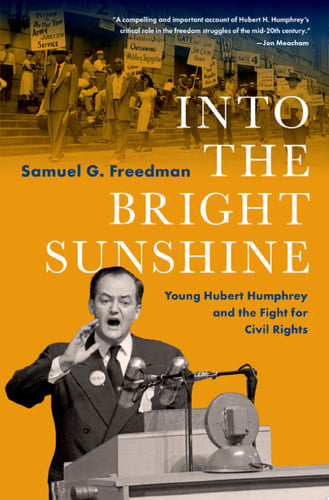
Into the bright sunshine: young Hubert Humphrey and the fight for civil rights

Freedman, Samuel G.
"Hubert Humphrey, a fallen hero and a dying man, rose on rickety legs to approach the podium of the Philadelphia Convention Hall, his pulpit for the commencement address at the University of Pennsylvania. He clutched a sheaf of paper with his speech for the occasion, typed and double-spaced by an assistant from his extemporaneous dictation, and then marked up in pencil by Humphrey himself. A note on the first page, circled to draw particular attention, read simply, "30 years ago--Here." In this place, at that time, twenty-nine years earlier to be precise, he had made history. From the dais now, Humphrey beheld five thousand impending graduates, an ebony sea of gowns and mortarboards, broken by one iconoclast in a homemade crown, two in ribboned bonnets, and another whose headgear bore the masking-tape message HI MA PA. In the horseshoe curve of the arena's double balcony loomed eight thousand parents and siblings, children, and friends. Wearing shirtsleeves and cotton shifts amid the stale heat, they looked like pale confetti from where Humphrey stood, and their flash cameras flickered away, a constellation of pinpricks"--
Oxford University Press 2023 488 pages

Judith S. Kaye in her own words: reflections on life and the law, with selected judicial opinions and articles

Kaye, Judith S.
An autobiography and selected writings by the former Chief Judge of New York’s highest court, the Court of Appeals. In 1983, Judith S. Kaye (1938–2016) became the first woman appointed to the Court of Appeals, New York’s highest court. Ten years later, she became the first woman to be appointed chief judge of the court, and by the time she retired, in 2008, she was the longest-serving chief judge in the court’s history. During her long career, she distinguished herself as a lawyer, jurist, reformer, mentor, and colleague, as well as a wife and mother. Bringing together Kaye’s own autobiography, completed shortly before her death, as well as selected judicial opinions, articles, and speeches, Judith S. Kaye in Her Own Words makes clear why she left such an enduring mark upon the court, the nation, and all who knew her. The first section of the book, Kaye’s memoir, focuses primarily on her years on the Court of Appeals, the inner workings of the court, and the challenges she faced, as chief judge, in managing a court system populated by hundreds of judges and thousands of employees. The second section, a carefully chosen selection of her written opinions (and occasional dissents), reveals how she guided the law in New York State for almost a quarter century with uncommon vision and humanity. Her decisions cover every facet of New York and federal law and have often been quoted and followed nationally. The final section of the book includes selections from her numerous articles and speeches, which cover the field, from common law jurisprudence to commercial law to constitutional analysis, all with an eye to the future and, above all, how the law can best affect the everyday lives of people who come to court—willingly or unwillingly—including, not least, those most in need of the law. BACK FLAP “Judith Kaye was one of the most admired judges in the nation—and a wonderful, real, often funny person as well. This collection captures the full range of the judge and the woman, and it serves as a great reminder of her enduring legacy.” — Jeffrey Toobin “An extraordinary woman, jurist, and leader who had a striking impact on the law and the administration of justice in New York State and beyond. This collection is more than a simple record of a remarkable life. It is a treasure—not only for those of us who knew and admired Judith but for all who may seek to understand and appreciate the profound impact she had on the law, the legal profession, and the administration of justice.” — from the Foreword by Honorable Janet DiFiore
Excelsior Editions, an imprint of State University of New York Press 2019-01-01 484 pages

The journey home

Antler, Joyce
In recent decades, prominent American Jewish women like Bella Abzug and Betty Friedan have made headlines and history, challenging the constraints facing women in American public life. Few realize that these women embody a hundred-year legacy of remarkable activism. From suffrage to birth control, from trade unionism to higher education, from civil rights to feminism to every aspect of popular culture, Jewish women have been in the vanguard, leading key social movements.
Schocken 1998 410 pages

Chaim Weizmann

Reinharz, Jehuda
In the pantheon of modern Jewish leaders, Chaim Weizmann is a giant. One of the founding fathers of the State of Israel and its first president, he was also a president of the World Zionist Organization, and an eminent chemist, for whom Israel's renowned Weizmann Institute of Science was named. Yet, until now, there has never been an authoritative biography of Weizmann that removed the layers of myth obscuring our image of the man. Both a personal portrait of a fascinating man and a far-reaching history of the Jews in the modern world, this book, written by one of America's leading authorities on Jewish history, delves into the factors that shaped Weizmann's personality and worldview. Though the book focuses on the making of Weizmann as a Zionist leader, it also lays the foundations for understanding his extraordinary achievements as a scientist. This volume, the first of two that will cover his entire career, ends when, at the age of 40, Weizmann is thrust onto the center stage of world politics as a major negotiator for the Balfour Declaration.
Oxford University Press 1985 566 pages

Two roads home: Hitler, Stalin, and the miraculous survival of my family

Finkelstein, Daniel
"An epic and beautifully written World War II family history that spans Europe, telling of two happy families uprooted by war, their incredible suffering in Hitler's and Stalin's camps, and the near-miraculous survival and rescue of the author's parents who met after the war. Daniel Finkelstein's grandfather Alfred Wiener was a German Jewish intellectual leader who tolled an early warning of the impending Holocaust and became an archivist of Nazi crimes. He relocated his family to safety in Amsterdam, where they became close with Anne Frank's family. But they were eventually separated, and Daniel's mother Mirjam was sent to Bergen-Belsen with her mother and sisters while Alfred worked feverishly to free them. Finkelstein's father, Ludwik, grew up in a prosperous Jewish family in Poland where his father was a patriotic hero of the Great War. But when Stalin took control, Finkelstein's grandfather was deported to Siberia, while Ludwik and his mother were sent to Kazahkstan, where they barely survived freezing winters and harrowing forced labor conditions. Love and Murder is a page-turning account of ingenuity, bravery and the almost unbelievable coincidences that brought Daniel's parents together. The story features secret archives, forgery and theft, and sweeps across Europe to show the expanse of the war. Moving, engrossing and inspiring, Love and Murder will profoundly touch all who read it"--
Doubleday 2023 374 pages

The art of diplomacy: strengthening the Canada-U.S. relationship in times of uncertainty

Heyman, Bruce,Heyman, Vicki
A personal and insightful call to action and a much-needed book about one of the most important bilateral relationships in the world—the relationship between Canada and the US—and why diplomacy matters now more than ever before. All over the world, diplomacy is under threat. Diplomats used to handle sensitive international negotiations, but increasingly, incendiary Tweets and bombastic public statements are posing a threat to foreign relations. In The Art of Diplomacy , the former US ambassador to Canada, Bruce Heyman, and his partner, Vicki Heyman, spell out why diplomacy and diplomats matter, especially in today’s turbulent times. This dynamic power couple arrived in Canada intent on representing American interests, but they quickly learned that to do so meant representing the shared interests of all citizens—no matter what side of the 49th parallel they happened to live on. Bruce and Vicki narrate their three years in Canada spent journeying across the country and meeting Canadians from all walks of life—including Supreme Court justices, prime ministers, fishermen, farmers, artists, and entrepreneurs. They tell the behind-the-scenes stories of how their team helped bring Obama to Canada and Trudeau to the US. They also reveal the importance of creating cultural and artistic exchange between Canada and the US, of promoting economic and trade interests, and overall, of making a lasting positive impact on one of the most important relationships in the free world today. This politically poignant and heartfelt memoir is a call to action, a reminder that only by working together to protect our shared values—the environment, social justice and human rights—can nations build a better world for all. As their long-time friend and colleague President Obama once said, “The world needs more Canada.” At this key moment in history, when opposing nationalist and populist agendas threaten to divide us, The Art of Diplomacy reminds us to keep calm, to work together and to carry on.
Simon & Schuster 2019-04-30 267 pages

Freud in his time and ours

Roudinesco, Elisabeth
Élisabeth Roudinesco offers a bold and modern reinterpretation of the iconic founder of psychoanalysis. Based on new archival sources, this is Freud's biography for the twenty-first century--a critical appraisal, at once sympathetic and impartial, of a genius greatly admired and yet greatly misunderstood in his own time and in ours. Roudinesco traces Freuds life from his upbringing as the eldest of eight siblings in a prosperous Jewish-Austrian household to his final days in London, a refugee of the Nazis' annexation of his homeland. She recreates the milieu of fin de siecle Vienna in the waning days of the Habsburg Empire--an era of extraordinary artistic innovation, given luster by such luminaries as Gustav Klimt, Stefan Zweig, and Gustav Mahler. In the midst of it all, at the modest residence of Berggasse 19, Freud pursued his clinical investigation of nervous disorders, blazing a path into the unplumbed recesses of human consciousness and desire. Yet this revolutionary who was overthrowing cherished notions of human rationality and sexuality was, in his politics and personal habits, in many ways conservative, Roudinesco shows. In his chauvinistic attitudes toward women, and in his stubborn refusal to acknowledge the growing threat of Hitler until it was nearly too late, even the analytically-minded Freud had his blind spots. Alert to his intellectual complexity--the numerous tensions in his character and thought that remained unresolved--Roudinesco ultimately views Freud less as a scientific thinker than as the master interpreter of civilization and culture.
Harvard University Press 2016-11-07 580 pages

The investigator: fifty years of uncovering the truth

Lenzner, Terry F.
The Los Angeles Times once called investigative lawyer Terry Lenzner “one of the most powerful and dreaded private investigators in the world.” In his fifty-year career, Lenzner has worked with politicians, celebrities, governments, and corporations worldwide; with a steadfast commitment to the truth, he has uncovered facts that have shaped policy and influenced major legal battles. In this captivating memoir, Lenzner speaks about his varied career and high-profile cases for the first time. At the Justice Department in 1964, he investigated the murder of three civil rights workers—an infamous event that inspired the film Mississippi Burning . He led the national Legal Services Program for the poor, prosecuted organized crime in New York, defended peace activist Philip Berrigan, and represented CIA operative Sid Gottlieb. As a counsel to the Senate Watergate Committee, Lenzner investigated Nixon’s dirty tricks and followed the money trail that led to the Watergate burglary and cover-up. He was the first person to deliver a congressional subpoena to a sitting U.S. president. He uncovered cost overruns of the Alaska oil pipeline, helped identify the Unabomber, investigated the circumstances of Princess Diana’s death, and cleared Hugo Chavez of false corruption charges. Lenzner also worked with President Clinton’s defense team during the impeachment hearings. The Investigator is a riveting personal account: Lenzner astounds with anecdotes of scandal and intrigue, offers lessons in investigative methods, and provides an eye-opening look behind some of the most talked-about media stories and world events of our time.
Blue Rider Press, a member of Penguin Group (USA) 2013 371 pages

Herzl: Theodor Herzl and the foundation of the Jewish State

Avineri, Shlomo
Theodor Herzl was born in 1860 in Budapest. He developed a successful career in journalism. As the Paris correspondent for Neue Freie Presse, Herzl followed the Dreyfus Affair, a notorious anti-Semitic incident in France in which a French Jewish army captain was falsely convicted of spying for Germany. Herzl came to reject his early ideas regarding Jewish emancipation and assimilation, and to believe that the Jews must remove themselves from Europe and create their own state. In 1896, he published 'Der Judenstaat' to immediate acclaim, attracting international attention. As a result, he met Kaiser Wilhelm II on several occasions, once in Jerusalem, attempted and failed to obtain support for a Jewish homeland from Pope Pius X, secured an offer from the British government to facilitate a large Jewish settlement in East Africa, and visited St Petersburg to confront the Russian threat to the Zionist movement. Herzl died suddenly in 1904, over 40 years before the creation of a Jewish state in Israel.
Phoenix 2014 274 pages

Ruby of Cochin

Daniel, Ruby
"Ruby of Cochin" is the first book written by a Jewish woman from Cochin. It is a rich description of Jewish life on the Southwest Coast of India, spanning many centuries. It is the story of one woman - yet it is also the story of all the Jews of Cochin, from the earliest settlements, when the Maharajah granted the Jews their land and privileged status, until today, when a transplanted Cochin community is finding new life in Israel. The book is written with a distinctive storyteller's voice and contains historical legends, ghost tales, colorful renditions of Jewish celebrations in Cochin, and translations of Jewish women's songs from Malayalam, the language of the Cochin Jews." -- Google books.
Jewish Publication Society 2001-09 211 pages

Laboratory for world destruction: Germans and Jews in Central Europe

Wistrich, Robert S.
The Austro-Hungarian Empire was rife with ethnic tensions that undermined the possibilities for Jewish assimilation in Central Europe. The Jews were trapped between rising German nationalism and other nationalisms. Discusses various Jewish and non-Jewish attitudes toward the "Jewish problem", whereby Jews were often stereotyped (e.g. by Rosa Luxemburg) or were considered to need a solution separate from that of European majority peoples (e.g. Nathan Birnbaum and Max Nordau). Views Nietzsche as belonging more to the philosemites than the antisemites, for whom he had great scorn; however, his complexity and obscurity provided ammunition for antisemites, including the Nazis. Herzl believed that a Jewish state was needed to provide a home for Jews suffering from antisemitism. Freud's experience of antisemitism, combined with his negative view of human nature, left no room for illusions about Austrian and German acceptance of Jews. Karl Kraus exhibited elements of Jewish self-hatred when he identified the worst elements of contemporary journalism and capitalism with Jews. Karl Lueger used political antisemitism to become mayor of Vienna. He provided a model for Hitler, who imbibed antisemitic attitudes and stereotypes from the cauldron of nationalisms that was Austria-Hungary.
Published by University of Nebraska Press for the Vidal Sassoon International Center for the Study of Antisemitism (SICSA), the Hebrew University of Jerusalem 2007 404 pages

The great book of Detroit sports lists

Stone, Mike
Sports talk in America has evolved from small-time barroom banter into a major media smorgasbord that runs 24/7 on TV and radio. With hundreds of billions of dollars generated annually by pro and college teams in major markets nationwide, sports fans across the country are more dedicated than ever to their teams. And when it comes to sports talk—especially all-sports radio—it's all about entertainment, information, prognostication, analysis, rankings, and endless discussion. Prominent sports-media figures in each of the three target cities—Cleveland, Detroit, and Washington, D.C.—engage in this phenomenon with a compilation of sports lists sure to delight as well as stir up debate within these already-buzzing sports communities. List topics include: • What were the most lopsided trades in local sports history? • Who were the most overrated athletes to play in our town? • What local athlete had the best appearance in TV or film? • What was the most heartbreaking loss in local sports history? • What was the greatest single play in local sports history? • Who are our team's most hated rivals? • Plus dozens of “guest” lists contributed by famous local sports and entertainment celebrities. Not only does Detroit host major pro sports teams—the Lions (NFL), the Red Wings (NHL), the Tigers (MLB), and the Pistons (NBA)—the area also includes prominent college sports programs such as the University of Michigan. Detroit's fans are some of the most educated and fanatical in the country, thanks to the work of long-time commentators Mike Stone and Art Regner.
Running Press Book Publishers 2008-10-14 324 pages

Not Prince Hamlet: literary and theatrical memoirs

Meyer, Michael Leverson
Michael Meyer's translations of Strindberg and Ibsen have often been described as definitive, as have his biographies of both writers. His Strindberg translations made him the first Englishman to receive the Gold Medal of the Swedish Academy, and his life of Ibsen won the Whitbread Biography prize. He has now turned his attention to his own life and his friendships with some of this century's most famous literary and theatrical names.
Secker & Warburg 1989 291 pages

Ahmad's war, Ahmad's peace

Goldfarb, Michael
Award-winning broadcast journalist and public radio correspondent Michael Goldfarb has written the most stirring narrative to emerge from the Second Gulf War. It travels to the frontlines of battle and into the hearts of two men from different cultures whose intimate friendship and mutual passion for freedom can inspire us all. Ahmad's War, Ahmad's Peace is the author's tribute to Ahmad Shawkat, the Iraqi Kurd who served as Goldfarb's translator during "Major Combat Operations." Under an oppressive regime, Ahmad worked to promote freedom of expression. Goldfarb recounts his powerful yet all-too-brief relationship with Ahmad and introduces readers to the life of a true hero. Eighteen years old when the Ba'ath Party seized control in Iraq, Ahmad intimately and poetically describes his imprisonment and torture twice by Saddam Hussein's regime. Ahmad was banished from his hometown of Mosul for his political writings, and just as he began to taste freedom with the fall of Saddam and his large family's return home, Ahmad was murdered for publicly decrying Islamic terror in newspaper editorials that he began to publish. Ahmad's story of one heroic man will forever change our perception of what all Iraqis have suffered and continue to endure.
Carroll & Graf 2006 354 pages