621 results for "History"

Warrior nation: a history of the Red Lake Ojibwe

Treuer, Anton
The Red Lake Nation has a unique and deeply important history. Unlike every other reservation in Minnesota, Red Lake holds its land in common -- and, consequently, the tribe retains its entire reservation land base. The people of Red Lake developed the first modern indigenous democratic governance system in the United States, decades before any other tribe, but they also maintained their system of hereditary chiefs. The tribe never surrendered to state jurisdiction over crimes committed on its reservation. The reservation is also home to the highest number of Ojibwe-speaking people in the state. Warrior Nation covers four centuries of the Red Lake Nation's forceful and assertive tenure on its land. Ojibwe historian and linguist Anton Treuer conducted oral histories with elders across the Red Lake reservation, learning the stories carried by the people. And the Red Lake band has, for the first time, made available its archival collections, including the personal papers of Peter Graves, the brilliant political strategist and tribal leader of the first half of the twentieth century, which tell a startling story about the negotiations over reservation boundaries.
Minnesota Historical Society Press 2015 447 pages

Conservative at the Core: a new history of American conservatism

Lichtman, Allan J.
"Allan J. Lichtman investigates the foundations and history of conservative thought to identify and reveal the central crisis that lies at the heart of conservative principles and today's politics. He explores a century of American conservative politics to demonstrate that professed conservative principles-free enterprise, limited government, fiscal responsibility, states' rights, law and order, personal morality, and American sovereignty-are dispensable notions for public appeal only. Instead, conservatives have only consistently advanced their version of traditional Christian values and support for private (not free) enterprise. Lichtman provides a sweeping history of the American conservative movement from the end of World War I to the present day. He draws on leaders like Calvin Coolidge, Herbert Hoover, Richard Nixon, Ronald Reagan, George W. Bush, Donald J. Trump, and the conservative Democrats responsible for Jim Crow discrimination in the South. Contrary to those who have described Trump as a deviation from professed core principles, Conservative at the Core ultimately argues that Trump and his allies represents the culmination of the American conservative tradition, consistently upholding and fulfilling conservative nationalist values"-- Provided by publisher.
University of Notre Dame Press 2025-09 364 pages

Year of fire, year of ash: the Soweto revolt

Hirson, Baruch
'We can say without fear of being contradicted by history, that June 16, 1976 heralded the beginning of the end of the centuries-old white rule in this country.' Nelson Mandela Originally banned on publication by the apartheid government, Year of Fire, Year of Ash is an eye-opening account of how, in June 1976, 20,000 school students faced down the tanks and guns of a vicious racist regime, in a revolt that galvanized the black working-class and became a pivotal turning point for the anti-apartheid movement. More than this, the book overturns much of the conventional logic that served to explain the event at the time, showing it was not simply a student protest, but part of a wider uprising. Released in this new edition to mark the fortieth anniversary, Year of Fire, Year of Ash provides an unparalleled insight into the origins and events of the uprising, from its antecedents in the 1920s to its role in inspiring global solidarity against apartheid. As South Africa experiences a new wave of popular discontent, and as new forms of black consciousness come to the fore in movements around the world, Baruch Hirson's book provides a timely reminder of the Soweto revolt's continued significance to struggles against oppression today.
Zed Books 2016-08-15 350 pages

Race, class and power: Harold Wolpe and the radical critique of apartheid

Friedman, Steven
Over four decades ago, radical scholars began to suggest a new way of looking at South African society - one that blamed the economic power of those who owned property for the racial bondage of the black majority. Their work, and the debates it triggered, are mostly forgotten, but they and their critics have much to say that sheds lights on today's South African realities. Harold Wolpe was arguably the most influential theorist of this generation. His writings played a major role in a revolution in thought, and his celebrated escape from prison in the 1960s made him a symbol of alternative action. Race, Class and Power clearly and insightfully examines Wolpe's work in the political, intellectual, and social contexts in which it was developed and to which it gave form. Drawing on interviews with those who Wolpe worked with, disagreed with, and inspired, the book also maps his influence on ideas and the culture that emerged in anti-apartheid circles in the 1970s. Harold Wolpe's writings are a prism through which South African society can be viewed, and this book is an intellectual biography both of Wolpe and of South Africa's left. It also assesses and engages with the ongoing impact of Wolpe's ideas into the post-apartheid present. Moreover, it suggests how Wolpe's work can move us towards a way of thinking about and acting upon South Africa's realities differently.
University of KwaZulu-Natal Press 2015 368 pages

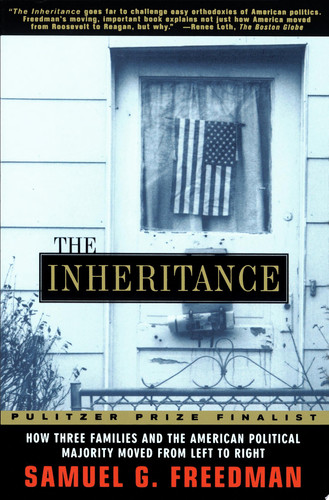
The inheritance: how three families and America moved from Roosevelt to Reagan and beyond

Freedman, Samuel G.
Orphan in the new world (Silvio Burigo) -- Liverpool on the Hudson (Lizzie Sanford Garrett) -- The dreamer and his son (Joseph Obrycki) -- The sewing room (Lizzie Garrett) -- The physics of cynicism (Joseph Obrycki) -- Worth two (Silvio Burigo) -- Voices from downstairs (Richie Garrett) -- Recessive genes (Silvio Burigo/Lorraine and Frank Trotta) -- Address as destiny (Vilma and Jack Maeby) -- Fence and basement (Silvio Burigo/Lorraine and Frank Trotta) -- Senator Clearwater (Richie Garrett) -- Uncle Paulie's Porch (Frank Trotta Jr.) -- The State Street Gang (Leslie Maeby) -- Poor snob (Tim Carey) -- Enchantment and its opposite (Frank Trotta Jr.) -- Incumbent protection (Leslie Maeby) -- Red suspenders (Tim Carey).
Simon & Schuster 1996 464 pages

Yankel's tavern: Jews, liquor, and life in the Kingdom of Poland

Dynner, Glenn
In nineteenth-century Eastern Europe, the Jewish-run tavern was often the center of leisure, hospitality, business, and even religious festivities. This unusual situation came about because the nobles who owned taverns throughout the formerly Polish lands believed that only Jews were sober enough to run taverns profitably, a belief so ingrained as to endure even the rise of Hasidisms robust drinking culture. As liquor became the regions boom industry, Jewish tavernkeepers became integral to both local economies and local social life, presiding over Christian celebrations and dispensing advice, medical remedies and loans. Nevertheless, reformers and government officials, blaming Jewish tavernkeepers for epidemic peasant drunkenness, sought to drive Jews out of the liquor trade. Their efforts were particularly intense and sustained in the Kingdom of Poland, a semi-autonomous province of the Russian empire that was often treated as a laboratory for social and political change. Historians have assumed that this spelled the end of the Polish Jewish liquor trade. However, newly discovered archival sources demonstrate that many nobles helped their Jewish tavernkeepers evade fees, bans and expulsions by installing Christians as fronts for their taverns. The resulta vast underground Jewish liquor tradereflects an impressive level of local Polish-Jewish co-existence that contrasts with the more familiar story of anti-Semitism and violence. By tapping into sources that reveal the lives of everyday Jews and Christians in the Kingdom of Poland, Yankels Tavern transforms our understanding of the region during the tumultuous period of Polish uprisings and Jewish mystical revival.
Oxford University Press 2014 249 pages

Fascist in the family: the tragedy of John Beckett M.P.

Beckett, Francis
John Beckett was a rising political star. Elected as Labour's youngest M.P. in 1924, he was constantly in the news and tipped for greatness. But ten years later he was propaganda chief for Mosley's fascists, and one of Britain's three best known anti-Semites. Yet his mother, whom he loved, was a Jew. Her ancestors were Solomons, Isaacs and Jacobsons, originally from Prussia. He successfully hid his Jewish ancestry all his life - he said his mother's family were "fisher folk from the east coast." His son, the author of this book, acclaimed political biographer and journalist Francis Beckett, did not discover the truth until John Beckett had been dead for years. He left Mosley and founded the National Socialist League with William Joyce, later Lord Haw Haw, and spent the war years in prison, considered a danger to the war effort. For the rest of his life, and all of Francis Beckett's childhood, John Beckett and his family were closely watched by the security services. Their devious machinations, traced in records only recently released, damaged chiefly his young family. This is a fascinating and brutally honest account of a troubled man in turbulent times.
Routledge, an imprint of the Taylor & Francis Group 2017 388 pages

Peasant-citizen and slave: the foundations of Athenian democracy

Wood, Ellen Meiksins
"The controversial thesis at the center of this study is that, despite the importance of slavery in Athenian society, the most distinctive characteristic of Athenian democracy was the unprecedented prominence it gave to free labor. Wood argues that the emergence of the peasant as citizen, juridically and politically independent, accounts for much that is remarkable in Athenian political institutions and culture. From a survey of historical writings of the eighteenth and nineteenth centuries, the focus of which distorted later debates, Wood goes on to take issue with influential arguments, such as those of G.E.M. de Ste Croix, about the importance of slavery in agricultural production. The social, political and cultural influence of the peasant-citizen is explored in a way which questions some of the most cherished conventions of Marxist and non-Marxist historiography" --Page 4 of cover
Verso 2015-11-03 210 pages

Class ideology and ancient political theory: Socrates, Plato, and Aristotle in social context

Wood, Ellen Meiksins
The political thought of Socrates, Plato and Aristotle defended and justified the values and way of life of the declining and decaying landed aristocracy in opposition to Athenian democracy and the craftsmen, traders and labourers upon which it increasingly rested. Although the Socratics recognized and condemned aristocratic regeneration, they hoped that the outlook and conduct of the nobility could be revitalized so as once more to become the foundation of civic life in order to stem the levelling tide of democracy, the tyranny of the mob, and the vulgarity that they felt were endangering Greece and especially Athens. To be understood and appreciated fully, the classics of political theory must be viewed as basically ideological and much more closely and rigorously related to their social contexts than has usually been the case. The point of departure for this critique of the Socratics is a particular conception of the Greek polis and its significance for Western social organization, an interpretation differing from most standard treatments. Besides casting new light upon the political thought of the Socratics, this study should help to illuminate the aristocratic myth about the character of the demos which, immortalized by the Socratics, has been a cornerstone of anti-democratic ideology and social theory in the West ever since the ancient philosophers first recorded their fears of the 'mob'.
Oxford University Press 1978 275 pages

As night falls: eighteenth century Ottoman cities after dark

Wishnitzer, Avner
"In a world that is constantly awake, illuminated and exposed, there is much to gain from looking into the darkness of times past. This fascinating and vivid picture of nocturnal life in Middle Eastern cities shows that the night in the eighteenth-century Ottoman Empire created unique conditions for economic, criminal, political, devotional and leisurely pursuits that were hardly possible during the day. Offering the possibility of livelihood and brotherhood, pleasure and refuge; the darkness allowed confiding, hiding and conspiring - activities which had far-reaching consequences on Ottoman state and society in the early modern period. Instead of dismissing the night as merely a dark corridor between days, As Night Falls demonstrates how fundamental these nocturnal hours have been in shaping the major social, cultural and political processes in the early modern Middle East"--
Cambridge University Press 2021 376 pages

Democracies and tyrannies of the Caribbean

Krehm, William
William Krehm was a correspondent for Time magazine in the 1940s and during this period he wrote a day-by-day account of what he saw and learned on this assignment. The countries he covered included El Salvador, Guatemala, Costa Rica, Venezuela, Panama, Honduras, the Dominican Republic and Haiti. Very little of what he wrote ever appeared in Time, due to the unwillingness of the magazine's editors at the time to offend the large corporations which had investments in the region, but Krehm's research eventually became a book that vividly describes the tyrannical and corrupt forces that controlled most of the Central American countries, with American support. At the time, no U.S. publisher was willing to issue such a controversial book, but it was translated into Spanish and widely distributed throughout Central and South America. Now it is being published for the first time in English, and it will prove invaluable to those who are closely following historical developments in that very volatile part of the world. Gregorio Selser, the well-known Mexican journalist, introduces each chapter with notes bringing the history of the countries covered up to date and tracing the changes that have taken place. An essential background work.
Lawrence Hill & Co 1984 244 pages

Left out: the politics of exclusion : essays, 1964-2002

Duberman, Martin B.
"One would be hard-pressed to name a more admirable contemporary American example of the intellectual engage than Martin Duberman. Historian, playwright, memoirist, biographer, social commentator, teacher, activist and assured podium performer, Duberman is an unapologetic, uncategorizable and nonsectarian radical whose constant questioning of conventional wisdoms - even on the left - has made him one of this country's pre-eminent participants in the political and cultural wars that have riven public life."â__In These Times"A marvelous collection of a lifetime of courageous writing by a deeply moral and reflective man who has engaged the greatest struggles of our times with an unflinching nerve, a wise heart and a brilliant intellect informed at all times by compassion."â__Jonathan KozolThe lives of â__outsidersâ__ have been the focus of Martin Duberman's work as a public intellectual for the past four decades. Best known for his biography of Paul Robeson, Duberman highlights the "banding together" of the excluded in Left Out. These identity-based movementsâ__black power, gay liberation, feminismâ__have created a vital and controversial change in American consciousness in recent decades. Duberman's collected essays trace this evolution of thought to the history of dissent from abolitionism through the New Left to today's organizing.Presenting summations of Duberman's views on such matters as race, foreign policy, gender and sexuality, Left Out offers incisive analyses of the split between class-based and identity-based politics on the Left. The "godfather" of the gay studies movement, Duberman has taken many brave and prescient stands. His writing shows why he is considered a deeply moral and wise man. For the first time available in paperback, this edition, updated through 2002, includes three new essays: "The State of Gay Studies," "Queer Economic Justice," and "Jewish Radicals, Effeminacy, and the Rise of Gay Chauvinism".
South End Press 2002 504 pages