580 results for "World History"

From Suburb to Shtetl The Jews of Boro Park

Egon Mayer,William B. Helmreich
"From Suburb to Shtetl" is an outstanding ethnography that moves beyond simple demographics. Mayer weaves an intricate tapestry of how family, school, and community leaders influence each other. Whether discussing the role of the rebbe or the matchmaker, those who know these communities will find what he says as relevant today as it was when first penned. This is hardly surprising, for the ultra-Orthodox community takes great pride in not changing, in maintaining itself as it was in Europe despite the allure of modern American society. His discussion of synagogue life is particularly informative and evocative. Those in charge of helping immigrants adopted the path of least resistance, allowing and even encouraging them to retain their identities except for those few aspects that might threaten the country's national interests. The American Orthodox community was tremendously augmented by the arrival from Europe, after World War Two, of thousands of Orthodox Jews who remained devoted to that way of life. Egon Mayer was himself part of a smaller, but significant group of Jews who came to the U.S. and settled mostly in Boro Park in the wake of the 1956 Hungarian Revolution. The interaction between the Hasidim and their less fervent Orthodox counterparts described and analyzed in this volume tells us a great deal about how people negotiate their beliefs, values, and norms when forced into close contact with each other in an urban setting within the larger American culture. By exploring these and many other related issues Mayer has given us the chance to assess and forecast the future of American Jewish life as a whole.
Taylor & Francis Group 2017-10-12 214 pages

Inside the Nixon administration: the secret diary of Arthur Burns, 1969-1974

Burns, Arthur F.
As chairman of the Federal Reserve Board in the seventies, Arthur Burns had a unique view of the Nixon administration. Burns first joined the Nixon administration as an advisor in 1969 and was privy to the dynamics of the president's coterie over the course of six tumultuous years. Now the recently released secret diary of this top-level economist offers a surprisingly candid inside look at Richard Nixon's fall. The diary tracks Burns's growing awareness of Nixon's behind-the-scenes maneuverings and worrisome behavior (such as "insane shouting") and reveals how such things undermined his respect and enthusiasm for the president. Perhaps even more telling, Burns's evaluations of his colleagues provide piercing insights into the president's inner circle, including Henry Kissinger ("a brilliant political analyst, but admittedly ignorant of economics"), George Schultz ("a no less confused amateur economist"), John Connally ("a thoroughly confused politician"), and the "vulgarians" H. R. Haldeman and John Ehrlichman-the only people he thought Nixon felt relaxed around. The Burns diary also offers rare and telling glimpses into the era's economy--particularly an account of how Nixon exerted political pressure to shape monetary policies that helped to fuel the stagflation of the 1970s. The administration sought to close the so-called gold window, an approximate valuation of dollars with gold bullion, by floating the dollar, and the consensus over many years has been that Nixon himself arranged this-speculation now confirmed by Burns's diary. It also underscores the growing pressure Burns felt to serve the needs of Nixon's reelection bid rather than the economic welfare of the nation. Sequestered for decades and unavailable until 2008, this document reveals an honest and relatively apolitical man surrounded by partisans in top administrative positions who were dishonest, inept-or both. "The President has many shortcomings," wrote Burns. "He has few convictions, but now and then he gets into a euphoric mood where he wants to persuade himself that he's a statesman. But his sycophantic advisers cannot even recognize that." Deftly annotated by distinguished historian Robert Ferrell, who provides effective historical context and perspective, the Burns diary is a potent-and poignant-testament to the Machiavellian and often Byzantine world of American presidential politics.
University Press of Kansas 2010-10-28 140 pages

Carrier Clash

Eric Hammel
CARRIER CLASH The Invasion of Guadalcanal & the Battle of the Eastern Solomons August 1942 Eric Hammel The Battle of the Eastern Solomons was history's third carrier clash. A collision of U.S. Navy and Imperial Navy carriers in the wake of the invasion of Guadalcanal-whose airfield the United States desperately needed and the Japanese desperately wanted back-the battle was waged at sea and over Guadalcanal's besieged Marine-held Lunga Perimeter on August 24, 1942. Based upon the first half of Eric Hammel's acclaimed 1987 battle narrative, Guadalcanal: The Carrier Battles, and in large part upon important new information obtained from both Japanese and American sources, Carrier Clash unravels many of the mysteries and misconceptions that have veiled this complex battle for more than a half century. Beginning with detailed descriptions of the history of the aircraft carrier, the development of carrier-air tactics, the training of carrier pilots, and numerous operational considerations that defined the way carrier battles had to be fought, Carrier Clash takes the reader into the air with brave U.S. Navy fighter pilots as they protect their ships and the Guadalcanal invasion fleet against determined Japanese air attacks on August 7 and 8, 1942. After he sets the stage for the August 24 Battle of the Eastern Solomons, author Hammel puts the reader right into the cockpits of U.S. Navy Dauntless dive-bombers as they dive on the Imperial Navy light carrier Ryujo-and hit the ship with 500-pound bombs! Once again, in this strange tit-for-tat battle, U.S. Navy Wildcat fighter pilots must defend their ships against an onslaught by Imperial Navy Val dive-bomber pilots determined to sink the U.S. carriers, or die trying. Hammel's coverage of the bomb damage to the USS Enterprise and subsequent fire-fighting and rescue efforts by her crew are especially compelling. Carrier Clash is the definitive combat history of the Battle of the Eastern Solomons, history's third battle (of only five) between American and Japanese aircraft carriers. Critical Acclaim for Carrier Clash: The Invasion of Guadalcanal and the Battle of the Eastern Solomons, August 1942: The Bookwatch says: Carrier Clash takes the reader into the air with brave U.S. Navy pilots . . . [It] is an important contribution to the military history of World war II's battle for control of the Pacific. The Book World says: Carrier Clash is a stark revelation of a complex encounter. Military Magazine says: Mr. Hammel presents the entire battle in a clear, easy-to-follow manner while interjecting interesting views of the [Battle of the Eastern Solomons] as seen by the participants on both sides. Military Review says: The book is loaded with great charts (maps), order of battle, and other hard to find details. Although Hammel describes the land and surface ship battles, his forte is his vivid descriptions of the aerial dogfights during the [Guadalcanal] invasion and the Battle of the Eastern Solomons. Canadian Military History says: Eric Hammel continues his tradition of exciting, well crafted books on the Pacific War with this account of the carrier battles that accompanied the American landings on Guadalcanal. . . . There is no denying that this is a cracking good read and an excellent companion to Hammel's other books on the Guadalcanal Campaign. Sea Power says: Acclaimed military historian Eric Hammel presents a landmark history of the Battle of the Eastern Solomons . . . Drawing on newly declassified information from U.S. and Japanese sources, and on numerous other archival sources, Hammel brings a fresh perspective to the outcome of the war as a whole. . . . [He] describes with precision and insight the key events in the Guadalcanal/Eastern Solomons campaigns, the strategic implications of the battle, and the impact on the overall battle plans of both adversaries.
Pacifica Military History 2009-06 394 pages

Conservative at the Core: a new history of American conservatism

Lichtman, Allan J.
"Allan J. Lichtman investigates the foundations and history of conservative thought to identify and reveal the central crisis that lies at the heart of conservative principles and today's politics. He explores a century of American conservative politics to demonstrate that professed conservative principles-free enterprise, limited government, fiscal responsibility, states' rights, law and order, personal morality, and American sovereignty-are dispensable notions for public appeal only. Instead, conservatives have only consistently advanced their version of traditional Christian values and support for private (not free) enterprise. Lichtman provides a sweeping history of the American conservative movement from the end of World War I to the present day. He draws on leaders like Calvin Coolidge, Herbert Hoover, Richard Nixon, Ronald Reagan, George W. Bush, Donald J. Trump, and the conservative Democrats responsible for Jim Crow discrimination in the South. Contrary to those who have described Trump as a deviation from professed core principles, Conservative at the Core ultimately argues that Trump and his allies represents the culmination of the American conservative tradition, consistently upholding and fulfilling conservative nationalist values"-- Provided by publisher.
University of Notre Dame Press 2025-09 364 pages

Racism, dissent, and Asian Americans from 1850 to the present: a documentary history

Foner,PhilipSheldon,1910-1994,Rosenberg,Daniel,1953-
Drawing from a broad range of articles, speeches, short stories, pamphlets, sermons, debates, laws, public statements, Supreme Court decisions and conventions, this documentary history demonstrates the persistence of a humanist, if not an anti-racist, pulse in American society in the face of discriminatory government policy and prevalent anti-Asian ideology and treatment. Focusing on support for the rights of Japanese and Chinese immigrants and their descendants, the book traces a 130-year period, culminating with the governmental redress for survivors of the Japanese evacuation and internment during WWII. Foner and Rosenberg highlight expressions from the clergy, the labor movement, the abolitionists, and public figures such as Wendell Phillips, Charles Sumner, Frederick Douglass, Mark Twain, John Stuart Mill, Norman Thomas and Carey McWilliams. It includes material never before published showing Black support for Asian rights and demonstrates the consistency of the Industrial Worker of the World's solidarity with Chinese and Japanese-American workers. It is also the first work to give serious treatment to clergymen's efforts against anti-Asian discrimination. After the introduction, Foner discusses law and dissent. The next four sections are devoted to statements by public figures, the views of the clergy, the labor movement and African-Americans. The final section covers relocation and protest. The book provides a valuable contribution to the debates on American dissent in general and against racism in particular, the meaning of American nationality, the criminality of the evacuation and internment of Japanese-Americans during World War II and the immigration policies of the United States government.
Greenwood Press 1993-04-30 311 pages

A life with history

Blum, John Morton
The author of such classic works as The Republican Roosevelt, V Was for Victory, and Years of Discord, John Morton Blum is one of a small group of intellectuals who for more than a quarter of a century dominated the writing of American political history. Writing now of his own career, Blum provides a behind-the-scenes look at Ivy League education and political power from the 1940s to the 1980s. Blum insightfully recounts a long and distinguished journey that began at Phillips Academy, where he first realized he could make a career of teaching and writing history. He tells how young men were socialized to the values of the Northeastern establishment in those years before World War II, and how as a non-practicing Jew he learned to overcome bigotry both at Andover and at Harvard, which then had no Jewish professors. In 1957 Blum joined the faculty of Yale University's history department, widely regarded as the nation's best, where he became both influential and popular and where his students included one future U.S. president as well as others who aspired to the office. He reveals much about the inner workings of Ivy League education and tells of controversies over the Vietnam War and the Black Panthers, his role in Eugene McCarthy's presidential campaign, and how he searched for common ground between reactionary faculty and radical students. More than a recounting of a singular life, Blum's story explains how political history was researched and written during the second half of the twentieth century, describing how the discipline evolved, gained ascendancy, and was challenged as historical fashions changed. It also offers revealing glimpses of such prominent academics as Kingman Brewster, Arthur Schlesinger, Jr., C. Vann Woodward, and William Sloan Coffin. Over a distinguished career, Blum witnessed considerable change in elite educational institutions, where minorities and women were grossly underrepresented when he first entered academia. In a memoir brimming with insight and laced with humor, he looks back at the academy—"not a refuge from reality but an alternative reality"—as he reflects upon his intellectual journey and his contributions to the study and writing of twentieth-century American history.
University Press of Kansas 2004 283 pages

And you shall know us by the trail of our vinyl: the Jewish past as told by the records we have loved and lost

Bennett, Roger
What started out as a mutual affinity for kitschy Jewish album covers-think Neil Diamond baring his chest hair on the cover of "Hot August Night "or Barbra Streisand in hot pants on the cover of "Streisand Superman"-soon became a quest for identity, history, and culture between the grooves of LPs. Together, Roger Bennett and Josh Kun embarked on a thrilling journey, scouring the world to collect thousands of vinyl LPs from attics, garage sales, and dusty archives. Pieced together, these scratched, once-loved and now-forgotten audio gems tell a vibrant tale: the story of Jews in America. "And You Shall Know Us by the Trail of Our Vinyl" spans the history of Jewish recorded music from the 1940s to the 1980s, weaving an account that begins with sacred songs and ends with the holy trinity of Neil, Barbra, and Barry. The LPs found here are also a love letter to forgotten moments in Jewish American pop history, celebrating well-dressed cantors singing Christmas tunes, Long Island suburbanites dancing the mambo, and Chassidic prog-rockers. The music, much of which is no longer available in any format, is brought to life through commentary from writers Aimee Bender, Etgar Keret, Michael Wex, and Shalom Auslander; performers Sandra Bernhard and Motown legend Lamont Dozier; music critics Oliver Wang and Anne Powers; and TV pioneer Norman Lear. A gateway to a forgotten kingdom of sound, the good, the bad, and the ugly of Jewish vinyl gives this aspect of Jewish culture the attention it so richly deserves.
Crown Publishers 2008 217 pages

The Jews' secret fleet

Greenfield, Murray S.
This is the dramatic story of the rescue of Jews from Europe after World War II by North American Jewish volunteers who smashed through the British blockade and brought thousands of refugees to safe haven in Palestine through the illegal Aliyah Bet. Film director Alan Rosenthal was inspired by this book to create his documentary film Waves of Freedom, released in 2008. Packed with photos, and enhanced by the eminent historian Sir Martin Gilbert's introduction, this meticulously researched book is the definitive word on a little-known chapter of Jewish history. ABOUT THE AUTHOR: Murray S. Greenfield was one of the volunteer sailors in the Aliyah Bet operations. He has served as executive director of the Association of Americans and Canadians in Israel (AACI) and as volunteer director of the American Association for Ethiopian Jewry (AAEJ). He lives in Israel with his wife Hana.
Gefen 2010 190 pages

The Betrayal of the American Right (Large Print Edition)

Murray Rothbard
LARGE PRINT EDITION! More at LargePrintLiberty.com This remarkable piece of history will change the way you look at American politics. It shows that the corruption of American "conservatism" began long before George W. Bush ballooned the budget and asserted dictatorial rights over the country and the world. The American Right long ago slid into the abyss.Betrayal of the American Right is the full story, and the author is none other than Murray N. Rothbard, who witnessed it all first hand. He tells his own story and reveals that machinations behind the subversion of an anti-state movement into one that cheers statism of the worst sort.The book was written in the mid-1970s and is only now published for the first time. Each time a prospective publisher promised to go ahead, the deal fell through. Even so, it has been privately circulated for the 30 years since it was written - and everyone lucky enough to own a copy of the manuscript knew he had a treasure.People who have read it swear that it is the best account ever how the old right was subverted to become a propaganda branch of the state, not just recently but fifty years ago. So Rothbard's account is not only a critical historical document; it also has explosive explanatory power.
CreateSpace Independent Publishing Platform 2007 256 pages

All in a Life-time

Morgenthau, Henry,Strother, French
"All in a Life-time" offers a rare and compelling glimpse into the world of early 20th-century diplomacy and United States foreign relations. Written by Henry Morgenthau and French Strother, this political memoir chronicles a distinguished career in public service. As a key figure during World War I, Morgenthau provides firsthand accounts and insightful observations on critical historical events. His experiences as an ambassador offer a unique perspective on the complexities of international relations and the challenges of representing the United States on the world stage. This meticulously prepared print republication allows readers to delve into the past and gain a deeper understanding of the historical context that shaped the 20th century. "All in a Life-time" remains a vital resource for anyone interested in biography, United States history, and the intricacies of public policy. Its enduring appeal lies in its timeless exploration of leadership, diplomacy, and the pursuit of a life dedicated to service. This work has been selected by scholars as being culturally important, and is part of the knowledge base of civilization as we know it. This work is in the public domain in the United States of America, and possibly other nations. Within the United States, you may freely copy and distribute this work, as no entity (individual or corporate) has a copyright on the body of the work. Scholars believe, and we concur, that this work is important enough to be preserved, reproduced, and made generally available to the public. We appreciate your support of the preservation process, and thank you for being an important part of keeping this knowledge alive and relevant.
Anson Street Press 2025-03-29 324 pages

The forest: a fable of America in the 1830s

Nemerov, Alexander
"Set amid the glimmering lakes and disappearing forests of the United States in the 1830s, The Forest: A Fable of America in the 1830s imagines how individuals at the time experienced their lives. Part truth, part fiction, this book follows painters, poets, enslaved individuals, farmers, and artisans through various settings. Some, such as Nathaniel Hawthorne, Nat Turner, Thomas Cole, and Edgar Allan Poe, are well-known; others are not. All are creators of private and grand designs, and makers of the worlds they inhabited. The Forest unfolds in brief stories. Each is an episode revealing a lost world of intricate relations: human beings going their own ways or crossing paths, in a place that is known to history, or is remote and unknown. For Alex Nemerov, the forest is a description of American society, as he writes, "the dense and discontinuous woods of nation, the foliating thoughts of different people, each with their separate life to lead." Nemerov's art history is at its center an experiment in writing, in how to write differently about visual culture. The Forest examines the history of the United States on a human scale, displaying the patterns of life alongside examples of paintings, prints, photographs and objects"--
Princeton University Press 2023 277 pages

The flight of the intellectuals

Berman, Paul
Twenty years ago, Ayatollah Khomeini called for the assassination of Salman Rushdie--and writers around the world instinctively rallied to Rushdie's defense. Today, according to writer Paul Berman, "Rushdie has metastasized into an entire social class"--an ever-growing group of sharp-tongued critics of Islamist extremism, especially critics from Muslim backgrounds, who survive only because of pseudonyms and police protection. And yet, instead of being applauded, the Rushdies of today (people like Ayan Hirsi Ali and Ibn Warraq) often find themselves dismissed as "strident" or as no better than fundamentalist themselves, and contrasted unfavorably with representatives of the Islamist movement who falsely claim to be "moderates." How did this happen? In THE FLIGHT OF THE INTELLECTUALS, Berman--"one of America's leading public intellectuals" ( Foreign Affairs )--conducts a searing examination into the intellectual atmosphere of the moment and shows how some of the West's best thinkers and journalists have fumbled badly in their efforts to grapple with Islamist ideas and violence. Berman's investigation of the history and nature of the Islamist movement includes some surprising revelations. In examining Hassan al-Banna, the founder of the Muslim Brotherhood, he shows the rise of an immense and often violent worldview, elements of which survives today in the brigades of al-Qaeda and Hamas. Berman also unearths the shocking story of al-Banna's associate, the Grand Mufti of Jerusalem, who collaborated personally with Adolf Hitler to incite Arab support of the Nazis' North African campaign. Echoes of the Grand Mufti's Nazified Islam can be heard among the followers of al-Banna even today. In a gripping and stylish narrative Berman also shows the legacy of these political traditions, most importantly by focusing on a single philosopher, who happens to be Hassan al-Banna's grandson, Oxford professor Tariq Ramadan--a figure widely celebrated in the West as a "moderate" despite his troubling ties to the Islamist movement. Looking closely into what Ramadan has actually written and said, Berman contrasts the reality of Ramadan with his image in the press. In doing so, THE FLIGHT OF THE INTELLECTUALS sheds light on a number of modern issues--on the massively reinvigorated anti-Semitism of our own time, on a newly fashionable turn against women's rights, and on the difficulties we have in discussing terrorism--and presents a stunning commentary about the modern media's peculiar inability to detect and analyze some of the most dangerous ideas in contemporary society.
Melville House 2010 299 pages

One Man's America A Journalist's Search for the Heart of His Country

Henry Grunwald,Henry Anatole Grunwald
A wise, witty, and humane autobiography filled with a passionate curiosity about the people--and meaning--of America. "One Man's America is at once a stirring account of a young immigrant becoming an American, a personal history of the major milestones of the late twentieth century, a fascinating insider's view of the most widely read news magazine in the world, and a warm and loving family saga. Here also is the remarkable success story of a boy driven from his native Vienna by the Nazis and returning years later as an ambassador; of a copy boy who rose to become editor of "Time magazine. During his long and distinguished career in journalism, Grunwald knew, befriended, and feuded with some of the greatest figures on the world stage, from Whitaker Chambers and Marilyn Monroe to John F. Kennedy and Henry Kissinger to Ronald Reagan and Fidel Castro. But the immense power his position allowed him was tempered by a fierce desire to know everything he could about the mores and folkways of the whole United States, Main Street bankers and student radicals alike, through whom he sought to understand the heart of his adopted country. "One Man's America is, above all, a hymn to the ever-turbulent, ever-changing land of America.
Knopf Doubleday Publishing Group 1998 672 pages

On the front lines of the Cold War: an American correspondent's journal from the Chinese Civil War to the Cuban Missile Crisis and Vietnam

Topping, Seymour
In the years following World War II, the United States suffered its most severe military and diplomatic reverses in Asia while Mao Zedong laid the foundation for the emergence of China as a major economic and military world power. As a correspondent for the International News Service, the Associated Press, and later for the New York Times, Seymour Topping documented on the ground the tumultuous events during the Chinese Civil War, the French Indochina War, and the American retreat from Vietnam, Cambodia, and Laos. In this riveting narrative, Topping chronicles his extraordinary experiences covering the East-West struggle in Asia and Eastern Europe from 1946 into the 1980s, taking us beyond conventional historical accounts to provide a fresh, first-hand perspective on American triumphs and defeats during the Cold War era. At the close of World War II, Topping—who had served as an infantry officer in the Pacific—reported for the International News Service from Beijing and Mao’s Yenan stronghold before joining the Associated Press in Nanking, Chiang Kai-shek’s capital. He covered the Chinese Civil War for the next three years, often interviewing Nationalist and Communist commanders in combat zones. Crossing Nationalist lines, Topping was captured by Communist guerrillas and tramped for days over battlefields to reach the People’s Liberation Army as it advanced on Nanking. The sole correspondent on the battlefield during the decisive Battle of the Huai-Hai, which sealed Mao’s victory, Topping later scored a world-wide exclusive as the first journalist to report the fall of the capital. In 1950, Topping opened the Associated Press bureau in Saigon, becoming the first American correspondent in Vietnam. In 1951, John F. Kennedy, then a young congressman on a fact-finding visit to Saigon, sought out Topping for a briefing. Assignments in London and West Berlin followed, then Moscow and Hong Kong for the New York Times. During those years Topping reported on the Chinese intervention in the Korean conflict, Mao’s Cultural Revolution and its preceding internal power struggle, the Chinese leader’s monumental ideological split with Nikita Khrushchev, the French Indochina War, America’s Vietnam War, and the genocides in Cambodia and Indonesia. He stood in the Kremlin with a vodka-tilting Khrushchev on the night the Cuban missile crisis ended and interviewed Fidel Castro in Havana on its aftermath. Throughout this captivating chronicle, Topping also relates the story of his marriage to Audrey Ronning, a world-renowned photojournalist and writer and daughter of the Canadian ambassador to China. As the couple traveled from post to post reporting on some of the biggest stories of the century in Asia and Eastern Europe, they raised five daughters. In an epilogue, Topping cites lessons to be learned from the Asia wars which could serve as useful guides for American policymakers in dealing with present-day conflicts in Afghanistan and Iraq. From China to Indochina, Burma to Korea and beyond, Topping did more than report the news; he became involved in international diplomacy, enabling him to gain extraordinary insights. In On the Front Lines of the Cold War, Topping shares these insights, providing an invaluable eyewitness account of some of the pivotal moments in modern history.
Louisiana State University Press 2010-03-15 435 pages

Socialism from Below

Hal Draper
The divisions running through the history of the socialist movement between reformists and revolutionaries, authoritarians and democrats, putschists and gradualists-the divisions and disputes which have provided the categories in terms of which the history of the movement has been written-are secondary. The important distinction is between those socialists who looked for some outside authority which would hand down salvation to the grateful masses from above and those who saw the key to the reform of existing society in the struggle from below for self-emancipation. Behind the question: "What do we mean by socialism?" lies a more important question. What do we mean by democracy?
Center for Socialist History 2002 386 pages

Islands of hell: the U.S. Marines in the Western Pacific, 1944-1945

Hammel, Eric M.
By the summer of 1944 the tide had turned in the Pacific War against the Japanese. The war was not nearly over, however, and the U.S. Marines had their heaviest combat in front of them. Here for the first time is a detailed photographic history for the Fighting Leathernecks' fierce combat for the Marianas, Peleliu, Iwo Jima, and Okinawa. Illustrated with hundreds of never-before-published photographs and supplemented with full-color maps, Islands of Hell is a historical and visual treat.
Zenith 2010-03-01 284 pages

Haunted in the New World: Jewish American culture from Cahan to The Goldbergs

Weber, Donald
Discusses Jewish identity in America as reflected in the culture of immigrants and descendants of immigrants. Self-hatred or, at least, ambivalence about oneself in the face of native American values is one theme. Ch. 5 (pp. 98-125), "To Make 'a Jew': Projecting Antisemitism in Post-War America", analyzes two novels - Arthur Miller's "Focus" and Saul Bellow's "The Victim" - that explore the psychosocial dimensions of postwar antisemitism. They raise the question whether possibilities of Jewish-Gentile relations might lead to personal and social renovation. In "Focus", a crypto-fascist antisemite who has internalized racist stereotypes finally identifies symbolically as a Jew. In "The Victim", both Jew and Gentile partially overcome their mutual stereotyping. The main Jewish protagonist also overcomes some negative aspects of his self-image.
Indiana University Press 2005-06-08 250 pages

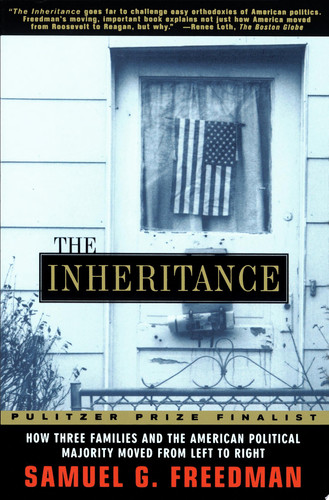
The inheritance: how three families and America moved from Roosevelt to Reagan and beyond

Freedman, Samuel G.
Orphan in the new world (Silvio Burigo) -- Liverpool on the Hudson (Lizzie Sanford Garrett) -- The dreamer and his son (Joseph Obrycki) -- The sewing room (Lizzie Garrett) -- The physics of cynicism (Joseph Obrycki) -- Worth two (Silvio Burigo) -- Voices from downstairs (Richie Garrett) -- Recessive genes (Silvio Burigo/Lorraine and Frank Trotta) -- Address as destiny (Vilma and Jack Maeby) -- Fence and basement (Silvio Burigo/Lorraine and Frank Trotta) -- Senator Clearwater (Richie Garrett) -- Uncle Paulie's Porch (Frank Trotta Jr.) -- The State Street Gang (Leslie Maeby) -- Poor snob (Tim Carey) -- Enchantment and its opposite (Frank Trotta Jr.) -- Incumbent protection (Leslie Maeby) -- Red suspenders (Tim Carey).
Simon & Schuster 1996 464 pages