58,196 results in 0.13 seconds

The room-mating season

Jaffe, Rona
A powerful new novel about life and love by Rona Jaffe, the internationally bestselling author The New York Times Book Review hails as "a minor genius." For over five decades, Rona Jaffe has captivated readers with her "deft, irresistible storytelling" (Los Angeles Times). Now this masterful author, whose books have sold more than 23 million copies worldwide, takes us through a season of friendship, discovery, betrayal, and love to tell a story of four friends and the events that shaped their futures. Leigh, Cady, Vanessa, and Susan meet when they become roommates in a townhouse on Manhattan's Upper East Side. New York in 1963 is a place of magical enchantment and infinite possibilities, especially when you're young and eager for the adventure a big city offers. Even being crammed together in a single bedroom with a kitchen too small to accommodate a table and chairs can't diminish their high spirits. A casting assistant at a talent company, Leigh is the level-headed one, the calm at the center of the whirlwind that is their lives. Cady is a prep-school teacher, emotional, passionate, and ready for love. Vanessa, a stewardess, craves her independence above all else. Susan is the wild card. Mercurial and unconventional, she makes a decision that will have far-reaching consequences in her life-and in the lives, through the years, of the others. Sleeping and dreaming side by side, Leigh, Cady, Vanessa, and Susan could not know the decisions they made in 1963 would be challenged later, not only because they had been young when they made them, but because the world itself was going to change around them. And then, of course, there were the events in their young lives that no one could control...the events that changed everything.
Dutton 2003-04-14 384 pages

Martyrdom: the psychology, theology, and politics of self-sacrifice

Fields, Rona M.
Martyrdom is a controversial and disputed concept. Just as religion is often hijacked by politics, martyrdom is frequently ascribed to a narrow, partisan, and parochial foundation. This is the first book to present varied views on the topic of martyrdom, reaching beyond cliches and simplistic explanations to provoke deep consideration of the essential nature of human beings and society. The volume's authors―experts in the disciplines of psychology, theology, and politics―examine martyrdom in thoughtful and thought-provoking chapters. A closing conversation between the authors is designed to inspire further discourse and debate. Readers engaged in the exploration of social justice, conflict, psychology, religion, and the politics of memory will find this book unique and stimulating. The authors have appeared on public television and public radio, as well as ABC, CBS, and NBC news and discussion programs.
Praeger 2004-03-30 184 pages

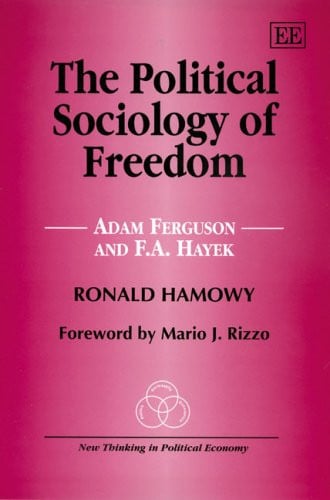
The political sociology of freedom: Adam Ferguson and F.A. Hayek

Hamowy, Ronald
Adam Ferguson and Friedrich Hayek, separated by a period of almost two hundred years, made original but similar contributions to the field of theoretical sociology. In this collection of essays, Ronald Hamowy explores the life and work of these two thinkers, giving special emphasis to their insights into the diffusion of knowledge. Ferguson, a giant of the Scottish Enlightenment, can be credited with laying the foundations of theoretical history by first proposing the idea that social institutions undergo evolutionary change. He theorized that while these institutions are formed by the actions of human beings, they are not the product of human design. Less than two centuries later, Hayek extended this insight to dealing with economic and social interaction, arguing that the knowledge requisite for structuring the social institutions under which we live is far too complex to be comprehended by any one mind or group of thinkers, and that these institutions had in fact evolved over long periods of time without deliberate design. Hayek was also the first to introduce the notion that market processes are a function of all participants contributing the limited knowledge that each possesses, out of which an orderly arrangement of enormous complexity emerges. Scholars and students of sociology, economics, history and political theory will find The Political Sociology of Freedom a unique and provocative read.
Edward Elgar 2005 265 pages

LAST CALL Twelve Men Who Dared Answer

Ronda Chervin,Ronda Chervin Ph D
Colorful stories of twelve men collared by the Lord in their latter days, compiled and edited by their philosophy professor, Dr. Ronda Chervin, who has herself authored over fifty books. Embellishing each story of personal conversion and priestly vocation is a poem on the priesthood by Ronda Chervin, and a prayer for priests by a saint. The book is illustrated throughout with woodcuts and engravings from numerous sources. Visit Dr. Chervin's websites at rondachervin.com and spirtualityrunningtogod.com. Read her daily blogs at ccwatershed.org.
CreateSpace Independent Publishing Platform 2012-07-03 264 pages

Wonderwater: Alice offshore

Horn, Roni
In this collaboration with four preeminent artists and writers, Roni Horn presents her latest work: Wonderwater (Alice Offshore). The publication takes the form of four individual books contained in a slipcase, plus an envelope of drawings by Anne Carson. Each volume comprises a text written in response to the same selection of Horn's titles/phrases: 19th C. Water; Cabinet Of; Dead Owl; Gurgles, Sucks, Echoes; Her, Her, Her and Her; Untitled (Yes); Water, Still; You are the Weather.The respondents are sculptor Louise Bourgeois, poet/writer Anne Carson, philosopher/writer Hélène Cixous and film director/artist John Waters. Individually, these booklets embody the voice of each writer. Together they become the content of Wonderwater (Alice Offshore)--further extending the landscape of Roni Horn's art.
Steidl 2004 169 pages

Traces of racial exception: racializing Israeli settler colonialism

Lenṭin, Ronit
Positioning race front and centre, this book theorizes that political violence, in the form of a socio-political process that differentiates between human and less-than-human populations, is used by the state of Israel in racializing and ruling the citizens of occupied Palestine. Lentin argues that Israel's rule over Palestine is an example of Agamben's state of exception, Goldberg's racial state and Wolfe's settler colony; the Israeli racial settler colony employs its laws to rule besieged Palestine, while excluding itself and its Jewish citizen-colonists from legal instruments and governmental technologies. Governing through emergency legislation and through practices of exception, emergency, necessity and security, Israel positions itself outside domestic and international law. Deconstructing Agamben's Eurocentric theoretical position Lentin shows that it occludes colonialism, settler colonialism and anti-colonialism and fails to specifically foreground race; instead she combines the work of Wolfe, who proposes race as a trace of settler colonialism, and Weheliye, who argues that Agamben's western-centric understanding of exception fail to speak from explicitly racialized and gendered standpoints. Employing existing media, activist, and academic accounts of racialization this book deliberately breaks from white, Western theorizations of biopolitics, exception, and bare life, and instead foregrounds race and gender in analysing settler colonial conditions in Israel.
Bloomsbury Academic 2019-10-31 280 pages

The one facing us

Matalon, Ronit
Esther, seventeen years old, wild and rebellious, is sent from Israel to Cameroon to stay with her hardheaded uncle Sicourelle, who is charged with straightening her out. But Esther resists her uncle's plans for her future-which include marriage to a cousin-and in the privileged indolence of postcolonial Africa, she looks to the past instead. Using sepia portraits and scraps of letters, Esther pieces together the history of her family, a once-grand Egyptian-Jewish clan, and its displacement from Cairo in the 1950s to Israel, West Africa, and New York. As the worn photographs yield their secrets, Esther uncovers a rich tale of wives and ex-wives; revolving mistresses and crushing marriages; intrigues and disappointments; poignant contrats between the living past and the dead present. In sensuous, inventive prose, Matalon penetrates the mysteries of cultural exile and family life to produce a first novel that is mature, authentic, and deeply moving.
Henry Holt 1999-06-15 304 pages

Vulgar Lives

Drexler, Rosalyn
Fiction. VULGAR LIVES is the shocking portrait of a woman's intense incestuous love for her brother composed in the form of a fictional journal. The book consists of letters addressed to the narrator's dead brother as she becomes more and more alienated from reality. The feelings and fantasies that make up her distorted world are described subtly and sensitively, depicting her with keen psychological insight.
Chiasmus Press 2007-02-02 132 pages

Babouk

Endore, S. Guy
Loosely based on the Haitian slave insurrection of 1791, Babouk is a biting account of colonialism at its peak. By using the imagination of the novelist to fill in the gaps in the historical record, Endore is able to show us how slavery felt to the slaves who experienced it. His novel is rare for its depiction of the shared history of the slaves and its attention to the variety of the slave experience. It provides the reader with a vivid history of Haiti and a compelling account of slavery and rebellion.
Monthly Review Press 1991-01-01 199 pages

Imagining Zion

S. Ilan Troen
This timely book tells the fascinating story of how Zionists colonizers planned and established nearly 700 agricultural settlements, towns, and cities from the 1880s to the present. This extraordinary activity of planners, architects, social scientists, military personnel, politicians, and settlers is inextricably linked to multiple contexts: Jewish and Zionist history, the Arab/Jewish conflict, and the diffusion of European ideas to non-European worlds. S. Ilan Troen demonstrates how professionals and settlers continually innovated plans for both rural and urban frontiers in response to the competing demands of social and political ideologies and the need to achieve productivity, economic independence, and security in a hostile environment. In the 1930s, security became the primary challenge, shaping and even distorting patterns of growth. Not until the 1993 Oslo Accords, with prospects of compromise and accommodation, did planners again imagine Israel as a normal state, developing like other modern societies. Troen concludes that if Palestinian Arabs become reconciled to a Jewish state, Israel will reassign priority to the social and economic development of the country and region.
Yale University Press 2011-03-11 360 pages