7908 results for "Science"

Being in time: a post-political manifesto

Atzmon, Gilad
The events of 2016 - Brexit and Trump - broke the mould which shaped ideas of democracy, politics and social identity. Gilad Atzmon argues that in the post-political universe in which we live, Left and Right have become indistinguishable and meaningless. Much of humanity has been reduced to serving the interests of big money and oligarchies. The freedom to think openly is now just a distant memory. Being in Time is a courageous attempt to grasp the intellectual developments that led towards the current dystopia. Book jacket.
Skyscraper 2017-04-18 213 pages

The Classical Heritage in Islam

Rosenthal, Franz
The influence of classical antiquity on the religious disciplines, theology, mysticism and law of Islam cannot be overestimated. This work demonstrates the significance of the classical heritage by drawing together a great range of literary renderings, paraphrases, commentaries and imitations, as well as independent Islamic elaborations. Professor Rosenthal's collection includes the work of early authors, authors of the Golden Age and later writers who imitated their works. The Classical Heritage in Islam reveals that the Muslim adoption of and dependence on classical texts was not blind imitation or a casual compounding of traditions, but rather an original synthesis and therefore a unique achievement.
Routledge 2016-03-30 322 pages

The Marxist Theory of Alienation

Ernest Mandel,George Novack
"Is alienation, or estrangement from one's fellow human beings, an innate and inevitable condition of human existence? The authors of this book say no. They explain that alienation is rooted in the development of class society itself, in the alienation of labor under all systems of private property from slavery to capitalism, where the products of the hands and minds of the vast majority are taken from them and controlled by the propertied class. Mandel and Novack argue that alienation can be overcome through the revolutionary fight for a society both free of domination by the capitalist class, and with complete democratic control of the government and economy by working people" -- Back cover.
Pathfinder Press 1973 102 pages

ReVisions Seeing Torah Through a Feminist Lens

Elyse Goldstein
What does it mean to re-vision Torah? "I use the title ReVisions for this book because I want readers both to revise--in the classic definition of reexamine and alter--and to see the text anew, to have a new vision, a 'revision,' of Torah.... It begins with the notion that women see the text differently than men do, ask different questions and bring different answers.... This book is not about rewriting the Torah. It is about rereading it." --from the Introduction Rabbi Elyse Goldstein--woman, rabbi, scholar, and feminist--challenges and defends, rereads and reinterprets the ancient text, revealing to modern readers a way to see Judaism anew, for a new vision--a "revision"--of the Torah. Goldstein boldly brings the Torah into a contemporary context at the same time she honestly reconciles its past.
Jewish Lights Publishing 2001 207 pages

Don't Think, Smile! Notes on a Decade of Denial

Ellen Willis
If the 1970s were the "Me Decade," and the '80s were the years of the Reagan counterrevolution, then the '90s, writes Ellen Willis, were the Decade of Denial. In keeping with the mass media's glib assumption that a phenomenal increase in wealth for a minority meant genuine national prosperity, the 1990s saw an astounding refusal, on both the left and right, to question received wisdom or engage in substantive deliberation. Turning her acute eye to the decade's defining moments-imbroglios like those surrounding the O. J. Simpson trial, The Bell Curve, Monica-gate, and the Million Man March-Ellen Willis reveals the mindlessness behind the noise. Arguing that we suffer from a lack of true freedom, she demands that we radically rethink our country and ourselves to create a society in which we can fully enjoy life.
Beacon Press 2000-11-16 224 pages

Citizens to lords: a social history of western political thought from antiquity to the Middle Ages

Wood, Ellen Meiksins
In this groundbreaking work, Ellen Meiksins Wood rewrites the history of political theory. She traces the development of the Western tradition from classical antiquity through to the Middle Ages in the perspective of social history—a significant departure not only from the standard abstract history of ideas but also from other contextual methods. Treating canonical thinkers as passionately engaged human beings, Wood examines their ideas not simply in the context of political languages but as creative responses to the social relations and conflicts of their time and place. She identifies a distinctive relation between property and state in Western history and shows how the canon, while largely the work of members or clients of dominant classes, was shaped by complex interactions among proprietors, labourers and states. Western political theory, Wodd argues, owes much of its vigour, and also many ambiguities, to these complex and often contradictory relations. From the Ancient Greek polis of Plato, Aristotle, Aeschylus and Sophocles, through the Roman Republic of Cicero and the Empire of St Paul and St Augustine, to the medieval world of Averroes, Thomas Aquinas and William of Ockham, Citizens to Lords offers a rich, dynamic exploration of thinkers and ideas that have indelibly stamped our modern world.
Verso 2008 245 pages

Masala Mamas Recipes and Stories from Indian Women Changing Their Communities Through Food and Love

Elana Sztokman
In the Kalwa slum in Mumbai, India, where harsh conditions make is difficult for some children to study, an amazing group of women is working to make sure that kids go to school. Meet the Masala Mamas, 16 women who live in the Kalwa slum who are dedicating their lives to providing hot meals for kids in school. Every morning, they cook hundreds of meals -- hot, nutritious meals from fresh, local ingredients and aromatic spices. They cook with extra special love, care, and dedication because their customers are the most important people in the world: children.
Lioness Books 2022-11 232 pages

First Philosophy Lectures 1923/24 and Related Texts from the Manuscripts (1920-1925)

Edmund Husserl
This volume presents, for the first time in English, Husserl’s seminal 1923/24 lecture course First Philosophy ( Erste Philosophie ) together with a selection of material from the famous research manuscripts of the same time period. The lecture course is divided into two systematic, yet interrelated parts (“Critical History of Ideas” and “Theory of the Phenomenological Reduction”). It has long been recognized by scholars as among the most important of the many lecture courses he taught in his career. Indeed it was deemed as crucially important by Husserl himself, who composed it with a view toward eventual publication. It is unsurprising, then, that First Philosophy is the only lecture course that is consistently counted among his major works. In addition to furnishing valuable insights into Husserl’s understanding of the history of philosophy, First Philosophy is his most sustained treatment of the phenomenological reduction,the central concept of his philosophical methodology. The selection of supplemental texts expands on the topics treated in the lectures, but also add other themes from Husserl’s vast oeuvre. The manuscript material is especially worthwhile, because in it, Husserl offers candid self-criticisms of his publicly enunciated words, and also makes forays into areas of his philosophy that he was loath to publicize, lest his words be misunderstood. As Husserl’s position as a key contributor to contemporary thought has, with the passage of time, become increasingly clear, the demand for access to his writings in English has steadily grown. This translation strives to meet this demand by providing English-speaking readers access to this central Husserlian text. It will be of interest to scholars of Husserl’s work, non-specialists, and students of phenomenology.
Springer Netherlands 2020-08-10 640 pages

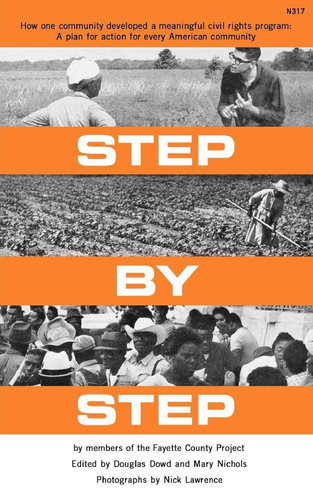
Step by Step Evolution and Operation of the Cornell Students' Civil-Rights Project in Tennessee, Summer, 1964

Douglas Dowd
The book arose out of the authors' experiences in a project which was itself unique: The Cornell-Tompkins Committee for Free and Fair Elections in Fayette County, Tennessee. The project entailed six to eight weeks of living in Fayette County by forty-five volunteers, mostly students from Cornell University, in the summer of 1964. The project was financed entirely, to an amount exceeding fifteen thousand dollars, by the contributions of students, faculty, and townspeople in and around Cornell University, and by contributions from more distant places solicited by those involved at Cornell.Of the many things learned from the Cornell project, one of the most important was how responsive a community can become when confronted with a concrete civil rights program, one with which it can identify, one small enough to be feasible and intelligible, but still compelling in terms of the needs involved.The authors believe that many thousands of Americans can find no good answer to the questions "What can I do." not because they are unwilling to do much, nor because there is little to be done, but because they lack the knowledge of what is needed where, and how and with whom one can go about responding to such needs. The book therefore undertakes, step by step, to describe and explain the development of the project at Cornell and its workings during the summer in Tennessee, and reasons that similar steps can be taken by others, with appropriate variations. It concludes with a detailed appendix listing civil rights projects and organizations desperately in need of help, whether in terms of money or volunteers or both.
W. W. Norton, Incorporated 1965-04 132 pages

Darwin in the Jewish imagination: Jews' engagement with evolutionary theory

Langton, Daniel R.
"The development of this project has taken many years and evolved in many unexpected directions as a result of the advice and feedback from many people. The subject is Darwin's Jews, that is, those Jewish thinkers in the late nineteenth- and early twentieth-centuries who have given Darwin a legacy within Jewish history beyond the tragic account of Nazi race theory and eugenics that all too often dominates the discussion of Jews and Darwin. For this reason, as much as any other, it seemed like a worthwhile endeavour. But the identification and selection of the different species of Darwin's Jews has proven to be difficult fieldwork, since there are so many ideological niches and environments for so many varieties of religious and non-religious Jews within the tangled bank of modern Jewish identity. Fortunately, I have not been working alone, and am grateful for the opportunity now to acknowledge the work of others"--
Oxford University Press 2026-02-04 310 pages

The Rhesus Chart

Charles Stross
The Hugo Award-winning author of The Delirium Brief reveals the secrets of The Laundry Files in an adventure of Lovecraftian horror and espionage hi-jinks... As a newly appointed junior manager within the Laundry—the clandestine organization responsible for protecting Britain against supernatural threats—Bob Howard is expected to show some initiative to help the agency battle the forces of darkness. But shining a light on what’s best left in the shadows is the last thing Bob wants to do—especially when those shadows hide an occult parasite spreading a deadly virus. Traders employed by a merchant bank in London are showing signs of infection—an array of unusual symptoms such as super-strength and -speed, an uncanny talent for mind control, an extreme allergic reaction to sunlight, and an unquenchable thirst for blood. While his department is tangled up in bureaucratic red tape (and Buffy reruns) debating how to stop the rash of vampirism, Bob digs deeper into the bank’s history—only to uncover a blood-curdling conspiracy between men and monsters...
Penguin 2015-06-30 384 pages

The Fuller Memorandum

Charles Stross
Computational demonologist Bob Howard is taking a much-needed break from the field to catch up on his filing in the Laundry archives when a top secret dossier known as the Fuller Memorandum vanishes—along with his boss, who the agency’s executives believe stole the file. Determined to discover exactly what the memorandum contained (and perhaps clear his boss), Bob runs afoul of Russian agents, ancient demons, and the apostles if a hideous faith who have plans to raise a very unpleasant undead entity known as the Eater of Souls. Now Bob must use all of his skills to learn the secret of the Fuller Memorandum in order to save the world—and avoid becoming an item on the Eater of Souls’s dinner menu…
Penguin Publishing Group 2011-06-28 320 pages