14302 results for "History"

Jewish liturgy: a comprehensive history

Elbogen, Ismar
The Jewish prayer book, the siddur, is the longest continuous record of the history, philosophy, literature, and ethos of the Jewish people. It has been read and reread in every generation, in every Jewish community. Now, for the first time, Ismar Elbogen's Jewish Liturgy: A Comprehensive History, the most complete scholarly study of Jewish liturgy in existence today, is available to the English-speaking community. Originally published in German, the work was reissued in.
Jewish Publication Society 1993 501 pages

Sephardi: cooking the history, recipes of the Jews of Spain and the diaspora, from the 13th Century to today

Piñer, Hélène Jawhara
"This is no ordinary cookbook. It is a cookbook steeped in the history of the Sephardic Jews, culled from such diverse sources as medieval cookbooks, Inquisition trials, medical treatises, and poems. The recipes it contains follow the history of the Jews of Spain and the Sephardic Diaspora. A culinary story is unearthed thanks to detailed analysis of real sources from the thirteenth century onwards. Whether written in Arabic, Spanish, Portuguese, Occitan, Italian, or Hebrew, the recipes bear witness to the culinary richness of the Sephardim, conversos, who were able to transport and bring their cuisines to life wherever they went. Spain, Morocco, Egypt, Turkey, Italy, Brazil, the Dominican Republic, and Mexico are all countries where the culinary culture of the Sephardim lives on. Each bite transports us to the most deeply moving and intriguing aspects of the history of the Jews. Eating is to re-remember"--
Cherry Orchard Books 2021 164 pages

Hitler, Stalin and I: an oral history

Kovály, Heda,Třeštíková, Helena
The oral history of a renowned Czech writer, whose optimism and faith in people survived grueling experiences under authoritarian regimes. Heda Margolius Kovály (1919-2010) was a renowned Czech writer and translator born to Jewish parents. Her bestselling memoir, Under a Cruel Star: A Life in Prague, 1941-1968 has been translated into more than a dozen languages. Her crime novel Innocence; or, Murder on Steep Street --based on her own experiences living under Stalinist oppression--was named an NPR Best Book in 2015. In the tradition of Studs Terkel, Hitler, Stalin and I is based on interviews between Kovály and award-winning filmmaker Helena Trestíková. In it, Kovály recounts her family history in Czechoslovakia, starving in the deprivations of Lodz Ghetto, how she miraculously left Auschwitz, fled from a death march, failed to find sanctuary amongst former friends in Prague as a concentration camp escapee, and participated in the liberation of Prague. Later under Communist rule, she suffered extreme social isolation as a pariah after her first husband Rudolf Margolius was unjustly accused in the infamous Slánsky Trial and executed for treason. Remarkably, Kovály, exiled in the United States after the Warsaw Pact invasion in 1968, only had love for her country and continued to believe in its people. She returned to Prague in 1996. Heda had an enormous talent for expressing herself. She spoke with precision and was descriptive and witty in places. I admired her attitude and composure, even after she had such extremely difficult experiences. Nazism and Communism afflicted Heda's life directly with maximum intensity. Nevertheless, she remained an optimist. Helena Trestíková has made over fifty documentary films. Hitler, Stalin and I has garnered several awards in the Czech Republic and Japan.
DoppelHouse Press 2018 160 pages

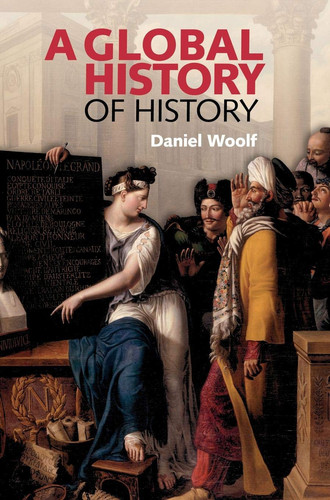
A global history of history

Woolf, D. R.
A global history of historical writing, thought and the development of the historical discipline from the ancient world to the present. This is a definitive guide to human efforts to recover, understand and represent the past, bringing together different historical traditions and their social, economic, political and cultural contexts. Daniel Woolf offers clear definitions of different genres and forms of history and addresses key themes such as the interactions between West and East, the conflict of oral, pictographic, and written accounts of the past and the place of history in society and in politics. Numerous textual extracts and illustrations in every chapter capture the historical cultures of past civilizations and demonstrate the different forms that historical consciousness has taken around the world. The book offers unique insights into the interconnections between different historical cultures over 3000 years and relates the rise of history to key themes in world history. --
Cambridge University Press 2011-02-17 568 pages

Barbarism and civilization: a history of Europe in our time

Wasserstein, Bernard
"Here is the definitive history of contemporary Europe, a controversial but authoritative and lively narrative that is destined to become the standard account of the period from 1914 to the present. In this important new book, University of Chicago historian Bernard Wasserstein offers the first serious, full-length history of a century of convulsive change. It is a history of barbarism and civilization, of cruelty and tenderness, of technological achievement and environmental blight, of imperial expansion and withdrawal, of authoritarian repression and of individualism resurgent. Wasserstein provides both a narrative of the main contours of the political, diplomatic, and military history and an analysis of the underpinnings of demographic, economic, and social developments. Most notably, the book explores the evolution of values and sensibilities in a period when, for the first time, God disappeared as a living presence in the minds of most Europeans. Wasserstein argues that barbarism and civilization were not polar opposites: rather they marched hand in hand. Twentieth-century Europe saw incontestable improvements in living conditions for most inhabitants of the continent: average life span was extended by more than half; real incomes increased dramatically; illiteracy was all but eliminated; women, ethnic minorities, and homosexuals advanced closer to equality of respect and opportunity. Yet the century also witnessed some of the most brutish episodes in the recorded history of our species. Hence Wasserstein's conclusion that "greed, selfishness, lies, and cruelty are the stuff of the history of Europe in our time." Drawing on the latest scholarly findings,including recent disclosures of intelligence materials and archival revelations that followed the fall of Communism in Eastern Europe, Wasserstein captures the essence of contemporary European history in an engaging narrative that is by turns grim, humorous, surprising, and enlightening." -- Publisher.
Oxford University Press 2007 901 pages

Narration and knowledge: (including the integral text of Analytical philosophy of history)

Danto, Arthur C.
Now in its third edition, Narration and Knowledge is a classic work exploring the nature of historical knowledge and its reliance on narrative. Analytical philosopher Arthur C. Danto introduces the concept of "narrative sentences," in which an event is described with reference to later events (for example, "the Thirty Years' War began in 1618") and discusses why such sentences cannot be understood until the later event happens (no one could have said in 1618 that "the Thirty Years' War began today"). Danto compares narrative and scientific explanation and explores the legitimacy of historical laws. He also argues that history is an autonomous and humanist discipline incapable of being reduced to scientific descriptions. Lydia Goehr's new introduction illustrates Danto's main arguments by questioning her very role, first, as an introducer of a book that has not yet been read by readers and, second, as an interpreter of a book written forty years ago. Frank Ankersmit's conclusion revisits the initial impact of the publication of Narration and Knowledge and considers its enduring legacy.
Columbia University Press 2007 437 pages

Potential history: unlearning imperialism

Azoulay, Ariella
In this theoretical tour-de-force, renowned scholar Ariella Aïsha Azoulay calls on us to recognize the imperial foundations of knowledge and to refuse its strictures and its many violences. Azoulay argues that the institutions that make our world, from archives and museums to ideas of sovereignty and human rights to history itself, are all dependent on imperial modes of thinking. Imperialism has segmented populations into differentially governed groups, continually emphasized the possibility of progress while it tries to destroy what came before, and voraciously seeks out the new by sealing the past away in dusty archival boxes and the glass vitrines of museums. By practicing what she calls potential history, Azoulay argues that we can still refuse the original imperial violence that shattered communities, lives, and worlds, from native peoples in the Americas at the moment of conquest to the Congo ruled by Belgium's brutal King Léopold II, from dispossessed Palestinians in 1948 to displaced refugees in our own day. In Potential History, Azoulay travels alongside historical companions--an old Palestinian man who refused to leave his village in 1948, an anonymous woman in war-ravaged Berlin, looted objects and documents torn from their worlds and now housed in archives and museums--to chart the ways imperialism has sought to order time, space, and politics. Rather than looking for a new future, Azoulay calls upon us to rewind history and unlearn our imperial rights, to continue to refuse imperial violence by making present what was invented as "past" and making the repair of torn worlds the substance of politics.
Verso 2019 634 pages

Trials of the diaspora: a history of anti-semitism in England

Julius, Anthony
Argues that antisemitism in England has always been either disregarded, underestimated, or misunderstood. England has seen four forms of antisemitism during its history: a radical antisemitism, which ended with the expulsion of the Jews in 1290; a literary antisemitism; a quotidian antisemitism of insult and partial exclusion that has existed since the mid-17th century; and an emergent, antisemitic anti-Zionism. Various forms and motifs of antisemitism were invented in England (e.g. expulsion) and others were adapted and extended - e.g. it was in England that the blood libel arose in its canonic medieval form, and where its first literary representation appeared, written by Thomas of Monmouth. Dwells on antisemitic motifs in English literature, from the 13th century ballad "Sir Hugh, or the Jew's Daughter" to Tom Paulin's poem "Killed in Crossfire" (2001). Since the 17th century, the antisemitism has been weak and mainly verbal; antisemitic zealots have been few in number and marginal in their influence. Nonetheless, it existed and was widespread amongst the populace. Modern political antisemitism emerged in the 1860s and continued into the 20th century, when the Jews came to be perceived as a challenge to British security. Dwells on the English antisemitic mentality, as well as on antisemitic anti-Zionism. Discerns two forms of the latter: secular anti-Zionism, supported by the left and post-left; and confessional anti-Zionism, either Muslim, Jewish, or Christian conservative.
Oxford University Press 2010-02-25 811 pages

Bible History Old Testament New Updated Edition

Alfred Edersheim
In this enduring classic, Alfred Edersheim explores the broad sweep of Old Testament history. He brings to his work his immense learning and familiarity with Judaism, as well as his love for Scripture and his desire for every Christian to know and understand the story of God's redemptive work in history. This new edition of Edersheim's classic features the following improvements: - Entirely reset in a modern and easy-to-read typeface - Complete and unabridged in one volume - Arabic numbers replace roman numerals - New maps to provide for richer understanding "In writing it " Bible History: Old Testament]" I have primarily had in view those who teach and those who learn, whether in the school or in the family. But my scope has also been wider. I have wished to furnish, what may be useful for reading in the family, --what indeed may, in some measure, serve the place of a popular exposition of the sacred history. More than this, I hope it may likewise prove a book to put in the hands of students, to show them what the Bible really teaches." --Alfred Edersheim
Hendrickson Publishers 1994-09-01 1024 pages

Owning the sun: a people's history of monopoly medicine from aspirin to COVID-19 vaccines

Zaitchik, Alexander
"Owning the Sun tells the story of one of the most contentious fights in human history: the legal right to control the production of lifesaving medicines. Medical science began as a discipline geared toward the betterment of all human life, but the merging of research with intellectual property and the rise of the pharmaceutical industry warped and eventually undermined its ethical foundations. Since the Second World War, federally funded research has facilitated most major medical breakthroughs, yet these drugs are often wholly controlled by price-gouging corporations with growing international ambitions. Why does the U.S. government fund the development of medical science in the name of the public, only to relinquish exclusive rights to drug companies, and how does such a system impoverish us, weaken our responses to global crises, and, as in the case of AIDS and COVID-19, put the world at risk? Outlining how generations of public health and science advocates have attempted to hold the line against Big Pharma and their allies in government, Alexander Zaitchik's first-in-kind history documents the rise of medical monopoly in the United States and its subsequent globalization. From the controversial arrival of patent-wielding German drug firms in the late nineteenth century, to present-day coordination between industry and philanthropic organizations-including the influential Gates Foundation-that stymie international efforts to vaccinate the world against COVID-19, Owning the Sun tells one of the most important and least understood histories of our time"--
Counterpoint 2022 285 pages

An intimate history of humanity

Zeldin, Theodore
Zeldin studies the problems of modern society in light of demonstrating how individuals pay attention to, or ignore, the experience of previous generations and cultures. Some of his examples are how people have acquired immunity to loneliness, how older fears give rise to new fears, and why people choose a way of life and what they do when it does not wholly satisfy them.
Harper Perennial 1995-12-01 488 pages

The Royal Family at War (Theo Aronson Royal History)

Aronson, Theo
'This war', wrote Winston Churchill to King George VI at the height of the Second World War, 'has brought throne and people closer together than was ever before recorded.' Here is a full and fascinating account of that coming together. It is a study of the contribution made not only by George VI and his redoubtable Queen, but also by the entire royal family during those turbulent years, and of how that contribution strengthened and popularized the monarchy. This is a family saga; an account of the lives, as much private as public, of all the diverse members of what George VI called 'The Firm'. Together with the tireless efforts of the King and Queen, it deals with such aspects as the Duke of Windsor's flirtation with fascism, the mysterious death of the Duke of Kent, the activities of the Athlones in Canada and the Gloucesters in Australia, and the imprisonment of the Princess Royal's eldest son, Viscount Lascelles. Occasionally tragic, often amusing, always interesting, The Royal Family at War is a richly detailed panorama of the monarchy in one of its finest hours. Theo Aronson is the author of over twenty works of royal historical biography including Grandmama of Europe, The King in Love, Napoleon and Josephine and a biography of Princess Margaret. In the course of researching and writing these books he has interviewed major and minor members of Britain’s royal family and members of the royal households, as well as various officials, servants, friends and others whose lives are in some way connected with the monarchy.
Independently published 2021-03-18 240 pages

History of the Jews in Russia and Poland From the Earliest Times Until the Present Day

Simon Dubnow
This work has been selected by scholars as being culturally important and is part of the knowledge base of civilization as we know it. This work is in the public domain in the United States of America, and possibly other nations. Within the United States, you may freely copy and distribute this work, as no entity (individual or corporate) has a copyright on the body of the work. Scholars believe, and we concur, that this work is important enough to be preserved, reproduced, and made generally available to the public. To ensure a quality reading experience, this work has been proofread and republished using a format that seamlessly blends the original graphical elements with text in an easy-to-read typeface. We appreciate your support of the preservation process, and thank you for being an important part of keeping this knowledge alive and relevant.
Creative Media Partners, LLC 2018-10-25 406 pages

History of the Jews in Russia and Poland

Simon Markovich Dubnow
This work has been selected by scholars as being culturally important and is part of the knowledge base of civilization as we know it. This work is in the public domain in the United States of America, and possibly other nations. Within the United States, you may freely copy and distribute this work, as no entity (individual or corporate) has a copyright on the body of the work. Scholars believe, and we concur, that this work is important enough to be preserved, reproduced, and made generally available to the public. To ensure a quality reading experience, this work has been proofread and republished using a format that seamlessly blends the original graphical elements with text in an easy-to-read typeface. We appreciate your support of the preservation process, and thank you for being an important part of keeping this knowledge alive and relevant.
Capital Communications, Incorporated 2017-05-26 406 pages

From metaphysics to midrash: myth, history, and the interpretation of Scripture in Lurianic Kabbala

Magid, Shaul
In From Metaphysics to Midrash, Shaul Magid explores the exegetical tradition of Isaac Luria and his followers within the historical context in 16th-century Safed, a unique community that brought practitioners of Judaism, Christianity, and Islam into close contact with one another. Luria's scripture became a theater in which kabbalists redrew boundaries of difference in areas of ethnicity, gender, and the human relation to the divine. Magid investigates how cultural influences altered scriptural exegesis of Lurianic Kabbala in its philosophical, hermeneutical, and historical perspectives. He suggests that Luria and his followers were far from cloistered. They used their considerable skills to weigh in on important matters of the day, offering, at times, some surprising solutions to perennial theological problems.
Indiana University Press 2008-07-09 349 pages

Virginia: a history

Rubin, Louis D. Jr.
From the beginning, Virginians have styled their government a conservative commonwealth, seeking stability amid change and often fashioning change to fit their concept of what Virginia--and America--should be like. In the eighteenth century Golden Age, Virginia was a world of broad acres and country gentlemen. To preserve the world, Virginians led a revolution and helped to found a government that they believed would secure their children's future. In the name of old and tried principles, Virginians in 1861 seceded from the Union to defend a way of life that to them seemed worth fighting for. In the twentieth century, they "paid as they went," convinced that debt meant the end of good government.
Norton 1984 228 pages