7908 results for "Science"

Ms. Marvel: a hero is born

Conway, Gerry,Claremont, Chris
Before she became Captain Marvel, NASA Security Chief Carol Danvers' life had been intertwined with the alien Kree's interventions on Earth. When her genetic structure melded with that of the Kree, Danvers was imbued with new powers and an all-new Marvel hero was born Famous X-Men writer Chris Claremont weaves complex plots and compelling characterization in the iconic original adventures of Ms. Marvel. The highlights are many: Ms. Marvel meets the Avengers for the very fi rst time. Mystique makes her first appearance. A battle with Ronan the Accuser. Encounters with the Guardians of the Galaxy and Sabretooth. The story reaches its epic conclusion in a Marvel milestone including the X-Men and the Avengers.
Marvel Worldwide, Inc 2019-02-26 706 pages

Iron Sunrise

Charles Stross
“[Stross] has the ability to superimpose an intriguing take on contemporary events over an imaginative story peopled by bizarre characters.” – The Kansas City Star A G2 star doesn’t just explode—not without outside interference. So the survivors of the planet Moscow, which was annihilated in just such an event, have launched a counterattack against the most likely culprit: the neighboring system of New Dresden. But New Dresden wasn’t responsible, and as the deadly missiles approach their target, Rachel Mansour, agent for the interests of Old Earth, is assigned to find out who was. Opposing her is an unknown—and unimaginable—enemy. At stake is not only the fate of New Dresden but also the very order of the universe. And the one person who knows the identity of that enemy is a disaffected teenager who calls herself Wednesday Shadowmist. But Wednesday has no idea what she knows…
Penguin 2005-06-28 448 pages

Glasshouse

Stross, Charles
When Robin wakes up in a clinic with most of his memories missing, it doesn't take him long to discover that someone is trying to kill him. It's the 27th century, when interstellar travel is by teleport gate and conflicts are fought by network worms that censor refugees' personalities and target historians. The civil war is over and Robin has been demobilized, but someone wants him out of the picture because of something his earlier self knew. On the run from a ruthless pursuer, he volunteers to participate in a unique experimental polity, the Glasshouse, constructed to simulate a pre-accelerated culture. Participants are assigned anonymized identities: it looks like the ideal hiding place for a posthuman on the run. But in this escape-proof environment, Robin will undergo an even more radical change, placing him at the mercy of the experimenters--and the mercy of his own unbalanced psyche.--From publisher description.
Ace Books 2006 335 pages

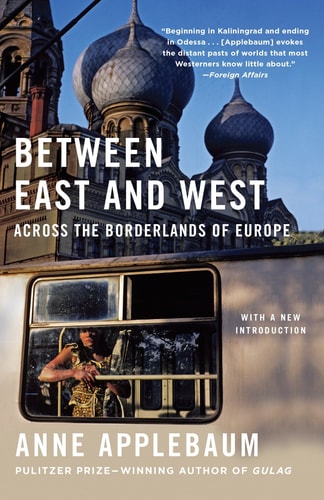
Between East and West Across the Borderlands of Europe

Anne Applebaum
In the summer and fall of 1991, Anne Applebaum, Pulitzer Prize-winning author of Gulag and Iron Curtain , took a three month road trip through the freshly independent borderlands of Eastern Europe. She deftly weaves the harrowing history of the region and captures the effects of political upheaval on a personal level. An extraordinary journey into the past and present of the lands east of Poland and west of Russia—an area defined throughout its history by colliding empires. Traveling from the former Soviet naval center of Kaliningrad on the Baltic to the Black Sea port of Odessa, Anne Applebaum encounters a rich range of competing cultures, religions, and national aspirations. In reasserting their heritage, the inhabitants of the borderlands attempt to build a future grounded in their fractured ancestral legacies. In the process, neighbors unearth old conflicts, devote themselves to recovering lost culture, and piece together competing legends to create a new tradition. Rich in surprising encounters and vivid characters, Between East and West brilliantly illuminates the soul of the borderlands and the shaping power of the past.
National Geographic Books 2017-06-13 336 pages

Green Angel and Green Witch (Two Novels, One Book)

Alice Hoffman
A two-fold tale of grief and hope, loss and love, beautifully, heartbreakingly rendered as only bestselling author Alice Hoffman can. When her family is lost in a terrible disaster, fifteen-year-old Green is haunted by loss and the past. Struggling to survive in a place where nothing seems to grow, Green retreats into the ruined realm of her garden. But in destroying her feelings, she also begins to destroy herself. It is only through a series of mysterious encounters that Green relearns the most important lessons of love and begins to heal as she tells her own story. In the magical sequel, Green Witch , Green continues to heal but still lives every day with feelings of loss. Her family is gone, the boy she loves is missing, and the world she once knew has been transformed by tragedy. In order to rediscover the truth about love, hope, and magic, she must venture away from her home, collecting the stories of a group of women who have been branded witches for their mysterious powers. Only through their stories will Green finally find her own heart's desire. Master storyteller and New York Times bestselling author Alice Hoffman weaves together two beautiful and heartbreaking tales of love and loss, healing and magic.
Scholastic, Incorporated 2024-09-17 272 pages

A Week at the Airport

Alain De Botton
The bestselling author of The Architecture of Happiness and The Art of Travel spends a week at an airport in a wittily intriguing meditation on the "non-place" that he believes is the centre of our civilization. In the summer of 2009, Alain de Botton was invited by the owners of Heathrow airport to become their first ever writer-in-residence. Given unprecedented, unrestricted access to wander around one of the world's busiest airports, he met travellers from all over the globe, and spoke with everyone from baggage handlers to pilots, and senior executives to the airport chaplain. Based on these conversations he has produced this extraordinary meditation on the nature of travel, work, relationships, and our daily lives. Working with the renowned documentary photographer Richard Baker, he explores the magical and the mundane, and the interactions of travellers and workers all over this familiar but mysterious "non-place," which by definition we are eager to leave. Taking the reader through departures, "air-side," and the arrivals hall, de Botton shows with his usual combination of wit and wisdom that spending time in an airport can be more revealing than we might think.
McClelland & Stewart 2010-09-21 112 pages

The World As I See It

Albert Einstein
" A Collection of Essays: ""The World As I See It"" is a compilation of essays written by Albert Einstein, offering insights into his philosophical, scientific, and social views. Scientific Perspectives: The book delves into Einstein's scientific theories, including relativity and quantum mechanics, explaining complex concepts in accessible language. Social and Political Commentary: Einstein shares his thoughts on various social and political issues of his time, such as pacifism, nationalism, and human rights. Philosophical Reflections: The essays explore philosophical questions about the nature of reality, the meaning of life, and the role of science in society. Ethical Considerations: Einstein discusses the ethical implications of scientific advancements and the responsibility of scientists to use their knowledge for the betterment of humanity. Personal Anecdotes: The book includes personal anecdotes that offer glimpses into Einstein's life and personality. Humanistic Values: Einstein emphasizes the importance of human values, such as compassion, empathy, and tolerance. Critical Thinking: The essays encourage readers to think critically and question conventional wisdom. Optimistic Outlook: Despite the challenges of his time, Einstein maintains an optimistic outlook on the future of humanity. Enduring Relevance: The ideas presented in the book remain relevant and thought-provoking today. Accessible Language: Einstein's writing style is clear and concise, making the book accessible to a wide audience. "
Namya Press 2024-12-16 107 pages

Choke: what the secrets of the brain reveal about getting it right when you have to

Beilock, Sian
Why do the smartest students often do poorly on standardized tests?Why did you tank that interview or miss that golf swing when you should have had it in the bag?Why do you mess up when it matters the most—and how can you perform your best instead? It happens to all of us. You’ve prepared for days, weeks, even years for the big day when you will finally show your stuff—in academics, in your career, in sports—but when the big moment arrives, nothing seems to work. You hit the wrong note, drop the ball, get stumped by a simple question. In other words, you choke. It’s not fun to think about, but now there’s good news: This doesn’t have to happen.Dr. Sian Beilock, an expert on performance and brain science, reveals in Choke the astonishing new science of why we all too often blunder when the stakes are high. What happens in our brain and body when we experience the dreaded performance anxiety? And what are we doing differently when everything magically "clicks" into place and the perfect golf swing, tricky test problem, or high-pressure business pitch becomes easy? In an energetic tour of the latest brain science, with surprising insights on every page, Beilock explains the inescapable links between body and mind; reveals the surprising similarities among the ways performers, students, athletes, and business people choke; and shows how to succeed brilliantly when it matters most. In lively prose and accessibly rendered science, Beilock examines how attention and working memory guide human performance, how experience and practice and brain development interact to create our abilities, and how stress affects all these factors. She sheds new light on counter-intuitive realities, like why the highest performing people are most susceptible to choking under pressure, why we may learn foreign languages best when we’re not paying attention, why early childhood athletic training can backfire, and how our emotions can make us both smarter and dumber. All these fascinating findings about academic, athletic, and creative intelligence come together in Beilock’s new ideas about performance under pressure—and her secrets to never choking again. Whether you’re at the Olympics, in the boardroom, or taking the SAT, Beilock’s clear, prescriptive guidance shows how to remain cool under pressure—the key to performing well when everything’s on the line.
Free Press 2010-09-21 294 pages

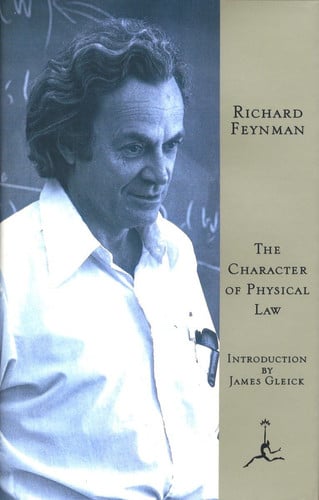
The character of physical law

Feynman, Richard P.
Like any set of oral reflections, The Character of Physical Law has special value as a demonstration of the mind in action. The reader is particularly lucky in Richard Feynman - one of the most eminent and imaginative modern physicists. In these Messenger Lectures, originally delivered at Cornell University and recorded for television by the BBC, Richard Feynman offers an overview of selected physical laws and gathers their common features into one broad principle of invariance. He maintains at the outset that the importance of a physical law is not ''how clever we are to have found it out - but . . . how clever nature is to pay attention to it'' and steers his discussions toward a final exposition of the elegance and simplicity of all scientific laws. Rather than an essay on the most significant achievements in modern science, The Character of Physical Law is a statement of what is most remarkable in nature. Feynman's enlightened approach, his wit, and his enthusiasm make this a memorable exposition of the scientist's craft. The law of gravitation is the author's principal example. Relating the details of its discovery and stressing its mathematical character, he uses it to demonstrate the essential interaction of mathematics and physics. He views mathematics as the key to any system of scientific laws, suggesting that if it were possible to fill out the structure of scientific theory completely, the result would be an integrated set of mathematical axioms. The principles of conservation, symmetry, and time irreversibility are then considered in relation to developments in classical and modern physics, and in his final lecture, Feynman develops his own analysis of the process and future of scientific discovery.
Modern Library 1994-11-08 167 pages

What Darwin got wrong

Fodor, Jerry A.
With a New Afterword What Darwin Got Wrong is a remarkable book, one that dares to challenge the theory of natural selection as an explanation for how evolution works--a devastating critique not in the name of religion but in the name of good science. Combining the results of cutting-edge work in experimental biology with crystal-clear philosophical arguments, Fodor and Piattelli-Palmarini mount a reasoned and convincing assault on the central tenets of Darwin's account of the origin of species. This is a concise argument that will transform the debate about evolution and move us beyond the false dilemma of being either for natural selection or against science.
Picador/Farrar, Straus and Giroux 2011-03-01 292 pages

All these things I've done

Zevin, Gabrielle
YA. Science fiction. From the author of the critically acclaimed Elsewhere comes this brilliant novel about an impossible romance, a family living outside of the law, and the ties that forever bind us. Chocolate and coffee are illegal, paper is hard to find, water is increasingly scarce, and New York City is rife with crime and poverty. And yet, for Anya Balanchine, the sixteen-year-old daughter of the city's most notorious (and dead) crime boss, life is fairly routine-going to school, taking care of her siblings and her dying grandmother, trying to avoid falling in love with the new assistant D.A.'s son, and avoiding her loser ex-boyfriend. That is until someone in her inner circle ends up poisoned by the chocolate her family manufactures and the police think she's to blame. Suddenly, Anya finds herself thrust unwillingly into the spotlight-at school, in the news, and most importantly, within her mafiya family. Engrossing and suspenseful, All These Things I've Done is an utterly unique, unputdownable read that blends both the familiar and fantastic.
Macmillan 2012 350 pages

Three stones make a wall: the story of archaeology

Cline, Eric H.
In 1922, Howard Carter peered into Tutankhamun's tomb for the first time, the only light coming from the candle in his outstretched hand. Urged to tell what he was seeing through the small opening he had cut in the door to the tomb, the Egyptologist famously replied, "I see wonderful things." Carter's fabulous discovery is just one of the many spellbinding stories told in Three Stones Make a Wall. Written by Eric Cline, an archaeologist with more than thirty seasons of excavation experience, this book traces the history of archaeology from an amateur pursuit to the cutting-edge science it is today by taking the reader on a tour of major archaeological sites and discoveries. Along the way, it addresses the questions archaeologists are asked most often: How do you know where to dig? How are excavations actually done? How do you know how old something is? Who gets to keep what is found? Taking readers from the pioneering digs of the eighteenth century to today's exciting new discoveries, Three Stones Make a Wall is a lively and essential introduction to the story of archaeology.
Princeton University Press 2018 384 pages

Chloe's vegan desserts: more than 100 exciting new recipes for cookies and pies, tarts and cobblers, cupcakes and cakes-- and more!

Coscarelli, Chloe
"The first vegan winner of Cupcake Wars--and of any reality cooking show!--Chef Chloe, author of the popular Chloe's Kitchen, brings her signature creativity and fun to the best part of every meal: Dessert!Chloe's fantastic-tasting, beautiful desserts are what first got her national media attention when she wowed the judges on Food Network's Cupcake Wars. And her famous desserts are what her enthusiastic fans always demand. Now Chef Chloe offers her first all-dessert cookbook--and you will just not believe these delicious dishes are vegan. Instead of relying on the tofu, applesauce, egg replacer, and mashed bananas that many other vegan cooks use, Chloe works a different kind of food science magic, with liquid proportions and leaveners like baking soda and vinegar to make cakes rise and remain moist and to give her food a texture and taste that vegans and non-vegans alike crave. Go ahead and lick that spoon! There're no worries when you cook vegan. Chloe re-creates classic desserts and treats from crÈme brulee to tiramisu to beignets as well as store-bought favorites--made with a humorous taste twist--like her ChloeO-type Oreos and Pumpkin Whoopie Pies. Chloe also serves up brand-new triumphs like her dreamy Lemon Olive Oil Cake with Rosemary Ice Cream, Coconut and Chocolate Cream Pies, Coconut Sorbet with Cashew Brittle, and a dozen innovative cupcake creations. Who can possibly resist? With 100 fabulous, easy-to-make recipes and gorgeous color photography, Chloe's Vegan Desserts is the next great innovative baking and dessert book with a universal appeal"--
Atria Paperback 2013-02-19 256 pages

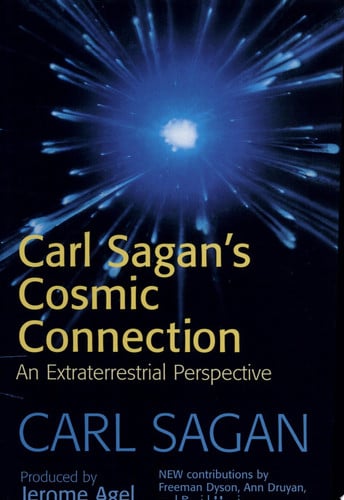
Carl Sagan's cosmic connection: an extraterrestrial perspective

Sagan, Carl
In 1973, Carl Sagan published The Cosmic Connection, a daring view of the universe, which rapidly became a classic work of popular science and inspired a generation of scientists and enthusiasts. This seminal work is reproduced here for a whole new generation to enjoy. In Sagan's typically lucid and lyrical style, he discusses many topics from astrophysics and solar system science, to colonization, terraforming and the search for extraterrestrials. Sagan conveys his own excitement and wonder, and relates the revelations of astronomy to the most profound human problems and concerns: issues that are just as valid today as they were thirty years ago. New to this edition are Freeman Dyson's comments on Sagan's vision and the importance of the work, Ann Druyan's assessment of Sagan's cultural significance as a champion of science, and David Morrison's discussion of the advances made since 1973 and what became of Sagan's predictions. Who knows what wonders this third millennium will reveal, but one thing is certain: Carl Sagan played a unique role in preparing us for them.
Cambridge University Press 2000-08-31 302 pages