58,196 results in 0.08 seconds

Ecstasy

Eigen, Michael
Leading psychotherapist offers compelling insights into the vital force of ecstasy. In this provocative and insightful new book, psychologist Michael Eigen presents a phenomenology of ecstatic states. Ecstasy is a force to be reckoned with — sometimes creative, sometimes destructive. Eigen argues that there is an ecstasy that comes through the ever-necessary confrontation of our psychic cores with suffering and degradation, and he shows that when we can learn to be present with these feelings, they add to the tone and texture of our lives, and help us to feel real. The author draws heavily on autobiographical material, psychotherapy sessions, case studies and psychoanalytic thinking, along with literary and biblical sources, demonstrating his reputation as one of the leading creative thinkers among psychotherapists in America. The result is an extremely intelligent, lyrical work, which succeeds in being theoretically well-informed without being pedantic. Written as a subjective first-hand account, Ecstasy will appeal to psychotherapists as well as to readers and students interested in spirituality and philosophy.
Wesleyan University Press 2001-11-15 104 pages

Feeling Matters

Eigen, Michael
As long as feelings are second-class citizens, people will be second class citizens. Experience is an endangered species. An important function of psychotherapy is to make time for experiencing. Psychic taste buds really exist and rarely rest. They feed us each other, gauge states of being, states of spirit. We taste each other's feelings and intentions. An important aim of this book is to build psychic taste buds, not put them down or pretend they don't exist. A positive feeling runs through this book, a love of life, an affirmation. Yet we discover many feel they do not have an impact. A sense of helplessness and impotence in face of awesome forces seems to be increasing. Health is a broad term with many dark threads. A creeping annihilating sense varies from pockets we try not to notice to soul murder that must be addressed. Yet individuals do try, in their private struggles and in the larger social sphere.
Taylor & Francis Group 2019-06-14 224 pages

Conscious/unconscious

Hafftka, Michael
Hafftka began writing Conscious/Unconscious in 1973 and completed it in 2006. Conscious/Unconscious is a book of short stories narrated in the first person, weaving an inner life made real by paradoxes and conflicting drives. The 27 drawings created for this book add another dimension to the written words. Hafftka is a visual artist represented in the permanent collections of The Metropolitan Museum, The NY MoMA, The Carnegie Museum of Art, The San Francisco Museum of Modern Art, The Brooklyn Museum, and other museums. He has had one-man shows at numerous galleries in the U.S and abroad.
Six Gallery Press 2007 182 pages

Roots in the air

Hamburger, Michael
Product Description During the 1980s Michael Hamburger published both collected and selected editions of his poetry, but `Roots in the Air' is his first collection of new poems to appear for a decade. "Memorably disquieting" was one reviewer's verdict on his last collection, a response which the poems in this book will evoke in many readers. His work is profoundly engaged with both the natural and human world, its concerns are felt not fashioned, and his verse has a natural ease and personal rhythms which make it both distinctive and approachable. About the Author Michael Hamburger was born in Berlin in 1924, and came to Britain as a child. His `Collected Poems' appeared in 1984. He has published several critical books, including `The Truth of Poetry' and numerous translations, among them versions of Hölderlin, Rilke, Hofmannsthal and Celan. In 1990 he was awarded the EC's first European Translation Prize for `Poems of Paul Celan'.
Anvil Press Poetry 1991 103 pages

The Historical Poetry of the Ancient Hebrews: Translated and Critically Examined by Michael Heilprin (V.2 ) (1879-80)

Heilprin, Michael
Originally published in 1879-80. This volume from the Cornell University Library's print collections was scanned on an APT BookScan and converted to JPG 2000 format by Kirtas Technologies. All titles scanned cover to cover and pages may include marks notations and other marginalia present in the original volume.
Cornell University Library 2009-07-08 232 pages

Customary international law in times of fundamental change: recognizing Grotian moments

Scharf, Michael P.
This is the first book to explore the concept of 'Grotian Moments'. Named for Hugo Grotius, whose masterpiece De jure belli ac pacis helped marshal in the modern system of international law, Grotian Moments are transformative developments that generate the unique conditions for accelerated formation of customary international law. In periods of fundamental change, whether by technological advances, the commission of new forms of crimes against humanity, or the development of new means of warfare or terrorism, customary international law may form much more rapidly and with less state practice than is normally the case to keep up with the pace of developments. The book examines the historic underpinnings of the Grotian Moment concept, provides a theoretical framework for testing its existence and application, and analyzes six case studies of potential Grotian Moments: Nuremberg, the continental shelf, space law, the Yugoslavia Tribunal's Tadic decision, the 1999 NATO intervention in Serbia and the 9/11 terrorist attacks.
Cambridge University Press 2013-05-31 228 pages

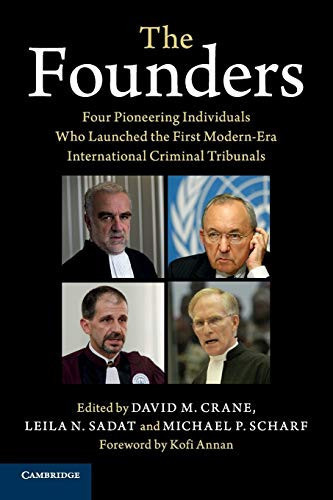
The founders: four pioneering individuals who launched the first modern-era international criminal tribunals

David M. Crane,Leila N. Sadat,Michael P. Scharf
"The Balkan Wars, the Rwanda genocide, and the crimes against humanity in Cambodia and Sierra Leone spurred the creation of international criminal tribunals to bring the perpetrators of unimaginable atrocities to justice. When Richard Goldstone, David Crane, Robert Petit, and Luis Moreno-Ocampo received the call - each set out on a unique quest to build an international criminal tribunal and launch its first prosecutions. Never before have the founding International Prosecutors told the behind-the-scenes stories of their historic journey. With no blueprint and little precedent, each was a path-breaker. This book contains the first-hand accounts of the challenges they faced, the obstacles they overcame, and the successes they achieved in obtaining justice for millions of victims"--
Cambridge University Press 2018-03-15 165 pages

As far as I remember

Kerr, Michael R. E.
This candidly written autobiography of Sir Michael Kerr chronicles the life of one of Britains most prominent judges of the 70s and 80s from his Continental childhood up to his career in the Court of Appeal and beyond. In the first part of his memoir,the author traces his family history and Germanic roots. His father, Alfred Kerr, was a well-known dramatic critic and essayist, whose writings were widely known throughout Germany from the turn of the century and have recently seen a resurrection, 50 years after his death, as related in the last chapter of the book. But because of the fame of his anti-Nazi writings and broadcasts, the Kerrs were forced to flee from Berlin as early as 3 March 1933, when Hitler came to power. The author and his sister Judith, later to become a famous author of childrens books, had a relatively happy cosmopolitan childhood in Zurich, Paris, Nice and ultimately England. But their parents lives remained on the edge of poverty and sometimes despair and there was never again a family home. The memoirs then tell of his years at Aldenham School and the beginnings of Cambridge, and of his assimilation into the English way of life. They relate the story of his internment as an enemy alien in 1940 and of his subsequent release and service as a pilot in the Royal Air Force until the end of World War II. The author then returned to Cambridge to finish his law degree and was urged to go the Bar. The later chapters of this autobiography are mainly devoted to the law. They recount the authors career as a leading commercial Junior and then a Silk, his initial hesitations about the Bench, but ultimately culminating in his appointment as a Lord Justice of Appeal. He describes the Bar of the post-war decades and is frank about the frustrations and disappointments of his career. He also provides insights into the oddities of the English legal system, but maintaining throughout his firm belief in the importance of an independent Bar.
Hart 2005 356 pages

Harrell Fletcher, Michael Rakowitz

Harrell Fletcher,Michael Rakowitz
A lively conversation largely composed of anecdotes and first person narratives that addresses central and shared concerns in both artists' practice. Discussions about the pedagogy of art, social practice, story-telling, sincerity, community-oriented projects, and documentary strategies are interwoven with analysis of some of Fletcher's and Rakowitz's key works.
A.R.T. Press 2008 76 pages