

7908 results for "Science"

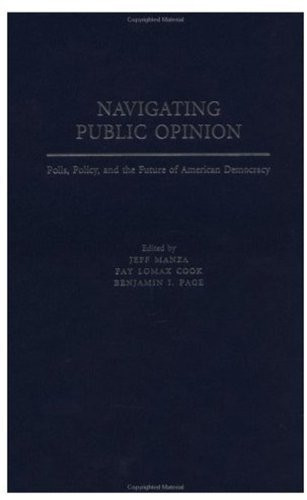
Navigating public opinion: polls, policy, and the future of American democracy
Do politicians listen to the public? How often and when? Or are the views of the public manipulated or used strategically by political and economic elites? Navigating Public Opinion brings together leading scholars of American politics to assess and debate these questions. It describes how the relationship between opinion and policy has changed over time; how key political actors use public opinion to formulate domestic and foreign policy; and how new measurement techniques might improve our understanding of public opinion in contemporary polling and survey research. The distinguished contributors shed new light on several long-standing controversies over policy responsiveness to public opinion. Featuring a new analysis by Robert Erikson, Michael MacKuen, and James Stimson that builds from their pathbreaking work on how public mood moves policy in a macro-model of policymaking, the volume also includes several critiques of this model by Lawrence Jacobs and Robert Shapiro, another critique by G. William Domhoff, and a rejoinder by Erikson and his coauthors. Other highlights include discussions of how political elites, including state-level policymakers, presidents, and makers of foreign policy, use (or shape) public opinion; and analyses of new methods for measuring public opinion such as survey-based experiments, probabilistic polling methods, non-survey-based measures of public opinion, and the potential and limitations of Internet polls and surveys. Introductory and concluding essays provide useful background context and offer an authoritative summary of what is known about how public opinion influences public policy. A must-have for all students of American politics, public opinion, and polling, this state-of-the-art collection addresses issues that lie at the heart of democratic governance today.
The rise of European liberalism
Beginning with the new worlds of the Renaissance and the Reformation, this book traces the growth of liberal doctrine through the advent of the French Revolution. It shows the relationship of liberalism to the emerging economic system of capitalism, and the impact of this relationship upon science, philosophy, and literature. Laski explains how the same causes which produced the socially active aspect of liberalism also inspired the growth of socialism. The contributions of men like Machiavelli, Locke, and Voltaire, the influence of the voyages of discovery, and the effect of the Puritan Rebellion are among the special topics discussed. The Rise of European Liberalism is a historical survey of the development of liberal thought, from its earliest whispers in early Protestantism to its significance in the "Red Decade" of the 1930s. Laski argues that liberalism as a philosophy came into existence with the rise of capitalism and thus functions primarily as an ideological defense of private property in a business civilization. Hence, liberalism's progressive side is doomed to defeat because, throughout its history, the bourgeois nature of the ideology has always prevailed. In the new introduction, John Stanley traces the history and influences of Laski's thought and provides a detailed analysis of Laski's work. The essay provides a coherent study in itself of why Laski is better remembered than widely read. The Rise of European Liberalism is a classic text that deserves rediscovery for historians, philosophers, sociologists, and political scientists of the present day.

The Cancer Biopathy
What is cancer? Traditionally, medical science has thought of it as an invasive tumor arising spontaneously in an otherwise healthy organism. Consequently, it has naïvely devised increasingly intricate techniques to eradicate the tumor and treat its complications. These techniques have had varying degrees of success. In contrast, Reich defines cancer not as a tumor-the tumor is merely a late manifestation of the disease-but as a systemic disease due to chronic thwarting of natural sexual functioning. The ensuing biopathic shrinking of the organism is revealed initially in emotional despair and resignation, which leads eventually to a disturbance of cellular metabolism, with the tumor as its most visible manifestation. In this radically different scientific investigation of a process that ends, literally, in the putrefaction of the living body due to chronic suffocation of the tissues, Reich has arrived at the conclusion that "cancer is the most significant somatic expression of the biophysiological effect of sexual stasis." If this is so, there is a far greater possibility for the prophylaxis of cancer than for its treatment. Reich's contribution to an understanding of cancer is based on his years of clinical, social, and laboratory study of human emotions and his discovery of the specific energy processes manifested in them. A detailed account of this discovery forms the opening chapters of the book, providing the experimental and theoretical basis for the later chapters in which he presents his findings on the emotional background of the disease, the crucial role played by inadequate sexual functioning that causes a general devitalization and shrinking, the origin of the cancer cell, experimental therapy with laboratory animals and human beings, and, finally, the problems and possibilities of prevention.

Hammer Town
Conner, "The Hammer," McVee has a score to settle and enough spare parts in her body to build a small car. Tarent Powers destroyed her life, but even her enhanced abilities and her job as a police agent couldn't get her close enough to the corporate mob boss to bring him down.Now the key to his unravelling has fallen into her lap. Can she do what's necessary to make him pay even if it means destroying the life of an innocent young woman?Come along for a ride in this future that corporate take-overs, plague and automation have made. A world where everything from crime, to central government, to the police are run by the corporations, and where a "mad" cult has sprung up whose members want to remake the world using hand tools and good, hard work."Conner McVee has a problem. She's a throwback in a sterile world almost totally reliant on machines, and she's a cop with ties to the underworld seeking revenge against the man who killed her lover. But when she sets a plot for revenge in motion, it turns into something far more than she ever bargained for. With the copsand criminals both after her, she's got to fight back to protect herself, her new lover, and her way of life. That's okay, she thinks fast, acts faster, and wields a modified nail gun. Maybe it's not a problem after all. Action, attitude, sex, politics, and more attitude... Rosen has another winner " - Rob Gates, free-lance writer & editor of "Spectrum""Selina Rosen writes an action adventure with a heroine who is as hard as nails and just as sharp. I guarantee, you won't want to put this one down." - Laura J. Underwood, author of Ard Magisterand The Black Hunter"Nobody creates tougher than nails heroines better than Selina Rosen. She's outdone even herself with Conner "The Hammer" McVee, a cyborg who is half-human, half-machine, and all woman.Hammer Town is high-octane science fiction overflowing with adventure, humor, romance and blue-collar sensibilities. Persons not enjoying this book must be diagnosed as entertainment impaired." - Garrett Peck, co-editor of Personal Demons and Tooth & Claw

The Man on Horseback: The Role of the Military in Politics
The role of the military in a society raises a number of issues: How much separation should there be between a civil government and its army? Should the military be totally subordinate to the polity? Or should the armed forces be allowed autonomy in order to provide national security? Recently, the dangers of military dictatorships-as have existed in countries like Panama, Chile, and Argentina-have become evident. However, developing countries often lack the administrative ability and societal unity to keep the state functioning in an orderly and economically feasible manner without military intervention.Societies, of course, have dealt with the realities of these problems throughout their histories, and the action they have taken at any particular point in time has depended on numerous factors. In the "first world" of democratic countries, the civil-military relationship has been thoroughly integrated, and indeed by most modern standards this is seen as essential. However, several influential Western thinkers have developed theories arguing for the separation of the military from any political or social role. Samuel Huntington, emphasized that professionalism would presuppose that the military should intervene as little as possible in the political sphere. Samuel E. Finer, in contrast, emphasizes that a government can be efficient enough way to keep the civil-military relationship in check, ensuring that the need for intervention by the armed forces in society would be minimal. At the time of the book's original publication, perhaps as a consequence of a post-World War II Cold War atmosphere, this was by no means a universally accepted position. Some considered the military to be a legitimate threat to a free society. Today's post-Cold War environment is an appropriate time to reconsider Finer's classic argument.The Man on Horseback continues to be an important contribution to the study of the military's role in the realm of politics, and will be of interest to students of political science, government, and the military.

The Holy Land
What if Americans were the terrorists, and a more civilized superpower found it necessary to put us down? What if contemporary Christian ministers preached salvation through murder of non-believing foreigners, and the US government recruited child suicide-assassins for this purpose? If you were an American living in such a crazed society, what would you do? If you were a civilized outsider, how would you deal with these insane savages? The Holy Land poses such predicaments, and more. In an attempt to save the Minervans from oppression in the central galaxy, the liberal Western Galactic Empire has relocated the sect to their ancient homeland of Kennewick, Washington. The fundamentalist fanatics ruling the USA find the presence of pagans in the holy city intolerable, however, and they launch an interstellar campaign of mass destruction in protest. Now, cast in a universe gone mad, the primitive Earthling POW Sergeant Hamilton and his case officer, the sophisticated Minervan priestess (3rd class) Aurora, must find the way out, or neither side will survive. In this madcap role-reversed science-fiction satire on the Mideast crisis and the War on Terrorism, the gloves come off. Written with wit and verve by Heinlein Award winner Robert Zubrin, the author of The Case for Mars, Entering Space, and First Landing, The Holy Land takes science fiction back to its Swiftian roots. Rarely since Czech humanist Karel Capek aimed his 1936 War with the Newts at fascism and appeasement has the medium been mobilized to such pointed effect. "A satiric tour de force" - School Library Journal "The duplicity, mendacity, and hypocrisy that characterize the present predicament in the Middle East are laid bare in Zubrin's engaing romp, with verve and biting wit." - National Review Online "Nothing is spared from Zubrin's satiric pen: religion, politics, economics, sex, war, psychology, philosophy - all are the objects of his barbs....The Holy Land is a surprisingly fine follow-up to Zubrin's other fictional and non-fiction works." - The Rocky Mountain News "It's a hoot." - The San Diego Union-Tribune.

When the Blue Shift Comes
A brand new work by the Grandmaster of Science Fiction, Robert Silverberg (with a sequel novella by Alvaro Zinos-amaro). *** What happens when the immortals of Earth are suddenly faced with their ultimate destruction? *** Hanosz Prime, a near-immortal (though not truly so, not being of true Earth stock) travels to humanity's ancient home to discover the ultimate answer to humanity's end.

A theory of cross-spaces
A classic treatment of cross-spaces from the acclaimed Annals of Mathematics Studies series Princeton University Press is proud to have published the Annals of Mathematics Studies since 1940. One of the oldest and most respected series in science publishing, it has included many of the most important and influential mathematical works of the twentieth century. The series continues this tradition as Princeton University Press publishes the major works of the twenty-first century. To mark the continued success of the series, all books are available in paperback and as ebooks.

Handbook of Bacterial Adhesion: Principles, Methods, and Applications
Research on bacterial adhesion and its significance is a major field involving many different aspects of nature and human life, such as marine science, soil and plant ecology, most importantly, the biomedical field. The adhesion ofbacteria to the food industry, and human tissue surfaces and implanted biomaterial surfaces is an important step in the patho genesis of infection. Handbook 0/ Bacterial Adhesion: Principles, Methods, and Applications is an outgrowth of the editors' own quest for information on laboratory techniques for studying bacte rial adhesion to biomaterials, bone, and other tissues and, more importantly, a response to significant needs in the research community. This book is designed to be an experimental guide for biomedical scientists, biomaterials scientists, students, laboratory technicians, or anyone who plans to conduct bacterial adhesion studies. More specifically, it is intended for all those researchers facing the chal lenge of implant infections in such devices as orthopedic prostheses, cardiovascular devices or catheters, cerebrospinal fluid shunts or extradural catheters, thoracic or abdominal catheters, portosystemic shunts or bile stents, urological catheters or stents, plastic surgical implants, oral or maxillofacial implants, contraceptive implants, or even contact lenses. It also covers research methods for the study of bacterial adhesion to tis sues such as teeth, respiratory mucosa, intestinal mucosa, and the urinary tract. In short, it constitutes a handbook for biomechanical and bioengineering researchers and students at all levels.

The night sky: soul and cosmos
"Ever since Homo sapiens first looked up at the stars, we as a species have been looking for meaning in the mysteries of the night sky. Over the millennia, as our knowledge, science, and technology developed, the stories we told ourselves about the universe and our place in it developed as well. In The Night Sky, Richard Grossinger traces those developments, covering multiple aspects of humanity's complex relationship to the cosmos. Covering not only astronomy but also cosmology, cosmogony, astrology, and science fiction, he offers us a revelatory look at the firmament through his own telescope, fitted with an anthropological lens. Throughout his explorations, Grossinger continually reflects on the deeper meaning of our changing concepts about the universe and creation, offering insight into how each new discovery causes us to redefine the values, moralities, and aesthetics by which we live. He also calls into question the self-aggrandizing notion that humanity can and will conquer all, and injects our strident confidence in science with a healthy dose of humility and wonder. Filled with poetic observation and profound questions, The Night Sky is a brilliant reflection of humanity's relationship with the cosmos--a relationship fed by longing, doubt, and awe"--

The Beatrix gates: plus The woman who didn't come back plus Trans central station and much more
The Beatrix Gates is a colorful mix of science fiction, magic realism, memoir, and myth exploring themes of spirituality and transformation. Courage and cowardice contend in a literary odyssey unlike any other. Written especially for this volume, "Trans Central Station" is Pollacks personal and political take on the transgender experience then and now, and tomorrow? "Burning Beard" is a fiercely revisionist Bible tale of plague and prophecy told through a postmodern prose of many colors. "The Woman Who Didnt Come Back" is about just what it says. And there is of course PM Press usual and unusual Outspoken Interview. --Publisher

An Appeal To Reason : A Cool Look At Global Warming
Global warming is an issue on which everyone - from layman to scientist, besides politicians, economists, policy makers and businessmen - has a stake, and an opinion that often borders on the extreme. In this persuasively argued work, Nigel Lawson calls for a fresh look at global warming, without in any way discounting the importance of the subject. Lawson carefully and succinctly examines all aspects of the debate: the science, the economics, the politics and the ethics. He concludes that conventional wisdom on global warming is suspect on a number o grounds; that global warming is not the devastating threat to the planet it is widely alleged to be; and that the remedy being proposed is, for very good reasons, not politically attainable; and even if it were, it would be worse than the warming it is supposed to avert. This hard-hitting response, argued with logic, common sense and wit, is particularly relevant to India, given that as a prime mover of the so-called 'Basic' countries (Brazil, South Africa, India and China) India is at the forefront of the environment debate, and that policies on emissions applicable to developed nations would have a direct impact on its rapid economic development - and livelihoods.

Concepts of mass in contemporary physics and philosophy
The concept of mass is one of the most fundamental notions in physics, comparable in importance only to those of space and time. But in contrast to the latter, which are the subject of innumerable physical and philosophical studies, the concept of mass has been but rarely investigated. Here Max Jammer, a leading philosopher and historian of physics, provides a concise but comprehensive, coherent, and self-contained study of the concept of mass as it is defined, interpreted, and applied in contemporary physics and as it is critically examined in the modern philosophy of science. With its focus on theories proposed after the mid-1950s, the book is the first of its kind, covering the most recent experimental and theoretical investigations into the nature of mass and its role in modern physics, from the realm of elementary particles to the cosmology of galaxies. The book begins with an analysis of the persistent difficulties of defining inertial mass in a noncircular manner and discusses the related question of whether mass is an observational or a theoretical concept. It then studies the notion of mass in special relativity and the delicate problem of whether the relativistic rest mass is the only legitimate notion of mass and whether it is identical with the classical (Newtonian) mass. This is followed by a critical analysis of the different derivations of the famous mass-energy relationship E = mc2 and its conflicting interpretations. Jammer then devotes a chapter to the distinction between inertial and gravitational mass and to the various versions of the so-called equivalence principle with which Newton initiated his Principia but which also became the starting point of Einstein's general relativity, which supersedes Newtonian physics. The book concludes with a presentation of recently proposed global and local dynamical theories of the origin and nature of mass. Destined to become a much-consulted reference for philosophers and physicists, this book is also written for the nonprofessional general reader interested in the foundations of physics.

Anthropology and the cognitive challenge
"In this provocative new study one of the world's most distinguished anthropologists proposes that an understanding of cognitive science enriches, rather than threatens, the work of social scientists. Maurice Bloch argues for a naturalist approach to social and cultural anthropology, introducing developments in cognitive sciences such as psychology and neurology and exploring the relevance of these developments for central anthropological concerns: the person or the self, cosmology, kinship, memory and globalisation. Opening with an exploration of the history of anthropology, Bloch shows why and how naturalist approaches were abandoned and argues that these once valid reasons are no longer relevant. Bloch then shows how such subjects as the self, memory and the conceptualisation of time benefit from being simultaneously approached with the tools of social and cognitive science. Anthropology and the Cognitive Challenge will stimulate fresh debate among scholars and students across a wide range of disciplines"--

The Warren Court in Historical and Political Perspective
The tenure of Earl Warren as chief justice of the United States Supreme Court (1953-69) was marked by a series of decisions unique in the history of the Court for the progressive agenda they bespoke. What made the Warren Court special? How can students of history and political science understand the Warren Court as part of constitutional history and politics? To answer such questions, nine well-known legal scholars and historians explore how each justice contributed to the distinctiveness of the Warren Court in Supreme Court history.

Race and other misadventures: essays in honor of Ashley Montagu in his ninetieth year
About the Author Larry T. Reynolds is Professor of Sociology at Central Michigan University and Adjunct Professor at the University of West Florida. He is former Chair of the Marxist Section of the American Sociological Association, recipient of the first annual Charles Horton Cooley Award, and past president of the North Central Sociological Association. A Fellow of the Rockport Institute, he has published in such journals as Sociometry, Sociological Quarterly, Phylon, and Current Anthropology. Among his recent books are Interactionism: Exposition and Critique (1993); A Critique of Contemporary American Sociology (1993); and Symbolic Interactionism (1994). Leonard Liberman is Professor of Anthropology and Sociology at Central Michigan University. His areas of interest are physical anthropology, social psychology, and the sociology of science. He has published in Phylon, Human Organization, Current Anthropology, Anthropology and Education Quarterly, and the American Anthropologist, and he is the author of the forthcoming volume, Outrageous Concepts: Race, Genes, and Sociobiology.

At the end of an age
At the End of an Age is a deeply informed and rewarding reflection on the nature of historical and scientific knowledge. Of extraordinary philosophical, religious, and historical scope, it is the product of a great historian's lifetime of thought on the subject of his discipline and the human condition. While running counter to most of the accepted ideas and doctrines of our time, it offers a compelling framework for understanding history, science, and man's capacity for self-knowledge. In this work, John Lukacs describes how we in the Western world have now been living through the ending of an entire historical age that began in Western Europe about five hundred years ago. Unlike people during the ending of the Middle Ages or the Roman empire, we can know where we are. But how and what is it that we know? In John Lukacs's view, there is no science apart from scientists, and all of "Science," including our view of the universe, is a human creation, imagined and defined by fallible human beings in a historical continuum. This radical and reactionary assertion--in its way a summa of the author's thinking, expressed here and there in many of his previous twenty-odd books--leads to his fundamental assertion that, contrary to all existing cosmological doctrines and theories, it is this earth which is the very center of the universe--the only universe we know and can know.

Captain Future - Spring/40: Adventure House Presents:
Calling Captain Future by Edmond Hamilton Curtis Newton, the Wizard of Science, and his trio of Futuremen blaze a trail across the stars to forestall the coup of Dr. Zarro—leader of a Legion of Peril! Jewel of Mars by H.L. Gold Men of Honor by Will Garth The Human Termites by Dr. David H. Keller Adventure House Published: 08/16 ISBN: 1-59798-586-4 ISBN-13: 978-1-59798-586-4 124 pages

The Great Wash (original U.S. Title The Secret Masters) (Valancourt 20th Century Classics)
"An extravaganza . . . fertile invention and forceful style . . . Mr. Kersh's many admirers will undoubtedly devour this highly flavoured hotch-potch with avidity." - Julian Maclaren-Ross, Sunday Times "[F]irst-rate Kersh, richly peopled with the odd bit roles he sketches so well and written with style and individuality." - Anthony Boucher, New York Herald Tribune "Sometimes funny, sometimes nightmarish, always first-class entertainment." - Basil Davenport, New York Times Journalist George Oaks and his friend Albert Kemp, a mystery novelist, are on their way to meet their friend, the celebrated philosopher Dr. Monacelli. But when a clerical mix-up leads to their meeting the American gangster Monty Cello instead, Oaks and Kemp quickly find themselves caught up in a bizarre and dangerous plot involving a murdered reporter, a missing scientist, and a group of powerful madmen with a plan to destroy the world as we know it. It's a race against time as Oaks and Kemp must infiltrate the villains' stronghold and save humanity before it's too late! Equal parts hard-boiled crime novel and apocalyptic science fiction tale, The Great Wash (1953) is one of the most exciting novels by Gerald Kersh (1911-1968), who is best known for his classics Night and the City (1938) and Fowlers End (1957). Fowlers End and four volumes of Kersh's strange and brilliant short fiction are also available from Valancourt.
