2180 results for "Business"

Big is beautiful: debunking the myth of small business

Atkinson, Robert,Lind, Michael
"In public discourse in the United States, small businesses are lauded as drivers of the economy and keys to economic growth, while "big business" is often vilified. Even in the face of evidence that larger firms are proven to be more likely to stimulate economic growth, American public policy favors small businesses through measures such as lowering taxes or regulatory requirements for firms under a certain number of employees. The authors trace the anti-big business sentiment back to its roots in the early founding of our nation. While the Jeffersonian ideal of every citizen being self-employed made sense for a pre-industrial agrarian society, changes in technology have led to significant economies of scale for big businesses. Now, we see that countries with more self-employed workers are also more likely to be in poverty (think of emerging economies where everyone is an entrepreneur, and compare it to the compensation and benefits packages available to employees of large firms in more advanced economies). Rather than simply taking the opposite view that "bigger is better," the authors argue that a modern capitalist society has room for businesses of all sizes and that we should not be privileging one type of business over another due to size alone, especially when our perception of who creates jobs and grows the economy does not track with reality"--
MIT Press 2018-03-30 352 pages

Business structures

Epstein, David G.,Freer, Richard D.,Roberts, Michael J.,Shepherd, George B.
As a part of our CasebookPlus offering, you'll receive the print book along with lifetime digital access to the eBook. Additionally you'll receive the Learning Library which includes quizzes tied specifically to your book, and outline starter and digital access to leading study aids in that subject and the Gilbert Law Dictionary. This book makes the Business Associations or Corporations course accessible to students whether or not they already know anything about business. In a conversational tone, the original text and problems emphasize the legal issues that 99% of lawyers will encounter in their professional career. The book is organized around the life-cycle of a business. And while it includes landmark cases, the focus is on the legal issues encountered when starting a business, growing a business, and ending a business. This is the only current casebook for an introductory course in business associations that is co-authored by a business school professor. The book thus consistently and clearly provides students with the business context for understanding the legal issues explored.
West Academic Publishing 2016 600 pages

Data Science and Digital Business

Fausto Pedro García Márquez,Benjamin Lev
This book combines the analytic principles of digital business and data science with business practice and big data. The interdisciplinary, contributed volume provides an interface between the main disciplines of engineering and technology and business administration. Written for managers, engineers and researchers who want to understand big data and develop new skills that are necessary in the digital business, it not only discusses the latest research, but also presents case studies demonstrating the successful application of data in the digital business.
Springer International Publishing 2019-01-16 316 pages

Frenemies: the epic disruption of the ad business (and everything else)

Auletta, Ken
An intimate and profound reckoning with the changes buffeting the $2 trillion global advertising and marketing business from the perspective of its most powerful players, by the bestselling author of Googled Advertising and marketing touches on every corner of our lives, and the industry is the invisible fuel powering almost all media. Complain about it though we might, without it the world would be a darker place. But of all the industries wracked by change in the digital age, few have been turned on their heads as dramatically as this one. Mad Men are turning into Math Men (and women--though too few), an instinctual art is transforming into a science, and we are a long way from the days of Don Draper. Frenemies is Ken Auletta's reckoning with an industry under existential assault. He enters the rooms of the ad world's most important players, meeting the old guard as well as new powers and power brokers, investigating their perspectives. It's essential reading, not simply because of what it reveals about this world, but because of the potential consequences: the survival of media as we know it depends on the money generated by advertising and marketing--revenue that is in peril in the face of technological changes and the fraying trust between the industry's key players.
Penguin Books 2019-06-04 373 pages

Clicking: 16 trends to future fit your life, your work, and your business

Popcorn, Faith
Faith Popcorn has been called "America's most highly regarded trends forecaster" (Newsday). She first identified the concepts of Cocooning, Female Think and Icon Toppling; predicted the fall of New Coke; and has helped create and market many of America's most successful new products. Her astonishingly accurate predictions are an invaluable asset to the American business world, and Clicking, which sold over 100,000 copies in hardcover, appeared on bestseller lists ranging from the New York Times and USA Today to the Chicago Tribune and Business Week. Now Popcorn, coauthor Lys Marigold, and Popcorn's company, BrainReserve, share even more of their remarkable insights about how we will conduct our businesses and live our lives in the future. Clicking is about positioning one's business, and one's self, to be poised to take the fullest advantage of upcoming trends. Loaded with telling anecdotes and inspiring examples, packed with ideas, products and people who have successfully mastered trends, or "clicked," this up-to-the minute revised report (including a major trend not identified in the hardcover) reveals the shape of the future.
Thorsons 1997 510 pages

Clicking: 16 trends to future fit your life, your work and your business

Popcorn, Faith
The woman who made Cocoon a verb, who predicted the retreat from the corporate rat race to home-based businesses, now shows readers how they can actively use trends to click into the future and into new careers and lifestyles that are more rewarding and fulfilling. From Pleasure Revenge to FemaleThink to Icon Toppling, Clicking explores the trends that will shape our future. Popcorn and her co-author, Lys Marigold, chart the sixteen major trends that Popcorn's company, BrainReserve, has identified to make the right choices - in business and in life. To illustrate the process, Popcorn and Marigold talk about people they've interviewed and give examples of new products, new ideas, and new companies, as well as individuals who have successfully clicked. Clicking is an invaluable road map that will teach readers how to capitalize on the newest trends and click into success. It is about possibilities, taking chances, and taking charge of the future - now.
Thorsons 1996 498 pages

The business of books: how international conglomerates took over publishing and changed the way we read

Schiffrin, André
Post-war American publishing has been ruthlessly transformed since André Schiffrin joined its ranks in 1956. Gone is a plethora of small but prestigious houses that often put ideas before profit in their publishing decisions, sometimes even deliberately. Now six behemoths share 80% of the market and profit margin is all. André Schiffrin can write about these changes with authority because he witnessed them from inside a conglomerate, as head of Pantheon, co-founded by his father, bought (and sold) by Random House. And he can write about them with candor because he is no longer on the inside, having quit corporate publishing in disgust to set up a flourishing independent house, The New Press. Schiffrin’s evident affection for his authors sparkles throughout a story woven around publishing the work of those such as Studs Terkel, Noam Chomsky, Gunnar Myrdal, George Kennan, Juliet Mitchell, R. D. Laing, Eric Hobsbawm and E.P.Thompson. Part-memoir, part-history, here is an account of the collapsing standards of contemporary publishing that is irascible, acute and passionate. An engaging counterpoint to recent, celebratory memoirs of the industry written by those with more stock options and fewer scruples than Schiffrin, The Business of Books warns of the danger to adventurous, intelligent publishing in the bullring of today’s marketplace.
Verso 2000 178 pages

Boss bitch: a simple 12-step plan to take charge of your career

Lapin, Nicole
"New York Times bestselling author Nicole Lapin is back with a sassy and actionable guide empowering women to be the boss of their lives and their careers. You don't need dozens or hundreds of employees to be a boss, says financial expert and serial entrepreneur Nicole Lapin. Hell, you don't even need one. You just need to find your inner Boss Bitch -- your most confident, savvy, ambitious self -- and own it. A Boss Bitch is the she-ro of her own story. She is someone who takes charge of her future and embraces being a "boss" in all aspects of the word: whether as the boss of her own life, family and career, the literal boss at work, or, as the boss of her own company. Whichever she chooses (or all three), a Boss Bitch is someone who gets out there and makes her success happen -- and so can you. Lapin draws on raw and often hilariously real stories from her own career -- the good, the bad, and the ugly -- to show what it means to be a "boss" in twelve easy steps. In her refreshingly accessible and relatable style, she first shows how to embrace the "boss of you" mentality by seizing the power that comes from believing in yourself and expanding your skillset. Then she offers candid no-nonsense advice for how to kill it at as the "boss at work" whether you have a high-up role or not. And finally, for those who want to take the plunge as an entrepreneur, she lays out the nuts and bolts of how to be the "boss of your own business" from raising money and getting it off the ground to hiring a kickass staff and dealing office drama to turning a profit. Being a badass in your career is something that should be worn as a badge of honor, says Lapin. Here, she inspires us to rise to the occasion and celebrate our successes -- and then keep killing it like the Boss Bitches we are!"--
Crown Business 2017-03-21 382 pages

Shameless exploitation in pursuit of the common good

Newman, Paul
""There are three rules for running a business; fortunately, we don't know any of them." In 1978, Paul Newman and A. E. Hotchner decided that rather than just distribute Paul's own salad dressing at Christmas to neighbors, they would offer it to a few local stores. Freewheeling, irreverent entrepreneurs, they conceived of their venture as a great way to poke fun at the mundane method of traditional marketing. Much to their surprise, the dressing was enthusiastically received. What had started as a lark quickly escalated into a full-fledged business, the first company to place all-natural foods in supermarkets. From salad dressing to spaghetti sauce, to popcorn and lemonade, Newman's Own became a major player in the food business. The company's profits were originally donated to medical research, education, and the environment, and eventually went to the creation of the eight Hole in the Wall Gang camps for children with serious illnesses. In these pages Newman and Hotchner recount the picaresque saga of their own nonmanagement adventure. In alternating voices, playing off one another in classic "Odd Couple" style, they describe how they systematically disregarded the advice of experts and relied instead on instinct, imagination, and mostly luck. They write about how they hurdled obstacle after obstacle, share their hilarious misadventures, and reveal their offbeat solutions to conventional problems. Even their approach to charity is decidedly different: every year they give away all the company's profits, empty the coffers, and start over again. The results of this amazing generosity are brought to life in heartwarming stories about the children at their camps. With rareglimpses into their zany style and their compassion for those less fortunate, Newman and Hotchner have written the perfect nonmanagement book, at once playful, informative, and inspirational.
Nan A. Talese 2003 253 pages

Microtrends The Small Forces Behind Tomorrow's Big Changes

Mark Penn
The adviser to Senator Hillary Clinton, Bill Gates, and President Bill Clinton proves that small is big by identifying 75 hidden-in-plain-sight trends that are moving America, revealing that the nation is no longer a melting pot but a collection of communities with many individual tastes and lifestyles. "The ideas in his book will help you see the world in a new way." --Bill Clinton "Mark Penn has a keen mind and a fascinating sense of what makes America tick, and you see it on every page of Microtrends ." --Bill Gates In 1982, readers discovered Megatrends . In 2000, The Tipping Point entered the lexicon. Now, in Microtrends , one of the most respected and sought-after analysts in the world articulates a new way of understanding how we live. Mark Penn, the man who identified "Soccer Moms" as a crucial constituency in President Clinton's 1996 reelection campaign, is known for his ability to detect relatively small patterns of behavior in our culture-microtrends that are wielding great influence on business, politics, and our personal lives. Only one percent of the public, or three million people, is enough to launch a business or social movement. Relying on some of the best data available, Penn identifies more than 70 microtrends in religion, leisure, politics, and family life that are changing the way we live. Among them: People are retiring but continuing to work. Teens are turning to knitting. Geeks are becoming the most sociable people around. Women are driving technology. Dads are older than ever and spending more time with their kids than in the past. You have to look at and interpret data to know what's going on, and that conventional wisdom is almost always wrong and outdated. The nation is no longer a melting pot. We are a collection of communities with many individual tastes and lifestyles. Those who recognize these emerging groups will prosper. Penn shows readers how to identify the microtrends that can transform a business enterprise, tip an election, spark a movement, or change your life. In today's world, small groups can have the biggest impact.
Grand Central Publishing 2007-09 448 pages

Other People's Money and How The Bankers Use It

Louis D. Brandeis
Louis D. Brandeis was a Supreme Court Justice and a patriot. He wrote "Other People's Money and How Bankers Use It" to warn the American people about the greedy bankers that control the United States and drive us into financial ruin. The book attacked the use of investment funds to promote the consolidation of various industries under the control of a small number of corporations, which Brandeis alleged were working in concert to prevent competition. Brandeis harshly criticized investment bankers who controlled large amounts of money deposited in their banks by middle-class people. The heads of these banks, Brandeis pointed out, routinely sat on the boards of railroad companies and large industrial manufacturers of various products, and routinely directed the resources of their banks to promote the interests of their own companies. These companies, in turn, sought to maintain control of their industries by crushing small businesses and stamping out innovators who developed better products to compete against them. Brandeis supported his contentions with a discussion of the actual dollar amounts--in millions of dollars--controlled by specific banks, industries, and industrialists such as J. P. Morgan, noting that these interests had recently acquired a far larger proportion of American wealth than corporate entities had ever had before. He extensively cited testimony from a Congressional investigation performed by the Pujo Committee, named after Louisiana Representative Arsène Pujo, into self-serving and monopolistic business dealing. Chapter V of the book ("What Publicity Can Do") contains in its opening section a well-known line that has frequently been cited in support of regulation through disclosure obligations: "Sunlight is said to be the best of disinfectants; electric light the most efficient policeman."
Brian Westland 1914 108 pages

The Agent My 40-Year Career Making Deals and Changing the Game

Leigh Steinberg,Michael Arkush
A New York Times bestseller! The real-life "Jerry Maguire," superagent Leigh Steinberg shares his personal stories on the rise, fall, and redemption of his game-changing career in the high-stakes world of professional sports Leigh Steinberg is renowned as one of the greatest sports agents in history, representing such All-Pro clients as Troy Aikman, Bruce Smith, and Ben Roethlisberger. Over one particular seven-year stretch, Steinberg represented the top NFL Draft pick an unheard of six times. Director Cameron Crowe credits Steinberg as a primary inspiration for the titular character in Jerry Maguire , even hiring Steinberg as a consultant on the film. Lightyears ahead of his contemporaries, he expanded his players' reach into entertainment. Already the bestselling author of a business book on negotiation, the original superagent is now taking readers behind the closed doors of professional sports, recounting priceless stories, like how he negotiated a $26.5 million package for Steve Young—the biggest ever at the time—and how he passed on the chance to represent Peyton Manning. Beginning with his early days as a student leader at Berkeley, Steinberg details his illustrious rise into pro sports fame, his decades of industry dominance, and how he overcame a series of high-profile struggles to regain his sobriety and launch his comeback. This riveting story takes readers inside the inner circle of top-notch agents and players through the visionary career of Leigh Steinberg, the pre-eminent superagent of our time.
St. Martin's Publishing Group 2015-08-25 336 pages

Gold Standard How to Rock the World and Run an Empire

Kym Gold
The cofounder of True Religion Brand Jeans, Kym Gold uses her story to serve up a firm dose of life and career lessons that helped her build a multimillion-dollar fashion brand from the ground up. Kym Gold’s mantra, “never settle for a no; always look for a yes,” is what led her to co-create True Religion Brand Jeans, a major retail clothing company that sold for close to a billion dollars in 2013. In Gold Standard, Kym finally gives her side of the story of how the once fledgling jeans company that nobody wanted, went on to become a giant revolutionizing player in the fashion industry. As a woman in the boys’ club world of the fickle fashion business, Kym armed herself and became one of True Religion’s majority shareholders and their lead female clothing designer. On Valentine’s Day in 2007, she was served divorce papers by her then husband and had her company ripped from under her—all within an hour. Since then, she has reestablished her place in the industry and catapulted herself into the coveted 1 percent of the richest Americans. In Gold Standard , Kym’s savvy business and fashion branding experience of thirty years gives a behind-the-scenes look into the always changing fashion industry. It also mixes in her compelling personal journey, including her marriage to Mark Burnett before he became TV's biggest mega producer, a compassionate view for women of the pressures of balancing a career, finances, and family. Kym motivates readers to throw the gold gloves on and put up a fight.
Skyhorse 2021-05-18 216 pages

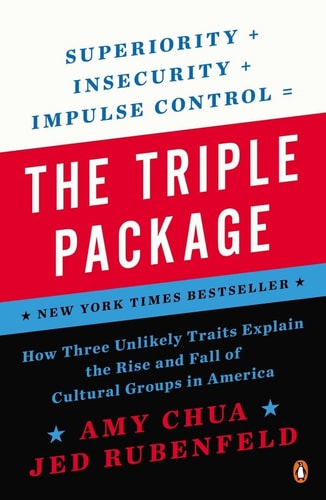
The Triple Package How Three Unlikely Traits Explain the Rise and Fall of Cultural Groups in America

Amy Chua,Jed Rubenfeld
"That certain groups do much better in America than others — as measured by income, occupational status, test scores, and so on — is difficult to talk about. In large part this is because the topic feels racially charged. The irony is that the facts actually debunk racial stereotypes. There are black and Hispanic subgroups in the United States far outperforming many white and Asian subgroups. Moreover, there’s a demonstrable arc to group success — in immigrant groups, it typically dissipates by the third generation — puncturing the notion of innate group differences and undermining the whole concept of 'model minorities.'" Mormons have recently risen to astonishing business success. Cubans in Miami climbed from poverty to prosperity in a generation. Nigerians earn doctorates at stunningly high rates. Indian and Chinese Americans have much higher incomes than other Americans; Jews may have the highest of all. Why do some groups rise? Drawing on groundbreaking original research and startling statistics, The Triple Package uncovers the secret to their success. A superiority complex, insecurity, impulse control—these are the elements of the Triple Package, the rare and potent cultural constellation that drives disproportionate group success. The Triple Package is open to anyone. America itself was once a Triple Package culture. It’s been losing that edge for a long time now. Even as headlines proclaim the death of upward mobility in America, the truth is that the old-fashioned American Dream is very much alive—but some groups have a cultural edge, which enables them to take advantage of opportunity far more than others. • Americans are taught that everyone is equal, that no group is superior to another. But remarkably, all of America’s most successful groups believe (even if they don’t say so aloud) that they’re exceptional, chosen, superior in some way. • Americans are taught that self-esteem—feeling good about yourself—is the key to a successful life. But in all of America’s most successful groups, people tend to feel insecure, inadequate, that they have to prove themselves. • America today spreads a message of immediate gratification, living for the moment. But all of America’s most successful groups cultivate heightened discipline and impulse control. But the Triple Package has a dark underside too. Each of its elements carries distinctive pathologies; when taken to an extreme, they can have truly toxic effects. Should people strive for the Triple Package? Should America? Ultimately, the authors conclude that the Triple Package is a ladder that should be climbed and then kicked away, drawing on its power but breaking free from its constraints. Provocative and profound, The Triple Package will transform the way we think about success and achievement.
Penguin 2015-01-27 352 pages

Administrative Behavior

Simon, Herbert A.
In this fourth edition of his ground-breaking work, Herbert A. Simon applies his pioneering theory of human choice and administrative decision-making to concrete organizational problems. To commemorate the fiftieth anniversary of the book's original publication, Professor Simon enhances his timeless observations on the human decision-making process with commentaries examining new facets of organizational behavior. Investigating the impact of changing social values and modem technology on the operation of organizations, the new ideas featured in this revised edition update a book that has become a worldwide classic. Named by Public Administration Review as "Book of the Half Century," Administrative Behavior is considered one of the most influential books on social science thinking, and was referred to by the Nobel Committee as "epoch-making." Written for managers and other professionals who wish to understand the decision-making processes at the heart of organization and management, it is also essential reading for students in business and management, economics, sociology, psychology computer science, government, and law.
The Macmillan Company 1957 259 pages

Management? It's Not What You Think!

Mintzberg, Henry,Ahlstrand, Bruce,Lampel, Joseph
Whether you subscribe to the philosophy that management is an art and not a science or that it’s a science composed of best practices and systemic steps, one thing is for sure: there is no one easy way to describe what managers do. In this inspiring book, Henry Mintzberg, one of today’s most respected and controversial thinkers on management, joins forces with other leading business figures to provide a provocative mix of writing on management that inspires laughter as much as it brings forth tears (for poor old management itself!). Management? It’s Not What You Think! gets readers thinking as they never have before on topics including management terminology and buzzwords, myths and maxims, MBAs, management fads, leadership, strategy, and much more. With wit, intrigue, and plenty of food for thought, Mintzberg presents articles, book and journal excerpts, letters, web selections, and musings that will spark debate in managers of all types and experiences and renew their interest in doing what they do best--managing.
AMACOM 2025-08-05 192 pages

The choice

Goldratt, Eliyahu M.,Goldratt-Ashlag, Efrat
"Eli Goldratt is known by millions of readers worldwide as a scientist, educator and business guru. His Theory of Constraints (TOC) is taught at business schools and MBA programs around the globe. Government agencies and businesses, large and small, have adopted his methodologies. TOC has been successfully applied in almost every area of human endeavor, from industry to healthcare to education. And while Eli Goldratt is indeed a scientist, an educator and a business leader, he is first and foremost a philosopher; some say a genius. He is a thinker who provokes others to do the same. In The Choice, Goldratt once again presents his thought-provoking approach, this time through a conversation with his daughter, Efrat, as they discuss his fundamental system of beliefs. Through examples and discussions, Eli Goldratt helps us understand, holistically, how the interrelation of emotions, intuition and logic influences our ability to think clearly and problem solve when making personal and professional decisions. Can every conflict be removed? Is every situation exceedingly simple? (no matter how complex it initially looks) Can every situation be substantially improved? Is there always a win-win solution? Dr. Goldratt exhorts his readers to examine and reassess their lives and business practices by cultivating a different perspective and a clear new vision. This revised edition includes Efrat's Notes - these notes and logical maps are helpful tools that assist in visualizing and implementing the thoughts and ideas expressed throughout this book"--
Routledge Taylor & Francis Group 2023 240 pages

Isn't it obvious

Eliyahu M. Goldratt,Ilan Eshkoli,Joe Brownleer
This book does for retail what Goldratt's International best-seller did for manufacturing. A breakthrough solution is exposed when some unexpected events force Caroline and Paul, a married couple working for their family's retail business, to make a few small changes in the way things are done. A solution that propels the family's regional chain of stores into a very profitable, rapidly growing, international enterprise. If there is a hint of Jonah, from THE GOAL, reappearing in this novel, it is Henry, the soon-to-retire president and majority owner of the company who logically states that, if you do not deal directly with the core problem, don't expect significant improvement. Eli Goldratt's Theory of Constraints is woven throughout this book but answers are not handed to you. The reader, along with the characters in the book, work through the process together to discover solutions.
North River Press 2009 232 pages

My journey

Karan, Donna
NAMED ONE OF THE BEST BOOKS OF THE YEAR BY HARPER’S BAZAAR • In this candid memoir, featuring a foreword by Barbra Streisand, renowned designer Donna Karan shares intimate details about her lonely childhood, her four-plus decades in the fashion industry, her two marriages, motherhood, and her ongoing quest for self-acceptance and spiritual peace. Donna Karan was born into the fashion business—her father was a tailor, and her mother was a showroom model and Seventh Avenue saleswoman—yet Karan dreamed of becoming a dancer like Martha Graham or a singer like Barbra Streisand. Fashion was her destiny, though. My Journey traces Karan’s early days as an intern at Anne Klein, the creation of her Seven Easy Pieces (which forever changed the way working women dressed), and the meteoric rise of her company. Along with juicy industry stories, Karan candidly discusses her difficult mother and traumatic childhood, her turbulent romantic life, all the loved ones she has lost over the years, and the personal awakening that occurred just as she reached the height of professional and financial success. That awakening set Karan down a path of spiritual discovery and self-improvement. From est to Kabbalah, from silent retreats to leech therapy, Karan tried everything to find, as she writes, “calm in the chaos.” But she also reveals how a chaotic life, fueled by endless curiosity and childlike impulses, helped her design seminal collections season after season for global powerhouse brands Donna Karan New York and DKNY. She also details how she has channeled her creativity (and her urge to solve problems and nurture others) into philanthropic work, particularly her early outspoken advocacy for AIDS awareness and research, and the creation of her Urban Zen Foundation, focusing on integrated healthcare and education as well as preservation of culture, which led to her current efforts in Haiti. Karan’s life has been crowded with glamorous characters and adventures around the world. But she sometimes still feels like that awkward teen from Long Island who never fit in—which makes her all the more endearing. Brimming with Karan’s infectious energy, My Journey is about much more than the fashion world: It is the story of a young woman whose vision and hard work made her a role model for women everywhere—a woman who dreamed big, fought to have it all, broke the rules, and loved passionately along the way. Praise for My Journey “By turns moving, insightful, and hilarious, yet always, always heartfelt . . . When you’re a true force of fashion, nothing holds you back.” — Vogue “When Donna Karan stepped down . . . it was the end of an era, so consider this autobiography her parting gift. . . . Expect a holistic view of the woman behind one of the most influential American labels.” — StyleCaster “Donna’s creativity and passion as a committed philanthropist are matched only by her gift for friendship. Whether she’s making the world more beautiful or giving a Haitian artisan the tools to create a sustainable business, Donna has always led with great heart and wonderful humor.” —President Bill Clinton “What we take for granted often comes from the most revolutionary of sources. In New York in the 1980s, no one was more radical than Donna Karan. She created a way of dressing that was womanly, practical, and empowering.” —Anna Wintour “An extraordinary personal, professional, and spiritual life . . . defined by Donna’s incredible resilience, her inward search for calm in the midst of success, and her insistence on always following her heart.” —Arianna Huffington
Ballantine Books 2015-10-13 363 pages