655 results for "History"

What Hitler Wants

Leon Trotsky
""What Hitler Wants"" is a political analysis written by Leon Trotsky in 1933, shortly after Adolf Hitler and the Nazi Party came to power in Germany. The book explores the motivations, goals, and strategies of the Nazi regime, particularly in regards to its expansionist ambitions and its hostility towards the Soviet Union. Trotsky argues that Hitler's regime is driven by a desire for territorial conquest and domination, fueled by a toxic blend of racism, nationalism, and anti-communism. He also critiques the policies of the Western powers, particularly their appeasement of Hitler and their failure to recognize the threat posed by fascism. The book is a powerful warning against the dangers of fascism and the need for international solidarity in the face of authoritarianism.This scarce antiquarian book is a facsimile reprint of the old original and may contain some imperfections such as library marks and notations. Because we believe this work is culturally important, we have made it available as part of our commitment for protecting, preserving, and promoting the world's literature in affordable, high quality, modern editions, that are true to their original work.
Literary Licensing, LLC 2011-07 30 pages

Blood and Steel; An Exposure of the 12-Hour Day in the Steel Industry

Jay Lovestone
Hardcover reprint of the original 1923 edition; hardbound in brown cloth with gold stamped lettering, 8vo - 6x9''. This item is printed on demand as a collector quality facsimile, crafted to hold its own in a library of first editions. Book Information: Lovestone, Jay . Blood and Steel; An Exposure of the 12-Hour Day in the Steel Industry. Indiana: Repressed Publishing LLC, 2012. Original Publishing: Lovestone, Jay . Blood and Steel; An Exposure of the 12-Hour Day in the Steel Industry. New York, Workers Party Of America, 1923. Subject: Wages, Iron and steel workers, United States, Hours of labor, United States, Steel Strike, U.S., 1919-1920.
Repressed Publishing 2015-01-01 34 pages

The Widening Circle of Genocide: Genocide - A Critical Bibliographic Review

Charny, Israel W.
This important study introduces the conceptual premise that families, like firms, analyze their circumstances, make decisions, and pursue courses of action on the basis of what they perceive to be the most efficient methods for producing and reproducing survival. Combining this premise with an extraordinary assemblage of facts gleaned over the period of a decade from the streets, markets and homes of Port-au-Prince, the author weaves a tapestry of despair and hope which only an unusual degree of intimacy with the details of everyday life in the city could provide. The result is a considerable deepening of understanding about the politics and economics by which family members earn their livelihoods, distribute resources within and between households, produce life and labor from food and water, provide shelter and schooling for themselves, and borrow money to finance these and other activities.These different dimensions of daily existence form a web of interdependency in which change in any one dimension causes change in all the others. As Professor Pass's work demonstrates, research and development assistance practices of public and private organizations, in such areas as employment, health, housing, education and credit are often irrelevant. This is because they are necessarily guided by prevailing concepts and theories with respect to the circumstances of the urban poor, which sometimes do the poor considerable disservice.With the additional insight provided by a decade of participation in the design of policies, programs and projects serving as a tempering influence, the author does not leap to easy criticism of prevailing views and practices. He notes that ideas and interventions change in response to new understanding, sometimes in ways that the producers of such understanding could never have imagined. The problem is that change is painfully slow, and in desperately poor countries like Haiti, waiting for change exacts an almost intolerable pric
Routledge 2018-04-16 375 pages

Zionism, Israel and the Arabs

Hal Draper
This series of essays by the late Hal Draper looks at the Middle East conflict from what was long a unique point of view. Unlike traditional Zionism whose slogan "a land without people for a people without a land" made clear its intentions with regard to the Palestinians and unlike Arab nationalists who denied Israel's right to exist; Draper argued that only a binational state that recognized the rights of both people offered a way out
CreateSpace Independent Publishing Platform 2010-11-03 228 pages

Karl Marx's theory of revolution. Vol. 2. The politics of social classes

Draper, Hal
This is the second installment of Hal Draper’s incomparable treatment of Marx’s political theory, policy, and practice. In forceful and readable language, Draper ranges through the development of the thought of Marx and Engels on the role of classes in society. This series, Karl Marx’s Theory of Revolution, represents an exhaustive and definitive treatment of Marx’s political theory, policy, and practice. Marx and Engels paid continuing attention to a host of problems of revolution, in addition to constructing their “grand theory.” All these political and social analyses are brought together in these volumes, as the author draws not only on the original writings of Marx and Engels but also on the sources that they used in formulating their ideas and the many commentaries on their published work. Draper’s series is a massive and immensely valuable scholarly undertaking. The bibliography alone will stand as a rich resource for years to come. Yet despite the scholarly treatment, the writing is direct, forceful, and unpedantic throughout, and will appeal to the beginning student as much as the advanced reader.
Monthly Review Press 1978-01-01 768 pages

Karl Marx's theory of revolution. Vol 4. Critique of other socialisms

Draper, Hal
Much of Karl Marx's most important work came out of his critique of other thinkers, including many socialists who differed significantly in their conceptions of socialism. The fourth volume in Hal Draper's series looks at these critiques to illuminate what Marx's socialism was, as well as what it was not. Some of these debates are well-known elements in Marx's work, such as his writings on the anarchists Proudhon and Bakunin. Others are less familiar, such as the writings on "Bismarckian socialism" and "Boulangism," but promise to become better known and understood with Draper's exposition. He also discusses the more general ideological tendencies of "utopian" and "sentimental" socialisms, which took various forms and were ingredients in many different socialist movements.
Monthly Review Press 1990-01-01 373 pages

The Nurturing Neighborhood The Brownsville Boys' Club and Jewish Community in Urban America, 1940-1990

Gerald Sorin
Drawing heavily on the reminiscences of the Brownsville boys themselves, and skillfully integrating these with material from newspapers, books, and commentary of the time, Sorin creates an original and compelling picture of the communal and individual vitality that allowed an unusual and heartening social achievement.
NYU Press 1992 272 pages

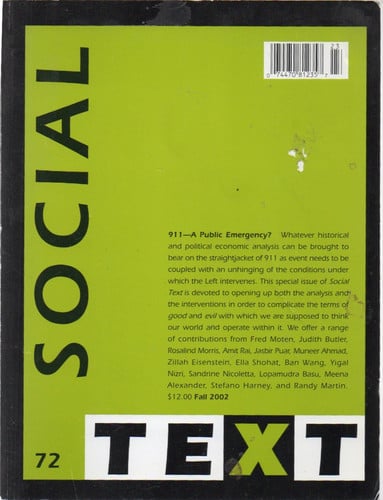
911 a Public Emergency?

Brent Hayes Edwards,Stefano Harney,Randy Martin,Ella Shohat,Timothy Mitchell,Fred Moten
Since September 11, public discourse has often been framed in terms of absolutes: an age of innocence gives way to a present under siege, while the United States and its allies face off against the Axis of Evil. This special issue of Social Text aims to move beyond these binaries toward thoughtful analysis. The editors argue that the challenge for the Left is to develop an antiterrorism stance that acknowledges the legacy of U.S. trade and foreign policy as well as the diversity of the Muslim faith and the dangers presented by fundamentalism of all kinds. Examining the strengths and shortcomings of area, race, and gender studies in the search for understanding, this issue considers cross-cultural feminism as a means of combating terrorism; racial profiling of Muslims in the context of other racist logics; and the homogenization of dissent. The issue includes poetry, photographic work, and an article by Judith Butler on the discursive space surrounding the attacks of September 11. This impressive range of contributions questions the meaning and implications of the events of September 11 and their aftermath. Contributors . Muneer Ahmad, Meena Alexander, Lopamudra Basu, Judith Butler, Zillah Eisenstein, Stefano Harney, Randy Martin, Rosalind C. Morris, Fred Moten, Sandrine Nicoletta, Yigal Nizri, Jasbir K. Puar, Amit S. Rai, Ella Shohat, Ban Wang
Duke University Press 2002-09-20 208 pages

Evolutionary Socialism

Eduard Bernstein
Evolutionary Socialism was Bernstein's most significant work, and it set the stage for the Democratic Socialism of today. In Evolutionary Socialism, Bernstein was principally concerned with refuting Karl Marx's predictions about the imminent and inevitable demise of capitalism. Bernstein warned that a violent proletarian revolution, as in France in 1848, produced only reactionary successes, which undermined workers' interests. Therefore, he rejected revolution and instead insisted the best strategy to be patiently building up a durable social movement working for continuous nonviolent incremental change.
Lulu.com 2021-07-15 108 pages

Varieties of Marxism

Shlomo Avineri
The essays included in this volume are based on papers delivered at the International Symposium on Varieties of Marxism, held at the Van Leer Jerusalem Foundation on June 16-19,1974, and dedicated to the memory of George Lichtheim. When the idea of such a symposium was first raised, the organizers planned to have George Lichtheim as one of the main speakers at the event. In our last and brief meeting in London, I suggested this to him and Lichtheim gave his consent to attend the symposium, though at that time no date was yet fixed. His tragic death a few months later left a gap not only in the program of the symposium but in Marxist studies generally; it was felt that per haps one way of paying tribute to his contribution to the study of a subject so near to his mind would be to name the symposium in his memory and devote an introductory paper to an attempt at an intel lectual portrait of George Lichtheim as an historian of ideas. The volume as published includes all papers delivered at the sym posium, with the excep,tion of the papers of J. L. Talmon (Jerusalem) on 'Marxism and Nationalism' and Gajo Petrovic (Zagreb) on 'Yugo slav Marxism'. Appended is also a short obituary written by me on Lichtheim for the journal Political Science published by the American Political Science Association.
Springer Netherlands 2011-10-12 404 pages