
651 results for "Science"

Navigating public opinion: polls, policy, and the future of American democracy

Professor of Sociology Jeff Manza,Jeff Manza,Fay Lomax Cook,Professor of Human Development and Social Policy in the School of Education and Social Policy Fay Lomax Cook,Benjamin I. Page,Gordon Scott Fulcher Professor of Decision Making in the Department of Political Science Benjamin I Page
Do politicians listen to the public? How often and when? Or are the views of the public manipulated or used strategically by political and economic elites? Navigating Public Opinion brings together leading scholars of American politics to assess and debate these questions. It describes how the relationship between opinion and policy has changed over time; how key political actors use public opinion to formulate domestic and foreign policy; and how new measurement techniques might improve our understanding of public opinion in contemporary polling and survey research. The distinguished contributors shed new light on several long-standing controversies over policy responsiveness to public opinion. Featuring a new analysis by Robert Erikson, Michael MacKuen, and James Stimson that builds from their pathbreaking work on how public mood moves policy in a macro-model of policymaking, the volume also includes several critiques of this model by Lawrence Jacobs and Robert Shapiro, another critique by G. William Domhoff, and a rejoinder by Erikson and his coauthors. Other highlights include discussions of how political elites, including state-level policymakers, presidents, and makers of foreign policy, use (or shape) public opinion; and analyses of new methods for measuring public opinion such as survey-based experiments, probabilistic polling methods, non-survey-based measures of public opinion, and the potential and limitations of Internet polls and surveys. Introductory and concluding essays provide useful background context and offer an authoritative summary of what is known about how public opinion influences public policy. A must-have for all students of American politics, public opinion, and polling, this state-of-the-art collection addresses issues that lie at the heart of democratic governance today.
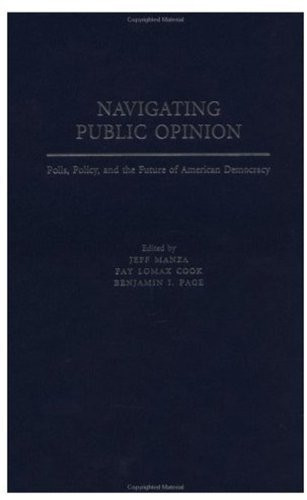
Oxford University Press 2002 376 pages

Carnival of Chaos On the Road with the Nomadic Festival

Sascha Altman DuBrul
Nonfiction. This is a document about an underground movement we're slowly bridging together through scattered clans of free thinkers, rebels and artists: groups of angry young people fed up living paycheck to paycheck in the wageslave braindeath passive observer (sub)urban trap that is our daily backdrop. An underground movement that has its poetic roots in the old traditions of traveling gypsies and pirates but is alive and well and lurking outside your door and maybe stirring somewhere in your hearts right at this very minute.
Bloodlink Press 1997 124 pages

Commies A Journey Through the Old Left, the New Left and the Leftover Left (Large Print 16pt)

Ronald Radosh
Ronald Radosh's earliest memory is of being trundled off to May Day celebrations by his communist parents with a Soviet flag stuck in his baby carriage. Then came education at New York's ''little red schoolhouse.'' Summers at ''commie camp.'' And college at the University of Wisconsin where he became a founding father of the New Left. Commies is a brilliant memoir of growing up in the culture of radicalism. But it also about the hard decisions faced by those professing a radical faith. For Radosh himself, the crisis came when he concluded in his authoritative book on Julius and Ethel Rosenberg that the couple (on whose behalf he had demonstrated as a boy) had indeed been guilty of spying. Attacked as a ''traitor,'' Radosh began to question his political commitments. His disillusionment climaxed in the 1980s when he traveled through Central America as a journalist and historian and ran into his old comrades there still searching for the revolution. One journalist calls Ronald Radosh ''the Zelig of the American Left, seen everywhere and knowing everyone.'' Humorous and tragic, filled with anecdote and personality, Commies is a trip log of his journey, the most intimate look yet at the experience of a radical generation.
ReadHowYouWant.com 2010-06 332 pages

Cry Havoc! The Great American Bring-down and how it Happened

Ralph de Toledano
In Cry Havoc!, legendary journalist Ralph de Toledano documents in chilling detail how a cabal of intellectuals, educrats, and politicians, manipulated by a well-financed, world-wide conspiracy, organized a strategy to undermine the American system -- and how this has been accomplished."Cry Havoc is must-reading." -- William F. Buckley, Jr."Cry Havoc is not only well written, but absolutely right." -- Prof. Herbert London
Anthem Books 2006 254 pages

American Taboo A Murder in the Peace Corps

Philip Weiss
In 1975, a new group of Peace Corps volunteers landed on the island nation of Tonga. Among them was Deborah Gardner -- a beautiful twenty-three-year-old who, in the following year, would be stabbed twenty-two times and left for dead inside her hut. Another volunteer turned himself in to the Tongan police, and many of the other Americans were sure he had committed the crime. But with the aid of the State Department, he returned home a free man. Although the story was kept quiet in the United States, Deb Gardner's death and the outlandish aftermath took on legendary proportions in Tonga. Now journalist Philip Weiss "shines daylight on the facts of this ugly case with the fervor of an avenging angel" (Chicago Tribune), exposing a gripping tale of love, violence, and clashing ideals. With bravura reporting and vivid, novelistic prose, Weiss transforms a Polynesian legend into a singular artifact of American history and a profoundly moving human story.
HarperCollins 2005-06-28 416 pages

City by city: dispatches from the American metropolis

Keith Gessen,Stephen Squibb
"A collection of essays--historical and personal--about the present and future of American cities Edited by Keith Gessen and Stephen Squibb, City by City is a collection of essays--historical, personal, and somewhere in between--about the present and future of American cities. It sweeps from Gold Rush, Alaska, to Miami, Florida, encompassing cities large and small, growing and failing. These essays look closely at the forces--gentrification, underemployment, politics, culture, and crime--that shape urban life. They also tell the stories of citizens whose fortunes have risen or fallen with those of the cities they call home. A cross between Hunter S. Thompson, Studs Terkel, and the Great Depression-era WPA guides to each state in the Union, City by City carries this project of American storytelling up to the days of our own Great Recession"--
n + 1/FARRAR, Straus and Giroux 2015-05-12 483 pages

The Forgotten Americans

John E. Schwarz,Thomas J. Volgy
Does the American Dream still exist when nearly 30 million Americans live in families in which workers find a paycheck and poverty in the same envelope? Just as Michael Harrington's The Other America shocked the nation with its disclosure of poverty in the 1960s, John E. Schwarz and Thomas J. Volgy's The Forgotten Americans exposes the breadth of poverty that exists today among responsible, hardworking Americans. At the end of the prosperous 1980s, the number of Americans living in working-poor families equaled the combined populations of the nation's 25 largest cities. Contrary to conventional wisdom, this situation is not largely confined to minorities, women, the undereducated or young adults. It is commonplace for workers from nearly all segments of society to be employed in low-paying jobs even during good economic times. The Forgotten Americans reveals the betrayal of the hopes and expectations of these industrious people through broad-based factual evidence and the real-life stories of individual families. Their hardship has been ignored at enormous cost to them and the country. Numerous problems at the forefront of national debate--welfare dependency, crime, and the inadequate performance of many American school children--are closely connected to the existence of working poverty on a large scale. Unless corrective action is taken, the country risks the creation of a deeply fractured society arising from the despair of millions of employed people who have discovered that practicing the work ethic yields little reward. The problem is staggering and often misunderstood by politicians, the media, and the public. Once Schwarz and Volgy have outlined the implications of this social and economic tragedy, they propose effective solutions that require simple changes to existing policies--solutions that are politically feasible and can be accomplished without new taxes.
W. W. Norton & Company 1993 219 pages

Jacob's Voices Reflections of a Wandering American Jew

Jerold S. Auerbach
An American professor of history finds his roots in a personal journey through Israel -- and through assimilated America, academia, baseball, and family -- headlong into deep tensions and ambivalence about country, culture, identity and religion. Worried about the commitment of Jews to their heritage, Jerold Auerbach (renowned author of Unequal Justice) shares his story and musings with insight, irony, and intensity. A personal journey, literally and spiritually, to Israel by one of the most recognized legal historians in the United States.
Quid Pro, LLC 2010-07-13 172 pages

Berkeley The Student Revolt

Hal Draper
"There's a time when the operation of the machine becomes so odious, makes you so sick at heart, that you can't take part! You can't even passively take part! And you've got to put your bodies upon the gears and upon the wheels ... upon the levers, upon all the apparatus, and you've got to make it stop!" These fiery words of protest, spoken by Mario Savio during the Berkeley Free Speech Movement, became a call to action that helped galvanize an entire generation of radicals during the 1960s. Led by student politicized through the fight for Civil Rights, the movement would reshape the American left and influence a generation of protesters across the globe. In this rousing and insightful participant's account, Hal Draper recounts the now iconic events of the FSM. From the impromptu speak out atop a police car after the administration decided to clamp down on students "distributing communist literature," to the inspiring Student Strike that shut down the entire campus, Draper's narrative captures the energy and dynamism of each twist and turn in the struggle, and offers invaluable analysis along the way. Brimming with lessons still relevant for today's activists, Berkeley: The Student Revolt is a classic of on-the-ground historical reportage.
Haymarket Books 2020-06-02 280 pages

The Production and Distribution of Knowledge in the United States

Fritz Machlup
The Production And Distribution Of Knowledge In The United States is a comprehensive book written by Fritz Machlup that explores the ways in which knowledge is produced and disseminated in the United States. The book covers a wide range of topics related to knowledge production and distribution, including the role of universities, scientific research, and intellectual property rights. Machlup also examines the impact of technology on knowledge production and distribution, as well as the ways in which knowledge is used in various sectors of the economy. The book provides a detailed analysis of the complex processes involved in the creation and dissemination of knowledge, and offers insights into the challenges and opportunities facing knowledge-based industries in the United States. Overall, The Production And Distribution Of Knowledge In The United States is a valuable resource for anyone interested in understanding the dynamics of knowledge production and distribution in modern society.This scarce antiquarian book is a facsimile reprint of the old original and may contain some imperfections such as library marks and notations. Because we believe this work is culturally important, we have made it available as part of our commitment for protecting, preserving, and promoting the world's literature in affordable, high quality, modern editions, that are true to their original work.
Literary Licensing, LLC 2012-08 436 pages

From Suburb to Shtetl The Jews of Boro Park

Egon Mayer,William B. Helmreich
"From Suburb to Shtetl" is an outstanding ethnography that moves beyond simple demographics. Mayer weaves an intricate tapestry of how family, school, and community leaders influence each other. Whether discussing the role of the rebbe or the matchmaker, those who know these communities will find what he says as relevant today as it was when first penned. This is hardly surprising, for the ultra-Orthodox community takes great pride in not changing, in maintaining itself as it was in Europe despite the allure of modern American society. His discussion of synagogue life is particularly informative and evocative. Those in charge of helping immigrants adopted the path of least resistance, allowing and even encouraging them to retain their identities except for those few aspects that might threaten the country's national interests. The American Orthodox community was tremendously augmented by the arrival from Europe, after World War Two, of thousands of Orthodox Jews who remained devoted to that way of life. Egon Mayer was himself part of a smaller, but significant group of Jews who came to the U.S. and settled mostly in Boro Park in the wake of the 1956 Hungarian Revolution. The interaction between the Hasidim and their less fervent Orthodox counterparts described and analyzed in this volume tells us a great deal about how people negotiate their beliefs, values, and norms when forced into close contact with each other in an urban setting within the larger American culture. By exploring these and many other related issues Mayer has given us the chance to assess and forecast the future of American Jewish life as a whole.
Taylor & Francis Group 2017-10-12 214 pages

David Thompson

James K. Smith
Surveyor, fur-trader and explorer, David Thompson was the first European to descend the Columbia River from its source to its mouth. A partner in the North West Company, Thompson explored western Canada exhaustively, and the maps he produced became the basis for many future maps of the region. Thompson first came to Canada in 1784 as a clerk for the Hudson's Bay Company. He spent several years gaining knowledge of the fur trade, making extensive expeditions and learning the ways of the aboriginal peoples. After learning the use of sextant, chronometer, telescope, compass and nautical almanac, surveying became his primary interest. He explored new territory whenever possible, keeping detailed journals of his bearings and weather conditions, and charted all of his journeys.
Fitzhenry & Whiteside 2003 64 pages