1464 results for "Jewish History"

The trial of God (as it was held on February 25, 1649, in Shamgorod): a play in three acts

Wiesel, Elie
It is the holiday of Purim -- a time to stage comic and entertaining plays or "Purimshpiels". But in the village of Shamgorod in 1649, this festive custom takes a tragic turn. Three itinerant actors show up at an inn to perform a Purim play for the Jewish community. The discovery that Shamgorod has suffered a pogrom and only two Jews have survived -- the innkeeper, Berish, and his daughter. Egged on by Berish, the actors agree that instead of a "Purimshpiel" they will stage a mock trial of God, indicting Him for allowing such things to happen to His children. Berish wants to be the Prosecutor; the three actors agree to be the Judges. But who will be Defense Attorney? A Stranger, who looks oddly familiar to all of them, appears and offers to take the role. Meanwhile the mob outside is planning a new assault on the inn. -- From publisher's description.
Schocken Books 1986 161 pages

The shaping of Jewish identity in nineteenth-century France

Berkovitz, Jay R.
Nineteenth-century French Jewry was a community struggling to meet the challenges of emancipation and modernity. This struggle, with its origins in the founding of the French nation, constitutes the core of modern Jewish identity. With the Revolution of 1789 came the collapse of the social, political, and philosophical foundations of exclusiveness, forcing French society and the Jews to come to terms with the meaning of emancipation. Over time, the enormous challenge that emancipation posed for traditional Jewish beliefs became evident. In the 1830s, a more comprehensive ideology of regeneration emerged through the efforts of younger Jewish scholars and intellectuals. A response to the social and religious implications of emancipation, it was characterized by the demand for the elimination of rituals that violated the French conceptions of civilization and social integration; a drive for greater administrative centralization; and the quest for inter-communal and ethnic unity. In its various elements, regeneration formed a distinct ideology of emancipation that was designed to mediate Jewish interaction with French society and culture. Jay Berkovitz reveals the complexities inherent in the processes of emancipation and modernization, focusing on the efforts of French Jewish leaders to come to terms with the social and religious implications of modernity. All in all, his emphasis on the intellectual history of French Jewry provides a new perspective on a significant chapter of Jewish history.
Wayne State University Press 2018-02-05 308 pages

Why history matters: life and thought

Lerner, Gerda
All human beings are practicing historians," writes Gerda Lerner. "We live our lives; we tell our stories. It is as natural as breathing." It is as important as breathing, too. History shapes our self-definition and our relationship to community; it locates us in time and place and helps to give meaning to our lives. History can be the vital thread that holds a nation together, as demonstrated most strikingly in the case of Jewish history. Conversely, for women, who have lived in a world in which they apparently had no history, its absence can be devastating. In Why History Matters, Lerner brings together her thinking and research of the last sixteen years, combining personal reminiscences with innovative theory that illuminate the importance of history and the vital role women have played in it.Why History Matters contains some of the most significant thinking and writing on history that Lerner has done in her entire career--a summation of her life and work. The chapters are divided into three sections, each widely different from the others, each revelatory of Lerner as a woman and a feminist. We read first of Lerner's coming to consciousness as a Jewish woman. There are moving accounts of her early life as a refugee in America, her return to Austria fifty years after fleeing the Nazis (to discover a nation remarkable both for the absence of Jews and for the anti-Semitism just below the surface), her slow assimilation into American life, and her decision to be a historian. If the first section is personal, the second focuses on more professional concerns. Included here is a fascinating essay on nonviolent resistance, tracing the idea from the Quakers (such as Mary Dyer), to abolitionists such as Theodore Dwight Weld (the "most mobbed man" in America), to Thoreau's essay Civil Disobedience, then across the sea to Tolstoy and Gandhi, before finally returning to America during the civil rights movement of the 1950s. There are insightful essays on "American Values" and on the tremendous advances women have made in the twentieth century, as well as Lerner's presidential address to the Organization of American Historians, which outlines the contributions of women to the field of history and the growing importance of women as a subject of history. The highlight of the final section of the book is Lerner's bold and innovative look at the issues of class and race as they relate to women, an essay that distills her thinking on these difficult subjects and offers a coherent conceptual framework that will prove of lasting interest to historians and intellectuals.A major figure in women's studies and long-term activist for women's issues, a founding member of NOW and a past president of the Organization of American Historians, Gerda Lerner is a pioneer in the field of Women's History and one of its leading practitioners. Why History Matters is the summation of the work and thinking of this distinguished historian.
Oxford University Press 1997 249 pages

Flags Over the Warsaw Ghetto

Moshe Arens
The Warsaw Ghetto Uprising has become a symbol of heroism throughout the world. A short time before the uprising began, Pawel Frenkel addressed a meeting of the Jewish Military fighters: Of course we will fight with guns in our hands, and most of us will fall. But we will live on in the lives and hearts of future generations and in the pages of their history.... We will die before our time but we are not doomed. We will be alive for as long as Jewish history lives! On the eve of Passover, April 19, 1943, German forces entered the Warsaw ghetto equipped with tanks, flame throwers, and machine guns. Against them stood an army of a few hundred young Jewish men and women, armed with pistols and Molotov cocktails. Who were these Jewish fighters who dared oppose the armed might of the SS troops under the command of SS General Juergen Stroop? Who commanded them in battle? What were their goals? In this groundbreaking work, Israel s former Minister of Defense, Prof. Moshe Arens, recounts a true tale of daring, courage, and sacrifice that should be accurately told out of respect for and in homage to the fighters who rose against the German attempt to liquidate the Warsaw ghetto, and made a last-ditch fight for the honor of the Jewish people. The generally accepted account of the Warsaw Ghetto Uprising is incomplete. The truth begins with the existence of not one, but two resistance organizations in the ghetto. Two young men, Mordechai Anielewicz of the Jewish Fighting Organization (ZOB), and Pawel Frenkel of the Jewish Military Organization (ZZW), rose to lead separate resistance organizations in the ghetto, which did not unite despite the desperate battle they were facing. Included is the complete text of The Stroop Report translated into English.
Amazon Digital Services LLC - Kdp 2019-04-16 416 pages

Chaim Weizmann

Reinharz, Jehuda
In the pantheon of modern Jewish leaders, Chaim Weizmann is a giant. One of the founding fathers of the State of Israel and its first president, he was also a president of the World Zionist Organization, and an eminent chemist, for whom Israel's renowned Weizmann Institute of Science was named. Yet, until now, there has never been an authoritative biography of Weizmann that removed the layers of myth obscuring our image of the man. Both a personal portrait of a fascinating man and a far-reaching history of the Jews in the modern world, this book, written by one of America's leading authorities on Jewish history, delves into the factors that shaped Weizmann's personality and worldview. Though the book focuses on the making of Weizmann as a Zionist leader, it also lays the foundations for understanding his extraordinary achievements as a scientist. This volume, the first of two that will cover his entire career, ends when, at the age of 40, Weizmann is thrust onto the center stage of world politics as a major negotiator for the Balfour Declaration.
Oxford University Press 1985 566 pages

Image before my eyes: a photographic history of Jewish life in Poland before the Holocaust

Dobroszycki, Lucjan
"The Jews of Poland between the World Wars come alive in this photographic essay in all their diversities....One imagines that Polish Jewry would have wanted to be remembered thus -- looking out to the camera and the world beyond." -- Ruth R. Wisse "Reveals a vibrantly rich kaleidoscope of life using many great photographs, some known, others never seen before. A volume to read, to study, to treasure." -- Cornell Capa "Beautifully balanced to serve the fascinating truth of a civilization that vanished into the darkest folds of history....All this seems so distant and yet so familiar, for although they are gone, they are family, and it was just yesterday." -- Mark Helprin "A poignant and visually beautiful reconstitution of the varied, culturally rich, and endlessly fascinating lost world of Polish Jews. Reading it makes one glow with pride." -- Louis Begley "If you're Jewish and looking for your roots and the world of your grandfathers, this is the book for you. If you're not Jewish, but just curious, this book is for you....It can take you on a voyage into a world that vanished in the gas and smoke of the Holocaust." -- Lucy S. Dawidowicz "One of the most extraordinary photographic histories ever assembled....An entire people and culture, now gone from the face of the earth, comes forth from its pages with an animation and vitality so powerful that the tragedy of the end of Polish Jewry seems for a moment, miraculously suspended." -- Simon Schama
Schocken Books 1994-11-01 269 pages

Re-inventing the Jewish past: European Jewish intellectuals and the Zionist return to history

Myers, David N.
David Myers' book explores a fascinating and untold chapter in modern Jewish intellectual history: the role of the first generation of Jewish scholars at the Hebrew University in Jerusalem in establishing Jewish studies within framework of a jewish national university. committed to rewriting jewsh history according to zionst standarts, these "jerusalem scholars" richly reflect the tensions that attended their dual allegiances, to both zionism and the discipline of history
Oxford University Press 1995-11-30 278 pages

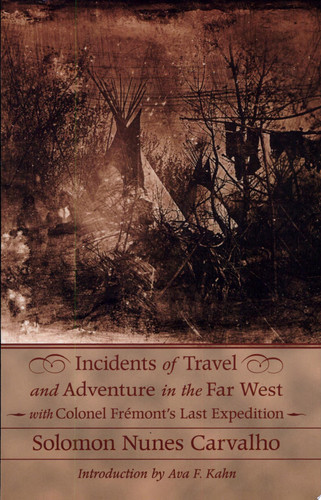
Incidents of travel and adventure in the Far West: with Colonel Fremont's last expedition across the Rocky Mountains, including three months' residence in Utah, and a perilous trip across the great American desert to the Pacific

Carvalho, Solomon Nunes
n August 1853, an American-born Sephardic Jew, Solomon Nunes Carvalho, accepted John Fremont's invitation to join his fifth expedition to find the best overland route to California. A Baltimore artist, inventor, and daguerreotypist, Carvalho was given the job of creating a photographic record of the lands and peoples along the way. Fremont's party left the Missouri on September 14, 1853, traveled up the Kansas River, overland to the Arkansas, upriver past Bent's Fort to the Huerfano, and traversed the Sandhill Pass into the Rocky Mountains. Beset by heavy snows and intense cold, they were reduced to eating their horses and mules and the occasional beaver or porcupine while making their way in midwinter across the Grand, Green, and Sevier Rivers. Suffering from frostbite, scurvy, and dysentery, Carvalho left the expedition in Utah; spent four months among the Mormons in Salt Lake City, where he observed with keen interest their system of spiritual wives; and reached California in 1854. Carvalho became the first Jewish writer to publish accounts of the Great American West and was also one of the first people to photograph the American West. Although only one of his plates is known to survive, others became the models for wood and steel engravings that broadcast the image of the West throughout the world. This Bison Books edition restores the discourses on Mormon doctrine omitted from previous twentieth-century editions. Ava F. Kahn is a visiting scholar at the California Studies Center, University of California, Berkeley. Her books include Jewish Voices of the California Gold Rush: A Documentary History, 1849-1880; Jewish Life in the American West: Perspectives on Migration, Settlement, and Community; and California Jews (coedited with Marc Dollinger).
University of Nebraska Press 2004-01-01 130 pages

Unsettled: an anthropology of the Jews

Konner, Melvin
Presented as an anthropoligist's view of Jewish culture and history, antisemitism is noted in terms of Christianity and contempt for Jews in terms of Islam (chs. 7 and 6, respectively). The Holocaust (including religious responses and literature) is the topic of ch. 13, "Smoke: How the Germans Gave the Jews Graves in the Air, " and reistance that of ch. 14, "Fire: How the Jews Fought Back."
Viking Compass 2003 500 pages

Zionism: an emotional state

Penslar, Derek Jonathan
"Emotion lies at the heart of all national movements, and Zionism is no exception. For those who identify as a Zionist, the word connotates liberation and redemption, uniqueness and vulnerability. Yet for many, Zionism is a source of distaste if not disgust, and those who reject it are no less passionate than those who embrace it. The power of such emotions helps explain why a word originally associated with territorial aspiration has survived for so many years after the establishment of the Israeli State. Zionism: An Emotional State expertly demonstrates how the energy propelling the Zionist project originates from bundles of feelings whose elements have varied in volume, intensity, and durability across space and time. Beginning with an original typology of Zionism and a new take on its relationship to colonialism, Penslar then examines the emotions that have shaped Zionist sensibilities and practices over the course of the movement's history. The resulting portrait of Zionism reconfigures how we understand Jewish Identity amidst continuing debates on the role of nationalism in the modern world"--
Rutgers University Press 2023 321 pages

Rywka's Diary: The Writings of a Jewish Girl from the Lodz Ghetto

Lipszyc, Rywka,Friedman, Anita
Product Description The newly discovered diary of a Polish teenager in the Lodz ghetto during World War II—originally published by Jewish Family & Children’s Services of San Francisco, now available in a revised, illustrated, and beautifully designed trade edition. After more than seventy years in obscurity, the diary of a teenage girl during the Holocaust has been revealed for the first time. Rywka’s Diary is at once an astonishing historical document and a moving tribute to the many ordinary people whose lives were forever altered by the Holocaust. At its heart, it is the diary of a girl named Rywka Lipszyc who detailed the brutal conditions that Jews in the Lodz ghetto, the second largest in Poland, endured under the Nazis: poverty, hunger and malnutrition, religious oppression, and, in Rywka’s case, the death of her parents and siblings. Handwritten in a school notebook between October 1943 and April 1944, the diary ends literally in mid-sentence. What became of Rywka is a mystery. A Red Army doctor found her notebook in Auschwitz after its liberation in 1945 and took it back with her to the Soviet Union. Rywka’s Diary is also a moving coming-of-age story, in which a young woman expresses her curiosity about the world and her place in it and reflects on her relationship with God—a remarkable affirmation of her commitment to Judaism and her faith in humanity. Interwoven into this carefully translated diary are photographs, news clippings, maps, and commentary from Holocaust scholars and the girl’s surviving relatives, which provide an in-depth picture of both the conditions of Rywka's life and the mysterious end to her diary. Moving and illuminating, told by a brave young girl whose strong and charismatic voice speaks for millions, Rywka’s Diary is an extraordinary addition to the history of the Holocaust and World War II. From the Back Cover The newly discovered diary of a Polish teenager in the Lodz ghetto during World War II—originally published by Jewish Family & Children’s Services of San Francisco, now available in a revised, illustrated, and beautifully designed trade edition. After more than seventy years in obscurity, the diary of a teenage girl during the Holocaust has been revealed for the first time. Rywka’s Diary is at once an astonishing historical document and a moving tribute to the many ordinary people whose lives were forever altered by the Holocaust. At its heart, it is the diary of a girl named Rywka Lipszyc who detailed the brutal conditions that Jews in the Lodz ghetto, the second largest in Poland, endured under the Nazis: poverty, hunger and malnutrition, religious oppression, and, in Rywka’s case, the death of her parents and siblings. Handwritten in a school notebook between October 1943 and April 1944, the diary ends literally in mid-sentence. What became of Rywka is a mystery. A Red Army doctor found her notebook in Auschwitz after its liberation in 1945 and took it back with her to the Soviet Union. Rywka’s Diary is also a moving coming-of-age story, in which a young woman expresses her curiosity about the world and her place in it and reflects on her relationship with God—a remarkable affirmation of her commitment to Judaism and her faith in humanity. Interwoven into this carefully translated diary are photographs, news clippings, maps, and commentary from Holocaust scholars and the girl’s surviving relatives, which provide an in-depth picture of both the conditions of Rywka's life and the mysterious end to her diary. Moving and illuminating, told by a brave young girl whose strong and charismatic voice speaks for millions, Rywka’s Diary is an extraordinary addition to the history of the Holocaust and World War II. About the Author Dr. Anita Friedman leads Jewish Family and Children's Services (JFCS) of the San Francisco Bay Area, one of the largest and oldest family service institutions in the United States. She oversees the JFCS Holocaust Center, which is dedicated to remembrance, research, a
Harper Paperbacks 2017-09-15 240 pages

The Jews of France: a history from antiquity to the present

Benbassa, Esther
In the first English-language edition of a general, synthetic history of French Jewry from antiquity to the present, Esther Benbassa tells the intriguing tale of the social, economic, and cultural vicissitudes of a people in diaspora. With verve and insight, she reveals the diversity of Jewish life throughout France's regions, while showing how Jewish identity has constantly redefined itself in a country known for both the Rights of Man and the Dreyfus affair. Beginning with late antiquity, she charts the migrations of Jews into France and traces their fortunes through the making of the French kingdom, the Revolution, the rise of modern anti-Semitism, and the current renewal of interest in Judaism.
Princeton University Press 1999 281 pages

Not in the heavens: the tradition of Jewish secular thought

Biale, David
Not in the Heavens traces the rise of Jewish secularism through the visionary writers and thinkers who led its development. Spanning the rich history of Judaism from the Bible to today, David Biale shows how the secular tradition these visionaries created is a uniquely Jewish one, and how the emergence of Jewish secularism was not merely a response to modernity but arose from forces long at play within Judaism itself. Biale explores how ancient Hebrew books like Job, Song of Songs, and Esther downplay or even exclude God altogether, and how Spinoza, inspired by medieval Jewish philosophy, recast the biblical God in the role of nature and stripped the Torah of its revelatory status to instead read scripture as a historical and cultural text. Biale examines the influential Jewish thinkers who followed in Spinoza's secularizing footsteps, such as Salomon Maimon, Heinrich Heine, Sigmund Freud, and Albert Einstein. He tells the stories of those who also took their cues from medieval Jewish mysticism in their revolts against tradition, including Hayim Nahman Bialik, Gershom Scholem, and Franz Kafka. And he looks at Zionists like David Ben-Gurion and other secular political thinkers who recast Israel and the Bible in modern terms of race, nationalism, and the state. Not in the Heavens demonstrates how these many Jewish paths to secularism were dependent, in complex and paradoxical ways, on the very religious traditions they were rejecting, and examines the legacy and meaning of Jewish secularism today.
Princeton University Press 2011 229 pages

The Reform Judaism reader: North American documents

Michael A. Meyer,W. Gunther Plaut
This classic reference book chronicles the history of Reform Judaism. Historical documents and writings by renowned authors that reflect the on-going evolution of Reform Judaism are included. This book will aid the reader in understanding the changing issues that have occurred since its establishment. This timely book traces the development of Reform Judaism in light of the ideas contained in the Statement of Principles for Reform Judaism adopted at the 1999 Pittsburgh Convention of the Central Conference of American Rabbis. The book covers such areas as theology, social action, the Sabbath, and education. -- Ideal for high school and adult study -- Classic reference for every Reform Jewish home and library -- Each document preceded by an introduction by the authors -- Online study guide available at www.uahcpress.com
UAHC Press 2001 228 pages

Der Judenstaat: Theodor Herzl

Herzl, Theodor
This is the original German edition of Der Judenstaat by Theodor Herzl, republished by Comprehendible Classics. For our new modern English translation, please visit our Author Page. "The Jewish State" (“Der Judenstaat”) by Theodor Herzl is considered one of the most important texts of modern Zionism. Written in 1896, this work significantly influenced the Zionist movement and the establishment of the modern State of Israel. Herzl, a Jewish journalist and political thinker from Austria, argued that the best way to avoid the widespread and rampant antisemitism was to create an independent Jewish state. In The Jewish State, Herzl paints a vivid picture of a homeland for the Jewish people, and shares intricate details about the foundations of this envisioned nation. He also explores the topic of identity and the relentless pursuit of a place to belong. Herzl's vision is a testament to the extraordinary capacity of an individual's ideas to mold the course of history. In fact, he's often called the father of modern political Zionism, and is officially referred to as "the spiritual father of the Jewish State" in the Israeli Declaration of Independence. This is a republication by Comprehendible Classics. We are on a mission to breathe new life into old books that have shaped our society. We believe that the most thought-provoking, inspiring and even controversial texts should be accessible to everyone. As part of our mission we also republish the original work in its original language, for anyone who wishes to compare the two, or simply is on the lookout for the original text. You can find all our titles and stay up to date with new releases by following us on social media @comprehendibleclassics or subscribing to our Amazon author page.
Independently published 2023-11-11 134 pages