14302 results for "History"

Totally, Tenderly, Tragically: Essays and Criticism from a Lifelong Love Affair

Phillip Lopate,Professor of Professional Practice Phillip Lopate
The essays in Phillip Lopate's new book record an ardent three-decades-plus love affair with the movies; like Michel Piccoli with Brigitte Bardot in Godard's "Contempt," he is "totally, tenderly, tragically" besotted with the cinema. Artfully braiding emotional and intellectual autobiography with critical and historical commentary, these essays exemplify and record a passionate engagement with an irreplaceable art form, its creators, and its critics. Lopate evaluates those filmmakers who have most affected him since his days as a nascent film cultist at Columbia: Antonioni, Godard, Bresson, Mizoguchi, Fassbinder, Ozu, and Visconti. He celebrates Andrew Sarris as the film critic who first won his heart and provides an eye-opening extended portrait and fondly skeptical critique of Pauline Kael, the most influential film writer of our time. And in essays such as "The Last Taboo: The Dumbing Down of American Movies, " he addresses the elusive question of whether movies can actually think. With his full-hearted affection and bracing intelligence, Phillip Lopate captures, as few others have, the insistent allure of films and filmgoing.
San Val 1998-10

Toward the next economics and other essays

Drucker, Peter F.
A collection of Peter Ferdinand Drucker's legendary essays on business, management, economics and society, written between 1972 and 1980. They reflect an international viewpoint and are concerned with what Drucker called "social ecology" and especially institutions - governments, organized science, business or schools. This hardcover release is being published as part of the Harvard Business Press Drucker Library.
Harvard Business Press 2010 216 pages

The Great Anarchists Ideas and Teachings of Seven Major Thinkers

Paul Eltzbacher,Steven T. Byington
This classic comparative study examines the thoughts of seven major writers on the subject of anarchy, using their own words to define the concept of anarchism, with subsidiary investigations of their ideology on the subjects of law, the state, and property. Three-quarters of this book consists of classified quotations from the seven writers—Godwin, Proudhon, Stirner, Bakunin, Kropotkin, Tucker, and Tolstoy; the author’s incisive commentary on each forms the balance of the text. An excellent introduction to anarchist theory and a convenient reference, this volume features a chronological presentation that clearly illustrates the theory’s historical development. The author selects the most important aspects of doctrine and matches them with revealing quotations. His choice of apt illustrations makes this compilation consistently interesting and enlightening, leaving readers with vivid and definite impressions of anarchistic teachings.
Courier Corporation 2004-12-17 320 pages

The World of Silence

Picard, Max
Max Picard’s philosophy of silence, presence, and resistance to conformity finds resonance with contemporary discussion on mindfulness, minimalism, and the pursuit of meaning. His insights remind us of the importance of slowing down, seeking solitude, and engaging with the world in a thoughtful and intentional manner. As a philosopher and writer whose contributions to the fields of aesthetics, philosophy of religion, and existentialism have left an indelible mark on intellectual discourse. Initially published in 1948, his book (‘Die Weit des Schweigens’) - ‘The World of Silence’ explored the intricate relationship between silence and speech. In this book, Picard crafts a masterpiece that remains relevant even in our hyper-connected world.
Independently published 2023 276 pages

Philosophers Speak for Themselves From Descartes to Locke

Thomas Vernor Smith,Marjorie Grene
Modern thought and modes of living have been immeasurably influenced by the philosophers of the Enlightenment—men such as Descartes, Hobbes, Spinoza, Newton, Leibniz, and Locke. Gathered together in this book and preceded by valuable biographical sketches are selections from the basic and most significant writings of each of these men.
University of Chicago Press 1956-08-15 488 pages

Mysteries and conspiracies: detective stories, spy novels and the making of modern societies

Boltanski, Luc
Through an exploration of the work of the great masters of detective stories and spy novels - G.K. Chesterton, Arthur Conan Doyle, John Le Carre and Graham Greene among others - Boltanski shows that these works of fiction and imagination tell us something fundamental about the nature of modern societies and the modern state.--Provided by publisher
Polity Press 2014 340 pages

Journeys beyond the pale: Yiddish travel writing in the modern world

Garrett, Leah
Product Description Journeys beyond the Pale is the first book to examine how Yiddish writers, from Mendele Moycher Sforim to Der Nister to the famed Sholem Aleichem, used motifs of travel to express their complicated relationship with modernization. The story of the Jews of the Pale of settlement encompasses current-day Russia, the Ukraine, Belarus, and Poland. Review "This book is deliciously subversive. Garrett demonstrates that the major writers in Yiddish, a language without its own territory, wrote as if their Jewish subjects lived and traveled freely at the center of the world; not on its margins, not in a ghetto, not in a valorized state of exile."—David G. Roskies, Jewish Theological Seminary "Garrett’s work goes a long way towards conceptualizing and analyzing a phenomenon omnipresent in Yiddish short stories, novels, poetry, and drama, combining theoretical considerations of the journey in general and specific, nuanced readings of Jewish journeys in particular."—Jeremy Dauber, Columbia University "This kind of scholarship is vital for the further progress in Yiddish studies and its integration into the mainstream humanities."—Mikhail Krutikov, Oxford Centre for Hebrew and Jewish Studies and author of Yiddish Fiction and the Crisis of Modernity, 1905–1914 From the Back Cover "This book is deliciously subversive. Garrett demonstrates that the major writers in Yiddish, a language without its own territory, wrote as if their Jewish subjects lived and traveled freely at the center of the world; not on its margins, not in a ghetto, not in a valorized state of exile."-David G. Roskies, Jewish Theological Seminary "Garrett's work goes a long way towards conceptualizing and analyzing a phenomenon omnipresent in Yiddish short stories, novels, poetry, and drama, combining theoretical considerations of the journey in general and specific, nuanced readings of Jewish journeys in particular."-Jeremy Dauber, Columbia University "This kind of scholarship is vital for the further progress in Yiddish studies and its integration into the mainstream humanities."-Mikhail Krutikov, Oxford Centre for Hebrew and Jewish Studies and author of Yiddish Fiction and the Crisis of Modernity, 1905-1914 About the Author Leah V. Garrett is assistant professor of Judaic studies and English literature at the University of Denver, Colorado.
University of Wisconsin Press 2003-03-10 226 pages

Not to be missed: fifty-four favorites from a lifetime of film

Turan, Kenneth
"As a child in 1950s Brooklyn, Kenneth Turan often turned to television programs like "Million Dollar Movie" on WOR-TV. Featuring a much-loved theme song from Gone with the Wind, "Million Dollar Movie" would run one feature film twice a day, every day, all week. It was there that he developed a life-long love of the world of the movies. One of the most discerning critics writing today, Kenneth Turan offers insights that are sure to delight and inspire movie-lovers of all kinds in his latest book, Unforgettable. As sophisticated and illuminating as the films they discuss, Turan's sketches are a blend of cultural analysis, historical anecdote and sordid Hollywood controversy, astute critical appraisals, all suffused with his abiding love for the silver screen. Turan's favorite films range across all genres, low and high. From All About Eve to Seven Samurai to Spirited Away, these are now timeless films--classic and contemporary, familiar and obscure, with big budgets and small--each as interesting as the lives of the authors and actors that made the usually two-or-so-hour-long cinematic experience itself"--
PublicAffairs 2014-06-03 345 pages

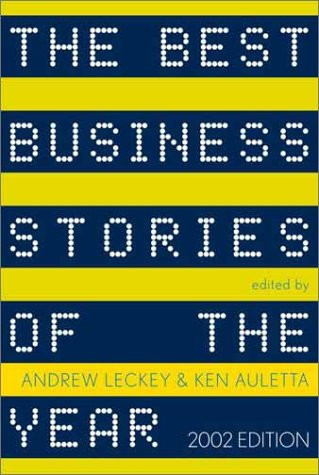
The Best Business Stories of the Year

Andrew Leckey,Ken Auletta
"[The editors] cast their net wide, picking up some excellent stories from nontraditional sources that even avid readers of the business press may have missed."-"USA Today," on the 2001 edition Series editor Andrew Leckey and guest editor Ken Auletta have scoured the print media, consulted with the editors of major business and general interest publications, and surveyed journalism school deans to find the best business stories from the last twelve months. Among those selected: Michael Lewis on teenage stock trader Jonathan Lebed, from "The New York Times Magazine"; James B. Stewart on the irrepressible Michael Milken, from "The New Yorker"; and many others from the pages of "The Wall Street Journal, Rolling Stone, Fortune, Rocky Mountain News, "and" Wired. " The second annual edition continues the excellence and comprehensive range of this fascinating anthology series.
Pantheon Books 2002 470 pages

Arcana IV: musicians on music

John Zorn
Now in its fourth installment, with a fifth in preparation, John Zorn's acclaimed Arcana series provides insight into the work and methodologies of some of the most creative musical minds of our time. Rather than an attempt to distill or define a musician's work, Arcana IV illuminates directly via personal vision and experience, through the undiluted words and thoughts of the practitioners themselves, elucidating through manifestos, scores, interviews, notes and critical papers, composer/performers address composing, improvising, teaching, living, touring and thinking in and through music. Essential for composers, musicians, students and fans alike, this challenging and original series has now become the major source on new music theory and practice in the twenty-first century. Among Arcana IV 's contributors are the late Derek Bailey, Nels Cline, Chris Cutler, Paul Dresher, Kenneth Gaburo, Shelley Hirsch, Wayne Horvitz, Vijay Iyer, Gordon Mumma, Matana Roberts, Katherine Supové and Carolyn Yarnell.
Hips Road 2009 402 pages

Symposium of the whole: a range of discourse toward an ethnopoetics

Rothenberg, Jerome,Rothenberg, Diane
Symposium of the Whole traces a discourse on poetry and culture that has profoundly influenced the art of our time, with precedents going back two centuries and more. Beginning with a reassertion of the complexity of poetry among peoples long labeled “primitive” and “savage,” many recent poets have sought to base a new poetics over the fullest range of human cultures. The attempt to define an ethnopoetics has been significantly connected with the most experimental and future-directed side of Romantic and modern poetry, both in the Western world and, increasingly, outside it. As a visionary poetics and as a politics, this complex redefinition of cultural and intellectual values has involved a rarely acknowledged collaboration between poets and scholars, who together have challenged the narrow view of literature that has excluded so many traditions. In this gathering, the Rothenbergs follow the idea of an ethnopoetics from predecessors such as Vico, Blake, Thoreau, and Tzara to more recent essays and manifestos by poets and social thinkers such as Olson, Eliade, Snyder, Turner, and Baraka. The themes range widely, from the divergence of oral and written cultures to the shaman as proto-poet and the reemergence of suppressed and rejected forms and images: the goddess, the trickster, and the “human universe.” The book’s three ethnographic sections demonstrate how various poetries are structured and composed, how they reflect meaning and worldview, and how they are performed in cultures where all art may be thought of as art-in-motion. Among the poetries discussed are the language of magic; West African drum language and poetry; the Huichol Indian language of reversals; chance operations in African divination poetry; picture-writings and action-writings from Australia and Africa; and American Indian sacred-clown dramas and traditional trickster narratives. The cumulative effect is a new reading of the poetic past and present—in the editors’ words, “a changed paradigm of what poetry was or now could come to be.”
University of California Press 2017 522 pages

Twenty-one steps: guarding the Tomb of the Unknown Soldier

Gottesfeld, Jeff
"With every step, the Tomb Guards pay homage to America's fallen. Discover their story, and that of the unknown soldiers they honor, through resonant words and illustrations. Keeping vigil at the Tomb of the Unknown Soldier, in Arlington National Cemetery, are the sentinel guards, whose every step, every turn, honors and remembers America's fallen. They protect fellow soldiers who have paid the ultimate sacrifice, making sure they are never alone. To stand there--with absolute precision, in every type of weather, at every moment of the day, one in a line uninterrupted since midnight July 2, 1937--is the ultimate privilege and the most difficult post to earn in the army. Everything these men and women do is in service to the Unknowns. Their standard is perfection. Exactly how the unnamed men came to be entombed at Arlington, and exactly how their fellow soldiers have come to keep vigil over them, is a sobering and powerful tale ... that honors the soldiers who honor the fallen"--Provided by publisher
Candlewick Press 2021-02-12 32 pages

Posthuman bodies

Jack Halberstam,Judith Halberstam,Ira Livingston
"It is a collection of essays that takes up, in a mostly affirmative way, various challenges to the coherence of the "human body" as a figure through which culture is processed and oriented." Partial contents : The end of the world of White Men ; Class and its close relations : identities among women, servants, and machines ; Soft fictions and intimate documents : can feminism be posthuman? ; Reproducing the posthuman body : ectogenetic fetus, surrogate mother, pregnant man ; The seductive power of science in the making of deviant subjectivity ; Phantom and reel projections lesbians and the (serial) killing-machine ; "Death of the family."
Indiana University Press 1995-12-01 275 pages

The beginning of heaven and Earth has no name: seven days with second-order cybernetics

Von Foerster, Heinz
"Heinz von Foerster was the inventor of second-order cybernetics, which recognizes the investigator as part of the system he is investigating. The Beginning of Heaven and Earth Has No Name provides an accessible, nonmathematical, and comprehensive overview of von Foerster's cybernetic ideas and of the philosophy latent within them. It distills concepts scattered across the lifework of this scientific polymath and influential interdisciplinarian. At the same time, as a book-length interview, it does justice to von Foerster's élan as a speaker and improviser, his skill as a raconteur. Developed from a week-long conversation between the editors and von Foerster near the end of his life, this work playfully engages von Foerster in developing the difference his notion of second-order cybernetics makes for topics ranging from emergence, life, order, and thermodynamics to observation, recursion, cognition, perception, memory, and communication. The book gives an English-speaking audience a new ease of access to the rich thought and generous spirit of this remarkable and protean thinker"--
Fordham University Press 2014 204 pages

Fly Like a Bat Out of Hell: The Letters of Harold Norse and Charles Bukowski

Norse, Harold,Bukowski, Charles
Fly Like a Bat Out of Hell collects the almost fifteen-year correspondence between two of America's most influential modern poets, Harold Norse and Charles Bukowski. Norse, then a tenuously established writer, acolyte of William Carlos Williams and one-time resident of the Beat Hotel, began exchanging letters with the fledgling bard of the downtrodden, Bukowski, in 1963. Their daily struggle for self-determination, recognition, and just a little money provides the dramatic arc of their ribald, thoughtful, often licentious, and always quotable correspondence. Sparring and exhorting, comforting and recriminating in terrific counterpoint, outdoing one another in scatological complaint, Norse and Bukowski intimately reveal the seldom seen realities of creative lives.
Thunder's Mouth Pr 2002-03-01 288 pages