7908 results for "Science"

Chemistry in theatre: insufficiency, phallacy or both

Djerassi, Carl
This book examines the questions "What can science do for the theatre?" and "What can the theatre do for science?" which raise challenges for both theatre professionals and scientists. Unusually, this book deals with plays first and foremost as reading material -- as texts to be read alone or in dramatic readings -- rather than emphasizing performances on the stage. Concrete examples are given to demonstrate the potential pedagogic value of using the dialogic style and plot structure of plays in science, with a special focus on chemistry.Very few books have dealt with the subject of science-in-theatre and virtually none with chemistry-in-theatre. Texts of the author's two recent plays, Insufficiency and Phallacy, are included in their entirety to offer concrete examples of plays dealing with actual (rather than invented) chemistry. Insufficiency represents an example from the field of beer and champagne bubbles, where the topics of academic tenure and fashion in chemistry are analyzed, whereas in Phallacy, a case history of the similarities and differences between science and art is presented for debate.
Imperial College Press 2012 112 pages

The Century Dictionary And Cyclopedia The Century Dictionary ... Prepared Under The Superintendence Of William Dwight Whitney ... Rev. & Enl. Under The Superintendence Of Benjamin E. Smith

William Dwight Whitney,Benjamin Eli Smith
This extensive dictionary and encyclopedia was overseen by two highly respected scholars of the late 19th century. Its entries cover a wide range of topics, from English language usage and etymology to science, literature, and history. A valuable resource for anyone seeking a comprehensive understanding of the era. This work has been selected by scholars as being culturally important, and is part of the knowledge base of civilization as we know it. This work is in the "public domain in the United States of America, and possibly other nations. Within the United States, you may freely copy and distribute this work, as no entity (individual or corporate) has a copyright on the body of the work. Scholars believe, and we concur, that this work is important enough to be preserved, reproduced, and made generally available to the public. We appreciate your support of the preservation process, and thank you for being an important part of keeping this knowledge alive and relevant.
Creative Media Partners, LLC 2023-07-18 834 pages

The Advanced Sleuth Investor Access Your Brain's Hidden Info, to Take Other People's Money

Avner Mandelman
Some information cannot be contained in ink and blips and must always remain physical. This has been found in science, but also applies to investing, where it provides big advantage to investors who investigate companies physically ("sleuthing.") In this book (a follow up on his first), seasoned investing expert Avner Mandelman, relying on recent findings in AI and the latest Nobel Prize winning research, presents case-studies and sleuthing techniques to help the reader take the money of those who haven't read the book. In these studies, written in an engaging style, you will learn from: Chess-playing computers, how a chess-inspired formula picks the best stocks to sleuth Top intel operatives, how to get informers to open up Top Generals, how to discern winner CEOs from mediocre ones Quantum physicists, how to go beyond public data and create your own Brain and AI scientists, how to access the "dark info" inside your own brain Top athletes and top-gun pilots, how to train to win.
Avner Mandelman 2023-03-03 248 pages

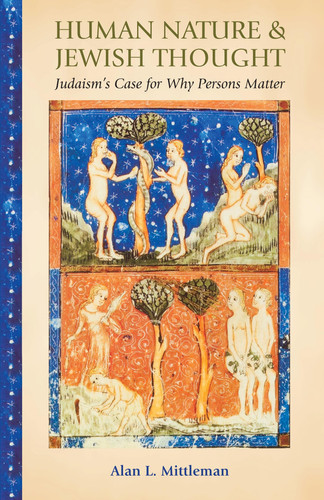
Human nature & Jewish thought: Judaism's case for why persons matter

Mittleman, Alan
This book explores one of the great questions of our time: How can we preserve our sense of what it means to be a person while at the same time accepting what science tells us to be true-namely, that human nature is continuous with the rest of nature? What, in other words, does it mean to be a person in a world of things? Alan Mittleman shows how the Jewish tradition provides rich ways of understanding human nature and personhood that preserve human dignity and distinction in a world of neuroscience, evolutionary biology, biotechnology, and pervasive scientism. These ancient resources can speak to Jewish, non-Jewish, and secular readers alike. Science may tell us what we are, Mittleman says, but it cannot tell us who we are, how we should live, or why we matter. Traditional Jewish thought, in open-minded dialogue with contemporary scientific perspectives, can help us answer these questions. Mittleman shows how, using sources ranging across the Jewish tradition, from the Hebrew Bible and the Talmud to more than a millennium of Jewish philosophy. Among the many subjects the book addresses are sexuality, birth and death, violence and evil, moral agency, and politics and economics. Throughout, Mittleman demonstrates how Jewish tradition brings new perspectives to-and challenges many current assumptions about-these central aspects of human nature. A study of human nature in Jewish thought and an original contribution to Jewish philosophy, this is a book for anyone interested in what it means to be human in a scientific age.
Princeton University Press 2015 215 pages

Freedom and terror: reason and unreason in politics

Kaplan, Abraham
This book examines reason and unreason in the legal and political responses to terrorism. Terrorism is often perceived as sheer madness, unreasonable use of extreme violence and senseless, futile political action. These assertions are challenged by this book. Combining traditional " thought (by Kaplan) on reason and unreason in terrorism with empirical explorations of post-modern terrorism and its use of communication platforms (by Weimann) the work uses interdisciplinary and cross disciplinary dimensions to provide a multidimensional picture of critical issues in current politics and a deeper examination of their implications than previously available. The book looks at various aspects of modern politics, from terrorism to protest, from decision-making to political discourse, applying the perspective of philosophical thought. To do so, political issues and actions are examined by using concepts such as reason, emotions, madness, magic, morality, absolutism, extremism, psychopathology, rationality and others. The analysis is rooted in theories and concepts derived from history, philosophy, religion, art, sociology, psychology, and political science. This book, which was mostly written by the late Abraham Kaplan, an American philosopher, and edited and updated by Gabriel Weimann, will be of much interest to students of political violence/terrorism, philosophy, war and conflict studies and political science in general.
Routledge 2011 189 pages

Probability and evidence

Ayer, A. J.
A. J. Ayer was one of the foremost analytical philosophers of the twentieth century, and was known as a brilliant and engaging speaker. In essays based on his influential Dewey Lectures, Ayer addresses some of the most critical and controversial questions in epistemology and the philosophy of science, examining the nature of inductive reasoning and grappling with the issues that most concerned him as a philosopher. This edition contains revised and expanded versions of the lectures and two additional essays. Ayer begins by considering Hume's formulation of the problem of induction and then explores the inferences on which we base our beliefs in factual matters. In other essays, he defines the three kinds of probability that inform inductive reasoning and examines the various criteria for verifiability and falsifiability. In his extensive introduction, Graham Macdonald discusses the arguments in Probability and Evidence , how they relate to Ayer's other works, and their influence in contemporary philosophy. He also provides a brief biographical sketch of Ayer, and includes a bibliography of works about and in response to Probability and Evidence .
Macmillan 1972 144 pages

Martin Buber and the human sciences

Maurice Friedman,Pat Boni
The specific focus of Martin Buber and the Human Sciences is “dialogue” as the foundation of and integrating factor in the human sciences, using dialogue in the special sense which Buber has made famous: mutuality, presentness, openness, meeting the other in his or her uniqueness and not just as a content for one’s own thought categories, and knowing as deriving in the first instance from mutual contact rather than knowledge of a subject about an object. By the “human sciences” the authors/editors mean material that can be meaningfully approached in a dialogic way, hence, the humanities, education, psychology, speech communication, anthropology, history, sociology, and economics. The essays in Martin Buber and the Human Sciences demonstrate that thirty years after Buber’s death his influence is still resonating in many countries and in many fields.
State University of New York Press 1996-05-24 415 pages

The anatomy of a scientific institution: the Paris Academy of Sciences, 1666-1803

Hahn, Roger
This title is part of UC Press's Voices Revived program, which commemorates University of California Press’s mission to seek out and cultivate the brightest minds and give them voice, reach, and impact. Drawing on a backlist dating to 1893, Voices Revived makes high-quality, peer-reviewed scholarship accessible once again using print-on-demand technology. This title was originally published in 1971.
University of California Press 2022-08-19 454 pages

The American Journal of the Medical Sciences

Hays, Isaac
This is a pre-1923 historical reproduction that was curated for quality. Quality assurance was conducted on each of these books in an attempt to remove books with imperfections introduced by the digitization process. Though we have made best efforts - the books may have occasional errors that do not impede the reading experience. We believe this work is culturally important and have elected to bring the book back into print as part of our continuing commitment to the preservation of printed works worldwide.
BiblioLife 2009-11-10 588 pages

Anthropos today: reflections on modern aquipment

Rabinow, Paul
The discipline of anthropology is, at its best, characterized by turbulence, self-examination, and inventiveness. In recent decades, new thinking and practice within the field has certainly reflected this pattern, as shown for example by numerous fruitful ventures into the "politics and poetics" of anthropology. Surprisingly little attention, however, has been given to the simple insight that anthropology is composed of claims, whether tacit or explicit, about anthropos and about logos--and the myriad ways in which these two Greek nouns have been, might be, and should be, connected. Anthropos Today represents a pathbreaking effort to fill this gap. Paul Rabinow brings together years of distinguished work in this magisterial volume that seeks to reinvigorate the human sciences. Specifically, he assembles a set of conceptual tools--"modern equipment"--to assess how intellectual work is currently conducted and how it might change. Anthropos Today crystallizes Rabinow's previous ethnographic inquiries into the production of truth about life in the world of biotechnology and genome mapping (and his invention of new ways of practicing this pursuit), and his findings on how new practices of life, labor, and language have emerged and been institutionalized. Here, Rabinow steps back from empirical research in order to reflect on the conceptual and ethical resources available today to conduct such inquiries. Drawing richly on Foucault and many other thinkers including Weber and Dewey, Rabinow concludes that a "contingent practice" must be developed that focuses on "events of problematization." Brilliantly synthesizing insights from American, French, and German traditions, he offers a lucid, deeply learned, original discussion of how one might best think about anthropos today.
Princeton university press 2003 159 pages

The Laws of Chaos

Farjoun, Emmanuel,Machover, Moshe
Classic work of political economics In this classic work of political economy, Emmanuel Farjoun and Moshé Machover rebuild two fundamental concepts of the price and profit. They redefine the basic notions of political economy, relying on probabilistic–statistical methods of the kind used in the modern foundations of other sciences. This amounts to a rigorous new foundation of the labour theory of value. A defining work of Econophysics, republished for the first time since 1983, Laws of Chaos remains a challenging, innovative work of Marxist economics.
Verso Books 1983-10-01 264 pages

Envisioning power: ideologies of dominance and crisis

Wolf, Eric Robert
With the originality and energy that have marked his earlier works, Eric Wolf now explores the historical relationship of ideas, power, and culture. Responding to anthropology's long reliance on a concept of culture that takes little account of power, Wolf argues that power is crucial in shaping the circumstances of cultural production. Responding to social-science notions of ideology that incorporate power but disregard the ways ideas respond to cultural promptings, he demonstrates how power and ideas connect through the medium of culture. Wolf advances his argument by examining three very different societies, each remarkable for its flamboyant ideological expressions: the Kwakiutl Indians of the Northwest Pacific Coast, the Aztecs of pre-Hispanic Mexico, and National Socialist Germany. Tracing the history of each case, he shows how these societies faced tensions posed by ecological, social, political, or psychological crises, prompting ideological responses that drew on distinctive, historically rooted cultural understandings. In each case study, Wolf analyzes how the regnant ideology intertwines with power around the pivotal relationships that govern social labor. Anyone interested in the history of anthropology or in how the social sciences make comparisons will want to join Wolf in Envisioning Power .
University of California press 1999-01-11 339 pages

Between class and elite: the evolution of the British labour movement: a sociological study

Bauman, Zygmunt
Historical study of the labour movement in the UK from 1750 to 1955, with particular reference to the sociological aspects of the role of trade union leadership as an Elite group within the working class - covers the evolution of the labour political party, political leadership, etc. References and statistical tables.
Manchester University Press 1972 334 pages

A history of the Jews in the English-speaking world: Great Britain

Rubinstein, W. D.
Deals also with British antisemitism from Cromwell's time to the present. There were objections against the admission of Jews to England in 1655, as well as attempts to restrict their rights in the 17th-18th centuries. Discusses pre-World War I antisemitic writers (e.g. G.K. Chesterton, H. Belloc) and the eugenics movement. Racial antisemitism was almost non-existent before 1914. Antisemitism reached a peak in Britain in 1917-22, but it was milder than in other Western countries. Relates, also, to left-wing antisemitism between the two World Wars. Ch. 3 (pp. 280-363), "Anglo-Jewry and the Holocaust, 1933-1945", deals with the reactions of Jews and non-Jews to the rise of Nazism and the Holocaust. Nazi antisemitism aroused revulsion in British society, even among conservatives and pro-Germans. States that Britain did more for refugees from Germany than any other country. British Jewry did all it could to rescue Jews to the extent that it understood their situation. During the war and the hostilities in the Middle East, there was an upsurge of antisemitism in the country but it receded in the 1950s. Contends that antisemitism in Britain was always a marginal phenomenon.
Macmillan 1996 539 pages

Women, androgynes, and other mythical beasts

OFlaherty, Wendy Doniger
"An important, provocative and original work, of great interest to Indian scholars, historians of religions, psychologists and historians of ideas, but accessible also to the cultivated reader. Even if one does not always agree with the author's interpretation, one cannot but admire her vast and precise learning, her splendid translations and exegesis of so many, and so different, Sanskrit texts, and her uninhibited, brilliant, and witty prose."—Mircea Eliade, University of Chicago "This is . . . a book which is as rich in detail as the carvings of the great Hindu temples. It shares with them a delight in the interplay of myth and mundane experience, and above all an empathy with the Hindu preoccupation with the meaning of human existence in all its complexity."—G. M. Carstairs, Times Literary Supplement
The University of Chicago Press 1982 382 pages