58,196 results in 0.07 seconds

Psychosynthesis: a manual of principles and techniques

Assagioli, Roberto
Roberto Assagioli was born in Venice 1888. He was educated as a medical doctor and psychiatrist, coming under the influence of the Freudian school. In 1910 he began to formulate the concept of psychosynthesis, arguing not that psychoanalysis was an incorrect approach, but that it was incomplete. Since those early days, he has spent his professional life elaborating a generous and comprehensive psychology of man that includes the soul as well the instinctual drives. More than a theory, it is also a practical, working method that includes many approaches to personal growth currently entering the mainstreams of psychology and education...meditation, encounter groups, inner-imagery, and several dozen more. These methods are unified around the notion of a self at the core of each individual that can direct the harmonious development of all aspects of the personality. Beyond that personal harmony lies access to higher realism...creativity, transpersonal experience, and spiritual development.
Viking Pr 1971 323 pages

The piranhas

Saviano, Roberto
'With the open-hearted rashness that belongs to every true writer, Saviano returns to tell the story of the fierce and grieving heart of Naples.' Elena Ferrante In Naples, a new kind of gang rules the streets: the 'Paranze', the 'Children's Gangs', groups of teenage boys who divide their time between Facebook or playing Call of Duty on their PlayStations and patrolling the streets armed with pistols and AK-47s, terrorizing local residents in order to mark out the territories of their Mafia bosses. Roberto Saviano's eye-opening novel The Piranhas tells the story of the rise of one such gang and its leader, Nicolas - known to his friends and enemies as the 'Maharajah'. But Nicolas's ambitions reach far beyond doing other men's bidding: he wants to be the one giving orders, calling the shots, and ruling the city. But the violence he is accustomed to wielding and witnessing soon spirals out of his control . . .
Picador 2018-09-11 368 pages

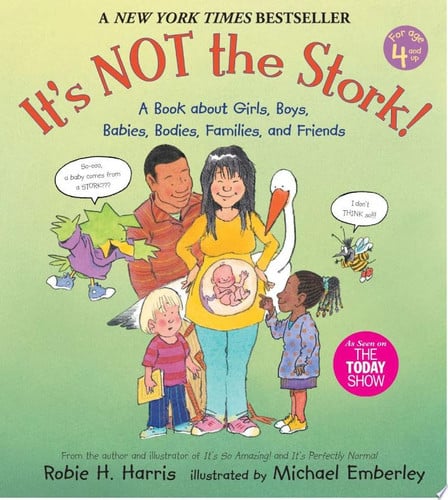
It's Not the Stork! A Book about Girls, Boys, Babies, Bodies, Families, and Friends

Robie H. Harris,Michael Emberley
From the expert team behind IT'S PERFECTLY NORMAL and IT'S SO AMAZING! comes a book for younger children about their bodies — a resource that parents, teachers, librarians, health care providers, and clergy can use with ease and confidence. Young children are curious about almost everything, especially their bodies. And young children are not afraid to ask questions. What makes me a girl? What makes me a boy? Why are some parts of girls' and boys' bodies the same and why are some parts different? How was I made? Where do babies come from? Is it true that a stork brings babies to mommies and daddies? IT'S NOT THE STORK! helps answer these endless and perfectly normal questions that preschool, kindergarten, and early elementary school children ask about how they began. Through lively, comfortable language and sensitive, engaging artwork, Robie H. Harris and Michael Emberley address readers in a reassuring way, mindful of a child's healthy desire for straightforward information. Two irresistible cartoon characters, a curious bird and a squeamish bee, provide comic relief and give voice to the full range of emotions and reactions children may experience while learning about their amazing bodies. Vetted and approved by science, health, and child development experts, the information is up-to-date, age-appropriate, and scientifically accurate, and always aimed at helping kids feel proud, knowledgeable, and comfortable about their own bodies, about how they were born, and about the family they are part of.
Candlewick Press 2008-08-26 59 pages

The tenant

Topor, Roland
When Trelkovsky, a Parisian in desperate need of a place to live, comes across an affordable apartment, he jumps at the chance to rent it, undaunted by the fact that the previous tenant hurled herself screaming through the window. What happens next is a harrowing descent into paranoia and madness as a series of bizarre events unfolds that leaves Trelkovsky doubting his sanity and fearing for his life. First published in French in 1964 and adapted for Roman Polanski's 1976 film version, Roland Topor's surreal and hallucinatory horror masterpiece The Tenant returns to print at last in this edition, which includes a new introduction by R B. Russell. "As closely coiled, as cold and quiet and deadly as a snake in the bed." - John Collier, author of Fancies and Goodnights "Echoes of Kafka, Poe, and Hitchcock . . . not recommended to any average reader who may be easily shocked." - Bestsellers "Grotesque and harrowing, The Tenant is a powerful fable set in the twilight zone." - The Observer
Valancourt Books 2020 174 pages

The life before us

Gary, Romain
Momo has been one of the ever-changing ragbag of whores' children at Madame Rosa's boarding house in Paris ever since he can remember. But when the check that pays for his keep no longer arrives and as Madame Rosa becomes too ill to climb the stairs to their apartment, he determines to support her any way he can. This sensitive, slightly macabre love story between Momo and Madame Rosa has a supporting cast of transvestites, pimps, and witch doctors from Paris's immigrant slum, Belleville. Profoundly moving, The Life Before Us won France's premier literary prize, the Prix Goncourt.
New Directions Publishing Corporation 2022 208 pages

The death of the banker: the decline and fall of the great financial dynasties and the triumph of the small investor

Chernow, Ron
National Book Award winner Ron Chernow expertly traces the decline of the big bankers and the rise of small investors. The reader is taken on a fascinating tour of Anglo-American high finance over the past two centuries, with detours into Canadian, German and Japanese finance. As the point of departure for his colourful, panoramic survey, Mr. Chernow poses a historic riddle: Why did the great financial dynasties - the Rothschilds, Barings, Morgans and Warburgs - flare so brilliantly in the 19th and 20th centuries and then enter into a precipitous decline? Why did such heavyweights give way to more anonymous financial conglomerates? And, most curious of all, why have small investors, banded together in mutual funds, suddenly inherited the financial earth? The Death of the Banker shows how American reformers mounted a spirited campaign to pry captive companies loose from their traditional bankers and restored competition to financial markets. In a world criss-crossed by capital flows, the banker will never again exercise such spectacular but arbitrary rule over clients.
Vintage Canada 1997 147 pages

The death of the banker: the decline and fall of the great financial dynasties and the triumph of the small investor

Chernow, Ron
"For anyone interested in the world behind the business-page headlines, this is the book to read." --Publishers Weekly With the same breadth of vision and narrative élan he brought to his monumental biographies of the great financiers, Ron Chernow examines the forces that made dynasties like the Morgans, the Warburgs, and the Rothschilds the financial arbiters of the early twentieth century and then rendered them virtually obsolete by the century's end. As he traces the shifting balance of power among investors, borrowers, and bankers, Chernow evokes both the grand theater of capital and the personal dramas of its most fascinating protagonists. Here is Siegmund Warburg, who dropped a client in the heat of a takeover deal because the man wore monogrammed shirt cuffs, as well as the imperious J. P. Morgan, who, when faced with a federal antitrust suit, admonished Theodore Roosevelt to "send your man to my man and they can fix it up." And here are the men who usurped their power, from the go-getters of the 1920s to the masters of the universe of the 1980s. Glittering with perception and anecdote, The Death of the Banker is at once a panorama of twentieth-century finance and a guide to the new era of giant mutual funds on Wall Street. "Chernow . . . delivers a sound, accessible account of the forces shaping capital, credit, currency, and securities markets on the eve of a new millennium. " --Kirkus Reviews
Vintage Books 1997 130 pages

Beaufort

Leshem, Ron
Beaufort. To the handful of Israeli soldiers occupying the ancient crusader fortress, it is a little slice of hell—a forbidding, fear-soaked enclave perched atop two acres of land in southern Lebanon, surrounded by an enemy they cannot see. And to the thirteen young men in his command, twenty-one-year-old Lieutenant Liraz “Erez” Liberti is a taskmaster, confessor, and the only hope in the face of attacks that come out of nowhere and of missions seemingly designed to get them all killed. But in their stony haven, Erez and his soldiers have created their own little world, their own rules, their own language. And here Erez listens to his men build castles out of words, telling stories, telling lies, talking incessantly of women, sex, and dead comrades. Until, in the final days of the occupation, Erez and his squad of fed-up, pissed-off, frightened young soldiers are given one last order: a mission that will shatter all remaining illusions—and stand as a testament to the universal, gut-wrenching futility of war. The basis for the Academy Award-nominated film of the same name.
Delta Trade Paperbacks 2009-02-24 360 pages

How the End Begins The Road to a Nuclear World War III

Ron Rosenbaum
In this startling book, now in paperback, the bestselling author of Explaining Hitler warns that a nuclear World War III is not only the most massive and imminent threat to existence as we know it, but also one of the most ignored. While Russian aggression grows and North Korean nuclear ambitions increase unabated, tensions continue to escalate between India and Pakistan and in the Middle East. Meanwhile, Iran remains committed to developing its nuclear program despite international sanctions. No other writer has assembled the extraordinary array of sources and experiences that Ron Rosenbaum calls on to inform his examination of nuclear war. While working from both historical and contemporary perspectives to explore the people and events that could shape the form of a third world war, he suggests humans have never before been so close to annihilation. In this book, Rosenbaum examines both the paranoia and very real set of possibilities that informs our view of nuclear war and asks whether we can “undream” the nightmare.
Simon and Schuster 2012-02-21 320 pages

Rise and kill first: the secret history of Israel's targeted assassinations

Bergman, Ronen
"The Talmud says: "If someone comes to kill you, rise up and kill him first." This instinct to take every measure, even the most aggressive, to defend the Jewish people is hardwired into Israel's DNA. From the very beginning of its statehood in 1948, protecting the nation from harm has been the responsibility of its intelligence community and armed services, and there is one weapon in their vast arsenal that they have relied upon to thwart the most serious threats. Targeted assassinations have been used countless times, on enemies large and small, sometimes in response to attacks against the Israeli people and sometimes preemptively. Journalist and military analyst Ronen Bergman offers an inside account of the targeted killing programs: their successes, their failures, and the moral and political price exacted on the men and women who approved and carried out the missions. Bergman has gained the rare cooperation of many current and former members of the Israeli government, including Prime Ministers Shimon Peres, Ehud Barak, Ariel Sharon, and Benjamin Netanyahu, as well as high-level figures in the country's military and intelligence services: the IDF (Israel Defense Forces), the Mossad (the world's most feared intelligence agency), Caesarea (a "Mossad within the Mossad" that carries out attacks on the highest-value targets), and the Shin Bet (an internal security service that implemented the largest targeted assassination campaign ever, in order to stop what had once appeared to be unstoppable: suicide terrorism). Bergman traces, from statehood to the present, the gripping events and thorny ethical questions underlying Israel's targeted killing campaign, which has shaped the Israeli nation, the Middle East, and the entire world." --
Random House 2018-01-30 753 pages

The distance learning playbook for parents: how to support your child's academic, social, and emotional development in any setting

Wiseman, Rosalind,Fisher, Douglas,Frey, Nancy,Hattie, John
"Parents are, and will always be, their child's best teacher. Helping your child get the best possible education is every parent's goal. While parent involvement has always been a vital part of a child's education, the pandemic and resulting remote instruction call for parents and educators to partner at an even deeper level. Following the success of Douglas Fisher, Nancy Frey, and John Hattie's The Distance Learning Playbook for Grades K-12, these renowned educators teamed up with New York Times bestselling author and parenting expert Rosalind Wiseman to bring you the consummate guide to supporting your child's academic, social, and emotional development in any learning environment - while not overwhelming you in the process"--
Corwin 2020

Intern nation: earning nothing and learning little in the brave new economy

Perlin, Ross
Millions of young people—and increasingly some not-so-young people—now work as interns. They famously shuttle coffee in a thousand magazine offices, legislative backrooms, and Hollywood studios, but they also deliver aid in Afghanistan, map the human genome, and pick up garbage. Intern Nation is the first exposé of the exploitative world of internships. In this witty, astonishing, and serious investigative work, Ross Perlin profiles fellow interns, talks to academics and professionals about what unleashed this phenomenon, and explains why the intern boom is perverting workplace practices around the world. The hardcover publication of this book precipitated a torrent of media coverage in the US and UK, and Perlin has added an entirely new afterword describing the growing focus on this woefully underreported story. Insightful and humorous, Intern Nation will transform the way we think about the culture of work.
Verso 2012-04-04 268 pages

Roy Lichtenstein

Lichtenstein, Roy
From the funny pages to the canvas, comics recontextualized In the late 50s and 60s, American painter Roy Lichtenstein (1923-1997) became one of the most important exponents of Pop Art - that movement which transformed products of mass consumption and the entertainment industry into subjects for art. This apotheosis of banal, everyday objects simultaneously constituted a criticism of the traditional elitist understanding of art. Almost alone among artists, Lichtenstein pursued the question of how an image becomes a work of art. Wholly in keeping with the spirit of the Classical Modern, he held that it was not the "rank" of the picture's subject that lends the picture its artistic character, but rather the artist's formal treatment of it. To Lichtenstein, however, this position seemed far too broad to be seriously pursued. Developed in the early 60s, Lichtenstein's grid technique, with its allusion to the mass-production of graphic art, allowed the painter to give vent to his own artistic scepticism. In the 60s and 70s, Lichtenstein expanded his formal repertoire of techniques for creating distance and irony by means of an idiosyncratic process of abstraction and especially by his use of his numerous art quotations. About the Series: Each book in TASCHEN's Basic Art series features: a detailed chronological summary of the life and oeuvre of the artist, covering his or her cultural and historical importance a concise biography approximately 100 illustrations with explanatory captions
Taschen 2000 96 pages