58,196 results in 0.07 seconds

Closed casket: the new Hercule Poirot mystery

Hannah, Sophie
"What I intend to say to you will come as a shock ..." With these words, Lady Athelinda Playford -- one of the world's most beloved children's authors -- springs a surprise on the lawyer entrusted with her will. As guests arrive for a party at her Irish mansion, Lady Playford has decided to cut off her two children without a penny ... and leave her vast fortune to someone else: an invalid who has only weeks to live. Among Lady Playford's visitors are two strangers: the famous Belgian detective Hercule Poirot, and Inspector Edward Catchpool of Scotland Yard. Neither knows why he has been invited -- until Poirot begins to wonder if Lady Playford expects a murder. But why does she seem so determined to provoke a killer? And why -- when the crime is committed despite Poirot's best efforts to stop it -- does the identity of the victim make no sense at all?
William Morrow, an imprint of HarperCollinsPublishers 2016 302 pages

Iron Man. Vol. 1. The Stark-Roxxon War

Ackerman, Spencer
A new era begins for Iron Man, written by Pulitzer Prize-winning journalist Spencer Ackerman! With his company restored, Tony Stark's first order of business is getting Stark Unlimited back out of the weapons game. But a multinational company doesn't just stop selling weapons overnight, and the board is more concerned with profit margins than super-hero ethics. Now they've made a deal with the devil: Stark Unlimited is for sale, and the highest bidder represents the combined might of Tony's two biggest competitors: Roxxon and A.I.M.! But they're ready for the old Tony Stark. This one? He's a lot angrier than he used to be. New armour, old enemies and unbelievable twists abound in this fresh take on a fury-powered Iron Man! Collecting: Iron Man (2024) 1-6
Marvel Worldwide, Inc 2025-06-24 144 pages

Janet & me: an illustrated story of love and loss

Mack, Stanley
In words and drawings both candid and human, Stan Mack follows his eighteen-year relationship with Janet Bode, a lighthearted fling that beat the odds to become an enduring love affair. The only thing they couldn't beat was cancer. As Janet and Stan confront the jagged terrain of cancer, then navigate the twilight of terminal illness, two portraits emerge: of a woman who faced her cancer the same way she lived her life, with guts and charm; and of the man who held her close and shared her struggle. For anyone who can't resist a beautifully told love story, for anyone who is touched by someone suffering from serious illness and looking for emotional and practical guidance, and for anyone who appreciates a life lived to the fullest, Janet & Me will resonate long after the last page is turned.
Simon & Schuster 2004-10 157 pages

Hospital of the transfiguration

Lem, Stanisław
"The Hospital of the Transfiguration is a very early novel by Lem. it was written in 1948, but supppressed by Polish censors, and was not published until 1955. The book appeared in an English translation in 1988. The censorship of this early realist novel is partly what drove Lem to write in the vein of science fiction almost exclusively for the next thirty years. The book is partly autobiographical, about a doctor working in a Polish asylum during World War II. At first the asylum seems like a bucolic refuge to the young doctor, but a series of encounters and incidents reveal an underlying brutality. he begins to seek relief in the strange conversation of the poet Sekulowski, who is posing as a patient in a bid for safety from the occupying German forces. Resistance fighters stockpile weapons in the surrounding woods. In the end, German troops arrive and, under euthanasia program Action T4, slaughter most of the patients and staff. Kirkus reviews noted, "Absorbing, also, to watch Lem outline many of the themes and ideas that he will later develop brilliantly in his science fiction. All in all, not for the fainthearted, even though Lem is not yet at full power here.""--
The MIT Press 2020-02-18 221 pages

Postmodern education: politics, culture, and social criticism

Aronowitz, Stanley
Introduction : class, race, and gender in educational politics--Textual authority, culture, and the politics of literacy--Postmodernism and the discorse of educational criticism--Cultural politics, reading formations, and the role of teachers as public intellectuals--Border pedagogy in the age of postmodernism--The punishment of disciplines : cultural studies and the transformation of legitimate knowledge--Working-class displacements and postmodern representations--Conclusion : postmodernism as politics--Beyond difference as technological utopianism and cultural separatism.
University of Minnesota Press 1991 205 pages

How to speak dog: mastering the art of dog-human communication

Coren, Stanley
At long last, dogs will know just how smart their owners can be. By unlocking the secrets of the hidden language of dogs, the author, a psychologist, allows us into the doggy dialogue and makes two-way communication a reality. For the first time, instead of receiving an incomprehensible mash of mixed human signals, man's best friend will be treated to the proper use of dog language. Finally, effective communication can take place between canines and these "strange tall dogs" who have mystified them for so long. Building on research into the simplified language of "baby talk" (that nearly universally recognized "motherese" with which mothers speak to their infants), the author provides insights into the structure and form of the simplified language that many dog owners use to communicate with their pets. A better understanding of this language, "Doggish," is the key to improved two-way communication. The book provides not only the sounds, words, actions, and movements with which we can effectively communicate with our dogs, but deciphers the signs that our dogs give to us. By giving us the information we need to interpret the wagging of their tails, the flapping of their ears, the movement of their bodies, and the lapping of their tongues as much as their barks, the author allows us into their rich world of communication, giving dog-lovers the skills they need to improve their relationships with their pets. As every owner will admit, dogs have an uncanny ability to respond to nuances of human speech. Although actual conversation of the sort Lassie seemed capable of in Hollywood mythmaking remains forever out of reach, research and observation show that a great deal of real communication is possible beyond the giving and obeying of commands. This book explores the limits of dogs' language abilities and charts the possibilities. It gives owners the key to interpret correctly not only information but emotional states. With easy-to-follow tips on how humans can mimic the language dogs use to talk with each other, it provides a surprising and fascinating window into the world of dog communication, why they speak and what they talk about. Drawing on substantial research in animal behavior, evolutionary biology, and years of personal experience, the author demonstrates that the average house dog can differentiate between 60 and 140 words, though some research suggests that dogs can hear many more and also pick words out of sentences and respond to them. This work examines people's beliefs about the ability of their dogs to communicate and contrasts those with the scientific reality. As the author shows us, the gulf is more narrow than many people think, and the rewards of bridging it are endless.
Simon & Schuster 2001-04-17 288 pages

Introduction to macroeconomics

Fischer, Stanley
Soft Cover, J. Michael Morgan Study Guide to Accompany Fischer/Dornbusch Economics 1983 version. There is a slight bend or fold in the front paper cover. Some pages in the upper corners have been folded over. The inside in in excellent shape. The back outer paper cover has some discoloration from another book it was against. The book is in great shape on the inside and looks like it has never been used.
McGraw-Hill 1983 476 pages

The Royal Game

Stefan Zweig
Paperback. 12,50 / 19,50 cm. In English. 88 p. "The more one limits oneself, the closer one is to the infinite." Chess (also known as The Royal Game) is the last work by Austrian author Stefan Zweig, just before he dies. The story unfolds on a cruiser sailing from New York to Buenos Aires. The passenger realizes that there is a reigning world chess champion on board, Mirko Czentovic, and they try to challenge him. There is only one mysterious man who could help them to beat this arrogant champion: Dr. B. a lawyer who was tormented and isolated by Nazis, learning how to play chess in his imagination. Chess, which we can consider as his farewell to life, has a long term impact on reader by sorting out the chess game, its tactics, the conflicts and the deep roads in human nature.
Ren Kitap 2020 88 pages

Fry's ties

Fry, Stephen
A witty, illustrated ode to Stephen Fry's decades-long obsession with a man's most trusted accessory- the tie. By the time he was fifteen, Stephen Fry owned more than forty ties. Inherited initially from a grandfather, matters turned more serious when he could afford to buy them brand spanking new. Stephen's collection now numbers well into the hundreds. And each tie - whether floral, fluorescent, football-themed; striped or spotty, outrageous or simply debonair - tells a story. A tale of the garment itself - the shops, makers and designers - as well as of Stephen, his reasons for choosing it, whether an occasion or just a whim. Inspired by Stephen's hugely popular Instagram posts, this book will feature beautiful, hand-drawn illustrations and photographs to celebrate his expansive collection of man's greatest asset- the Tie, in all its sophisticated glory.[Bokinfo]
Michael Joseph 2021-11-11 255 pages

The ode less travelled: unlocking the poet within

Fry, Stephen
Comedian and actor Stephen Fry?s witty and practical guide, now in paperback, gives the aspiring poet or student the tools and confidence to write and understand poetry. Stephen Fry believes that if one can speak and read English, one can write poetry. In The Ode Less Travelled , he invites readers to discover the delights of writing poetry for pleasure and provides the tools and confidence to get started. Through enjoyable exercises, witty insights, and simple step-by-step advice, Fry introduces the concepts of Metre, Rhyme, Form, Diction, and Poetics. Most of us have never been taught to read or write poetry, and so it can seem mysterious and intimidating. But Fry, a wonderfully competent, engaging teacher and a writer of poetry himself, sets out to correct this problem by explaining the various elements of poetry in simple terms, without condescension. Fry?s method works, and his enthusiasm is contagious as he explores different forms of poetry: the haiku, the ballad, the villanelle, and the sonnet, among many others. Along the way, he introduces us to poets we?ve heard of but never read. The Ode Less Travelled is not just the survey course you never took in college, it?s a lively celebration of poetry that makes even the most reluctant reader want to pick up a pencil and give it a try.
Gotham Books 2006 357 pages

The Norton Shakespeare Tragedies + the Norton Shakespeare Histories

Stephen Greenblatt,Walter Cohen,Jean E. Howard,Gordon McMullan,Katharine Eisaman Maus,Suzanne Gossett
Product Description Both an enhanced digital edition―the first edited specifically for undergraduates―and a handsome print volume, The Norton Shakespeare, Third Edition, provides a freshly edited text, acclaimed apparatus, and an unmatched value. The attractive print and digital bundle offers students a great reading experience at an affordable price in two ways―a hardcover volume for their dorm shelf and lifetime library, and a digital edition ideal for in-class use. Students can access the ebook from their computer, tablet, or smartphone via the registration code included in the print volume at no additional charge. As one instructor summed it up, “It’s a long overdue step forward in the way Shakespeare is taught.” Book Description with The Norton Shakespeare Digital Edition registration card About the Author Stephen Greenblatt (Ph.D. Yale) is Cogan University Professor of the Humanities at Harvard University. Also General Editor of The Norton Anthology of English Literature, he is the author of eleven books, including Tyrant, The Rise and Fall of Adam and Eve: The Story that Created Us, The Swerve: How the World Became Modern (winner of the 2011 National Book Award and the 2012 Pulitzer Prize); Shakespeare's Freedom; Will in the World: How Shakespeare Became Shakespeare; Hamlet in Purgatory; Marvelous Possessions: The Wonder of the New World; Learning to Curse: Essays in Early Modern Culture; and Renaissance Self-Fashioning: From More to Shakespeare. He has edited seven collections of criticism, including Cultural Mobility: A Manifesto, and is a founding coeditor of the journal Representations. His honors include the MLA’s James Russell Lowell Prize, for both Shakespearean Negotiations: The Circulation of Social Energy in Renaissance England and The Swerve, the Sapegno Prize, the Distinguished Humanist Award from the Mellon Foundation, the Wilbur Cross Medal from the Yale University Graduate School, the William Shakespeare Award for Classical Theatre, the Erasmus Institute Prize, two Guggenheim Fellowships, and the Distinguished Teaching Award from the University of California, Berkeley. He was president of the Modern Language Association of America and is a fellow of the American Academy of Arts and Sciences, the American Philosophical Society, and the American Academy of Arts and Letters. Walter Cohen (Ph.D. Berkeley) is Professor of English at the University of Michigan, Ann Arbor, and Professor of Comparative Literature Emeritus at Cornell University, where he received the Clark Distinguished Teaching Award. He is the author of Drama of a Nation: Public Theater in Renaissance England and Spain, as well as numerous journal articles on Renaissance literature, literary criticism, the history of the novel, and world literature. He has recently completed a critical study entitled A History of European Literature: The West and the World from Antiquity to the Present. Jean E. Howard (Ph.D., Yale) is the George Delacorte Professor in the Humanities at Columbia University. A past president of the Shakespeare Association of America, she is the author of numerous books on Renaissance drama, including Shakespeare’s Art of Orchestration: Stage Technique and Audience Response (1984), The Stage and Social Struggle (1994), Engendering a Nation: A Feminist Account of Shakespeare’s English Histories, with Phyllis Rackin (1997), Theater of a City: The Places of London Comedy 1598–1642 (2007), and Marx and Shakespeare with Crystal Bartolovich (2012). She is at work on a book about the English history play from Shakespeare to Caryl Churchill and another on the invention of Renaissance tragedy. Katharine Eisaman Maus (Ph.D. Johns Hopkins) is James Branch Cabell Professor of English at the University of Virginia. She is the author of Being and Having in Shakespeare; Inwardness and Theater in the English Renaissance; and Ben Jonson and the Roman Frame of Mind; editor of a volume of Renaissance tragedies; an
W W Norton & Co Inc 2015-10-01 1232 pages

The swerve: how the Renaissance began

Greenblatt, Stephen
In this book the author transports readers to the dawn of the Renaissance and chronicles the life of an intrepid book lover who rescued the Roman philosophical text On the Nature of Things from certain oblivion. In this work he has crafted both a work of history and a story of discovery, in which one manuscript, plucked from a thousand years of neglect, changed the course of human thought and made possible the world as we know it. Nearly six hundred years ago, a short, genial, cannily alert man in his late thirties took a very old manuscript off a library shelf, saw with excitement what he had discovered, and ordered that it be copied. That book was the last surviving manuscript of an ancient Roman philosophical epic, On the Nature of Things, by Lucretius, a beautiful poem of the most dangerous ideas: that the universe functioned without the aid of gods, that religious fear was damaging to human life, and that matter was made up of very small particles in eternal motion, colliding and swerving in new directions. The copying and translation of this ancient book, the greatest discovery of the greatest book-hunter of his age, fueled the Renaissance, inspiring artists such as Botticelli and thinkers such as Giordano Bruno; shaped the thought of Galileo and Freud, Darwin and Einstein; and had a revolutionary influence on writers such as Montaigne and Shakespeare and even Thomas Jefferson.
Bodley Head 2011 356 pages

Ever since Darwin: reflections in natural history

Gould, Stephen Jay
More than any other modern scientists, Stephen Jay Gould has opened up to millions the wonders of evolutionary biology. His genius as an essayist lies in his unmatched ability to use his knowledge of the world, including popular culture, to illuminate the realm of science. Ever Since Darwin, Stephen Jay Gould's first book, has sold more than a quarter of a million copies. Like all succeeding collections by this unique writer, it brings the art of the scientific essay to unparalleled heights.
Norton 1979 285 pages

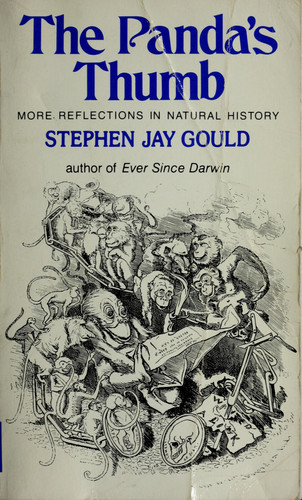
The panda's thumb: more reflections in natural history

Gould, Stephen Jay
A collection of essays by reknown scientist Jay Stephen Gould drawn from his columns in Natural History. The essays deal with topics such as: evolutionary opportunism (nature is a tinkerer, making the most of what's available in the course of adapting to the environment); new information on Darwin and his contemporaries; racism and cultural relativism; the evolutionary pattern of sudden rapid change; the origin of birds or the warm-bloodedness of dinosaurs; and, Teilhard de Chardin as a co-conspirator in the Piltdown hoax.
Norton 1980 343 pages