

8468 results for "History"

A World of Women Anthropological Studies of Women in the Societies of the World

Rethinking the other in antiquity
"Prevalent among classicists today is the notion that Greeks, Romans, and Jews enhanced their own self-perception by contrasting themselves with the so-called Other--Egyptians, Phoenicians, Ethiopians, Gauls, and other foreigners--frequently through hostile stereotypes, distortions, and caricature. Erich Gruen demonstrates how the ancients found connections rather than contrasts, how they expressed admiration for the achievements and principles of other societies, and how they discerned--and even invented--kinship relations and shared roots with diverse peoples." -- from publisher description.

Jews in Svoboda's army in the Soviet Union: Czechoslovak Jewry's fight against the Nazis during World War II

Jewish Poland revisited: heritage tourism in unquiet places
Since the end of Communism, Jews from around the world have visited Poland to tour Holocaust-related sites. A few venture further, seeking to learn about their own Polish roots and connect with contemporary Poles. For their part, a growing number of Poles are fascinated by all things Jewish. Erica T. Lehrer explores the intersection of Polish and Jewish memory projects in the historically Jewish neighborhood of Kazimierz in Krakow. Her own journey becomes part of the story as she demonstrates that Jews and Poles use spaces, institutions, interpersonal exchanges, and cultural representations

The man who stole first base: tales from baseball's past

Katrina's legacy: white racism and black reconstruction in New Orleans and the Gulf Coast
Katrina's Legacy focuses on the centrality of the Black Liberation Movement the entire U.S. Left and programmatic proposals supporting a new reconstruction in New Orleans and the Gulf Coast.

Munda trail
Recalls the battle over New Georgia in the Solomon Islands, one of America's offensive actions in the Pacific during World War II

Reckless rites: purim and the legacy of Jewish violence

Language, eros, being: kabbalistic hermeneutics and poetic imagination
This study - a blend of philosophy, poetry, and philology - draws on theories of sexuality, phenomenology, comparative religion, philological writings, Russian formalism, Wittgenstein, Rosenzweig, William Blake, and the very physics of the time-space continuum to explore Kabbalah.

Through a speculum that shines: vision and imagination in medieval Jewish mysticism
A comprehensive treatment of visionary experience in some of the main texts of Jewish mysticism, this book reveals the overwhelmingly visual nature of religious experience in Jewish spirituality from antiquity through the late Middle Ages. Using phenomenological and critical historical tools, Wolfson examines Jewish mystical texts from late antiquity, pre-kabbalistic sources from the tenth to the twelfth centuries, and twelfth- and thirteenth-century kabbalistic literature.

Language, eros, being: kabbalistic hermeneutics and poetic imagination
This study - a blend of philosophy, poetry, and philology - draws on theories of sexuality, phenomenology, comparative religion, philological writings, Russian formalism, Wittgenstein, Rosenzweig, William Blake, and the very physics of the time-space continuum to explore Kabbalah.

Modern Conservative Judaism: evolving thought and practice
"A Conservative Movement insider's guide to the evolution of Conservative Jewish thought and practice over the last half century, offering insight into the diverse (and occasionally contentious) thought processes behind the movement's most important laws, policies, and documents"--

A living tree: the roots and growth of Jewish law
This book examines biblical and rabbinic law as a coherent, continuing legal tradition. It explains the relationship between religion and law and the interaction between law and morality. Abundant selections from primary Jewish sources, many newly translated, enable the reader to address the tradition directly as a living body of law with emphasis on the concerns that are primary for lawyers, legislators, and judges. Through an in-depth examination of personal injury law and marriage and divorce law, the book explores jurisprudential issues important for any legal system and displays the primary characteristics of Jewish law.

From Christian Science to Jewish Science: spiritual healing and American Jews
During the late nineteenth and early twentieth centuries, thousands of American Jews were drawn to the teachings of Christian Science. Viewing such attraction with alarm, American Reform Rabbis sought to counter Christian Science's appeal by formulating a Jewish vision of happiness and health. Unlike Christian Science, it acknowledged the benefits of modern medicine yet, sharing the belief in God as the true source of healing, similarly emphasized the power of visualization and affirmative prayer. Though the numbers of those formally affiliated with Jewish would remain small, its emphasis on the connection between mind and body influenced scores of rabbis and thousands if not hundreds of thousands of American Jews, predating contemporary Jewish interest in spiritual healing by more than seventy years. Examining an important and previously unwritten chapter in the story of American Judaism, this book sheds light on religious and social concerns of twentieth-century American Jewry, including ways in which adherence to Jewish Science helped thousands bridge the perceived gap between Judaism and modernity.

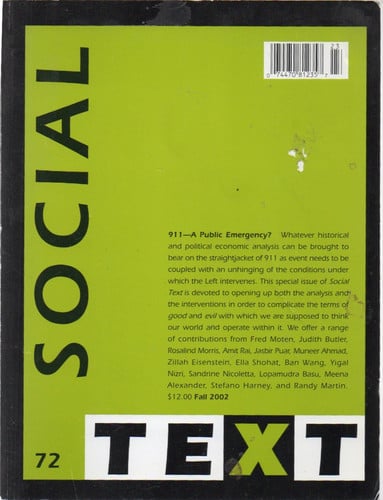
911 a Public Emergency?
Since September 11, public discourse has often been framed in terms of absolutes: an age of innocence gives way to a present under siege, while the United States and its allies face off against the Axis of Evil. This special issue of Social Text aims to move beyond these binaries toward thoughtful analysis. The editors argue that the challenge for the Left is to develop an antiterrorism stance that acknowledges the legacy of U.S. trade and foreign policy as well as the diversity of the Muslim faith and the dangers presented by fundamentalism of all kinds. Examining the strengths and shortcomings of area, race, and gender studies in the search for understanding, this issue considers cross-cultural feminism as a means of combating terrorism; racial profiling of Muslims in the context of other racist logics; and the homogenization of dissent. The issue includes poetry, photographic work, and an article by Judith Butler on the discursive space surrounding the attacks of September 11. This impressive range of contributions questions the meaning and implications of the events of September 11 and their aftermath. Contributors . Muneer Ahmad, Meena Alexander, Lopamudra Basu, Judith Butler, Zillah Eisenstein, Stefano Harney, Randy Martin, Rosalind C. Morris, Fred Moten, Sandrine Nicoletta, Yigal Nizri, Jasbir K. Puar, Amit S. Rai, Ella Shohat, Ban Wang
The exiles return
"The Exiles Return is set in Occupied Vienna in 1954-5. It describes five people who grew up there before the war and have come back to see if they can re-establish the life they have lost. The novel begins with Professor Kuno Adler, who is Jewish and fled Vienna after the Anschluss (the events of March 1938 when Hitler's troops marched into Austria). He is returning from New York to try and take up his old life as a research scientist. We realise through his confrontation with officialdom and with the changed fabric of the city (the lime trees are there no longer, it is hard to know who behaved well during the war and who was a Nazi sympathiser) that a refugee who goes back has a very difficult time. Next we are introduced to a wealthy Greek named Kanakis..."--Publisher description.

Party in the Blitz The English Years
Elias Canetti originally intended Party in the Blitz to capture an image of his time in post-war London. Well known throughout Europe, Canetti scorned British intellectuals who weren't familiar with his work. By force of will alone he accumulated English followers, but not before being christened "the godmonster of Hampstead." Canetti's memories of various people in his social circle are brief and scathing brimstone sketches. T.S. Eliot, Iris Murdoch, Wittgenstein, Herbert Read, Bertrand Russell-Canetti rakes them all over the coals. To Canetti, T.S. Eliot was nothing more than an American emigrant trying desperately to act British, and Canetti's portrayal of Iris Murdoch, with whom he had an affair, is nothing short of brutal. Michael Hofmann's translation pulls no punches, delivering the goods on Canetti's searing injection: "when you write down your life, every page should contain something no one has ever heard about."

Miss Granby's secret, or, The bastard of Pinsk
How much did Aunt Addie know? How much did she feel? Aunt Addie better known to the world at large as Adelaide Granby, the fabulously successful author of 49 volumes of gushing, melodramatic Victorian romance. Upon her death in 1912, flowers and cards pour in, including one particularly lavish set "From Stanislaw", whom her independent-minded, suffragette niece Pamela decides was "darling Aunt Addie's Grande Passion." Pamela also inherits a stack of Aunt Addie's secret papers, including youthful diaries and her unintentionally hilarious unpublished first novel, written when she was only 16, entitled The Bastard of Pinsk (a "bastard", 16-year-old Adelaide was sure, being "A very noble Hero of Royal Blood.") As Pamela explores these documents and talks with those who knew her aunt when, seeking the real-life source of her romantic sensibility, the reader is drawn irresistibly into the intrigue. In a novel both sentimental and brutally honest, nostalgic for and horrified by the sentiments of the past, hilarious and poignant, all at once, the brilliant Eleanor Farjeon poses surprisingly powerful questions about what makes a love "real" and how much one really needs to know to experience it... This new edition features a superb introduction by twentieth-century women's historian Elizabeth Crawford. "Naughtiness of a definitely mauve tint." Beatrice Sherman, New York Times

Slavery and abolition in the Ottoman Middle East
This exploration of slavery from the Ottoman viewpoint is based on extensive research in British and Turkish archives and offers rich, original, and important insights into Ottoman life and thought.
