

58,196 results in 0.08 seconds

The burden of responsibility: Blum, Camus, Aron, and the French twentieth century
Using the lives of the three outstanding French intellectuals of the twentieth century, renowned historian Tony Judt offers a unique look at how intellectuals can ignore political pressures and demonstrate a heroic commitment to personal integrity and moral responsibility unfettered by the difficult political exigencies of their time. Through the prism of the lives of Leon Blum, Albert Camus, and Raymond Aron, Judt examines pivotal issues in the history of contemporary French society—antisemitism and the dilemma of Jewish identity, political and moral idealism in public life, the Marxist moment in French thought, the traumas of decolonization, the disaffection of the intelligentsia, and the insidious quarrels rending Right and Left. Judt focuses particularly on Blum's leadership of the Popular Front and his stern defiance of the Vichy governments, on Camus's part in the Resistance and Algerian War, and on Aron's cultural commentary and opposition to the facile acceptance by many French intellectuals of communism's utopian promise. Severely maligned by powerful critics and rivals, each of these exemplary figures stood fast in their principles and eventually won some measure of personal and public redemption. Judt constructs a compelling portrait of modern French intellectual life and politics. He challenges the conventional account of the role of intellectuals precisely because they mattered in France, because they could shape public opinion and influence policy. In Blum, Camus, and Aron, Judt finds three very different men who did not simply play the role, but evinced a courage and a responsibility in public life that far outshone their contemporaries. "An eloquent and instructive study of intellectual courage in the face of what the author persuasively describes as intellectual irresponsibility."—Richard Bernstein, New York Times

When the facts change: essays, 1995-2010
"In an age in which the lack of independent public intellectuals has often been sorely lamented, the historian Tony Judt played a rare and valuable role, bringing together history and current events, Europe and America, what was and what is with what should be. In When the Facts Change, Tony Judt's widow and fellow historian Jennifer Homans has assembled an essential collection of the most important and influential pieces written in the last fifteen years of Judt's life, the years in which he found his voice in the public sphere. Included are seminal essays on the full range of Judt's concerns, including Europe as an idea and in reality, before 1989 and thereafter; Israel, the Holocaust and the Jews; American hyperpower and the world after 9/11; and issues of social inclusion and social justice in an age of increasing inequality. Judt was at once most at home and in a state of what he called internal exile from his native England, from Europe, and from America, and he finally settled in New York--between them all. He was a historian of the twentieth century acutely aware of the dangers of ethnic exceptionalism, and if he was shaped by anything, it was the Jewish past and his own secularism. His essays on Israel ignited a firestorm debate for their forthright criticisms of Israeli government polices relating to the Palestinians and the occupied territories. Those crucial pieces are published here in book form for the first time, including an essay, never previously published, called 'What Is to Be Done?' These pieces are suffused with a deep compassion for the Israeli dilemma, a compassion that instilled in Judt a sense of responsibility to speak out and try to find a better path, away from what he saw as a road to ruin. When the Facts Change also contains Judt's homages to the culture heroes who were some of his greatest inspirations: Amos Elon, Francois Furet, Leszek Kolakowski, and perhaps above all Albert Camus, who never accepted the complacent view that the problem of evil couldn't lie within us as well as outside us. Included here too is a magnificent two-part essay on the social and political importance of railway travel to our modern conception of a good society; as well as the urgent text of 'What Is Living and What Is Dead in Social Democracy, ' the final public speech of his life, delivered from a wheelchair after he had been stricken with a terrible illness; and a tender and wise dialogue with his then-teenage son, Daniel, about the different outlooks and burdens of their two generations. To read When the Facts Change is to miss Tony Judt's voice terribly, but to cherish it for what it was, and still is: a wise, human, deeply informed view on our most pressing concerns, delivered in good faith."--

A Bright Room Called Day
From the Pulitzer Prize-winning author of Angels in America comes this powerful portrayal of individual dissolution and resolution in the face of political catastrophe. "Tony Kushner's A BRIGHT ROOM CALLED DAY ... is unabashedly political, thought-provoking, a little scary, and frequently a good deal of theatrical fun ... BRIGHT ROOM is ... an examination of Nazi Germany in an attempt to shed insight on our own time. It's brash, audacious, and, depending on your politics, anything from infuriatingly naïve to intoxicatingly visionary. In its 1932-33 span, it tells of a group of Berlin artists and friends, with varying degrees of communist leanings, and of the changes in their lives as democracy falls and Adolph Hitler takes over." -Sid Smith, Chicago Tribune "It's fun to see a show this engaged. This passionate and ready to talk. Wild, uneven, pugnacious, ragged, committed, smart, dumb, satirical, and utterly serious ... Always dramatically and intellectually forceful. And most important, always passionately committed. More than a diatribe against Reagan or a falling-into-the-Nazi-abyss history play, A BRIGHT ROOM CALLED DAY is an assertion of the need for commitment." -Anthony Adler, The Reader

Angels in America, Part One Millennium Approaches
"ANGELS IN AMERICA has proved to be a watershed drama, the most lyrical and ambitious augury of an era since Tennessee Williams's The Glass Menagerie." John Lahr, The New Yorker "The most influential American play of the last two decades." Patrick Healy, The New York Times "Daring and dazzling! The most ambitious American play of our time: an epic that ranges from earth to heaven; focuses on politics, sex and religion; transports us to Washington, the Kremlin, the South Bronx, Salt Lake City and Antarctica; deals with Jews, Mormons, WASPs, blacks; switches between realism and fantasy, from the tragedy of AIDS to the camp comedy of drag queens to the death or at least absconding of God." Jack Kroll, Newsweek "The greatest American play of the waning years of the twentieth century." Chris Jones, Chicago Tribune

The Way We're Working Isn't Working
Through his years of intensive work consulting to companies including Procter & Gamble, Sony, Toyota, Microsoft, Ford and Ernst & Young, with his firm The Energy Project, Schwartz has developed a powerful program for changing the way we are working that greatly boosts our engagement and our satisfication with our work and increases our performance. In this book he marshalls a wide range of powerful evidence from business research and psychology that shows that the current model of work is not only not optimal, it is specfically counter-productive because it saps us of our physical, emotional, mental and spiritual energy. In order for us to perform at our best, we must make a set of key changes in our work lives -- and in order to develop the full potential of their work force, our managers and companies must institute changes that will provide us with the regular physical renewal, emotional reward, mental focus and stimulation; and sense of purpose and significance that we need.

sTori telling
The star of Beverly Hills 90210 offers a hilarious, insightful memoir about growing up on America’s favorite teen drama and her life after the show. She was television's most famous virgin—and, as Aaron Spelling's daughter, arguably its most famous case of nepotism. Portraying Donna Martin on Beverly Hills, 90210, Tori Spelling became one of the most recognizable young actresses of her generation, with a not-so-private personal life every bit as fascinating as her character's exploits. Yet years later the name Tori Spelling too often closed—and sometimes slammed—the same doors it had opened. sTORI telling is Tori's chance to finally tell her side of the tabloid-worthy life she's led, and she talks about it all: her decadent childhood birthday parties, her nose job, her fairy-tale wedding to the wrong man, her so-called feud with her mother. Tori has already revealed her flair for brilliant, self-effacing satire on her VH1 show So NoTORIous and Oxygen's Tori & Dean: Inn Love, but her memoir goes deeper, into the real life behind the rumors: her complicated relationship with her parents; her struggles as an actress after 90210; her accident-prone love life; and, ultimately, her quest to define herself on her own terms. From her over-the-top first wedding to finding new love to her much-publicized—and misunderstood—"disinheritance," sTORI telling is a juicy, eye-opening, enthralling look at what it really means to be Tori Spelling.

One Monday Morning
In this cumulative story, a little boy imagines that a king and queen and their growing entourage return each morning of the week to visit him until he is finally home to greet them at his home in the city.

Writing with pictures: how to write and illustrate children's books
How to write and illustrate children's books.

Languages in Contact: Findings and Problems
"This remains the fundamental base for studies of multilingual communities and language shift. Weinreich laid out the concepts, principles and issues that govern empirical work in this field, and it has not been replaced by any later general treatment."Prof. Dr. William Labov, University of Pennsylvania, Department of Linguistics

The Addams Family
Lyrics of the iconic song guide readers on a tour of the Addams Family mansion.

By Way of Deception
By Way of Deception: A Devastating Insider's Portrait of the Mossad.

Naming names
The subject is cold-war Hollywood, but Mr. Navasky goes far beyond that small town and brings the subject right up to the present.

Yes to life: in spite of everything
'Viktor Frankl gives us the gift of looking at everything in life as an opportunity' Edith Eger, bestselling author of The Choice 'Offers a path to finding hope even in these dark times' The New York Times A rediscovered masterpiece by the 16 million copy bestselling author of Man's Search For Meaning Just months after his liberation from Auschwitz renowned psychiatrist Viktor E. Frankl delivered a series of talks revealing the foundations of his life-affirming philosophy. The psychologist, who would soon become world famous, explained his central thoughts on meaning, resilience and his conviction that every crisis contains opportunity. Published here for the very first time in English, Frankl's words resonate as strongly today as they did in 1946. Despite the unspeakable horrors in the camp, Frankl learnt from his fellow inmates that it is always possible to say 'yes to life' - a profound and timeless lesson for us all. With an introduction by Daniel Goleman. ' Frankl's is a voice that seems as necessary now as it was in the shadow of the Holocaust' Guardian

The Torah Modern Commentary: Deuteronomy
Book by Plaut, W. Gunther

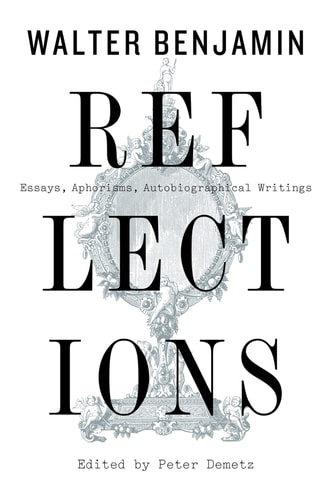
Reflections: essays, aphorisms, autobiographical writings
Zusammenfassung: "A companion volume to Illuminations, the first collection of Walter Benjamin's writings, Reflections presents a further sampling of his wide-ranging work"--(Provided by publisher.)
Existentialism: from Dostoevsky to Sartre
One of the foremost resources on existentialism from renowned philosopher, poet, and Nietzsche translator Walter Kaufmann—a must-read for philosophers, both armchair and professional. Existentialism from Dostoevsky to Sartre provides basic writings of Dostoevsky, Kierkegaard, Nietzsche, Rilke, Kafka, Ortega, Jaspers, Heidegger, Sartre, and Camus, including some not previously translated, along with an invaluable introductory essay by Walter Kaufmann.

Putinism: Russia and its future with the West
"A timely, topical book grounding Russia's recent turn towards conservativism in pre-1917 culture and explaining what this shift could mean for the rest of the world" ; "There is no question that tensions between Russia and America are on the rise. The forced annexation of Crimea, the downing of Malaysia Airlines flight 17, and the Russian government's treatment of homosexuals have created diplomatic standoffs and led to a volley of economic sanctions. Much of the blame for Russia's recent hostility towards the West has fallen on steely-eyed President Vladimir Putin, and Americans have begun to wonder if they are witnessing the rebirth of Cold War-style dictatorship. Not so fast, argues veteran historian Walter Laqueur. For two decades Laqueur has been ahead of the curve, predicting events in post-Soviet Russia with uncanny accuracy. In Putinism, he deftly demonstrates how three long-standing pillars of Russian ideology: a strong belief in the Orthodox Church, a sense of Eurasian 'manifest destiny, ' and a fear of foreign enemies, continue to exert a powerful influence on the Russian populace. As a result, Putin may well be much more a servant of his people than we think. Topical and provocative, Putinism contains much more than historical analysis. Looking to the future, Laqueur explains how the tendency to view Russia as a Cold War relic is dangerous and premature. Russia can, and will, continue to challenge the West so it is in our best interest to figure out exactly who it is we are facing--and what they want--before it is too late"

Been wrong so long it feels like right: a king oliver novel
"Joe King Oliver is at a crossroads: with his grandmother on death's door, he tasked with tracking down his estranged father, a man he discovers has been out of prison for more than a decade. He also seeks to protect another family, a mysterious woman and her young daughter on the run from an abusive billionaire who'll stop at nothing to retrieve them. Heartfelt, pulse-pounding, and undeniably sexy, Been Wrong So Long It Feels Like Right shows Walter Mosley at his very best"-- Provided by publisher.

