

77 results for "Biography"

Last Man Out The Story of the Springhill Mine Disaster
One evening in late October 1958, the deepest coal mine in North America "bumped"-its rock floors heaved up and smashed into rock ceilings. Most of the men on the shift perished. But nineteen men were trapped alive a mile below the earth's surface, struggling to survive without food, water, light, or fresh air. Almost a week passed without rescue. Hopes of finding life dwindled; then a miracle happened: Rescuers stumbled across a broken pipe that led to the cave of survivors. In the media circus that followed, the survivors' endurance was mythologized and twisted, and the state of Georgia's tourism ploy-inviting the survivors to recuperate on a Georgia beach-turned racist and pitted the miners against each other. Using long-lost stories and interviews with survivors, Greene has reconstructed an extraordinary drama of their struggle and miraculous rescue.

Karl, the Universe and Everything
Learn about Dr Karl, the universe and everything, and discover how air-conditioning is sexist, how you can kill a spinning hard drive by shouting at it and how space junk is threatening our future capabilities for space travel. Could there be life on one of Saturn's moons? How much power could you collect from all the lightning on Earth? Why do books have book-smell? Why is 10 per cent of the Earth's land area prone to sinkholes? Why are some people chronically late? What would happen if the Earth stopped spinning? Why do most people hardly remember anything from the first half-a-dozen years of their life? How close are we to the Artificial Uterus? Why do some songs turn into "earworms" and stick inside your brain? Why does your hotel room access card get wiped so easily? And is your home WiFi really spying on you?

Before the Year Dot
Most recognisable as EastEnders' Dot Cotton, June Brown is both an institution and a national treasure. Her full and captivating life makes her more than just a soap star, but a showbiz veteran. And this largely anticipated book doesn't shy away from her strong opinions and fascinating stories; it's a celebration of her extraordinary life. June's childhood was colourful and quirky though marked with tragedy with the death of a brother and a sister and a difficult father. June went on to be classically trained at the Old Vic Drama School in London before going on to play the role of Dot Cotton, the longest serving member of the cast of EastEnders. But the tragedies June has endured make those of her down-trodden character pale into insignificance. Her first husband gassed himself in the marital home, leaving June to find his body and in 2003 her adored second husband of 45 years lost a 3 year battle to dementia. Further tragedy ensued when her second child was born prematurely and, as a result of medical malpractice, lived for just 16 days. Through all of life's considerable trials and heartbreak, her wit, charm and indefatigable spirit have remained strong. This is the inspiring story of the full and captivating life of one of our most respected and admired soap stars.

Running Against the Wind The True Story of Twin Sisters from Brooklyn Who Changed the Lives of Thousands of African-American Youngsters in New York City
Brooklyn, Bed-Sty, post WWII euphoria, nostalgia, the PAL and race relations as they really were, as lived by pioneering track stars, the DeSaussure twins, who opened Police Athletic League to thousands of girls of color. Story of a religious home life, pride of a mixed neighborhood, athletic triumphs and defeats. Successful today, they are giving back.

Mosaic
international praise for Diane Armstrong: 'Mosaic flows like a novel which, once started, is hard to put down. It is a compelling family history of extraordinary people played out against some of the most frightening events of our century. The depth of emotions evoked is stunning. I was thrilled and deeply moved.' Joseph Heller author of Catch-22 'Diane Armstrong's book is a source of delight to the reader. Written with fervor and talent, it will capture your attention and retain it to the last page.' Elie Wiesel Nobel Prize winner a family story you'll never forget ... This extraordinary true story begins in the Polish city of Krakow in 1890 and spans one hundred years and four continents. It is the story of a Jewish family whose patriarch, Daniel Baldinger, divorces the wife he loves because she is barren. He believes 'a man must have sons to say Kaddish for him when he dies.' To ensure having children, he marries a girl of eighteen. By 1913, Daniel has eleven children - including six sons to say Kaddish for him. Impatient for his God-given son to begin learning the sacred language of the Torah, Daniel sent Avner to cheder at Chevre Tilem when he was three years old. Most boys were enrolled at four or five, but Daniel couldn't wait for Avner's rabbinical training to begin. Cheder was the place where childhood ended. At this religious day school, Jewish boys learned Hebrew and studied the Torah. No coloured pictures, childish stories or lively games relieved the tedium of this dour classroom where Avner had to memorise words he didn't understand, learn hundreds of rules and write strange squiggles. But although God has answered Daniel's prayers, it is with a bitter twist: each of his six sons rebels against his religion, and not one of them says Kaddish for him when he dies. This richly textured portrait follows these eleven children from the 1890s, through the terrifying years of the Holocaust (when Diane and her parents assumed non-Jewish names and passed themselves off as Catholics in the little village of Piszczac), to the present. A long shadow fell across the little girl tracing patterns in the dirt with a stick. After watching her for a few minutes, the stranger asked, 'What's your name, little girl?' Without looking up, she replied, 'Danusia Boguslawska.' 'But what was your name before that?' he insisted. My father, Henek, who was standing by the open window, froze when he heard the last question. Instead of rushing outside and grabbing the child to prevent her from answering that insidious question, he was struck dumb and stood there helplessly awaiting her reply, on which all their lives depended. Mosaic is compelling storytelling at its best: from the fascinating detail of Polish Jewish culture at the turn of the century and the rivalries and dramas of family life, to its moving account of lives torn apart by war and prejudice, this is a remarkable story of a family, and of one woman's journey to reclaim her heritage. For centuries Poland has been a battleground whose fields, watered by more blood than rain, have nurtured ancient hatreds. Jews have not had a monopoly on suffering, grief and loss. Before we drive away from Szczakowa, I look back at the leafy street where the synagogue and mikveh stood, just a short stroll from the house on Parkowa Street. If I close my eyes, I can see a dapper white-haired gentleman in top hat and patent leather shoes like mirrors striding ahead of his wife in a flowered hat with feathers, her long full skirt rustling as she tries to keep up with him as they walk to the synagogue on Kilinskiego Street for the marriage of their daughter Lieba to Daniel Baldinger. In this forgotten country town, I've found important pieces of the mosaic.

They Said I Wasn't Really Black
As a biracial (Black/White) young man adopted by a white family, Aaron Dworkin has had the unique advantage of being able to observe life and society around us from differing cultural perspectives. In this collection of poetry, he has captured many of his experiences, dramatic, humorous, insightful and moving. He invites you to share this unique adventure with him.

This Crazy Time Living Our Environmental Challenge
Passionate, profound and funny, Berman is inspiring people from all walks of life to get off the sidelines and fight the good fight--and win. This unique book--part manifesto from a leader, part humorous activist memoir from a soccer mom--offers a wryly honest, behind-the-scenes, ultimately uplifting look at the state of the planet. For almost 20 years, Tzeporah Berman has been one of our most influential environmentalists. A founder of ForestEthics and PowerUp Canada, she was instrumental in shaping the tactics and concerns of the modern environmental movement. In her early 20s she faced nearly one thousand criminal charges and 6 years in prison for her role organizing blockades in Canada's rainforest. She later transformed her tactics and sat down with CEOs and political leaders to reshape their policies and practices. In her new role at Greenpeace International she is fighting the problem of our time: climate change. This Crazy Time is an impassioned plea for a better world.

The Royalty A Spiritual Awakening

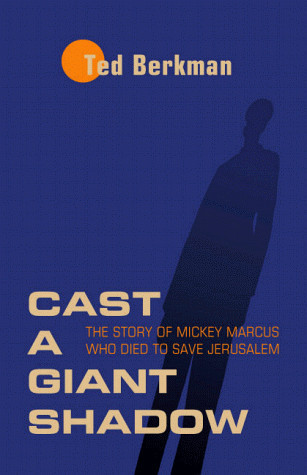
Cast a Giant Shadow The Story of Mickey Marcus Who Died to Save Jerusalem
Colonel David "Mickey" Marcus--after serving his country with distinction in World War II--responded to the appeal of a beleaguered country in the Middle East and became one of the truly great heroes of modern Israel, the only soldier interred at West Point who was killed while fighting under a foreign flag.
Stella

In Search of Common Ground Conversations with Erik H. Erikson and Huey P. Newton
Random pages have underlining or check marks, bottom front corner folded. No crease to spine. 1974 Dell, 4 1/4 By 7",

Kicking the Pricks
"Soon after he started filming "The Last of England" (which had much autobiographical content) in 1986, Derek Jarman started work on this book, which contains diary entries, interviews and notes from the script. He writes of his childhood and his kleptomaniac father, the process through which he came to terms with his homosexuality, his early work as a painter and designer, and his debut as a film director. Serious themes are followed thoughout, as Jarman writes of what he regards as the corruption of the cinema industry, the moral and personal consequences of the AIDS virus, and the down side of Thatcher's Britain.

Member of the Legislature
This is Morton Shulman's own fast- moving story of his eight years in politics. It is sharp but full of public concern, opinionated but self-critical, serious in intent but often hilarious in the telling. It reflects perfectly the life-style of its author-- there is never a dull moment. During his eight years as a member of the provincial Legislature, Morton Shulman's name was rarely off the front pages. Here Shulman tells the dramatic stories behind the headlines, and the stories that never made the front page. For Shulman, an "unrepentant capitalist" millionaire, the decision to run for the NDP was a chance to get back at the Conservative government that had fired him as Coroner. But it became much more than that, as Shulman, the man who always was approachable, became an unofficial ombudsman for the province and the people. Shulman's career as a Member of the Legislature was as stormy as his record in office as Chief Coroner. He smuggled a camera into the House and took pictures of government members asleep during debates. Disguised as a workman, he walked into the INCO plant at Sudbury and spent the night measuring sulphur dioxide levels which proved that in spite of government inspectors' assurances the pollution levels were dangerously high. He exposed Mafia connections with union leaders, politicians and police, and ended up with a Mafia contract on his life and a full-time police guard. He put on a hard hat and walked unchallenged into the Pickering Nuclear Power Plant to show that there was virtually no security in this potentially dangerous area. All these capers had but one goal -- to expose the bureaucratic bungling that affected and sometimes even endangered the lives of the ordinary Canadians who paid the tax bill. One after another he took on the Departments of Labour, Health, Highways, Reform Institutions, Natural Resources, Energy, the Attorney General, Bell Canada and more. His eight years as a Member of the Legislature brought some changes in government policies, Royal Commissions and numerous editorials about the situations he brought to public attention. Sometimes he lost, but the degree of public trust in Morton Shulman brought him national attention. There's never been another Member like Shulman.

Year of the King
(Limelight). In 1984 Antony Sher, hailed as "the most exciting actor of his generation" by the Observer, made his debut on homemade crutches as the infamous Richard III in the Royal Shakespeare Company production of the play. He would go on to win the Laurence Olivier and Evening Standard Awards for best actor. In his own words and sketches, he chronicles his personal and professional journey to this award-winning performance, from the moment he was offered the role to opening night, in the critically acclaimed book Year of the King, now available in this special 20th anniversary edition. From his brainstorm to use crutches to bring the king's deformity to life, to his research for the role, which included watching interviews with psychopaths, reading about mass murderers, and speaking with doctors and physically challenged individuals, to his visit to his homeland of South Africa, to his experiences in working with the Royal Shakespeare Company, the reader is given a front-row seat to Sher's physical and mental preparation or rather transformation for his landmark performance as "the bottled spider."

Burn, Baby! Burn! The Autobiography of Magnificent Montague
With his dynamic on-air personality and his trademark cry of "Burn, baby! BURN!" when spinning the hottest new records, Magnificent Montague was the charismatic voice of soul music in Chicago, New York, and Los Angeles from the mid-1950s to the mid-1960s. In this memoir Montague recounts the events of his momentous radio career, which ran from the era of segregation to that of the civil rights movement; as he does so, he also tells the broader story of a life spent in the passionate pursuit of knowledge, historical and musical. Like many black disc jockeys of his day, Montague played a role in his community beyond simply spreading the music of James Brown, Otis Redding, Aretha Franklin, and other prominent artists. Montague served as an unofficial spokesman for his black listeners, reflecting their beliefs and acting as a sounding board for their concerns. Montague was based in Los Angeles in 1965 when the Watts rioters seized on his incendiary slogan, turning the shout of musical appreciation into a rallying cry for racial violence. In Burn, Baby! BURN! Montague recalls these tumultuous times, including the personal struggle he faced over whether to remain true to his listeners or bend to political pressure and stop shouting his suddenly controversial slogan. Since the mid-1950s Montague had also expressed his passion for African American culture by becoming a zealous collector of artifacts of black history. He has built a monumental collection, taking time out from his collecting to become only the second African American to build his own radio station literally from the ground up. A compelling account of a rich and varied life, Burn, Baby! BURN! gives an insider's view of half a century of black history, told with on-the-air zest by the DJ/historian who was there to see it unfold.

Jacob's Voices Reflections of a Wandering American Jew
An American professor of history finds his roots in a personal journey through Israel -- and through assimilated America, academia, baseball, and family -- headlong into deep tensions and ambivalence about country, culture, identity and religion. Worried about the commitment of Jews to their heritage, Jerold Auerbach (renowned author of Unequal Justice) shares his story and musings with insight, irony, and intensity. A personal journey, literally and spiritually, to Israel by one of the most recognized legal historians in the United States.

Journey Through a Small Planet
In Journey Through a Small Planet (1972), the writer Emanuel Litvinoff recalls his working-class Jewish childhood in the East End of London: a small cluster of streets right next to the city, but worlds apart in culture and spirit. With vivid intensity Litvinoff describes the overcrowded tenements of Brick Lane and Whitechapel, the smell of pickled herring and onion bread, the rattle of sewing machines and chatter in Yiddish. He also relates stories of his parents, who fled from Russia in 1914, his experiences at school and a brief flirtation with Communism. Unsentimental, vital and almost dream like, this is a masterly evocation of a long-vanished world.

Fishing with John
This is a love story; an unlikely convergence of two people from different worlds who were able to make a rich and tender life together, and not only endure each other's company in alarmingly close quarters but revel in it. Edith Iglauer was born in Cleveland and lived an urban, sophisticated life in New York until she met and married John Daly, a commercial fisherman in British Columbia. She spent more than four years on his forty-one-foot troller, the Morekelp until his sudden death. John Daly was an impassioned and greatly talented fisherman who was convinced that he could "think like a fish"; an amateur philosopher who worked out, and followed, an orginal set of beliefs and principles; a mystic who, after forty years of fishing, felt himself to be at one with the sea and the mountains along the British Columbia coast; a scholarly looking, high-spirited, full-blown eccentric who covered the white walls of his pilothouse with his favorite quotations in bold black letters ("Lawyers spend their professional careers shoveling smoke. O.W. Holmes") Fishing with John established Edith Iglauer as one of BC's most popular writers. This unusual West Coast love story sold 16,000 copies in hardcover and continues to be a bestseller in paperback.

Leaving Russia: a Jewish story
Narrated in the tradition of Tolstoy's confessional trilogy and Nabokov's autobiography, Leaving Russia: A Jewish Story is a searing account of growing up a Jewish refusenik, of a young poet's rebellion against totalitarian culture, and of Soviet fantasies of the West during the Cold War. Shrayer's remembrances ore set against a rich backdrop of politics, travel, and ethnic conflict on the brink of the Soviet empire's collapse. His moving story offers generous doses of humor and tenderness, counterbalanced with longing and violence.
