329 results for "Biology"

Darwin and the Darwinian revolution

Himmelfarb, Gertrude
In her enduring study of the impact of Darwinism on the intellectual climate of the nineteenth century, Gertrude Himmelfarb brings massive documentation to bear in challenging the conventional view of Darwin's greatness. Touching on biography, history, and philosophy, she traces the origins and development of Darwin's views against the opinions of his time; assesses the influences on him; and shows what he intended his theory to mean, what his readers took it to mean,
I.R. Dee 1996 510 pages

The tangled bank: an introduction to evolution

Zimmer, Carl
"The Tangled Bank is the first textbook about evolution intended for the general reader. Zimmer, an award-winning science writer, takes readers on a fascinating journey into the latest discoveries about evolution. In the Canadian Arctic, paleontologists unearth fossils documenting the move of our ancestors from sea to land. In the outback of Australia, a zoologist tracks some of the world's deadliest snakes to decipher the 100-million-year evolution of venom molecules. In Africa, geneticists are gathering DNA to probe the origin of our species. In clear, non-technical language, Zimmer explains the central concepts essential for understanding new advances in evolution, including natural selection, genetic drift, and sexual selection. He demonstrates how vital evolution is to all branches of modern biology-from the fight against deadly antibiotic-resistant bacteria to the analysis of the human genome. Richly illustrated with 285 illustrations and photographs, The Tangled Bank is essential reading for anyone who wants to understand the history of life on Earth."-- Publisher's description.
Roberts and Co. Publishers 2010 385 pages

Mind and cosmos: why the materialist neo-Darwinian conception of nature is almost certainly false

Nagel, Thomas
The modern materialist approach to life has conspicuously failed to explain such central mind-related features of our world as consciousness, intentionality, meaning, and value. This failure to account for something so integral to nature as mind, argues philosopher Thomas Nagel, is a major problem, threatening to unravel the entire naturalistic world picture, extending to biology, evolutionary theory, and cosmology. Since minds are features of biological systems that have developed through evolution, the standard materialist version of evolutionary biology is fundamentally incomplete. And the cosmological history that led to the origin of life and the coming into existence of the conditions for evolution cannot be a merely materialist history, either. An adequate conception of nature would have to explain the appearance in the universe of materially irreducible conscious minds, as such. Nagel's skepticism is not based on religious belief or on a belief in any definite alternative. In Mind and Cosmos, he does suggest that if the materialist account is wrong, then principles of a different kind may also be at work in the history of nature, principles of the growth of order that are in their logical form teleological rather than mechanistic. In spite of the great achievements of the physical sciences, reductive materialism is a world view ripe for displacement. Nagel shows that to recognize its limits is the first step in looking for alternatives, or at least in being open to their possibility.--Publisher description.
Oxford University Press 2012-11-22 130 pages

Ever since Darwin: reflections in natural history

Gould, Stephen Jay
More than any other modern scientists, Stephen Jay Gould has opened up to millions the wonders of evolutionary biology. His genius as an essayist lies in his unmatched ability to use his knowledge of the world, including popular culture, to illuminate the realm of science. Ever Since Darwin, Stephen Jay Gould's first book, has sold more than a quarter of a million copies. Like all succeeding collections by this unique writer, it brings the art of the scientific essay to unparalleled heights.
Norton 1979 285 pages

How to speak dog: mastering the art of dog-human communication

Coren, Stanley
At long last, dogs will know just how smart their owners can be. By unlocking the secrets of the hidden language of dogs, the author, a psychologist, allows us into the doggy dialogue and makes two-way communication a reality. For the first time, instead of receiving an incomprehensible mash of mixed human signals, man's best friend will be treated to the proper use of dog language. Finally, effective communication can take place between canines and these "strange tall dogs" who have mystified them for so long. Building on research into the simplified language of "baby talk" (that nearly universally recognized "motherese" with which mothers speak to their infants), the author provides insights into the structure and form of the simplified language that many dog owners use to communicate with their pets. A better understanding of this language, "Doggish," is the key to improved two-way communication. The book provides not only the sounds, words, actions, and movements with which we can effectively communicate with our dogs, but deciphers the signs that our dogs give to us. By giving us the information we need to interpret the wagging of their tails, the flapping of their ears, the movement of their bodies, and the lapping of their tongues as much as their barks, the author allows us into their rich world of communication, giving dog-lovers the skills they need to improve their relationships with their pets. As every owner will admit, dogs have an uncanny ability to respond to nuances of human speech. Although actual conversation of the sort Lassie seemed capable of in Hollywood mythmaking remains forever out of reach, research and observation show that a great deal of real communication is possible beyond the giving and obeying of commands. This book explores the limits of dogs' language abilities and charts the possibilities. It gives owners the key to interpret correctly not only information but emotional states. With easy-to-follow tips on how humans can mimic the language dogs use to talk with each other, it provides a surprising and fascinating window into the world of dog communication, why they speak and what they talk about. Drawing on substantial research in animal behavior, evolutionary biology, and years of personal experience, the author demonstrates that the average house dog can differentiate between 60 and 140 words, though some research suggests that dogs can hear many more and also pick words out of sentences and respond to them. This work examines people's beliefs about the ability of their dogs to communicate and contrasts those with the scientific reality. As the author shows us, the gulf is more narrow than many people think, and the rewards of bridging it are endless.
Simon & Schuster 2001-04-17 288 pages

One renegade cell: how cancer begins

Weinberg, Robert A.
Cancer research has reached a major turning point. The quality and quantity of information gathered about this disease in the past twenty years has revolutionized our understanding of its origins and behavior. No one is better qualified to comment on these dramatic leaps forward than molecular biologist Robert A. Weinberg, director of one of the leading cancer research centers in the world. In One Renegade Cell , Weinberg presents an accessible and state-of-the-art account of how the disease begins and how, one day, it will be cured.Weinberg tells how the roots of cancer were uncovered in 1909 and when the first cancer-causing virus was discovered. He then moves forward to the discovery of the role of chemical carcinogens and radiation in triggering cancer, and relates the remarkable story of the discoveries of oncogenes and tumor suppressor genes, the master controllers of normal and malignant cell proliferation.This book, which presumes little prior knowledge of biology, describes the revolution in biomedical research that has finally uncovered the forces driving malignant growth. Drawing on insights that simply were not available until recently, the discoveries presented in One Renegade Cell have already begun to profoundly alter the way that we diagnose and treat human cancers.
Basic Books 1998-10-08 170 pages

Survival of the prettiest: the science of beauty

Etcoff, Nancy L.
Beauty is not a myth. According to scientist and psychologist Nancy Etcoff, the pursuit of beauty is neither a cultural construction, an invention of Madison Avenue, nor a backlash against feminism. Survival of the Prettiest, the first in-depth scientific inquiry into the nature of human beauty, posits that beauty is an essential and ineradicable part of human nature, from what makes a face beautiful to the deepest questions about the human condition. Every human civilization has revered beauty, pursued it at enormous costs, and endured both the tragic and the comic consequences of that pursuit. Provocative, witty, and insightful, Etcoff sheds light on every aspect of human beauty, including why we devour fashion magazines, check our waistlines, and gaze longingly at objects of desire. Informed by state-of-the-art theories of the human mind from cognitive science and evolutionary biology, Survival of the Prettiest tells us why gentlemen prefer blondes, why high heels have never gone out of style, why eyebrows are plucked and hair is coiffed. Etcoff also explains how sexual preference is guided by ancient rules that make us most attracted to those with whom we are most likely to reproduce. Research on why we find infant features irresistibly attractive, as well as controversial new work that suggests parents show more affection to attractive newborns, is part of a broad investigation that includes insights into how beauty influences our perceptions, attitudes, and behavior toward others. When the attainment of beauty is viewed in the context of a Darwinian struggle for survival, many of the most extreme practices surrounding our looks, such as body piercing and serial plastic surgeries, suddenly seem less outlandish. In fact, those very practices may ensure the survival of our genes. Agree or disagree, you will never think about human beauty the same way again.
Doubleday 1999 325 pages

Astrobiology: a multidisciplinary approach

Lunine, Jonathan Irving
Astrobiology: A Multi-Disciplinary Approach is the most comprehensive textbook designed for emerging upper level courses in astrobiology. Internationally renowned authority Jonathan Lunine provides a solid foundation in the essential concepts of physics, chemistry, biology, and other relevant sciences to help readers achieve a more well-rounded understanding of the fascinating study of the origin of life, planetary evolution, and life in the cosmos. The basics of astrobiology focusing on essential concepts in physics, chemistry, biology, and other sciences.
Pearson Addison Wesley 2005 586 pages

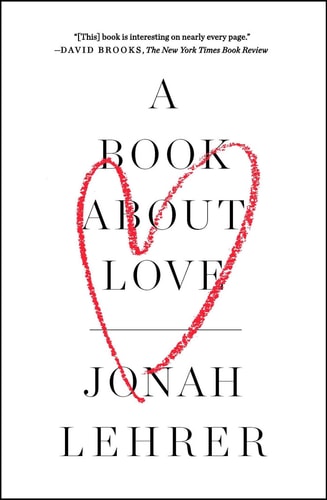
A Book About Love

Jonah Lehrer
Number one bestselling science writer Jonah Lehrer explores the “only happiness that lasts”—love—in a book that “is interesting on nearly every page” (David Brooks, The New York Times Book Review ). Weaving together scientific studies from clinical psychologists, longitudinal studies of health and happiness, historical accounts and literary depictions, child-rearing manuals, and the language of online dating sites, Jonah Lehrer’s A Book About Love plumbs the most mysterious, most formative, most important impulse governing our lives. Love confuses and compels us—and it can destroy and define us. It has inspired our greatest poetry, defined our societies and our beliefs, and governs our biology. From the way infants attach to their parents, to the way we fall in love with another person, to the way some find a love for God or their pets, to the way we remember and mourn love after it expires, this book focuses on research that attempts, even in glancing ways, to deal with the long-term and the everyday. The most dangerous myth of love is that it’s easy, that we fall into the feeling and then the feeling takes care of itself. While we can easily measure the dopamine that causes the initial feelings of “falling” in love, the partnerships and devotions that last decades or longer remain a mystery. “Lehrer uses scores of detailed vignettes to traverse a complicated intellectual landscape, eventually arriving at modern theories of love…He is a talent” ( USA TODAY ), and A Book About Love decodes the set of skills necessary to cultivate a lifetime of love. Love, Lehrer argues, is not built solely on overwhelming passion, but, fascinatingly, on a set of skills to be cultivated over a lifetime.
Simon and Schuster 2017-07-25 304 pages

Sum Forty Tales from the Afterlives

David Eagleman
Sum is a stunning exploration of funny and unexpected afterlives that have never been considered--each presented as a vignette that offers a lens through which to see ourselves here and now. In one afterlife you may find that God is the size of a microbe and is unaware of your existence. In another, you work as a background character in other people's dreams. Or you may find that the afterlife contains only those people whom you remember. The stories in Sum are rooted in romance, science, and awe: a mixture of death, hope, computers, immortality, love, biology, and desire that cuts through human nature at new and exciting angles.
Penguin Books Canada 2009-02-17 128 pages

Not in our genes: biology, ideology, and human nature

Lewontin, Richard,Rose, Steven P. R.,Kamin, Leon J.
In this classic work, three eminent scientists expose and dismantle the claims that class, race, and gender inequalities are the products of our biological and genetic inheritances. Not in Our Genes provides a bold and biting critique of biological determinism and sociobiology. In refuting the claim that what individuals can and cannot do is fixed, in essence, by their genetic makeup, the authors offer an important reply to an argument raging far beyond the scientific world and widely affecting our society and our lives. This edition features a new introduction by the authors.
Haymarket Books 2017 322 pages

At the water's edge: macroevolution and the transformation of life

Zimmer, Carl
Everybody Out of the Pond At the Water's Edge will change the way you think about your place in the world. The awesome journey of life's transformation from the first microbes 4 billion years ago to Homo sapiens today is an epic that we are only now beginning to grasp. Magnificent and bizarre, it is the story of how we got here, what we left behind, and what we brought with us. We all know about evolution, but it still seems absurd that our ancestors were fish. Darwin's idea of natural selection was the key to solving generation-to-generation evolution -- microevolution -- but it could only point us toward a complete explanation, still to come, of the engines of macroevolution, the transformation of body shapes across millions of years. Now, drawing on the latest fossil discoveries and breakthrough scientific analysis, Carl Zimmer reveals how macroevolution works. Escorting us along the trail of discovery up to the current dramatic research in paleontology, ecology, genetics, and embryology, Zimmer shows how scientists today are unveiling the secrets of life that biologists struggled with two centuries ago. In this book, you will find a dazzling, brash literary talent and a rigorous scientific sensibility gracefully brought together. Carl Zimmer provides a comprehensive, lucid, and authoritative answer to the mystery of how nature actually made itself.
Touchstone 1999-09-08 290 pages

Savage spawn

Kellerman, Jonathan
This thought-provoking and timely book from a #1 New York Times bestselling novelist and noted child psychologist reveals the factors that often lead to explosive and shocking juvenile violence. “Ethically and morally, kids are works in progress. Throw in psychopathy and you’ve got a soul that will never be complete.” In this powerful, disturbing book, bestselling author and noted child psychologist Jonathan Kellerman shines a penetrating light on antisocial youth—kids who kill without remorse—asserting that “psychopathic tendencies begin very early in life, as young as three, and they endure.” Criticizing our quick impulse to blame violent movies or a “morally bankrupt” society, Kellerman convinces us that it is the kids themselves who need to be examined. Carefully. How do children become cold-blooded killers? Kellerman warns that today’s aggressive bully is tomorrow’s Mafia don, cult leader, or genocidal dictator. Violently psychopathic youths possess an overriding need for power, control, and stimulation, and all display a complete lack of regard for the humanity of others. He examines the origins of psychopathy and the ever-shifting debate between nurture and nature, offering some controversial solutions to dealing with homicidal tendencies in children. As timely as today’s headlines, more gripping than fiction, Savage Spawn is a provocative look at the links between society and biology, children and violence. Kellerman’s sobering message will remain with you long after the last page is turned.
Random House International 2000 134 pages

Curious Minds How a Child Becomes a Scientist

John Brockman
What makes a child decide to become a scientist? •For Robert Sapolsky–Stanford professor of biology–it was an argument with a rabbi over a passage in the Bible. •Physicist Lee Smolin traces his inspiration to a volume of Einstein’s work, picked up as a diversion from heartbreak. •Mihaly Csikszentmihalyi, a psychologist and the author of Flow , found his calling through Descartes. Murray Gell-Mann, Nicholas Humphrey, Freeman Dyson . . . 27 scientists in all write about what it was that sent them on the path to their life's work. Illuminating memoir meets superb science writing in stories that invite us to consider what it is–and what it isn’t–that sets the scientific mind apart.
Knopf Doubleday Publishing Group 2005-09-13 256 pages