109 results for "Children"

The bomb

Zinn, Howard
As an active WWII bombardier returning from the end of the war in Europe and preparing for combat in Japan, Howard Zinn read the headline "Atomic Bomb Dropped on Japan" and was glad—the war would be over. "Like other Americans," writes Zinn, "I had no idea what was going on at the higher levels, and had no idea what that 'atomic bomb' had done to men, women, children in Hiroshima, any more than I ever really understood what the bombs I dropped on European cities were doing to human flesh and blood." During the war, Zinn had taken part in the aerial bombing of Royan, France, and in 1966, he went to Hiroshima, where he was invited to a "house of rest" where survivors of the bombing gathered. In this short and powerful book, the backstory of the making and use of the bomb, Zinn offers his deep personal reflections and political analysis of these events, and the profound influence they had in transforming him from an order-taking combat soldier to one of our greatest anti-authoritarian, anti-war historians. Simultaneous publication this August in the U.S. and Japan commemorates the 65th anniversary of the USA's two atomic bombings of Japan by calling for the abolition of all nuclear weapons and an end to war as an acceptable solution to human conflict. "It's my favorite. . . . He wrote the book to remind himself and to remind us that anybody can throw the wrench in the machinery, and we often should." -- Bill Moyers "Part history, part memoir, part sermon, The Bomb is meant to wake up citizens, to rouse them to reject 'the abstractions of duty and obedience' and to refuse to heed the call of war." —Jonah Raskin, The Rag Blog
City Lights Books 2010-08-01 91 pages

Children of the city: at work and at play

Nasaw, David
The turn of the century was a time of explosive growth for American cities, a time of nascent hopes and apparently limitless possibilities. In Children of the City, David Nasaw re-creates this period in our social history from the vantage point of the children who grew up then. Drawing on hundreds of memoirs, autobiographies, oral histories and unpublished—and until now unexamined—primary source materials from cities across the country, he provides us with a warm and eloquent portrait of these children, their families, their daily lives, their fears, and their dreams. Illustrated with 68 photographs from the period, many never before published, Children of the City offers a vibrant protrait of a time when our cities and our grandparents were young.
Oxford University Press 1986-05-22 244 pages

Alan and Naomi

Myron Levoy
It's 1944 in New York City. Alan Silverman doesn't want to give up his stickball game for anyone-especially not for crazy-acting Naomi Kirshenbaum. But when he hears about her horrifying experience during the war in France, Alan changes his mind. Slowly, he struggles to befriend her, and one day-miraculously-she begins to trust him. Alan finds she is not only intelligent, but also fun to be with. But the scars of war are still very much with Naomi. ALA-Best of the Best for Children New York Times -Best Books for Children YALSA-Best of the Best List
iUniverse 2007-10 196 pages

Feast your eyes

Goldberg, Myla
"After discovering photography as a teenager through her high school's photo club, Lillian rejects her parents' expectations of college and marriage and moves to New York City in 1955. When a small gallery exhibits partially nude photographs of Lillian and her daughter, Samantha, Lillian is arrested, thrust into the national spotlight, and targeted with an obscenity charge. Mother and daughter's sudden notoriety changes the course of both of their lives and especially Lillian's career as she continues a lifelong quest for artistic legitimacy and recognition. Narrated by Samantha, Feast Your Eyes reads as a collection of Samantha's memories, interviews with Lillian's friends and lovers, and excerpts from Lillian's journals and letters--a collage of stories and impressions, together amounting to an astounding portrait of a mother and an artist dedicated, above all, to a vision of beauty, truth, and authenticity"--Provided by publisher.
Scribner 2019-04-16 326 pages

All those mornings . . . at the Post The 20th Century in Sports from Famed Washington Post Columnist Shirley Povich

Shirley Povich
Shirley Povich was the Dean of American sportswriters. As a columnist for The Washington Post for more than seventyfive years, he was an eyewitness to the most thrilling moments in American sports, including: the legendary 1927 Dempsy-Tunney "long count"; the celebrated 1938 race between Seabiscuit and War Admiral; the 1946 signing of Jackie Robinson by the Brooklyn Dodgers; Don Larsen's perfect game in the 1956 World Series; the Ali-Frazier fight of 1971; and the murder of eleven Israeli athletes at the 1972 Munich Olympics. But Povich's columns were about more than sports; they reflected the dramatic changes in American society over the course of the 20th Century. Driven by a strong sense of social justice, Povich called for the integration of major league baseball in 1939, and twenty years later he was still at it, attacking Washington Redskins owner George Preston Marshall for having an all-white team. For the 100th anniversary of his birth, Povich's children— David, Maury, and Lynn — and his colleague at the Post, former sports editor George Solomon, have pulled together this panoramic collection of Povich's most beloved columns. The result is a front-row seat to the most awe-inspiring sports moments of our American Century.
PublicAffairs 2006-05-02 432 pages

All those mornings-- at the Post: the twentieth century in sports from famed Washington post columnist Shirley Povich

Povich, Shirley
Shirley Povich was the Dean of American sportswriters. As a columnist for The Washington Post for more than seventyfive years, he was an eyewitness to the most thrilling moments in American sports, including: the legendary 1927 Dempsy-Tunney "long count"; the celebrated 1938 race between Seabiscuit and War Admiral; the 1946 signing of Jackie Robinson by the Brooklyn Dodgers; Don Larsen's perfect game in the 1956 World Series; the Ali-Frazier fight of 1971; and the murder of eleven Israeli athletes at the 1972 Munich Olympics. But Povich's columns were about more than sports; they reflected the dramatic changes in American society over the course of the 20th Century. Driven by a strong sense of social justice, Povich called for the integration of major league baseball in 1939, and twenty years later he was still at it, attacking Washington Redskins owner George Preston Marshall for having an all-white team. For the 100th anniversary of his birth, Povich's children— David, Maury, and Lynn — and his colleague at the Post, former sports editor George Solomon, have pulled together this panoramic collection of Povich's most beloved columns. The result is a front-row seat to the most awe-inspiring sports moments of our American Century.
Public Affairs 2005-04-05 404 pages

Street

Carrie Boretz
The photographs inSTREETwere taken by Carrie Boretz in New York City from the mid-1970s through the 1990s. It is common knowledge that the city was on rocky ground for many of those years but these are not pictures filled with drama or strife. Instead Boretz was always more interested in the subtle and familiar moments of everyday life in the various neighborhoods where she lived, before much of the graffiti was scrubbed away and the city sanitized and reborn to what it has since become. For so many living in and visiting New York today, it is forgotten or altogether not known how different so many parts of the city were during that time. Many of these pictures show the reality of the streets then, where every day workers, the homeless, the affluent, and tourists all shared the common space, providing examples of how one of the greatest cities in the world was one often filled with contradictions. But there is also a timeless element to these images as children still play in the parks, streets, and schoolyards, commuters still face the elements daily as they wait, there are still regular demonstrations and parades, and the whole spectrum of the joys and pitfalls of humanity are still visible most anywhere a person looks. For Boretz nothing was scripted, it all played out right before her. As Patti Smith said, "You need no rationale, no schooling. It's love at first sight. You see something and you have to capture it. Instinctive, bang, you feel one with it." Indeed, Boretz doesn't have a philosophy about shooting other than trusting her instinct: she saw, she shot, she moved on, always looking for moments that made her heart beat faster. It was the continual rush of knowing that at any time she could come upon something real and beautiful. That is why and how she shot and why and how herSTREETis so special.
powerHouse Books 2017-09-19 119 pages

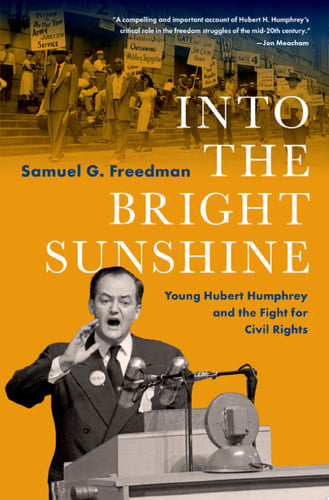
Into the bright sunshine: young Hubert Humphrey and the fight for civil rights

Freedman, Samuel G.
"Hubert Humphrey, a fallen hero and a dying man, rose on rickety legs to approach the podium of the Philadelphia Convention Hall, his pulpit for the commencement address at the University of Pennsylvania. He clutched a sheaf of paper with his speech for the occasion, typed and double-spaced by an assistant from his extemporaneous dictation, and then marked up in pencil by Humphrey himself. A note on the first page, circled to draw particular attention, read simply, "30 years ago--Here." In this place, at that time, twenty-nine years earlier to be precise, he had made history. From the dais now, Humphrey beheld five thousand impending graduates, an ebony sea of gowns and mortarboards, broken by one iconoclast in a homemade crown, two in ribboned bonnets, and another whose headgear bore the masking-tape message HI MA PA. In the horseshoe curve of the arena's double balcony loomed eight thousand parents and siblings, children, and friends. Wearing shirtsleeves and cotton shifts amid the stale heat, they looked like pale confetti from where Humphrey stood, and their flash cameras flickered away, a constellation of pinpricks"--
Oxford University Press 2023 488 pages

The alphabet in my hands: a writing life

Agosín, Marjorie
Marjorie Agosín writes of a beloved childhood nanny: "Since I was Jewish she baptized me with holy water brought forth from the fonts of nearby churches. She told me to stay very still so I wouldn't sprout horns. . . . I was somewhere between taciturn and happy gazing into the mirror as if approaching the edge of a cliff . . . and I watched myself in the deep, transparent veil of this night of all nights." Many of the themes expressed in this vignette--cultural dissonance, family, and community--are poetically intertwined throughout The Alphabet in My Hands . Agosín takes us on a personal journey of discovery that is as much internal reflection as it is an exodus across continents and decades. Agosín's childhood and early adolescence were spent with her Jewish family in Chile. While her family raised her to regard her Jewish heritage with loving awareness, they also participated in the dominant Catholic culture--an aunt organized Easter egg hunts and her mother admired the beauty of Chile's Catholic churches. The young Agosín became keenly aware of her dual identity in her country, both as a participant and an outsider. The second half of The Alphabet in My Hands recounts the events that forced her family to emigrate to America: the overthrow of Salvador Allende by General Augusto Pinochet. Agosín writes of her new life in Athens, Georgia, of the sudden loss of all that was familiar. Ostracized as an emigrant--a "non-white" with a strange foreign accent--her high school years were made even more painful by the news from Chile: prisoners taken and classmates disappearing or shot. Years later, Agosín goes back to Chile and she travels there with her own children. As she stares down at her old homeland from the plane, she writes: "Why do I love this place that forced us into exile, that punished my father for being a Jew?" And in the final chapter of The Alphabet in My Hands , this award-winning poet addresses two important topics: her current residence in New England and the central role of writing and literature in her life.
Rutgers University Press 2000 187 pages

Never say you've had a lucky life: especially if you've had a lucky life

Epstein, Joseph
"An autobiography usually requires a justification. The great autobiographies-those by Benvenuto Cellini, Jean-Jacques Rousseau, Benjamin Franklin, and Henry Brooks Adams-were justified by their authors living in interesting times, harboring radically new ideas, or participating in great events. Joseph Epstein qualifies on none of these counts. His life has been quiet, lucky in numerous ways, and far from dramatic. But it has also been emblematic of the great changes in our country since World War II. He grew up in a petit-bourgeois, Midwestern milieu, and the city of Chicago looms large in his life. He drew a lucky ticket in the parent lottery and his was a happy boyhood spent on playgrounds and hanging around drug stores. At high school dances, he was the rhumba king and at drive-in movies he was never allowed to go as far with girls as he so ardently desired. At twenty-six, after two years in the army, he found himself married, the father or stepfather of four children, and living in New York on the meager salary of a magazine subeditor. He was ablaze with ambition and fettered by frustration. He broke out by moving to Little Rock, Arkansas, to direct the city's anti-poverty program at the height of the Civil Rights movement. His writing career blossomed, he began teaching at Northwestern University, and, for twenty-five years, edited one of great intellectual magazines. Never Say You've Had a Lucky Life is an intimate look at one life steeped in radical change: from a traditionally moral culture to a therapeutic one, from an era when the extended family was strong to its current diminished status, from print to digital life featuring the war of pixel on print, and on. But for all the seriousness of Epstein's themes, this book is memorable for its comic point of view and the constant reminder of how unpredictable, various, and wondrously rich life can be"--
Simon & Schuster 2024-04-16 287 pages

Ashes and diamonds

Andrzejewski, Jerzy
Product Description Originally published in Poland in 1948, and acclaimed as one of the finest postwar Polish novels, Ashes and Diamonds takes place in the spring of 1945, as the nation is in the throes of its transformation to People' Poland. Communists, socialists, and nationalists; thieves and black marketeers; servants and fading aristocrats; veteran terrorists and bands of murderous children bewitched by the lure of crime and adventure--all of these converge on a provincial town's chief hotel, a microcosm of an uprooted world. About the Author Jerzy Andrzejewski (1909-1983) published his first book, Unavoidable Roads, a collection of short stories, in 1936. Two years later he won several prizes, incuding one from the Polish Academy of Literature, for his first novel, Mode of the Heart. Ashes and Diamonds, originally published in 1948, was made into a highly esteemed film and was awarded the International Critics' Prize at the 1959 Venice Film Festival.
Northwestern University Press 1991 238 pages

New and collected poems

Paley, Grace
Like her celebrated short fiction, Paley's poems are street-smart yet vulnerable, full of earthy observations and a refreshing bemusement; they display a wonderful ear for the rhythm of the speech of her native New York, where "talk is cheap but comes in variety." She "tells the story of the stories" told by children and grandmothers, which resonate "in the mind's ear" as "talk talk talk/the tickling tongue/of strangers." These poems are rich with the fullness of everyday life: the doings of Paley's Greenwich Village neighborhood, summers in Vermont, fulltime political activism, memories of family and friends. Paley's wonderful economy with words recalls William Carlos Williams and the objectivist poets. ISBN 0-88448-098-4: $19.95.
Tilbury House 1992 126 pages

Going out: the rise and fall of public amusements

Nasaw, David
There was a time not very long ago when "going out" was only for the rich and the reckless. At the turn of the century, "going out" became part of everyday life as vaudeville halls, photograph parlors, penny arcades, nickelodeons, nightclubs, dance halls, world's fair midways, amusement parks, ballparks, and movie palaces opened their doors to the people of the city. The new amusement centers welcomed women, men, and children, native-born and immigrant, rich, poor, and middling. Only African Americans were excluded or segregated in the audience, though they were overrepresented on stage. Going Out chronicles the twentieth-century entertainment revolution that changed forever the ways we live, work, and play. In a matter of decades, a new public world of amusements was created where ethnic, class, and neighborhood differences were subordinated to the common pursuit of a good time. Clerks and bankers, sales girls and society ladies "turkey trotted" to ragtime in nightclubs and dance halls; "shot the chute" and clutched one another in "barrels of love"; visited "Darkest Africa" on the world's fair midways; and sat together in the dark watching pictures move on a screen. In Going Out, we meet the colorful characters who invented show business: Thomas Alva Edison, who was astonished when his phonograph made money playing music (he had designed it to take business dictation); Benjamin Franklin Keith, the circus grifter who opened a dime museum in Boston in the 1880s and within a decade owned the world's largest vaudeville theater circuit; Adolph Zukor and Marcus Loew, the New York furriers who made millions in the early picture-show business; and the dozens of small-time show businessmen who rode the rails with their "shows" in their trunks. And we hear the stories of the early black performers and their struggles to maintain their dignity and livelihood while audiences demanded their public humiliation. Going Out is a history of twentieth-century show business and of the new American public that assembled in the city's wondrous pleasure palaces, parks, and theaters. The book concludes with an account of the fall or relocation of this entertainment world, as central city amusement parks, movie palaces, and ballparks were uprooted and transported to the suburbs in the decades following World War II.
Harvard University Press 1999-04-15 312 pages

The last gift of time: life beyond sixty

Heilbrun, Carolyn G.
As a young woman, Carolyn Heilbrun made a resolution not to live past "three score years and ten." Taking her own life at the age of seventy, she reasoned, would lend clean closure to a life well lived, and would keep her from the many tragedies of aging--becoming a burden to her children, witnessing the deterioration of her body, falling prey to a crippling disease. But on the advent of her seventieth birthday, she looked back on the past ten years and found, to her surprise, that her sixties had been the happiest decade of all: after fifty years, her marriage had matured into a happy balance of companionship and respect for solitude; she had developed deep friendships with her grown children and a small circle of peers; she had mastered a highly successful career as a scholar and writer. In the poignant, essayistic writing that best showcases her elegant talent and provocative mind, Carolyn Heilbrun celebrates the many pleasures of a mature life. Filled with wisdom, knowledge, wry humor, and literary allusion, The Last Gift of Time is a moving book for all women invested in the pursuit of leading a woman's life to its fullest capacity.
Dial Press 1997 225 pages

Chocolate and cuckoo clocks: the essential Alan Coren

Coren, Alan
Edited by his children, Giles and Victoria, Chocolate and Cuckoo Clocks is an anthology of humorous writing from the former editor of Punch and Radio 4 national treasure Alan Coren, who died in October 2007. In a prolific forty-year career Alan Coren wrote for The Times , Observer, Tatler , Daily Mail , Mail on Sunday, Listener , Punch and the New Yorker , and published over 20 books including The Sanity Inspector, Golfing for Cats and The Collected Bulletins of Idi Amin (he turned down an invitation from Amin to visit Uganda saying, 'I'll probably end up as a sandwich'). Even twenty years ago he estimated that he had published six million words, or ten copies of War and Peace . Coren was one of Britain's most prolific and now much-missed humourists, finding the comedy of life all around him and rendering it, hilariously and compellingly, in polished and witty prose which will be eagerly devoured by his loyal fanbase.
Canongate 2009 438 pages