70 results for "Children"

Black cowboy, wild horses

Julius Lester
Bob Lemmons is famous for his ability to track wild horses. He rides his horse, Warrior, picks up the trail of mustangs, then runs with them day and night until they accept his presence. Bob and Warrior must then challenge the stallion for leadership of the wild herd. A victorious Bob leads the mustangs across the wide plains and for one last spectacular run before guiding them into the corral. Bob's job is done, but he dreams of galloping with Warrior forever to where the sky and land meet. This splendid collaboration by an award-winning team captures the beauty and harshness of the frontier, a boundless arena for the struggle between freedom and survival. Based on accounts of Bob Lemmons, a formerly enslaved person, Black Cowboy, Wild Horses has been rewritten as a picture book by Julius Lester from his story "The Man Who Was a Horse" in Long Journey Home , first published by Dial in 1972.
The Dial Press 2021-09-28 40 pages

Street

Carrie Boretz
The photographs inSTREETwere taken by Carrie Boretz in New York City from the mid-1970s through the 1990s. It is common knowledge that the city was on rocky ground for many of those years but these are not pictures filled with drama or strife. Instead Boretz was always more interested in the subtle and familiar moments of everyday life in the various neighborhoods where she lived, before much of the graffiti was scrubbed away and the city sanitized and reborn to what it has since become. For so many living in and visiting New York today, it is forgotten or altogether not known how different so many parts of the city were during that time. Many of these pictures show the reality of the streets then, where every day workers, the homeless, the affluent, and tourists all shared the common space, providing examples of how one of the greatest cities in the world was one often filled with contradictions. But there is also a timeless element to these images as children still play in the parks, streets, and schoolyards, commuters still face the elements daily as they wait, there are still regular demonstrations and parades, and the whole spectrum of the joys and pitfalls of humanity are still visible most anywhere a person looks. For Boretz nothing was scripted, it all played out right before her. As Patti Smith said, "You need no rationale, no schooling. It's love at first sight. You see something and you have to capture it. Instinctive, bang, you feel one with it." Indeed, Boretz doesn't have a philosophy about shooting other than trusting her instinct: she saw, she shot, she moved on, always looking for moments that made her heart beat faster. It was the continual rush of knowing that at any time she could come upon something real and beautiful. That is why and how she shot and why and how herSTREETis so special.
powerHouse Books 2017-09-19 119 pages

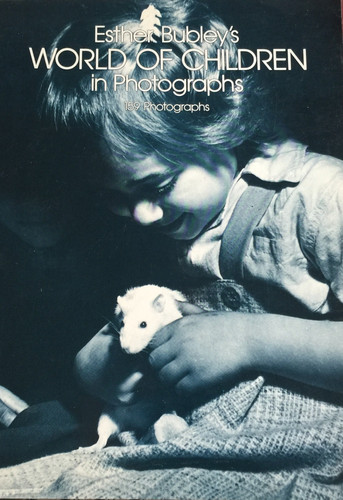
Esther Bubley's world of children in photographs

Bubley, Esther
In this collection, you will see children from Ms. Bubley's viewpoint and perspective. This is a beautiful collection from an award-wining photojournalist. Award-winning photojournalist Esther Bubley is recognized for both her artistic composition and her superb story telling ability. Bubley's career in documentary photography and photojournalism was launched in 1942 when Roy Stryker hired her to work in his dark room at the Office of War Information (OWI), where his famed Farm Security Administration (FSA) photographic project had recently been transferred. In 1944, Bubley followed Stryker to Standard Oil (New Jersey)(SONJ) where he was charged with compiling a photographic library. Bubley was a freelancer for Standard Oil for the rest of the 1940s and 1950s. She simultaneously developed a thriving career separate from Stryker, working for a variety of clients -- including Life, the Ladies' Home Journal, the Children's Bureau, Pepsi-Cola International, Pan American World Airways, and UNICEF -- who sent her on assignments throughout the continental United States and around the world.
Dover 1981 105 pages

Life on the Lower East Side

Lepkoff, Rebecca
A young Rebecca Lepkoff, camera in hand, navigated the streets of the Lower East Side of New York in the 1930s and 1940s, before the Alfred E. Smith housing project largely demolished and forever changed its character. She captured the lives and times of a vibrant, close-knit, and functional multiethnic community. Through her lens, she documented street scenesa woman stopping in front of a tenement to share some news, a fruit seller peddling her wares, a woman hanging laundry on a clothesline. Stoops, rooftops, fire escapes, and sidewalks in front of candy stores and delis were the preferred social and recreational locales. In the absence of playgrounds, children improvised outdoor play areas and congregated Saturday afternoons in front of the Loew's Canal. Life on the Lower East Side , the first monograph of Lepkoff's works, highlights the lost neighborhood between the Brooklyn and Manhattan bridges from the Bowery to the East River. With over 170 beautifully reproduced duotone photographs and essays by Peter Dans and Suzanne Wasserman, the book reveals the dynamic community of Italians, Irish, Jews, Greeks, Spaniards, Chinese, Puerto Ricans, and African Americans. Lepkoff's images uncover a forgotten time and place and reveal how the Lower East Side has both stayed the same and changed forever.
Princeton Architectural Press 2006-09-28 208 pages

Smoke

Berger, John
A pictoral essay by the great art critic, novelist and long-time smoker, John Berger, and Turkish writer and illustrator Selçuk Demirel. "Once upon a time, men, women and (secretly) children smoked." This charming illustrated work reflects on the cultural implications of smoking, and suggests, through a series of brilliantly inventive illustrations, that society's attitude to smoke is both paradoxical and intolerant. It portrays a world in which smokers, banished from public places, must encounter one another as outlaws. Meanwhile, car exhausts and factory chimneys continue to pollute the atmosphere. Smoke is a beautifully illustrated prose poem that lingers in the mind. "A cigarette is a breathing space. It makes a parenthesis. The time of a cigarette is a parenthesis, and if it is shared you are both in that parenthesis. It's like a proscenium arch for a dialogue." - John Berger (in interview)
Notting Hill Editions 2017 67 pages

Dahlov Ipcar's Maine alphabet

Ipcar, Dahlov
This charming ABC book from Maine artist Dahlov Ipcar contains an original illustration done especially for this edition, her first new children's book illustration in more than twenty years. The Maine wildlife and coastal scenes are near and dear to her heart, and this new book serves as a kind of love letter to her home state where she lived and worked for almost seventy-five years, where, as she writes, A is for animals, wild and free, and W is for woodlands of wonder for you and for me.
Down East Books 2024 32 pages

The lion who ate everything

Hill, Tobias
The lion has eaten everything - even his city! Can Mama Onion teach him to control his greed? In the City of Rain, a hungry lion prowls the streets in search of food. When he chances upon Mama Onion's Takeaway Paradise, the lion devours everything the restaurant has to offer. But he's still hungry and the greedy lion can't help himself: he devours the City of Rain, too. With his appetite finally sated, the lion begins to feel sad that his terrible greed has destroyed the beautiful city. Luckily, Mama Onion has a plan: she'll teach Lion to control his nature by teaching him to cook.
Walker 2008 30 pages

American odyssey, 1963-1999

Mark, Mary Ellen
The unspoken poetry of our nation revealed by an American master. The first collection of the extensive and superlative work realized by Mary Ellen Mark in the United States, Mary Ellen Mark is composed of many previously unpublished images, as well as photographs from several of her best-known projects. From "Streetwise" to "The Damm Family," Mary Ellen Mark includes the most iconic images from these groundbreaking stories, as well as powerful, never-before-seen photographs Mark accomplished in subsequent years. She makes a deeply felt commitment to her subjects, and her empathy and humanity come through in every image. Mark is unsurpassed at shaping not only the odd but the everyday into genuinely surprising visual icons. With an eye for symbolism and a gift for meticulous composition, she is drawn to a variety of spectacles and situations, and demonstrates a particular affinity for children. Her elegantly revealing imagery creates a fascinating portrait of our complex, amusing, and occasionally unsettling country.
Aperture 1999 151 pages

A sunny day: a touch and feel story about shapes!

Price, Katie
It's a sunny day and Katie and Peter are finding shapes! Touch the textured areas and help them find the different shapes around them. Guide your child's finger over the texture and ask them what shape it is. Developed using Katie's experience with her own children and their different needs, this book is suitable for children of all abilities. The touch and feel areas help children develop early co-ordination skills. The bright and colourful pictures, touch and feel elements and clear text make this a fun and stimulating book that everyone can enjoy.
Red Fox 2008 10 pages

Triptychs: Buffalo's Lower West Side revisited

Rogovin, Milton
In the early 1970s, Milton Rogovin set out to document the neighborhood near his house. He made a series of portraits of working-class people in Buffalo's Lower West Side. Then he returned to photograph the same people in the early 1980s and again in the 1990s. The result is this remarkable and moving portrait of time and place in America. Here are fifty of an acclaimed photographer's engaging Triptychs - a visual chronicle of change, aging, endurance, and finally survival. As Robert Coles writes in his foreword, "These photographs constitute a major contribution to the American documentary tradition. They represent the insistence of one careful, gifted, attentive photographer upon seeing through, as it were, his self-assigned job of seeing." Here we see working people who, like most Americans, find partners, have children and grandchildren, sometimes separate, and sometimes die early. Some age considerably in the ten years between photographs, others almost not at all. Some lose children, change partners and houses, and some visibly change lifestyles. What remains constant is the passing of time and its effects upon his subjects, so evident in Rogovin's work. These are among the themes observed and discussed in Stephen Jay Gould's illuminating introduction.
W. W. Norton 1994 141 pages