51 results for "Economic Development"

Federalists reconsidered

Ben-Atar, Doron
These essays demonstrate that American political culture was fashioned in a dialogue between Federalists and Jeffersonians. They portray an active Federalist coalition that offered a vibrant intellectual and political alternative throughout the era of the early republic. Cutting across boundaries of region, culture, race, gender, and class, Federalists struggled with the problems of nation building, national identity, and economic development.
University Press of Virginia 1998 310 pages

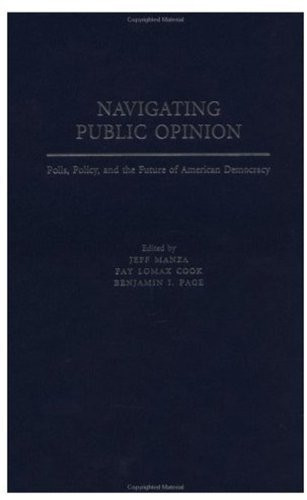
Navigating public opinion: polls, policy, and the future of American democracy

Professor of Sociology Jeff Manza,Jeff Manza,Fay Lomax Cook,Professor of Human Development and Social Policy in the School of Education and Social Policy Fay Lomax Cook,Benjamin I. Page,Gordon Scott Fulcher Professor of Decision Making in the Department of Political Science Benjamin I Page
Do politicians listen to the public? How often and when? Or are the views of the public manipulated or used strategically by political and economic elites? Navigating Public Opinion brings together leading scholars of American politics to assess and debate these questions. It describes how the relationship between opinion and policy has changed over time; how key political actors use public opinion to formulate domestic and foreign policy; and how new measurement techniques might improve our understanding of public opinion in contemporary polling and survey research. The distinguished contributors shed new light on several long-standing controversies over policy responsiveness to public opinion. Featuring a new analysis by Robert Erikson, Michael MacKuen, and James Stimson that builds from their pathbreaking work on how public mood moves policy in a macro-model of policymaking, the volume also includes several critiques of this model by Lawrence Jacobs and Robert Shapiro, another critique by G. William Domhoff, and a rejoinder by Erikson and his coauthors. Other highlights include discussions of how political elites, including state-level policymakers, presidents, and makers of foreign policy, use (or shape) public opinion; and analyses of new methods for measuring public opinion such as survey-based experiments, probabilistic polling methods, non-survey-based measures of public opinion, and the potential and limitations of Internet polls and surveys. Introductory and concluding essays provide useful background context and offer an authoritative summary of what is known about how public opinion influences public policy. A must-have for all students of American politics, public opinion, and polling, this state-of-the-art collection addresses issues that lie at the heart of democratic governance today.
Oxford University Press 2002 376 pages

The tyranny of dead ideas: letting go of the old ways of thinking to unleash a new prosperity

Miller, Matthew
A leading political and business thinker identifies the greatest threat to our economic future: the things we think we know--but don't. In the face of global competition and rapid technological change, our economy is facing its most severe test in nearly a century. Yet our leaders have failed to prepare us for what lies ahead because they are in the grip of a set of "dead ideas" about how a modern economy should work. These ways of thinking--dubious at best and often dead wrong--are on a collision course with irreversible economic developments. Here, Matt Miller offers a blend of business-world acumen and public-policy vision to lay bare how this conventional wisdom holds our country back, and he introduces us to a new way of thinking--what he calls "tomorrow's destined ideas"--that can reinvigorate our economy, our politics, and our day-to-day lives. --From publisher description.
Times Books 2009 258 pages

Urban change in the United States and Western Europe: comparative analysis and policy

Summers, Anita A.
In this completely revised second edition, the authors explore what can be learned from a rigorous comparison of the patterns of urban concentrations of residents and employment in Western Europe and the United States. Using a wide range of methodological techniques, including economic theory, econometrics, regional science, and institutional historical analysis, the essays analyze the factors underlying urban economic development, with particular emphasis on the role and effectiveness of public policy.
Urban Institute Press 1999-08-15 621 pages

The politics of national security

Raskin, Marcus G.
The evolution of the national security state in the United States can be traced from the political, military, and economic dimensions of American power in the postwar world. In Raskin's view, the United States emerged from the Second World War with tremendously increased prestige and material power, and American leadership created a national security apparatus as a planning instrument to ensure national stability, to mute class conflicts, and to secure the domestic economy. This state then became the basis around the world for covert and overt imperialism.The consensus that developed served to maintain stability at home and to guide the modern empire abroad. This development required a state that was orderly and that was predicated on modern bureaucracy, which operated within the values and assumptions of the ruling elites.The national security state system was successful primarily in the economic sphere, with bipartisan foreign-policy decision making aimed at ensuring a stable business climate at home and abroad. Military involvement in Indochina evidenced the decline of American hegemony; the genocidal nature of the arms race and the questions raised by protestors of the sixties signaled the break up of the national security consensus.Raskin concludes the book with an examination of alternative directions, especially regarding the need and the possibilities for renewed public debate of national policy and purpose.
Transaction Books 1979 211 pages

Stagnation and the financial explosion

Magdoff, Harry
This is the fourth in a continuing series of collected essays by the former editors of Monthly Review on the state of the U.S. economy and its relation to the global system. Like its predecessors, this volume focuses on the most recent phase of the development of U.S. capitalism, stressing the profound contradictions of the underlying processes of capital accumulation and pointing the way to the fundamental reforms that are the essential precondition for a real economic revival.
Monthly Review Press 1987-02-01 208 pages

Discontents: postmodern and postcommunist

Hollander, Paul
What ails people at the present time in Western and especially American society is an inexhaustible subject. Discussion of these discontents in the United States in the last decade of the twentieth century leads to an obvious question: How much and what kind of discontents are possible in a society that has experienced over a decade of economic growth, close to full employment, hardly any inflation, falling crime rates, declining teenage pregnancies, and other good things? Is there anything to worry about in a country that has become the undisputed superpower of the world and no longer faces another hostile superpower such as the Soviet Union used to be? Paul Hollander wrestles with these and other questions in seeking to understand conditions and developments within American culture and society in the context of their relationship to political systems, movements and ideas critical of the United States and Western values. Hollander examines disparate phenomena, such as the O.J. Simpson case, the banning of West Side Story in Amherst, Massachusetts, the popularity and expos of Rigoberta Menchu, and the appeal of sports utility vehicles, which shed light on the major themes of the volume. Topics include conflicts among American intellectuals (including disputes over the Kosovo intervention), the impact of postmodernism on higher education, the persisting appeal of victimhood in American society, the flaws of American sociology, academic specialists' failure to anticipate the collapse of the Soviet Union, and the new anti-Americanism in postcommunist societies. Among topics of historical interest are a survey of Western judgments and misjudgments of the communist systems; examination of the relative neglect of political violence in communist states, and analysis of officially enforced, secular-religious cult of communist rulers. Many of these writings are linked to the author's longstanding interest in why people accept or reject particular political systems and in the contradictory human needs and desires which condition and limit the pursuit of social and political ends. Sociologists, political scientists, and the general reader will find this book of great interest. Paul Hollander is professor emeritus of sociology at the University of Massachusetts, Amherst, and a fellow of the David Center for Russian Studies at Harvard University. His books include Soviet and American Society, Political Pilgrims, The Survival of the Adversary Culture , and Anti-Americanism .
Transaction Publishers 2002 430 pages

The end of prosperity: the American economy in the 1970s

Magdoff, Harry
This is the second in the series of four collections of essays in which Paul M. Sweezy and Harry Magdoff, the editors of Monthly Review, set out as it took place the development of U.S. and global capitalism from the late 1960s to the "financial explosion" age of the early 1990s and after. This second set of essays constitute in their totality a probing analysis of the condition of the United States economy in the 1970s, immediately after the end of the "golden age" of capitalism. The authors concluded, correctly, that a new period had begun-"one of sluggish capitalist accumulation and unemployment in the advanced capitalist countries on a scale not seen since the 1930s."
Monthly Review Press 1977 136 pages