187 results for "Economics"

The crisis of vision in modern economic thought

Heilbroner, Robert L.
A deep and widespread crisis affects modern economic theory, a crisis that derives from the absence of a "vision"--a set of widely shared political and social preconceptions--on which all economics ultimately depends. This absence, in turn, reflects the collapse of the Keynesian view that provided such a foundation from 1940 through the early 1970s, comparable to earlier visions provided by Smith, Ricardo, Mill, and Marshall. The "unraveling" of Keynesianism has been followed by a division into discordant and ineffective camps whose common denominator seems to be their shared analytical refinement and lack of practical applicability. This provocative analysis attempts both to describe this state of affairs, and to suggest the direction in which economic thinking must move if it is to regain the relevance and remedial power it now pointedly lacks.
Cambridge University Press 1995 131 pages

Inside the economist's mind: conversations with eminent economists

Paul A. Samuelson,William A. Barnett
By focusing on the human side as well as the intellectual dimensions of how economists work and think, this collection of interviews with top economists of the 20th century becomes a startling and lively introduction to the modern world of macroeconomics. A fun read! For more information, frequent updates, and to comment on the forthcoming book, visit William A. Barnett's weblog at http://economistmind.blogspot.com/. Acclaim for Inside the Economist's Mind "In candid interviews, these great economists prove to be fabulous story tellers of their lives and times. Unendingly gripping for insiders, this book should also help non-specialists understand how economists think." Professor Julio Rotemberg, Harvard University Business School, and Editor, Review of Economics and Statistics. "Economics used to be called the 'dismal science'. It will be impossible for anybody to hold that view anymore ... This is science with flesh and blood, and a lot of fascinating stories that you will find nowhere else." Dr. Jean-Pascal Bénassy, Paris-Jourdan Sciences Économiques, Paris, France "This book provides a rare and intriguing view of the personal and professional lives of leading economists ... It is like A Beautiful Mind , scaled by a factor of 16 [the number of interviews in the book]." Professor Lee Ohanian, University of California at Los Angeles " ... if you want an insider view of how economics has been developing in the last decades, this is the (only) book for you." Professor Giancarlo Gandolfo, University of Rome ‘La Sapienza,’ Rome "Here we see the HUMAN side of path-breaking research, the personalities and pitfalls, the DRAMA behind the science." Professor Francis X. Diebold, University of Pennsylvania, Philadelphia
Blackwell Pub 2007 419 pages

On the Principles of Political Economy and Taxation

David Ricardo
On the Principles of Political Economy and Taxation (19 April 1817) is a book by David Ricardo on economics. The book concludes that land rent grows as population increases. It also presents the theory of comparative advantage, the theory that free trade between two or more countries can be mutually beneficial, even when one country has an absolute advantage over the other countries in all areas of production.
CreateSpace Independent Publishing Platform 2018-08-19 244 pages

Bankers and Pashas: International Finance and Economic Imperialism in Egypt

David S. Landes
فى نهاية الخمسينات عثر الباحث الإقتصادى الأمريكى ديفيد لاندز على أرشيف سرى فى باريس يحتوى على مراسلات اثنين من كبار ممولى الخديوى اسماعيل الأجانب. وقد ألقت هذه المراسلات ضوءا جديدا على قصة النهب الأوروبى لثروة مصر فى عهد أسرة محمد على, والوصول بها إلى مرحلة الخراب ثم الإحتلال ...يحتوى الكتاب أيضا على دراسة للمترجم وهو المفكر اليسارى د. عبد العظيم أنيس - أحد رواد النضال الوطنى والتقدمى منذ الأربعينات - بعنوان : الخراب الحديث لمصر المحروسة
Harper Torchbooks 1969-01-01 354 pages

A Theory of the Consumption Function

Milton Friedman
What is the exact nature of the consumption function? Can this term be defined so that it will be consistent with empirical evidence and a valid instrument in the hands of future economic researchers and policy makers? In this volume a distinguished American economist presents a new theory of the consumption function, tests it against extensive statistical J material and suggests some of its significant implications. Central to the new theory is its sharp distinction between two concepts of income, measured income, or that which is recorded for a particular period, and permanent income, a longer-period concept in terms of which consumers decide how much to spend and how much to save. Milton Friedman suggests that the total amount spent on consumption is on the average the same fraction of permanent income, regardless of the size of permanent income. The magnitude of the fraction depends on variables such as interest rate, degree of uncertainty relating to occupation, ratio of wealth to income, family size, and so on. The hypothesis is shown to be consistent with budget studies and time series data, and some of its far-reaching implications are explored in the final chapter.
Must Have Books 2022-03-15 254 pages

Transaction Man Traders, Disrupters, and the Dismantling of Middle-Class America

Nicholas Lemann
An Amazon Best History Book of 2019 "A splendid and beautifully written illustration of the tremendous importance public policy has for the daily lives of ordinary people." —Ryan Cooper, Washington Monthly Over the last generation, the United States has undergone seismic changes. Stable institutions have given way to frictionless transactions, which are celebrated no matter what collateral damage they generate. The concentration of great wealth has coincided with the fraying of social ties and the rise of inequality. How did all this come about? In Transaction Man , Nicholas Lemann explains the United States’—and the world’s—great transformation by examining three remarkable individuals who epitomized and helped create their eras. Adolf Berle, Franklin Delano Roosevelt’s chief theorist of the economy, imagined a society dominated by large corporations, which a newly powerful federal government had forced to become benign and stable institutions, contributing to the public good by offering stable employment and generous pensions. By the 1970s, the corporations’ large stockholders grew restive under this regime, and their chief theoretician, Harvard Business School’s Michael Jensen, insisted that firms should maximize shareholder value, whatever the consequences. Today, Silicon Valley titans such as the LinkedIn cofounder and venture capitalist Reid Hoffman hope “networks” can reknit our social fabric. Lemann interweaves these fresh and vivid profiles with a history of the Morgan Stanley investment bank from the 1930s through the financial crisis of 2008, while also tracking the rise and fall of a working-class Chicago neighborhood and the family-run car dealerships at its heart. Incisive and sweeping, Transaction Man is the definitive account of the reengineering of America and the enormous impact it has had on us all.
Picador 2020-11-10 320 pages

Gender and the Politics of History

Joan Wallach Scott
This landmark work from a renowned feminist historian is a foundational demonstration of the uses of gender as a conceptual tool for cultural and historical analysis. Joan Wallach Scott offers a trenchant critique of the compartmentalization of women's history, arguing that political and social categories are always fundamentally shaped by gender and that questions of gender are essential to considerations of difference in history. Exploring topics ranging from language and class to the politics of work and family, Gender and the Politics of History is a vital contribution to feminist history and historical methodology that also speaks more broadly to the ongoing redefinition of gender in our political and cultural vocabularies. This anniversary edition of a classic text in feminist theory and history shows the evergreen relevance of Scott's work to the humanities and social sciences. In a new preface, Scott reflects on the book's legacy and implications for contemporary politics as well as what she has reconsidered as a result of her engagement with psychoanalytic theory. The book also includes a previously unpublished essay, "The Conundrum of Equality," which takes up the question of affirmative action.
Columbia University Press 2018

Abolition: a history of slavery and antislavery

Drescher, Seymour
In one form or another, slavery has existed throughout the world for millennia. It helped to change the world, and the world transformed the institution. In the 1450s, when Europeans from the small corner of the globe least enmeshed in the institution first interacted with peoples of other continents, they created, in the Americas, the most dynamic, productive, and exploitative system of coerced labor in human history. Three centuries later these same intercontinental actions produced a movement that successfully challenged the institution at the peak of its dynamism. Within another century a new surge of European expansion constructed Old World empires under the banner of antislavery. However, twentieth-century Europe itself was inundated by a new system of slavery, larger and more deadly than its earlier system of New World slavery. This book examines these dramatic expansions and contractions of the institution of slavery and the impact of violence, economics, and civil society in the ebb and flow of slavery and antislavery during the last five centuries.
Cambridge University Press 2009-07-31 471 pages

The escape from hunger and premature death, 1700-2100: Europe, America, and the Third World

Fogel, Robert William
Nobel laureate Robert Fogel's compelling new study examines health, nutrition and technology over the last three centuries and beyond. Throughout most of human history, chronic malnutrition has been the norm. During the past three centuries, however, a synergy between improvements in productive technology and in human physiology has enabled humans to more than double their average longevity and to increase their average body size by over 50 per cent. Larger, healthier humans have contributed to the acceleration of economic growth and technological change, resulting in reduced economic inequality, declining hours of work and a corresponding increase in leisure time. Increased longevity has also brought increased demand for health care. Professor Fogel argues that health care should be viewed as the growth industry of the twenty-first century and systems of financing it should be reformed. His book will be essential reading for all those interested in economics, demography, history and health care policy.
Cambridge University Press 2004 191 pages

DarkMarket

Misha Glenny
Shortlisted for the Orwell Prize and the CWA Gold Dagger for Non-Fiction Award The benefits of living in a digital, globalised society are enormous; so too are the dangers. The world has become a law enforcer's nightmare and every criminal's dream. We bank online, shop online, date, learn, work and live online. But have the institutions that keep us safe on the streets learned to protect us in the burgeoning digital world?Ê Have we become complacent about our personal security Ñ sharing our thoughts, beliefs and the details of our daily lives with anyone who cares to relieve us of them? In this fascinating and compelling book, Misha Glenny, author of the international bestseller McMafia, explores the three fundamental threats facing us in the twenty-first century: cyber crime, cyber warfare and cyber industrial espionage. Governments and the private sector are losing billions of dollars each year, fighting an ever-morphing, often invisible, and highly intelligent new breed of criminal: the hacker. Glenny has travelled and trawled the world. And by exploring the rise and fall of the criminal website, DarkMarket, he has uncovered the most vivid, alarming and illuminating stories.ÊWhether JiLsi or Matrix, Iceman, Master Splynter or Lord Cyric; whether Detective Sergeant Chris Dawson in Bolton or Agent Keith Mularski in Pittsburgh, Glenny has tracked down and interviewed all the players Ñ the criminals, the geeks, the police, the security experts and the victims Ñ and he places everyone and everything in a rich brew of politics, economics and history. The result is simply unputdownable. DarkMarketis authoritative and completely engrossing. It's a must-read for everyone who uses a computer: the essential crime book for our times.
House of Anansi 2011-09-20 320 pages

Uncountable: a philosophical history of number and humanity from antiquity to the present

Nirenberg, David,Nirenberg, Ricardo L.
"From the time of Pythagoras, we have been tempted to treat numbers as the ultimate or only truth. This book tells the history of that habit of thought. But more, it argues that the logic of counting sacrifices much of what makes us human, and that we have a responsibility to match the objects of our attention to the forms of knowledge that do them justice. Humans have extended the insights and methods of number and mathematics to more and more aspects of the world, even to their gods and their religions.Today those powers are greater than ever, as computation is applied to virtually every aspect of human activity.But the rules of mathematics do not strictly apply to many things-from elementary particles to people-in the world.By subjecting such things to the laws of logic and mathematics, we gain some kinds of knowledge, but we also lose others. How do our choices about what parts of the world to subject to the logics of mathematics affect how we live and how we die?This question is rarely asked, but it is urgent, because the sciences built upon those laws now govern so much of our knowledge, from physics to psychology.Number and Knowledge sets out to ask it. In chapters proceeding chronologically from Ancient Greek philosophy and the rise of monotheistic religions to the emergence of modern physics and economics, the book traces how ideals, practices, and habits of thought formed over millennia have turned number into the foundation-stone of human claims to knowledge and certainty.But the book is also a philosophical and poetic exhortation to take responsibility for that history, for the knowledge it has produced, and for the many aspects of the world and of humanity that it ignores or endangers.To understand what can be counted and what can't is to embrace the ethics of purposeful knowing"--
University of Chicago Press 2021-10-20 420 pages

The evolution of central banks

Goodhart, C. A. E.
"The Evolution of Central Banks" employs a wide range of historical evidence and reassesses current monetary analysis to argue that the development of non-profit-maximizing and noncompetitive central banks to supervise and regulate the commercial banking system fulfils a necessary and natural function.Goodhart surveys the case for free banking, examines the key role of the clearing house in the evolution of the central bank, and investigates bank expansion and fluctuation in the context of the clearing house mechanism. He concludes that it is the noncompetitive aspect of the central bank that is crucial to the performance of its role. Goodhart addresses the questions of deposit insurance and takes up the "club theory" approach to the central bank. Included in the historical study of their origins are 8 European central banks, the Bank of Japan, the Bank of England, and the Federal Reserve Board of the United States.Charles Goodhart was appointed to the newly established Norman Sosnow Chair of Banking and Finance at the London School of Economics in 1985. For the previous 17 years he served as a monetary economist at the Bank of England, becoming a Chief Adviser in 1980.
MIT Press 1988 205 pages

Bootstrapped Liberating Ourselves from the American Dream

Alissa Quart
An unsparing, incisive, yet ultimately hopeful look at how we can shed the American obsession with self-reliance that has made us less healthy, less secure, and less fulfilled The promise that you can "pull yourself up by your bootstraps" is central to the story of the American Dream. It's the belief that if you work hard and rely on your own resources, you will eventually succeed. However, time and again we have seen how this foundational myth, with its emphasis on individual determination, brittle self-sufficiency, and personal accomplishment, does not help us. Instead, as income inequality rises around us, we are left with shame and self-blame for our condition. Acclaimed journalist Alissa Quart argues that at the heart of our suffering is a do-it-yourself ethos, the misplaced belief in our own independence and the conviction that we must rely on ourselves alone. Looking at a range of delusions and half solutions--from "grit" to the false Horatio Alger story to the rise of GoFundMe--Quart reveals how we have been steered away from robust social programs that would address the root causes of our problems. Meanwhile, the responsibility for survival has been shifted onto the backs of ordinary people, burdening generations with debt instead of providing the social safety net we so desperately need. Insightful, sharply argued, and characterized by Quart's lively writing and deep reporting, and for fans of Evicted and Nickel and Dimed, Bootstrapped is a powerful examination of what ails us at a societal level and a plan for how we can free ourselves from these self-defeating narratives.
HarperCollins Publishers 2024-04-09 288 pages

The gifts of Athena

Mokyr, Joel
The growth of technological and scientific knowledge in the past two centuries has been the overriding dynamic element in the economic and social history of the world. Its result is now often called the knowledge economy. But what are the historical origins of this revolution and what have been its mechanisms? In The Gifts of Athena , Joel Mokyr constructs an original framework to analyze the concept of "useful" knowledge. He argues that the growth explosion in the modern West in the past two centuries was driven not just by the appearance of new technological ideas but also by the improved access to these ideas in society at large--as made possible by social networks comprising universities, publishers, professional sciences, and kindred institutions. Through a wealth of historical evidence set in clear and lively prose, he shows that changes in the intellectual and social environment and the institutional background in which knowledge was generated and disseminated brought about the Industrial Revolution, followed by sustained economic growth and continuing technological change. Mokyr draws a link between intellectual forces such as the European enlightenment and subsequent economic changes of the nineteenth century, and follows their development into the twentieth century. He further explores some of the key implications of the knowledge revolution. Among these is the rise and fall of the "factory system" as an organizing principle of modern economic organization. He analyzes the impact of this revolution on information technology and communications as well as on the public's state of health and the structure of households. By examining the social and political roots of resistance to new knowledge, Mokyr also links growth in knowledge to political economy and connects the economic history of technology to the New Institutional Economics. The Gifts of Athena provides crucial insights into a matter of fundamental concern to a range of disciplines including economics, economic history, political economy, the history of technology, and the history of science.
Princeton University Press 2002 359 pages

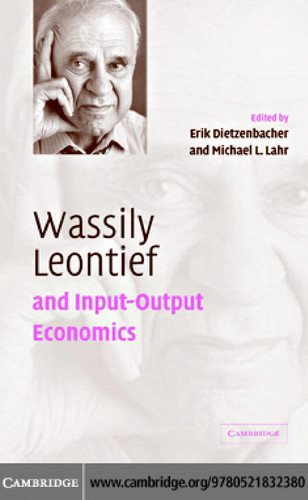
Wassily Leontief and input-output economics

Wassily Leontief,Erik Dietzenbacher,Michael L. Lahr
Wassily Leontief (1905–1999) was the founding father of input-output economics, for which he received the Nobel Prize in 1973. This book offers a collection of papers in memory of Leontief by his students and close colleagues. The first part, 'Reflections on Input-Output Economics', focuses upon Leontief as a person and scholar as well as his personal contributions to economics. It includes contributions by Nobel Laureate Paul A. Samuelson who shares his memories of a young Professor Leontief at Harvard and ends with the last joint interview with Wassily and his wife, to date previously unpublished. The second part, 'Perspectives of Input-Output Economics', includes theoretical and empirical research inspired by Leontief's work and offers a wide-ranging sample of the state of interindustry economics, a field Leontief founded. This is a strong collection likely to appeal to a wide range of professionals in universities, government, industry and international organizations.
Cambridge University Press 2004-03-25 396 pages

Keynes: useful economics for the world economy

Temin, Peter
As the global economic crisis continues to cause damage, some policy makers have called for a more Keynesian approach to current economic problems. In this book, the economists Peter Temin and David Vines provide an accessible introduction to Keynesian ideas that connects Keynes's insights to today's global economy and offers readers a way to understand current policy debates. John Maynard Keynes (1883-1946) created the branch of economics now known as macroeconomics. He played a major role in the reconstruction of Europe and the world economy after the Second World War. Keynesian economics came to be identified with efforts to mitigate the Great Depression and with postwar economic policies that helped power a golden age of economic growth. Temin and Vines argue that Keynes also provided a way to understand the interactions among nations, and therein lies his relevance for today's global crisis. Temin and Vines survey economic thinking before Keynes and explain how difficult it was for Keynes to escape from conventional wisdom. They set out the Keynesian analysis of a closed economy and expand the analysis to the international economy, using a few simple graphs to present Keynes's formal analyses in an accessible way. They discuss problems of today's world economy, showcasing the usefulness of a simple Keynesian approach to current economic policy choices. Keynesian ideas, they argue, can lay the basis for a return to economic growth.
The MIT Press 2014-09-12 117 pages