84 results for "Entrepreneurship"

Food on Wheels The Complete Guide to Starting a Food Truck, Food Cart, Or Other Mobile Food Business

Jennifer Lewis
Food trucks are hitting the streets from Miami to Maui but greasy reheated tacos and soggy burgers are a thing of the past. Today's mobile eateries have foodies flocking for gourmet bacon jam burgers, delicious Parisian-style crepes, and decadent handcrafted organic ice cream cones just to name a few. A less expensive alternative to opening a brick-and-mortar restaurant, food trucks, food trailers, food carts, and even food bicycles can be started by anyone whether you're a trained chef or an amateur baker. If you've ever dreamed of jumping on the food truck bandwagon this book will provide you with all the information necessary to get you on the road. Highlights include: * Understanding all the startup costs and sources for purchasing or leasing your kitchen on wheels; * Building a business plan that will guide decision making and set you up for success; * Scouting locations for optimal visability and sales; * Calculating your true product costs and how to price your menu in a way that will be profitable; * Connecting with customers inexpensively by using traditional marketing tools and social media to keep them coming back for more; and * Appendices containing detailed worksheets that clearly walk you through the financial side of the business and comprehensive lists of resources and business licensing offices broken down by state and territory.
Rabbit Ranch Publishing 2011-09-29 178 pages

Franchising Pathway to Wealth Creation

Stephen Spinelli, Jr.,Robert Rosenberg,Sue Birley
Franchising: Pathway to Wealth Creation is franchising as true entrepreneurship, for every potential franchisor and franchisee ready to generate large-scale wealth. Authors include the entrepreneur who built the world's largest system of Jiffy Lube franchises, the executive who grew Dunkin' Donuts by 1,000%, and the franchising expert at the world's #1 franchise bank lender. This remarkable team covers every step from assessment through cashing out, every element of the product/service delivery system, and every facet of the franchisee/franchisor relationship.
Prentice Hall PTR 2008-02 234 pages

The art of being unreasonable: lessons in unconventional thinking

Broad, Eli
Eli Broad?s embrace of "unreasonable thinking" has helped him build two Fortune 500 companies, amass personal billions, and use his wealth to create a new approach to philanthropy. He has helped to fund scientific research institutes, K-12 education reform, and some of the world?s greatest contemporary art museums. By contrast, "reasonable" people come up with all the reasons something new and different can?t be done, because, after all, no one else has done it that way. This book shares the "unreasonable" principles-from negotiating to risk-taking, from investing to hiring-that have made Eli Broad such a success.
John Wiley & Sons 2012-05-08 192 pages

Self-esteem at work: how confident people make powerful companies

Branden, Nathaniel
In his latest work, renowned psychologist, author, and consultant Nathaniel Branden--father of the self-esteem movement-shows you how high self-esteem is becoming a prime determinant of both organizational and personal success in the Information Age. Get the basics on: * Stirring creativity through self-esteem * Establishing a work culture that builds self-esteem * Boosting communication skills . . . and much more! "Nathaniel Branden is a giant. His work integrating innovation and entrepreneurship with self-esteem is the cutting edge, and shows how the qualities of high self-esteem are the same attributes needed for succes in today's environment." -Ken Blanchard, coauthor, The One Minute Manager "I want to personally thank Nathaniel Branden for adding a million dollars to our sales this year, which I don't believe we would have had without his ideas triggering new thinking . . . ." -- Thomas E. Trumble, president and CEO, Leanin' Tree The 21-week, self-directed development program at the end of the book is essential for employees at every level of an organization.
Jossey-Bass Publishers 1998-07-21 144 pages

Japan unbound: a volatile nation's quest for pride and purpose

Nathan, John
Not since World War II has Japan faced a crisis like the one before it now. An apparently endless recession has weakened the foundations of the traditional family and severed the bond between Japan's corporations and employees. Unruly children turn classrooms into battlefields. Ultranationalist pride and xenophobia are celebrated in best-selling comic books and championed by media superstars, including the governor of Tokyo. Upheavals across the society have significant ramifications for America. As the Japanese reject their traditions wholesale, they view their half-century-old connection to the United States with mounting skepticism. Drawing on his fluent Japanese and unmatched intimacy with the culture, John Nathan reveals a nation newly unmoored from the traditions that have shored it up and sometimes stifled it. Dramatic changes in business are augured by Carlos Ghosn, the Brazilian president of Nissan, once scorned as an outsider, now hailed for reviving a moribund giant. The soft-spoken artist Yoshinori Kobayashi foments and reflects rabid nationalism among millions with his hugely popular comic books. Yasuo Tanaka, a puckish writer and bon vivant, wins the governorship of Nagano and revolutionizes Japanese politics with his radical populism. Nathan delves beyond Japan's celebrities to map the epic shifts in daily life. He unveils the horrors of the Japanese school system. He goes inside a "career transition service" to witness the novel, nuanced rituals of job-hunting Japanese-style. He takes the pulse of ordinary citizens who are caught up in the country's many profound social shifts: agitprop pop culture, emerging feminism, environmentalism, teenage consumerism, entrepreneurship, and more. With immediacy and élan, John Nathan dispels conventional wisdom about Japan and replaces it with a brilliant vision of a country roiling with pride, uncertainty, creativity, fear, and hope.
Houghton Mifflin 2004-01 271 pages

Competition and entrepreneurship

Kirzner, Israel M.
Competition and Entrepreneurship defines Israel M. Kirzner's unique contribution to the economics profession. Pointing out the shortcomings of the traditional microeconomic model, Kirzner offers an alternative and complementary view, which illuminates and enriches the way economists think of the market process. Recognizing that economics cannot explain sheer novelty and ultimately social change by referring only to productive factors already in use, Kirzner develops a theory of the market process that focuses on the role of the pure entrepreneurial element in human action. This leads him to reconstruct the theory of price in order to understand, as he puts it, "how the decisions of individual participants in the market interact to generate the market forces which compel changes in prices, outputs, and methods of production and in the allocation of resources." In doing so, Kirzner offers a new appraisal of competition moving the entrepreneurial function back to center stage, thereby shedding new light on issues such as monopoly pricing, cartels, and pure profit. No other economist in recent times has been so closely identified with the Austrian School of economics as Kirzner. A leader of the generation of Austrian economists after Ludwig von Mises and F. A. Hayek, Kirzner has been recognized as one of the minds behind the revival of entrepreneurship and market process theory in the twentieth century.
Liberty Fund 2013 200 pages

Raw deal: how the "Uber economy" and runaway capitalism are screwing American workers

Hill, Steven
"Every day, innovative entrepreneurs pioneer bold economic ideas that change the way we live and work. Companies like Google, Apple, Oracle, Facebook and Twitter aren't the only ones shaping our economic future--there's another trend emerging that will change the ways we work and live. The "sharing economy," or the "collaborative consumption economy," includes companies like TaskRabbit, Airbnb, Uber, Lyft, Zaarly, and DocVacay who are purveyors of an economic system that revolves around sharing human and physical resources. This new aspect to the economy, Steven Hill argues, is a dead end for U.S. workers, as well as for the national economy. In Raw Deal, Hill shows the "sharing economy" is a new and troubling component to what is an overall bad economy that undermines workers. Vulnerable freelancers and day laborers hire themselves out for ever smaller jobs and amounts of money, and it is only the companies who hire them who reap the big benefits. Hill argues that we must shift the support for American workers to one that is individual-based rather than workplace-based. Countering the onset of the freelance society and the new economy is the new civil rights and labor struggles of our time. This important book answers these questions and provides pragmatic solutions to adapt our economic system to its new realities, launching a new civil rights struggle capable of transforming the freelance society into a stakeholder society"--
St. Martin's Press 2015-10-20 326 pages

The big idea: how to make your entrepreneurial dreams come true, from the AHA moment to your first million

Deutsch, Donny
Donny Deutsch's hit CNBC show The Big Idea has put the spotlight on those ordinary moments when people have the courage and stamina to make their dreams come true. In his book, Deutsch draws not only on his own tremendous focus and expertise, but on that of dozens of the successful entrepreneurs whom he has interviewed, to help you create your own enterprise. From the "Gut Check Moment" to "Mom Power," The Big Idea takes aspiring entrepreneurs along every step of the way.
Hyperion 2009-01-01 258 pages

The telephone booth Indian

Liebling, A. J.
A classic work on Broadway sharpers, grifters, and con men by the late, great New Yorker journalist A. J. Liebling. Often referred to as “Liebling lowlife pieces,” the essays in The Telephone Booth Indian boisterously celebrate raffishness. A. J. Liebling appreciated a good scam and knew how to cultivate the scammers. Telephone Booth Indians (entrepreneurs so impecunious that they conduct business from telephone booths in the lobbies of New York City office buildings) and a host of other petty nomads of Broadway—with names like Marty the Clutch and Count de Pennies—are the protagonists in this incomparable Liebling work. In The Telephone Booth Indian , Liebling proves just why he was the go-to man on New York lowlife and con culture; this is the master at the top of his form, uncovering scam after scam and writing about them with the wit and charisma that established him as one of the greatest journalists of his generation and one of New York’s finest cultural chroniclers.
Broadway Books 2004-07-13 241 pages

It's Your Business: 183 Essential Tips that Will Transform Your Small Business

Silverstein, Frank,Everson, Lisa,Ramberg, JJ
Based upon one of MSNBC's longest-running series (YOUR BUSINESS with JJ Ramberg), this collection of hard-earned practical advice is culled from the thousands of successful small business owners and entrepreneurs who have appeared on J.J.'s show. With advice from Ramberg and such notable entrepreneurs as Blake Mycoskie and Mike Michalowicz, this right-to-the-point book covers topics from human resources to finance, public relations to sales, and much, much more -- all geared towards the small business owner. Knowing that entrepreneurs have no time to waste, Ramberg presents simple and effective guidance that can be put to use right away. This book will be indispensable for every small business owner, from a family-owned store to a venture capitalist-backed start up.
Business Plus 2012-10-16 304 pages

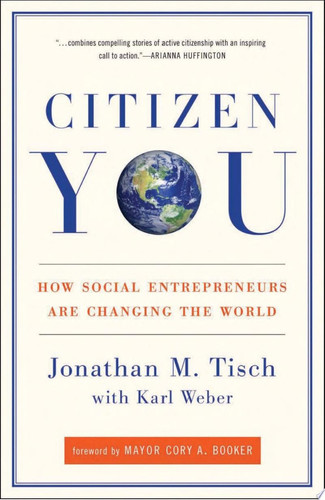
Citizen You How Social Entrepreneurs Are Changing the World

Jonathan Tisch,Karl Weber
Just when the world needs it most, a new style of social engagement is emerging: Active Citizenship. A key member of one of New York’s most civic-minded families—one that has supported many of America’s notable institutions and deserving programs—Jonathan Tisch has devoted a lifetime to “active citizenship.” It’s an idea that uses the power of practical creativity and grassroots participation to solve seemingly intractable problems. In Citizen You , Tisch challenges readers to join this movement and points the way toward making our world a better place, one person and one neighborhood at a time. Tisch has filled Citizen You with accounts of people who you’ll meet, such inspirational individuals as: Scott Harrison, who has used the networking and marketing skills he developed as a night club promoter to help over a million people in the developing world get access for the first time to clean, safe drinking water. Steffi Coplan, whose Broadway2Broadway project brought out the hidden musical talents of kids at an inner city school. Eric Schwarz, who decided to do something about America’s under-performing schools, and parlayed a single classroom mentoring project into the nationwide Citizens Schools movement. Chris Swan, who is training a new generation of “citizen engineers” to make sure that the projects they build aren’t just structurally sound but also environmentally and socially sustainable. Dave Nelson, who traded his role as an executive at IBM for a job at a struggling nonprofit that teaches kids about the power of entrepreneurship—and discovered a host of new challenges and rewards in the process. Through these and many other remarkable stories, you’ll learn how today’s active citizens are transforming thinking about social change. Rather than short-term fixes and hand-me-down charity, they’re striving to build sustainable, systemic solutions to our most challenging problems, building and empowering communities rather than fostering dependency. And they’re using a host of new tools, from online networking and private-public partnerships to corporate engagement and social entrepreneurship, to redefine how change can happen. Citizen You is a potent antidote to pessimism. At a time of unprecedented challenges on the national and world stage, when active citizenship is not a choice but a necessity, Citizen You dares us to reshape the social, political, and intellectual structures that have long confined us, and offers fresh thinking that redefines the very concept of activism. For more information and ideas about how to be an active citizen go to www.citizenyou.org
Crown 2011-05-03 288 pages

The rich: from slaves to super-yachts : a 2000-year history

Kampfner, John
From the Orwell Prize shortlisted author of Freedom for Sale, The Richis the fascinating history of how economic elites from ancient Egypt to the present day have gained and spent their money. Starting with Ancient Egypt and Greece and culminating with the oligarchies of modern Russia and China, it compares and contrasts the rich and powerful down the ages and around the world. What unites them? Have the same instincts of entrepreneurship, ambition, vanity, greed and philanthropy applied throughout? As contemporary politicians, economists and the public wrestle with the inequities of our time - the parallel world inhabited by the ultra-wealthy at a time of broader hardship - it is salutary to look to history for explanations. This book synthesises thousands of years of human behaviour and asks the question: is the development of the globalised super-rich over the past twenty years anything new?
Little, Brown an imprint of Little, Brown Book Group 2014 454 pages

The permanent revolution: apostolic imagination and practice for the 21st century church

Hirsch, Alan
"A new brand of apostolic ministry for today's world The Permanent Revolution is a work of theological re-imagination and re-construction that draws from biblical studies, theology, organizational theory, leadership studies, and key social sciences. The book elaborates on the apostolic role rooted in the five-fold ministry from Ephesians 4 (apostles, prophets, evangelists, shepherds, and teacher), and its significance for the missional movement. It explores how the apostolic ministry facilitates ongoing renewal in the life of the church and focuses on leadership in relation to missional innovation and entrepreneurship.The authors examine the nature of organization as reframed through the lens of apostolic ministry. Shows how to view the world through a biblical perspective and continue the "permanent revolution" that Jesus started Outlines the essential characteristics of apostolic movement and how to restructure the church and ministry to be more consistent with them Alan Hirsch is a leading voice in the missional movement of the Christian West This groundbreaking book integrates theology, sociology, and leadership to further define the apostolic movement"--Provided by publisher.
Jossey-Bass 2012-02-28 326 pages

Man, Economy, and State, Scholar's Edition

Murray N. Rothbard
Rothbards great treatise and its complementary text are now combined into a single 4.5"x7" pocket edition. The full 1,500 page treatise in an easy to read and super convenient package. It might not seem possible but it is done and it works. It makes a great companion volume to Misess Human Action in pocket size, as well as the Bastiat Collection in pocket size. Murray N. Rothbards great treatise provides a sweeping presentation of Austrian economic theory, a reconstruction of many aspects of that theory, a rigorous criticism of alternative schools, and an inspiring look at a science of liberty that concerns nearly everything and should concern everyone. This edition takes this book out of the category of underground classic and raises it up to its proper status as one of the great economic treatises of all time, a book that is essential for anyone seeking a robust economic education. The captivating new introduction by Professor Joseph Salerno that frames up the Rothbardian contribution in a completely new way, and reassesses the place of this book in the history of economic thought. In Salernos view, Rothbard was not attempting to write a distinctively "Austrian" book but rather a comprehensive treatise on economics that eschewed the Keynesian and positivist corruptions. This is what accounts for its extraordinarily logical structure and depth. That it would later be called Austrian is only due to the long-lasting nature of the corruptions of economics that Rothbard tried to correct. Students have used this book for decades as the intellectual foil for what they have been required to learning from conventional economics classes. In many ways, it has built the Austrian school in the generation that followed Mises. It was Rothbard who polished the Austrian contribution to theory and wove it together with a full-scale philosophy of political ethics that inspired the generation of the Austrian revival, and continues to fuel its growth and development today. From Rothbard, we learn that economics is the science that deals with the rise and fall of civilization, the advancement and retrenchment of human development, the feeding and healing of the multitudes, and the question of whether human affairs are dominated by cooperation or violence. Economics in Rothbards wonderful book emerges as the beautiful logic of that underlies human action in a world of scarcity, the lens on how exchange makes it possible for people to cooperate toward their mutual betterment. We see how money facilitates this, and allows for calculation over time that permits capital to expand and investment to take place. We see how entrepreneurship, based on real judgments and risk taking, is the driving force of the market. Whats striking is how this remarkable book has lived in the shadows for so long. It began as a guide to Human Action, and it swelled into a treatise in its own right. Rothbard worked many years on the book, even as he was completing his PhD at Columbia University. He realized better than anyone else that Misess economic theories were so important that they needed restatement and interpretation. But he also knew that Misesian theory needed elaboration, expansion, and application in a variety of areas. The result was much more: a rigorous but accessible defense of the whole theory of the market economy, from its very foundations. But the publisher decided to cut the last part of the book, a part that appeared years later as Power and Market. This is the section that applies the theory presented in the first 1,000 pages to matters of government intervention. Issue by issue, the book refutes the case for taxation, the welfare state, regulation, economic planning, and all forms of socialism, large and small. It remains an incredibly fruitful assembly of vigorous argumentation and evidence. A major advantage of Man, Economy, and State, in addition to its systematic presentation, is that it is written in the clearest English you will find anywhere in the economics literature. The jargon is kept to a minimum. The prose is crystalline and vigorous. The examples are compelling. No one has explained the formation of prices, the damage of inflation, the process of production, the workings of interest rates, and a hundred of topics, with such energy and clarity. Over years, students have told us that this book is what made it possible for them to get through graduate school. Why? Because Rothbard takes on the mainstream in its own terms and provides a radical, logical, comprehensive answer. If you have read the book, you know the feeling that comes with reaching the last page: one walks away with the sense that one now fully understands economic theory and all its ramifications. It is a shame that the authentic edition of the classic that Rothbard wrote fully 40 years ago is only now coming into print. And yet the good news is that, at last, this remarkable work in the history of ideas, the book that makes such a technically competent, systematic, and sweeping case for the economics of liberty, is at last available. REVIEWS As the result of many years of sagacious and discerning meditation, [Rothbard] joins the ranks of the eminent economists by publishing a voluminous work, a systematic treatise on economics.... An epochal contribution to the general science of human action, praxeology, and its practically most important and up-to-now best elaborated part, economics. Henceforth all essential studies in in these branches of knowledge will have to take full account of the theories and criticisms expounded by Dr. Rothbard. Ludwig von Mises It is in fact the most important general treatise on economic principles since Ludwig von Misess Human Action in 1949. Henry Hazlitt Man, Economy, and State is Murray Rothbards main work in economic theory. It appeared in 1962, when Murray was only 36 years old. In it Murray develops the entire body of economic theory, in a step by step fashion, beginning with incontestable axioms and proceeding to the most intricate problems of business cycle theory and fundamental breakthroughs in monopoly theory. And along the way he presents a blistering refutation of all variants of mathematical economics. The book has in the meantime become a modern classic and ranks with Misess Human Action as one of the two towering achievements of the Austrian School of economics. In Power and Market, Murray analyzed the economic consequences of any conceivable form of government interference in markets. The Scholars Edition brings both books together to form a magnificent whole. Hans-Hermann Hoppe In 1972, this book was selling in hardback for $150 in current dollars. So the pocket edition, which includes Power and Market, a great index, plus improved layout, is about a fraction of the cost of the original, for a far better product.
Ludwig von Mises Institute 2009 1438 pages

The invention of enterprise: entrepreneurship from ancient Mesopotamia to modern times

David S. Landes,Joel Mokyr,William J. Baumol
Whether hailed as heroes or cast as threats to social order, entrepreneurs - and their innovations - have had an enormous influence on the growth and prosperity of nations. "The Invention of Enterprise" gathers together, for the first time, leading economic historians to explore the entrepreneur's role in society from antiquity to the present. Addressing social and institutional influences from a historical context, each chapter examines entrepreneurship during a particular period and in an important geographic location. The book chronicles the sweeping history of enterprise in Mesopotamia and Neo-Babylon; carries the reader through the Islamic Middle East; offers insights into the entrepreneurial history of China, Japan, and Colonial India; and, describes the crucial role of the entrepreneur in innovative activity in Europe and the United States, from the medieval period to today. In considering the critical contributions of entrepreneurship, the authors discuss why entrepreneurial activities are not always productive and may even sabotage prosperity. They examine the institutions and restrictions that have enabled or impeded innovation, and the incentives for the adoption and dissemination of inventions. They also describe the wide variations in global entrepreneurial activity during different historical periods and the similarities in development, as well as entrepreneurship's role in economic growth. The book is filled with past examples and events that provide lessons for promoting and successfully pursuing contemporary entrepreneurship as a means of contributing to the welfare of society.
Princeton University Press 2010-01-31 566 pages

Branson

Tom Bower
'Bower's book is a devastating indictment' Sunday Times 'Explosive ... Bower reveals a remarkable and sinister picture of the man who likes to appear as the ever-smiling hero' Daily Mail A sensational critical biography of the man and his business practices. No British tycoon is better known, few claim to be richer and none has masterminded a more recognisable brand than Richard Branson. What is behind the success of the buccaneering balloonist, the tabloids' favourite celebrity nude, the 'grinning jumper' and the scourge of corporate goliaths? Tom Bower has a uncovered a different tale to the one so eagerly promoted by Virgin's publicists. Here is the full story of Branson: his businesses, his friendships, his ambition, his law-breaking, his drug-taking, his bullying. Offering an intimate scrutiny of exactly how Richard Branson created and sold himself, this biography reveals Branson to be a single-minded profiteer who, while occasionally generous to others, has a fixed purpose to enhance his family's wealth in secret off-shore trust funds. Instead of a glittering saint, Branson emerges as a devious actor, proud of plucking for his own profit the good ideas of others.
Fourth Estate 2001 393 pages

Better, Stronger, Faster The Myth of American Decline . . . and the Rise of a New Economy

Daniel Gross
Daniel Gross, Yahoo! financial columnist and author of Dumb Money , offers a refreshingly optimistic take on our nation’s economic prospects, examining the positive trends that point to a better, stronger future. Financial meltdown, a deep recession, and political polarization—combined with strong growth outside the U.S.—have led to a global bubble of pessimism surrounding the U.S. and its economic prospects. Bloated with debt, outpaced by China, India, and other emerging markets, the U.S. has been left for dead as an economic force. But, Daniel Gross, widely respected for his Newsweek and Slate coverage of the crash and the recovery, shows that much of the talk about decline is misplaced. In the wake of the crash, rather than accept the inevitability of a Japan-style lost decade, America’s businesses and institutions tapped into the very strengths that built the nation’s economy into the global powerhouse in the first place: speed, ingenuity, adaptability, pragmatism, entrepreneurship, and, most significantly, an ability to engage with the world. As the U.S. wallowed in self-pity, the world continued to see promise in what America has to offer—buying exports, investing in the U.S., and adapting American companies and business models as their own. Global growth, it turns out, is not a zero-sum game. These same attributes can propel the world’s largest economy forward through the significant headwinds it faces. Better, Stronger, Faster is a narrative of the remarkable reconstruction and reorientation that started in March 2009, a period that Gross compares to March 1933. Both marked the start of unexpected recoveries and monumental shifts in our nation’s history. As Gross explains, through stories of innovative solutions devised by policymakers, businesses, investors, and consumers, America has the potential to emerge from this period, not as the unrivaled ruler of the global economy, but as a leader and enabler of growth.
Free Press 2014-10-18 272 pages

If you really want to change the world: a guide to creating, building, and sustaining breakthrough ventures

Kressel, Henry
"Silicon Valley's popular approach to creating new ventures is rooted in trial and error-test markets with new concepts and a minimum amount of capital, and hope for valuable businesses to emerge. But this fail-fast, hit-or-miss, step-and-pivot, or tech-first philosophy can leave a trail of destruction and loss in its wake. It can be like a random walk in the forest-without a compass. This book is about helping the great entrepreneurs find true north. Henry Kressel and Norman Winarsky-technologists, inventors, and investors with stellar track records-have an approach for those who wish to create a market-leading company that will make an impact on the world: a disciplined and staged approach they've used to launch, invest in, and develop dozens of successful companies-and to create whole new markets. The method they describe takes the entrepreneur by the hand, step-by-step, through the critical stages of development of a great venture, from concept to acquisition or public offering, to being a mature company seeking to maintain its culture of innovation. It is a guide by innovators and for innovators, with approaches that are timeless. If You Really Want to Change the World is your guide to creating massively successful ventures. Drawing on the authors' experiences as well as those of their partners from around the world, Kressel and Winarsky share the stories of their triumphs and misses as of a way of demonstrating their method and inspiring their readers. They guide entrepreneurs and innovators in companies of all scale-start-ups, research institutions, government agencies, and corporations-on how to execute with the aim of creating companies that can change the world. "--
Harvard Business Review Press 2015 215 pages

Bust Out!: Ignite Your Inner Entrepreneur

Cohen, David
Life is changing at the speed of light it seems, careers are shifting, entire industries that we grew up with are totally fading away and new ones are coming in to the forefront. As Boomers, we need to adopt new ideas and strategies to succeed and one of those is having a "Plan B"... just in case you are or have experienced job loss, downsizing, rightsizing, or maybe just maybe in a moment of boldness, decide it's time for you to "Bust Out" and it's time for a change...it's time to do your own thing... pursue your passion and launch your own business! In Bust Out-Ignite your Inner Entrepreneur you will get the ideas, tools, tips and resources to help you "Bust Out" and launch your venture successfully. We cite case studies, have you do workshops, share interviews, articles and load you up with very cool ideas to help you navigate the world of launching your own small business. So, if you're a Boomer who is making the change, or you need to have a "Plan B" in place...if you have a dream, a vision, the drive and a darn good idea...then "Bust Out" is the book to help you Ignite Your Inner Entrepreneur!
Better Choice Publishing, A 2012 286 pages