126 results for "Genetics"

The Structure and Measurement of Intelligence

Hans Eysenck
What is meant by the term "intelligence" and, once de- fined, how do we go about achieving a valid measurement of this faculty? This classic textbook, originally published in 1979, and now reissued with a new preface by Sybil Eysenck, incorporates a broad range of findings and reanalyzes much of the existing literature in this area. In The Structure and Measurement of Intelligence, Hans Eysenck draws on methods for determining the effect of genetics and environment on the development of intelligence and examines the validity of the term as defined in relation to internal as well as external criteria. He tests a number of hypotheses on intelligence against empirical research findings and considers various criticisms in detail. The significance of intelligence and its measurement in society are explored in depth. Eysenck greatly expands upon such questions as: Does IQ measure intelligence? How valid is the nature versus nurture argument? and, How might socioeconomic status influence one's intelligence? Designed primarily for students and scholars in psychology and education, this text will make thought-provoking reading for all concerned with the development and measurement of intelligence in the individual.
[distributor] Taylor & Francis, c/o Bookpoint 2017-10-27 226 pages

Human diversity

Lewontin, Richard C.
Richard Lewontin explores the complexity of human variation and tackles the controversial question: Are our personalities and capabilities predetermined by our genes? Answering with a resounding "no", Human Diversity makes the case that biological differences are only a small part of what makes individuals unique - anyone, regardless of race, class, or sex, has the potential to develop virtually any identity within the spectrum of humanity.
Scientific American Library 1982 179 pages

Complexities: beyond nature & nurture

Susan McKinnon,Sydel Silverman
Recent years have seen a growing impetus to explain social life almost exclusively in biological and mechanistic terms, and to dismiss cultural meaning and difference. Daily we read assertions that everything from disease to morality—not to mention the presumed characteristics of race, gender, and sexuality—can be explained by reference primarily to genetics and our evolutionary past. Complexities mobilizes experts from several fields of anthropology—cultural , archaeological, linguistic, and biological—to offer a compelling challenge to the resurgence of reductive theories of human biological and social life. This book presents evidence to contest such theories and to provide a multifaceted account of the complexity and variability of the human condition. Charting a course that moves beyond any simple opposition between nature and nurture, Complexities argues that a nonreductive perspective has important implications for how we understand and develop human potential.
University of Chicago Press 2005-06 330 pages

One and the Same My Life as an Identical Twin and What I've Learned About Everyone's Struggle to Be Singular

Abigail Pogrebin
Journalist Abigail Pogrebin is many things—wife, mother, New Yorker—but the one that has defined her most profoundly is “identical twin.” As children, she and her sister, Robin, were inseparable. But when Robin began to pull away as an adult, Abigail was left to wonder not only why, but also about the very nature of twinship. What does it mean to have a mirror image? How can you be unique when somebody shares your DNA? In One and the Same , Abigail sets off on a quest to understand how genetics shape us, crisscrossing the country to explore the varied relationships between twins, which range from passionate to bitterly resentful. She speaks to the experts and tries to answer the question parents ask most—is it better to encourage their separateness or closeness? And she paints a riveting portrait of twin life, yielding fascinating truths about how we become who we are.
Knopf Doubleday Publishing Group 2010-10-05 288 pages

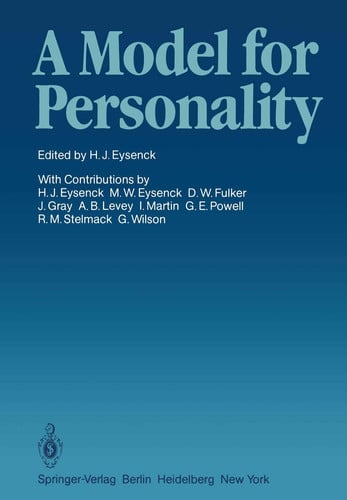
A Model for Personality

H.J. Eysenck
H. J. Eysenck This book is not an introduction to personality research, it is not a textbook, and above all it is not a model of personality. The title, A Modelfor Personality, was chosen on purpose to indicate that we are here concerned with a discussion of how models in this field ought to be constructed, what their functions were, and whether such models or paradigms could with advantage be produced at this stage of development. One particular aspect of personality, extraversion introversion (E), has been chosen to exemplify the desiderata which emerge from such a discussion. It is not suggested that personality and E are synonymous - merely that this particular dimension is perhaps better known than any other, has had more experimental work done on it than any other and has acquired a better theoretical substructure, and more links with genetics and physiology, than any other. Hence it seems most likely to serve as an example of how a satisfactory model of personality might ultimately be constructed, i. e. by analogy with E. Other dimensions of personality, such as neuroticism-stability or psycho tic ism-superego functioning, are mentioned in the discussion, but only when they overlap or interrelate with E. The book uses E as an example to illustrate the way in which a model of personality can be constructed, but it is in no way a summary of all that is known about E.
Springer Berlin Heidelberg 2011-10-26 287 pages

Gene sharing and evolution: the diversity of protein functions

Piatigorsky, Joram
"Gene sharing" means that the different functions of a protein may share the same gene--that is, a protein produced by a gene evolved to fulfill a specialized function for one biological role may also perform alternate functions for other biological roles. In the 1980s and early 1990s, Joram Piatigorsky and colleagues coined the term "gene sharing" to describe the use of multifunctional proteins as crystallins in the eye lens. In Gene Sharing and Evolution Piatigorsky explores the generality and implications of gene sharing throughout evolution and argues that most if not all proteins perform a variety of functions in the same and in different species, and that this is a fundamental necessity for evolution. How is a gene identified, by its structure or its function? Do the boundaries of a gene include its regulatory elements? What is the influence of gene expression on natural selection of protein functions, and how is variation in gene expression selected in evolution? These are neither new nor resolved questions. Piatigorsky shows us that the extensiveness of gene sharing and protein multifunctionality offers a way of responding to these questions that sheds light on the complex interrelationships among genes, proteins, and evolution.
Harvard University Press 2007-02-28 320 pages

Nature's thumbprint: the new genetics of personality

Neubauer, Peter B.
In Nature's Thumbprint, one of the country's foremost psychiatrists and his son, a writer, explore the impact of today's new genetic research on our understanding of human development and personality. Using original case studies of identical twins adopted in infancy and reared apart, this extraordinary book untangles the complex interaction between genetics and experience.
Columbia University Press 1996 223 pages

The origins of the British

Oppenheimer, Stephen
'British prehistory will never look the same again.' Professor Colin Renfrew, University of Cambridge Stephen Oppenheimer's extraordinary scientific detective story combining genetics, linguistics, archaeology and historical record shatters the myths we have come to live by. It demonstrates that the Anglo-Saxon invasions contributed just a tiny fraction (5%) to the English gene pool. Two-thirds of the English people reveal an unbroken line of genetic descent from south-western Europeans arriving long before the first farmers. The bulk of the remaining third arrived between 7,000 and 3,000 years ago as part of long-term north-west European trade and immigration, especially from Scandinavia - and may have brought with them the earliest forms of English language. As for the Celts - the Irish, Scots and Welsh - history has traditionally placed their origins in Iron Age Central Europe. Oppenheimer's genetic synthesis tells a different story. There is indeed a deep divide between the English and the rest of the British. But as this book reveals the division is many thousands of years older than previously thought. 'Be prepared to have all your cherished notions of English history and Britishness swept away' - Clive Gamble
Robinson 2007 628 pages

Uncultivated microorganisms

Slava S. Epstein
In 1898, an Austrian microbiologist Heinrich Winterberg made a curious observation: the number of microbial cells in his samples did not match the number of colonies formed on nutrient media (Winterberg 1898). About a decade later, J. Amann qu- tified this mismatch, which turned out to be surprisingly large, with non-growing cells outnumbering the cultivable ones almost 150 times (Amann 1911). These papers signify some of the earliest steps towards the discovery of an important phenomenon known today as the Great Plate Count Anomaly (Staley and Konopka 1985). Note how early in the history of microbiology these steps were taken. Detecting the Anomaly almost certainly required the Plate. If so, then the period from 1881 to 1887, the years when Robert Koch and Petri introduced their key inventions (Koch 1881; Petri 1887), sets the earliest boundary for the discovery, which is remarkably close to the 1898 observations by H. Winterberg. Celebrating its 111th anniversary, the Great Plate Count Anomaly today is arguably the oldest unresolved microbiological phenomenon. In the years to follow, the Anomaly was repeatedly confirmed by all microb- logists who cared to compare the cell count in the inoculum to the colony count in the Petri dish (cf., Cholodny 1929; Butkevich 1932; Butkevich and Butkevich 1936). By mid-century, the remarkable difference between the two counts became a universally recognized phenomenon, acknowledged by several classics of the time (Waksman and Hotchkiss 1937; ZoBell 1946; Jannasch and Jones 1959).
Springer 2009-07-23 208 pages

The shape of life: genes, development, and the evolution of animal form

Raff, Rudolf A.
Rudolf Raff is recognized as a pioneer in evolutionary developmental biology. In their 1983 book, Embryos, Genes, and Evolution , Raff and co-author Thomas Kaufman proposed a synthesis of developmental and evolutionary biology. In The Shape of Life , Raff analyzes the rise of this new experimental discipline and lays out new research questions, hypotheses, and approaches to guide its development. Raff uses the evolution of animal body plans to exemplify the interplay between developmental mechanisms and evolutionary patterns. Animal body plans emerged half a billion years ago. Evolution within these body plans during this span of time has resulted in the tremendous diversity of living animal forms. Raff argues for an integrated approach to the study of the intertwined roles of development and evolution involving phylogenetic, comparative, and functional biology. This new synthesis will interest not only scientists working in these areas, but also paleontologists, zoologists, morphologists, molecular biologists, and geneticists.
University of Chicago Press 1996-06-15 520 pages

The Lysenko affair

Joravsky, David
The Lysenko affair was perhaps the most bizarre chapter in the history of modern science. For thirty years, until 1965, Soviet genetics was dominated by a fanatical agronomist who achieved dictatorial power over genetics and plant science as well as agronomy. "A standard source both for Soviet specialists and for sociologists of science."— American Journal of Sociology "Joravsky has produced . . . the most detailed and authoritative treatment of Lysenko and his view on genetics."— New York Times Book Review
University of Chicago Press 1986-08-15 459 pages

Recreating motherhood

Rothman, Barbara Katz
Selling "genetically gifted" human eggs on the free market for a hefty price. In vitro fertilization. Fetal rights. Prenatal diagnosis. Surrogacy. All are instances of biomedical and social "advancements" with which we have become familiar in recent years. Yet these issues are often regarded as distinct or only loosely related under the rubric of reproduction. Barbara Katz Rothman demonstrates how they form a complex whole that demands of us in response a woman-centered, class-sensitive way of understanding motherhood. We need a social policy for dealing with mothers and motherhood that is consistent with feminist politics and feminist theory. Her book show how we as a society must first recognize that the real needs of mother, father, and children have been swept aside in an attempt to reduce the complex process of human reproduction to a clinical event that can be controlled by medical technology. Rothman suggests ways to accomplish social and legal change that would allow technological advances to affirm motherhood and the mother-child relationship without cost to women's identity. This new edition of Recreating Motherhood contains exciting updates. Rothman shows how this material is key in understanding the family, not just motherhood. And a new chapter, "Reflections on a Decade," explores how new reproductive technologies combine with new marketing and new genetics to pose troubling social questions.
Rutgers University Press 2000 226 pages

The double-edged helix: social implications of genetics in a diverse society

Joseph S. Alper,Catherine Ard,Adrienne Asch,Jon Beckwith
Selected as an Outstanding Academic Title for 2003 from Choice Magazine The Double-Edged Helix explores the impact of recent genetic discoveries on both different population segments and society as a whole. The authors address the medical and ethical implications of the new technologies, outlining potential positive and negative effects of genetic research on minorities, individuals with disabilities, and those of diverse sexual orientations. Presenting a wide array of perspectives, this book emphasizes the need to ensure that research into genetics research does not result in discrimination against people on the basis of their DNA.
Johns Hopkins university press 2002 293 pages

Psychiatric genetics and genomics

Social Genetic and Developmental Psychiatry Centre Peter McGuffin, PH.D.,Peter McGuffin,Michael J. Owen,Irving I. Gottesman,Irving L Gottesman, PH.D.
Genetics promises to provide one of the most powerful approaches to understanding the functional pathology of the human brain. This book presents a critical review of the evidence for a genetic contribution to common psychiatric conditions and the rarer single-gene disorders that may have psychiatric presentations The first section of the book introduces the reader to molecular biology and the techniques of molecular genetics. The coverage then moves on to consider the genetics of normal and abnormal development, followed by a look at the genetics of abnormal behaviour in adults. This section includes, amongst others, consideration of personality disorders, schizophrenia and the dementias. The final section considers the applications of the work and covers issues such as counselling and ethics, closing with a look to the future. The editors are internationally renowned figures in this field and they have invited a team of equally eminent chapter authors. This will be essential reading for psychiatrists and geneticists and will be essential reading for psychiatrists and geneticists and will be of interest to neurologists, psychologists and neuroscientists.
Oxford University Press 2002 472 pages