70 results for "History"

Fritz Lang: interviews

Lang, Fritz
The films of Fritz Lang depict an entrapping, claustrophobic world in which people are controlled by larger forces. His overriding theme is the struggle against fate and against the traits of human nature that doom us. His life and work spanned six decades of film history-from the silent era through the golden age of German Expressionism of the 1920s and the classic studio system in Hollywood to the rise of the international co-production. In Hollywood he worked for every major studio except Disney. He made blockbusters, modest B movies, and everything in between. Among his films are classics of German cinema-including Metropolis and M . In America he made some of the most notable crime movies ( Fury ), noir films ( The Big Heat ), and Westerns ( The Return of Frank James ) of the studio era. Despite the different time periods, nations, and genres in which he worked, his films remain stylistically consistent. Lang (1890-1976), a notoriously difficult interviewee, granted relatively few interviews apart from short publicity exchanges in the promotion of his films. Fully aware of his public persona, he was a canny self-promoter who carefully constructed half-truths and myths about himself. This fascinating collection covers his conversations about his life and his works over a period of forty years. They reveal how cinema for Lang was an intensely personal art. "For me," he said, "cinema is a vice. I love it intimately. I've often written that it is the art form of our century."
University Press of Mississippi 2003 195 pages

Shop talk

Roth, Philip
In Philip Roth's intimate intellectual encounters with an international and diverse cast of writers, they explore the importance of region, politics and history in their work and trace the imaginative path by which a writer's highly individualized art is informed by the wider conditions of life. With Primo Levi, Roth discusses the stubborn core of rationality that helped the Italian chemist-writer survive the demented laboratory of Auschwitz. With Milan Kundera, he analyzes the mix of politics and sexuality that made him the most subversive writer in communist Czechoslovakia. With Edna O'Brien, he explores the circumstances that have forced generations of Irish writers into exile. Elsewhere Roth offers appreciative portraits of two friends--the writer Bernard Malamud and the painter Philip Guston--at the end of their careers, and gives us a masterful assessment of the work of Saul Bellow. Intimate, charming, and crackling with ideas about the interplay between imagination and the writer's historical situation, Shop Talk is a literary symposium of the highest level, presided over by America's foremost novelist.
Vintage 2002 160 pages

Paul Krassner's Impolite interviews

Krassner, Paul
Krassner's Impolite Interviews delivers 21 of the most compelling encounters you will ever witness, from a 1959 interview with author Alan Watts to Timothy Leary in 1995 just weeks before he died, from Norman Mailer talking about sex to Jerry Garcia recounting what it was like to play the Pyramids. Each interview gives a unique take on major issues: Communism, segregation, the Cold War, the sexual revolution, the drug culture, by major personalities. Impolite Interviews presents perspectives as diverse as George Lincoln Rockwell (then head of the American Nazi Party) and spiritual master Ram Dass. Krassner offers readers an illuminating look at some of the most important figures of the second half of this century through the eyes of one of this era's most innovative journalists.
Seven Stories Press 1999-09-07 340 pages

Miles Davis and David Liebman: jazz connections

Liebman, Dave
An oral history based on converstaions with David Liebman about his musical career and his association with Miles Davis. Chapter one of the text examines Liebman's background and early influences (Elvin Jones and Miles Davis). Chapter two provides information about Liebman and his band, their artistic objectives, interaction with an audience, and teaching and aesthetics. Liebman's place in the jazz spectrum, including performance style, and musical and language communication are explored in the third chapter, while chapter four looks more generally at lifestyles and attitudes of jazz musicians. The final two chapters of the book have comments by David Liebman shortly before and shortly after the death of Miles Davis in May 1991.
Edwin Mellen Press 1996 206 pages

Conversations with Chaim Potok

Potok, Chaim
One of America's most popular Jewish writers, Chaim Potok (b. 1929) is the author of such novels as The Chosen (1967), The Promise (1969), The Book of Lights (1981), and Davita's Harp (1985). Each of his novels explores the tension between tradition and modernity, and the clash between Jewish culture and contemporary Western civilization, which he calls "core-to-core culture confrontation." Although primarily known as a novelist, Potok is an ordained Conservative rabbi and a world-class Judaic scholar who has also published children's books, theological discourses, biographies, and histories. Conversations with Chaim Potok presents interviews ranging from 1976 to 1999. Potok discusses the broad range of his writing and the deep influence of non-Jewish novels-in particular, Evelyn Waugh's Brideshead Revisited and James Joyce's Portrait of the Artist as a Young Man -on his work. Interviews bear witness to Potok's many other influences-Orthodox Jewish doctrine, Freudian psychoanalytical theory, Picasso's Guernica, and Jewish kabbalah mysticism. Though labeled an American Jewish writer, Potok argues that Flannery O'Connor should then be called an American Catholic writer and John Updike an American Protestant writer. "In his mind," editor Daniel Walden writes, "just as Faulkner was a writer focused on a particular place, Oxford, Mississippi, . . . so Potok's territory was a small section of New York City." Potok often explores conflict in his writings and in his interviews. Strict Jewish teachings deem fiction an artifice and therefore unnecessary, yet since the age of sixteen Potok has been driven to write novels. At the root of all of these conversations is Potok's intense interest in the turmoil between Jewish culture, religion, and tradition and what he calls "Western secular humanism." As he discusses his work, he continually includes broader issues, such as the state of Jewish literature and art, pointing out with pride and enthusiasm his belief that Jewish culture, in the twentieth century, has finally begun to have a significant role in producing and shaping the world's art and literature. Whether discussing the finer details of Talmudic textual analysis or his period of chaplaincy during the Korean War, Potok is articulate and philosophical, bringing deep consideration into what may seem small subjects. Although his novels and histories take place primarily in the recent past, the Chaim Potok that emerges from this collection is a writer deeply rooted in the tensions of the present. Daniel Walden is Professor Emeritus of American Studies, English and Comparative Literature at Penn State University. He has written or edited several books, including On Being Jewish (1974), Twentieth Century American Jewish Writers (1984), The World of Chaim Potok (1985), and American Jewish Poets: The Roots and the Stems (1990).
University Press of Mississippi 2001 181 pages

What it is: the life of a jazz artist

Liebman, Dave
Dave Liebman is one of the leading forces in contemporary jazz. Prominently known for performing with Miles Davis and Elvin Jones, he has exerted considerable influence as a saxophonist, bandleader, composer, author, and educator. In addition to his recent recognition as a National Endowment for the Arts Jazz Master, he has received the Order of Arts and Letters from France and holds an honorary doctorate from the Sibelius Academy in Helsinki, Finland. He has mentored many of today's most notable young jazz musicians worldwide and is a prolific writer on jazz. In What It Is: The Life of a Jazz Artist, friend, pianist, and noted jazz scholar Lewis Porter conducts a series of in-depth interviews with Liebman, who discusses his professional, personal, and musical relationships with Davis and Jones, as well as such notable musicians as Chick Corea, Richie Beirach, Michael and Randy Brecker, and many others. Through the interviews, Liebman discusses such personal matters as contracting polio as a child and the difficulties it caused as an adult during his rise as a jazz musician. He offers insights into the life of jazz performers of his generation, particularly the tumultuous period of the 1960s and 1970s. The book also features rare photos from Liebman's personal collection. A fascinating and witty storyteller, Liebman's stories in What It Is will appeal to jazz fans and scholars by providing a firsthand look into the creative life of one of America's leading jazz musicians.
Scarecrow Press 2012 363 pages

The American aces speak

Hammel, Eric M.
Picking up where he left off in his acclaimed Aces Against Japan and Aces Against Germany, leading combat historian Eric Hammel comes through again with an engrossing new collection of thirty-eight first-person accounts by American World War Il fighter aces. Coupled with a clear overview of America's far-flung air war against Japan and a clear appreciation of the burgeoning industrial might backing the American war effort, Hammel's detailed interviews bring forth the most thrilling in-the-cockpit experiences that World War II's fabled Army, Navy, Marine, and Flying Tiger aces have chosen to tell. Ride with 2d Lieutenant Jack Donalson as he downs three Zeros-over Luzon on the second desperate day of World War II in the Philippines. Share three lonely air battles over Burma and China with Flying Tiger aces RT Smith, Dick Rossi, and Joe Rosbert. Hear the cry of victory as 2d Lieutenant Don McGee survives yet another encounter with Zeros over embattled Port Moresby, New Guinea, in his substandard P-39 Airacobra. Feel your heart beat with anxiety as an injured Ensign Ed Wendorf races against time to land his damaged Helicat aboard the USS Lexington before he bleeds to death. And thrill to the hunt as Pearl Harbor veteran 1st Lieutenant Frank Holmes seeks personal revenge against Admiral Isoroku Yamamoto on one of history's most important and most thrilling fighter missions. Aces Against Japan II is a highly charged excursion into life and death in the air, told by men who excelled at piston-engine aerial combat and lived to tell about it. In sum, it is an emotional rendering of what brave airmen felt and how they fought in the now-dim days of America's living national history.
Presidio 1992 302 pages

Anarchist voices: an oral history of anarchism in America

Avrich, Paul
Through his many books on the history of anarchism, Paul Avrich has done much to dispel the public's conception of the anarchists as mere terrorists. In Anarchist Voices, Avrich lets American anarchists speak for themselves. This book contains 180 interviews conducted by Avrich over a period of 30 years, interviews that portray the human dimensions of a movement much maligned by the authorities and contemporary journalists. Most of the interviewees (anarchists as well as their friends and relatives) were active during the heyday of the movement, between the 1880s and the 1930s. They represent all schools of anarchism and include both famous figures and minor ones, previously overlooked by most historians. Their stories provide a wealth of personal detail about such anarchist luminaries as Emma Goldman and Sacco and Vanzetti. The interviews are grouped in six sections organized around individuals or major aspects of the movement. Each section begins with an explanatory essay, and each interview with a biographical note. Avrich also includes a selected bibliography and a list of anarchist periodicals. This work of impeccable scholarship will be an invaluable resource not only for scholars of anarchism but also for those studying immigration, ethnic politics, the history of education, and legal and labor history. -- "Publishers Weekly"
Princeton University Press 1995 574 pages

Tony Kushner in conversation

Kushner, Tony
In the Fall of 1992, Millennium Approaches, the first part of Tony Kushner's Angels in America, won England's prestigious Evening Standard award as the season's Best Play. By the Spring of 1993, Millennium had come to Broadway and won its highest honor, the Tony Award for Best Play, and the distinguished Pulitzer Prize for drama as well. Through its epic theatrical panorama of the intimate and political dynamics that arise when individuals, histories, and cultures intersect, Millennium captured the imagination and the conscience of all who saw it. Its ability to deeply move the audience in personal, communal, and political ways was admirably (and astoundingly) matched by the subsequent production of the play's second part, Perestroika, which brought Kushner yet another Evening Standard award and Tony Award for Best Play (1994). Tony Kushner has, almost overnight, become the premier American male playwright to "represent" the 1990s, as David Mamet and August Wilson dominated critical attention in the 1980s. The phenomenally positive response to Angels in America was matched by the equally enthusiastic reception of its young, politically engaged playwright, who impressed journalists and scholars with his eloquent intellect, wit, and moral convictions. Kushner spoke for a younger generation of American artists and activists whose art is intimately connected to social vision and "revolutionary" possibilities in the public and private sectors. His role as a generational (read "national," "liberal," "socialist," "Jewish," "queer") spokesman has provided him with a public platform from which to address concerns that lie at the center of national debate. In a short time Kushner has capturedand retained a nation's fascination, and his opinions are widely sought out on a wide range of topics. And, most often, the platform from which Kushner expresses his ideas is the personal interview, in which he boldly confronts Americans to rethink, even to reinvent, themselves as the Millennium approaches. Tony Kushner in Conversation is the first book to compile Kushner's most significant interviews of the past decade, tracing his career from its early years to his maturing artistic and political visions. The collection includes pieces that first appeared in an amazingly broad range of periodicals as well as interviews not previously published, such as his appearance on PBS on The Charlie Rose Show. In addition to Angels in America, Tony Kushner is author of Slavs! and is currently finishing work on Henry Box Brown, scheduled to have its world premiere at the Royal National Theatre in the summer of 1997. Robert Vorlicky is Associate Professor of Drama at Tisch School of the Arts, New York University.
University of Michigan Press 1997 286 pages

Joseph L. Mankiewicz: interviews

Mankiewicz, Joseph L.
Joseph L. Mankiewicz: Interviews features talks with the master director of such classics as All About Eve, The Barefoot Contessa, and Cleopatra. Mankiewicz (1909-1993) was a creative force in Hollywood from the end of the silent film era through the early years of the Hollywood renaissance of the 1970s. Displaying the wit, insight, and daring that were the hallmarks of his movies, Mankiewicz explores his films and his approach to writing and directing. These interviews span the period from his greatest Hollywood triumphs-he won four Oscars in two years-to just shortly before his death in 1993. From the time he arrived in 1929 through his last film Sleuth in 1972, he had a front-row seat to Hollywood history. This volume offers a hard-to-find, wide-ranging discussion between Mankiewicz and Gary Carey. A Michel Ciment interview appears here in English for the first time. The book will become a welcome resource for admirers of Mankiewicz and his work as well as those interested in the history of classic Hollywood. A writer based in Brooklyn, Brian Dauth has published in Senses of Cinema and MR Zine.
University Press of Mississippi 2008 207 pages

Hermann Nitsch: life and work

Spera, Danielle
The oral autobiography of the controversial Vienna Aktionist, with archival materials and additional writings by Nitsch A pioneer of Vienna's postwar avant-garde and the most notorious member of the Vienna Aktionist group, Hermann Nitsch (1938-2022) united performance, painting and musical composition in dramatic, often blood-soaked rituals. Newly translated into English from the original German, this oral autobiography offers the readers Nitsch's life story in his own words. Over the course of an in-depth interview with Austrian journalist Danielle Spera, he recounts his family history, early childhood, the evolution of his artistic practice and the fraught reception of his work, as well as his various romantic and financial struggles. The interview is illustrated with images of his work, in the studio and in action; archival photographs; and other ephemeral material, such as flyers and news clips. Excerpts from Nitsch's writings, including "Blood Organ Manifesto" and "Verbal Poetry of the Orgies Mysteries Theatre," punctuate the interview between Spera and the artist.
Nitsch Foundation 2023 439 pages

Israel and the daughters of the Shoah: reoccupying the territories of silence

Lenṭin, Ronit
The murder of a third of Europe's Jews by the Nazis is unquestionably the worst catastrophe in the history of contemporary Judaism and a formative event in the history of Zionism and the State of Israel. Understandably, therefore, the Shoah, written about, analyzed, and given various political interpretations, has shaped public discourse in the history of the State of Israel. The key element of Shoah in the Israeli context is victimhood and as such it has become a source of shame, shrouded in silence and subordinated to the dominant discourse which, resulting from the construction of a "new Hebrew" active subjectivity, taught the postwar generation of Israelis to reject diaspora Jewry and its alleged passivity in the face of catastrophe. This book is the culmination of years of preoccupation with the meaning of the Shoah for the author, an Israeli woman with a "split subjectivity: - that of a daughter of a family of Shoah survivors, and that of a daughter of the first Israeli-born generation; the culmination of her need to break the silence about the Shoah in a society which constructed itself as the Israeli antithesis to diaspora Jewry, and to excavate a "truth" from underneath the mountain of Zionist nation-building myths. These myths, the author argues, not only had deep implication for the formation of her generation but also a profound impact on the Israeli-Palestinian conflict. Moreover, they are shot through with images of the "masculine" Israeli, constrasted with those of the weak, passive, non-virile Jewish "Other" of the diaspora. This book offers the first gendered analysis of Israeli society and the Shoah. The author employs personal narratives of nine Israeli daughters of Shoah survivors, writers and film makers, and a feminist re-reading of official and unofficial Israeli and Zionist discourses to explore the ways in which the
Berghahn Books 2000 256 pages

Conversations with Ilan Stavans

Stavans, Ilan
For almost twenty years, Ilan Stavans—described by the Washington Post as "Latin America’s liveliest and boldest critic and most innovative cultural enthusiast"—has interviewed path-breaking intellectuals and artists in a wide range of media. As host of the critically acclaimed PBS series La Plaza, he interviews guests on pressing issues that affect the Western Hemisphere today, asking hard-hitting questions on immigration, religion, bilingualism, race, and democracy. This book collects for the first time in one volume Stavans’s most provocative and enlightening interviews with Hispanics from both sides of the Rio Grande. Spontaneous and surprising, these conversations reflect Latino life in the United States in all its facets. Among the more than two dozen selections, Edward James Olmos talks about Hispanics in Hollywood; John Leguizamo describes how he shapes a stage show; author Richard Rodriguez reflects on his gang background; Esmeralda Santiago takes on the Puerto Rican stereotype; and Piri Thomas shares thoughts on the writing of Down These Mean Streets. "A conversation is a tango," writes Stavans, "for it takes two to dance it." Conversations with Ilan Stavans invites readers to catch the rhythm and enjoy these unique meetings of minds.
University of Arizona Press 2005 214 pages

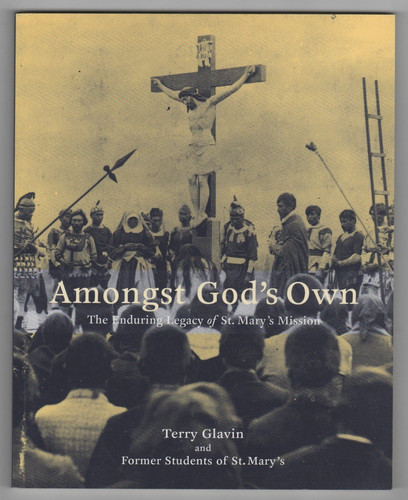
Amongst God's own: the enduring legacy of St. Mary's Mission

Glavin, Terry
For over 100 years, the Oblates of Mary Immaculate operated St. Mary's Mission, a residential school near Mission, BC. Now the stories of its former students are told for the first time. In Amongst God's Own, acclaimed writer Terry Glavin has woven the accounts of 35 native elders into a bold, uncompromising narrative of life at St. Mary's. Sitting with the Oblates' arrival and their establishment of the Mission on the Fraser River, Glavin tracks the chronology of St. Mary's through the 20th century, revealing the Order's religious, political, and social underpinnings. Native voices recount the realities of day-to-day life at the school. Moving beyond the prevalent discourse of oppression and victimhood, the result is a ground-breaking portrait of this place and time that illuminates 200 years of Native-white interaction in BC. Enhancing the stories are 60 photos culled from personal and archival collections. Amongst God's Own is a unique record of a people at a crossroads, caught in a clash between government and religious authority whose consequences reverberate to this day.
Longhouse Publishing 2002 95 pages

Passion and craft: conversations with notable writers

Bonnie Lyons,Bill Oliver
The twelve contemporary fiction writers interviewed in Passion and Craft go beyond the merely autobiographical, revealing that, despite their differences, they share passionate devotion and discipline for their craft. Included are Richard Ford, winner in 1995 of both the Pulitzer Prize and the PEN/Faulkner Award; Gina Berriault, 1997 winner of the National Book Critics Circle Award; Bobbie Ann Mason; T. Coraghessan Boyle; Rick Bass; Leonard Michaels; Christopher Tilghman; Thom Jones; Julia Alvarez; Andre Dubus; Jayne Anne Phillips; and Tobias Wolff. Their comments will interest readers devoted to their novels and stories, other writers, and aspiring writers.
University of Illinois Press 1998 195 pages