123 results for "History"

Yes, I can say that: when they come for the comedians, we're all in trouble

Gold, Judy
"Judy Gold, a concise, funny, and thoughtful polemic on the current assault on comedy, that explores how it is undermining free speech and a fundamental attack against the integrity of the art. From Mae West and Lenny Bruce to Richard Pryor and Howard Stern to Kathy Griffith and Kevin Hart, comedians have long been under fire for using provocative, often taboo subjects to challenge mores and get a laugh. But in the age of social media, comedians are at greater risk of being silenced, enduring shaming, threats, and damaged careers because of angry, censorious electronic mobs. But while comedians' work has often been used to rile up detractors, a new threat has emerged from the left: identity politics and notions like "safetyism" and trigger warnings that are now creating a cultural and political standard that runs perilously close to censorship. From college campuses to the Oscars, comics are being censured for old jokes, long-standing comedy traditions, unfinished bits and old material that instead of being forgotten, go viral. For comics like Judy Gold, today's attacks on comics would have Richard Pryor and Lenny Bruce "rolling in their graves." "No one has the right to tell comics what they can or cannot joke about. Do you tell artists what they can or cannot paint?" she asks. Freedom of speech is fundamental for great stand-up comedy. Humor is the most palatable way to discuss a subversive or taboo topic, but it better be funny. A comic's observations are deliberately delivered to entertain, provoke, and lead to an exchange of ideas. "We are truth tellers." More important, the tolerance of free speech is essential for a healthy democracy. In addition to offering readers a quick study on the history of comedy and the arts (noting such historical reference points as The Hays Code) and the threats to them., Gold takes readers on a hilarious ride with chapters such as "Thank God Don Rickles is Dead," as well as her singular take on "micro-aggressions," such as: Person: "OMG! You're a lesbian? I had no idea. I mean you wear make-up. When did you become a lesbian?" Judy Gold: "Coincidently, right after I met you!" (micro-assault!) In this era of "fake news," partisan politics, and heated rhetoric, the need to protect free speech has never been greater, especially for comics, who often serve as the canaries in the coalmine, monitoring the health of our democracy. Yes I Can Say That is a funny and provocative look at how safe spaces are the very antithesis of comedy as an art form-and an urgent call to arms to protect our most fundamental Constitutional right. There's a good reason it was the FIRST amendment"--
Dey Street 2020 212 pages

The Cold War & the university: toward an intellectual history of the postwar years

Noam Chomsky,Richard C. Lewontin,Ira Katznelson,Laura Nader,David Montgomery,Richard Ohmann,Immanuel Maurice Wallerstein,Raymond Siever,Howard Zinn
"The years following 1945 witnessed a massive change in American intellectual thought and in the life of American universities. The vast effort to mobilize intellectual talent during the war established new links between the government and the academy. After the war, many of those who had worked with the military or the Office of Strategic Services (OSS) took jobs in the burgeoning postwar structure of university-based military research and the intelligence agencies, bringing infusions of government money into many fields." "Little has been written about the long-term impact of this close association, despite considerable study of the McCarthy period's destructive impact on academic careers. The Cold War and the University is a groundbreaking collection of newly commissioned essays that takes a bold first step toward the reconstruction of this history. In it, some of the country's most prominent intellectuals use their own experiences to explore what happened to the university in the postwar years and why." "In wide-ranging and revealing essays, these writers show the many ways existing disciplines, such as anthropology, were affected by the Cold War ethos; they discuss the rise of new fields, such as area studies; and they explore the changing nature of dissent and academic freedom during and since the Cold War."--BOOK JACKET.Title Summary field provided by Blackwell North America, Inc. All Rights Reserved
New Press 1997 258 pages

The nationalist revival: trade, immigration, and the revolt against globalization

Judis, John B.
"Why has nationalism come roaring back? Trump in America, Brexit in the U.K., anti-EU parties in Italy, Germany, France, the Netherlands, Austria, Poland, and Hungary, and nativist or authoritarian leaders in Turkey, Russia, India, and China -- why has nationalism suddenly returned with a vengeance? Is the world headed back to the fractious conflicts between nations that led to world wars and depression in the early 20th Century? Why are nationalists so angry about free trade and immigration? Why has globalization become a dirty word? Based on travels in America, Europe, and Asia, veteran political analyst John B. Judis found that almost all people share nationalist sentiments that can be the basis of vibrant democracies as well as repressive dictatorships. Today's outbreak of toxic "us vs. them" nationalism is an extreme reaction to utopian cosmopolitanism, which advocates open borders, free trade, rampant outsourcing, and has branded nationalist sentiments as bigotry. Can a new international order be created that doesn't dismiss what is constructive about nationalism? As he did for populism in The Populist Explosion, a runaway success after the 2016 election, Judis looks at nationalism from its modern origins in the 1800s to today to find answers"--Back cover.
Columbia Global Reports 2018 157 pages

The Undertow: scenes from a slow civil war

Sharlet, Jeff
"One of America's finest reporters and essayists explores the powerful currents beneath the roiled waters of a nation coming apart. An unmatched guide to the religious dimensions of American politics, Jeff Sharlet journeys into corners of our national psyche where others fear to tread. The Undertow is both inquiry and meditation, an attempt to understand how, over the last decade, reaction has morphed into delusion, social division into distrust, distrust into paranoia, and hatred into fantasies-sometimes realities-of violence. Across the country, men "of God" glorify materialism, a gluttony of the soul, while citing Scripture and preparing for civil war-a firestorm they long for as an absolution and exaltation. Lies, greed, and glorification of war boom through microphones at hipster megachurches that once upon a time might have preached peace and understanding. Political rallies are as aflame with need and giddy expectation as religious revivals. At a conference for incels, lonely single men come together to rage against women. On the Far Right, everything is heightened-love into adulation, fear into vengeance, anger into white-hot rage. Here, in the undertow, our forty-fifth president, a vessel of conspiratorial fears and fantasies, continues to rise to sainthood, and the insurrectionist Ashli Babbitt, killed on January 6 at the Capitol, is beatified as a martyr of white womanhood. Framing this dangerous vision, Sharlet remembers and celebrates the courage of those who sing a different song of community, and of an America long dreamt of and yet to be fully born, dedicated to justice and freedom for all. Exploring a geography of grief and uncertainty in the midst of plague and rising fascism, The Undertow is a necessary reckoning with our precarious present that brings to light a decade of American failures as well as a vision for American possibility"--
W.W. Norton & Company 2023 337 pages

Hamas and civil society in Gaza: engaging the Islamist social sector

Roy, Sara M.
"Many in the United States and Israel believe that Hamas is nothing but a terrorist organization, and that its social sector serves merely to recruit new supporters for its violent agenda. Based on Sara Roy's extensive fieldwork in the Gaza Strip and West Bank during the critical period of the Oslo peace process, Hamas and Civil Society in Gaza shows how the social service activities sponsored by the Islamist group emphasized not political violence but rather community development and civic restoration. Roy demonstrates how Islamic social institutions in Gaza and the West Bank advocated a moderate approach to change that valued order and stability, not disorder and instability; were less dogmatically Islamic than is often assumed; and served people who had a range of political outlooks and no history of acting collectively in support of radical Islam. These institutions attempted to create civic communities, not religious congregations. They reflected a deep commitment to stimulate a social, cultural, and moral renewal of the Muslim community, one couched not only--or even primarily--in religious terms. Vividly illustrating Hamas's unrecognized potential for moderation, accommodation, and change, Hamas and Civil Society in Gaza also traces critical developments in Hamas's social and political sectors through the Second Intifada to today, and offers an assessment of the current, more adverse situation in the occupied territories. The Oslo period held great promise that has since been squandered. This book argues for more enlightened policies by the United States and Israel, ones that reflect Hamas's proven record of nonviolent community building"--
Princeton University Press 2011 319 pages

Freedom for sale: why the world is trading democracy for security

Kampfner, John
Democratic liberalism v. authoritarianism – the ideological divide that defined the twentieth century. But when the cold war ended, “the end of history” was proclaimed. Soon the fire of freedom would burn worldwide, the experts said. And where markets were freed, human rights would inevitably follow. Or not. In the last twenty years, nations including India, Russia, China and the United Arab Emirates have disproved the idea that capitalism and democracy are inextricably linked. Emerging middle classes have proven themselves all too willing to sacrifice certain democratic rights – including free speech, an open media, and free elections – in exchange for prosperity. But they are not alone. We are all doing it. Alarmingly, Western democracy has adopted some of the attributes of that authoritarianism. Combining boots on the ground reporting with incisive analysis, award-winning journalist John Kampfner describes this alarming trend – one which has only been exacerbated by the global economic meltdown – and what citizens must do to counter it.
Basic Books 2010-01-26 294 pages

The mind of the master class: history and faith in the Southern slaveholders' worldview

Fox-Genovese, Elizabeth
Presenting many slaveholders as intelligent, honorable and pious men and women, this study asks how people who were admirable in so many ways could have presided over a social system that inflicted gross abuse on slaves. The South had formidable proslavery intellectuals who participated fully in transatlantic debates and boldly challenged an ascendant capitalist ("free-labor") society. Blending classical and Christian traditions, they forged a moral and political philosophy designed to sustain conservative principles in history, political economy, social theory, and theology, while translating them into political action.
Cambridge University Press 2005-10-17 828 pages

Baseball rebels: the players, people, and social movements that shook up the game and changed America

Dreier, Peter,Elias, Robert,Zirin, Dave
"Baseball Rebels tells stories of reformers and radicals who were influenced by, and in turn influenced, America's broader political and social protest movements, including battles against racism, corporate control, worker exploitation, sexism and homophobia, and American militarism"--
University of Nebraska Press 2022-04 370 pages

Buying power: a history of consumer activism in America

Glickman, Lawrence B.
A definitive history of consumer activism, Buying Power traces the lineage of this political tradition back to our nation’s founding, revealing that Americans used purchasing power to support causes and punish enemies long before the word boycott even entered our lexicon. Taking the Boston Tea Party as his starting point, Lawrence Glickman argues that the rejection of British imports by revolutionary patriots inaugurated a continuous series of consumer boycotts, campaigns for safe and ethical consumption, and efforts to make goods more broadly accessible. He explores abolitionist-led efforts to eschew slave-made goods, African American consumer campaigns against Jim Crow, a 1930s refusal of silk from fascist Japan, and emerging contemporary movements like slow food. Uncovering previously unknown episodes and analyzing famous events from a fresh perspective, Glickman illuminates moments when consumer activism intersected with political and civil rights movements. He also sheds new light on activists’ relationship with the consumer movement, which gave rise to lobbies like the National Consumers League and Consumers Union as well as ill-fated legislation to create a federal Consumer Protection Agency.
University of Chicago Press 2012-05-15 403 pages

Written in stone: public monuments in changing societies

Levinson, Sanford
Twentieth Anniversary Edition with a new preface and afterword From the removal of Confederate monuments in New Orleans in the spring of 2017 to the violent aftermath of the white nationalist march on the Robert E. Lee monument in Charlottesville later that summer, debates and conflicts over the memorialization of Confederate “heroes” have stormed to the forefront of popular American political and cultural discourse. In Written in Stone Sanford Levinson considers the tangled responses to controversial monuments and commemorations while examining how those with political power configure public spaces in ways that shape public memory and politics. Paying particular attention to the American South, though drawing examples as well from elsewhere in the United States and throughout the world, Levinson shows how the social and legal arguments regarding the display, construction, modification, and destruction of public monuments mark the seemingly endless confrontation over the symbolism attached to public space. This twentieth anniversary edition of Written in Stone includes a new preface and an extensive afterword that takes account of recent events in cities, schools and universities, and public spaces throughout the United States and elsewhere. Twenty years on, Levinson's work is more timely and relevant than ever.
Duke University Press 2018-10-26 206 pages

Why the Dreyfus Affair matters

Begley, Louis
In December 1894, Captain Alfred Dreyfus, a brilliant French artillery officer and a Jew of Alsatian descent, was court-martialed for selling secrets to the German military attaché in Paris based on perjured testimony and trumped-up evidence. The sentence was military degradation and life imprisonment on Devil's Island, a hellhole off the coast of French Guiana. Five years later, the case was overturned, and eventually Dreyfus was completely exonerated. Meanwhile, the Dreyfus Affair tore France apart, pitting Dreyfusards - committed to restoring freedom and honor to an innocent man convicted of a crime committed by another - against nationalists, anti-Semites, and militarists who preferred having an innocent man rot to exposing the crimes committed by ministers of war and the army's top brass in order to secure Dreyfus's conviction.
Yale University Press 2009 249 pages

Howard Zinn on democratic education

Zinn, Howard
Perhaps no other historian has had a more profound and revolutionary impact on American education than Howard Zinn. This is the first book devoted to his views on education and its role in a democratic society. Howard Zinn on Democratic Education describes what is missing from school textbooks and in classrooms-and how we move beyond these deficiencies to improve student education. Critical skills of citizenship are insufficiently developed in schools, according to Zinn. Textbooks and curricula must be changed to transcend the recitation of received wisdom too common today in schools. In these respects, recent Bush Administration and educational policies of most previous US presidents have been on the wrong track in meeting educational needs. This book seeks to redefine national goals at a time when public debates over education have never been more polarised--nor higher in public visibility and contentious debate. Zinn's essays on education-many never before published--are framed in this book by a dialogue between Zinn and Donaldo Macedo, a distinguished critic of literacy and schooling, whose books with Paulo Freire, Noam Chomsky and other authors have received international acclaim.
Paradigm Publishers 2005 213 pages

Great catastrophe: Armenians and Turks in the shadow of genocide

De Waal, Thomas
The destruction of the Armenians of the Ottoman Empire in 1915-16 was the greatest atrocity of World War I. Around one million Armenians were killed, and the survivors were scattered across the world. Although it is now a century old, the issue of what most of the world calls the Armenian Genocide of 1915 is still a live and divisive issue that mobilizes Armenians across the world, shapes the identity and politics of modern Turkey, and has consumed the attention of U.S. politicians for years. In Great Catastrophe, the eminent scholar and reporter Thomas de Waal looks at the aftermath and politics of the Armenian Genocide and tells the story of recent efforts by courageous Armenians, Kurds, and Turks to come to terms with the disaster as Turkey enters a new post-Kemalist era. The story of what happened to the Armenians in 1915-16 is well-known. Here we are told the "history of the history" and the lesser-known story of what happened to Armenians, Kurds, and Turks in the century that followed. De Waal relates how different generations tackled the issue of the "Great Catastrophe" from the 1920s until the failure of the Protocols signed by independent Armenia and Turkey in 2010. Quarrels between diaspora Armenians supporting and opposing the Soviet Union broke into violence and culminated with the murder of an archbishop in 1933. The devising of the word "genocide," the growth of modern identity politics, and the 50th anniversary of the massacres re-energized a new generation of Armenians. In Turkey the issue was initially forgotten, only to return to the political agenda in the context of the Cold War and an outbreak of Armenian terrorism. More recently, Turkey has started to confront its taboos. In an astonishing revival of oral history, the descendants of tens of thousands of "Islamized Armenians," who have been in the shadows since 1915, have begun to reemerge and reclaim their identities. Drawing on archival sources, reportage and moving personal stories, de Waal tells the full story of Armenian-Turkish relations since the Genocide in all its extraordinary twists and turns. He looks behind the propaganda to examine the realities of a terrible historical crime and the divisive "politics of genocide" it produced. The book throws light not only on our understanding of Armenian-Turkish relations but also of how mass atrocities and historical tragedies shape contemporary politics.
Oxford University Press 2015 298 pages

The Age of Responsibility: luck, choice, and the welfare state

Mounk, Yascha
A novel focus on "personal responsibility" has transformed political thought and public policy in America and Europe. Since the 1970s, responsibility--which once meant the moral duty to help and support others--has come to suggest an obligation to be self-sufficient. This narrow conception of responsibility has guided recent reforms of the welfare state, making key entitlements conditional on good behavior. Drawing on intellectual history, political theory, and moral philosophy, Yascha Mounk shows why the Age of Responsibility is pernicious--and how it might be overcome. Mounk shows that today's focus on individual culpability is both wrong and counterproductive: it distracts us from the larger economic forces determining aggregate outcomes, ignores what we owe our fellow citizens regardless of their choices, and blinds us to other key values, such as the desire to live in a society of equals. Recognizing that even society's neediest members seek to exercise genuine agency, Mounk builds a positive conception of responsibility. Instead of punishing individuals for their past choices, he argues, public policy should aim to empower them to take responsibility for themselves--and those around them.--
Harvard University Press 2017 280 pages

Resurgence and reconciliation: indigenous-settler relations and earth teachings

Michael Asch,John Borrows,James Tully
"The two major schools of thought in Indigenous-Settler relations on the ground, in the courts, in public policy, and in research are resurgence and reconciliation. Resurgence refers to practices of Indigenous self-determination and cultural renewal whereas reconciliation refers to practices of reconciliation between Indigenous and Settler nations, such as nation-with-nation treaty negotiations. Reconciliation also refers to the sustainable reconciliation of both Indigenous and Settler peoples with the living earth as the grounds for both resurgence and Indigenous-Settler reconciliation. Critically and constructively analyzing these two schools from a wide variety of perspectives and lived experiences, this volume connects both discourses to the ecosystem dynamics that animate the living earth. Resurgence and Reconciliation is multi-disciplinary, blending law, political science, political economy, women's studies, ecology, history, anthropology, sustainability, and climate change. Its dialogic approach strives to put these fields in conversation and draw out the connections and tensions between them. By using "earth-teachings" to inform social practices, the editors and contributors offer a rich, innovative, and holistic way forward in response to the world's most profound natural and social challenges. This timely volume shows how the complexities and interconnections of resurgence and reconciliation and the living earth are often overlooked in contemporary discourse and debate."--
University of Toronto Press 2018-01-01 369 pages

COVID: the politics of fear and the power of science

Siegel, Marc
"Life for citizens of the developed world before the pandemic was safer, easier, and healthier than for any other people in history thanks to modern medicine, science, technology, and intelligence ... but COVID-19 has stolen that security and our nation's peace of mind. Now there is a pandemic virus, as well as a crippling epidemic of fear sweeping America. Why? The answer, according to nationally renowned health commentator Dr. Marc Siegel, is that we already lived in an artificially created culture of fear that was just waiting to be unleashed. In COVID: The Politics of Fear and the Power of Science, Siegel identifies three major catalysts of the culture of fear: government, the media, and our own psyche. With fascinating, blow-by-blow analyses of the most sensational false alarms of the past few years, compounded now by the worst contagion of our lifetimes, he shows how fear mongers manipulate our most primitive instincts-- often without our even realizing it. COVID shows us how to look behind the hype and hysteria, inoculate ourselves against these crippling fear tactics, and develop the emotional and intellectual skills needed to take back our lives, even as we battle the pandemic itself."--Provided by publisher
Turner Publishing Company 2020 230 pages

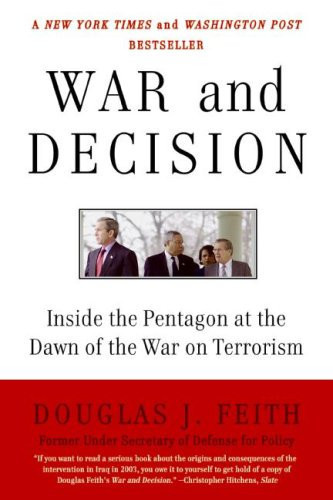
War and decision: inside the Pentagon at the dawn of the War on Terrorism

Feith, Douglas J.
Of all the players in the planning and evolution of the Bush Administration's war on terrorism, few were more integral--or more controversial--than Douglas Feith, the chief strategist on Donald Rumsfeld's Pentagon policy team. A highly influential international policy analyst for more than a quarter century, Feith worked closely with Rumsfeld, Paul Wolfowitz, Colin Powell, Condoleezza Rice, Vice President Cheney, and President Bush in defining the U.S. response to the attacks of 9/11--from the successful war on Afghanistan to the more challenging invasion of Iraq and its aftermath. Now, in this candid and revealing memoir, Feith--a charter member of the neoconservative movement and an architect of the administration's preventive strategy in the war on terrorism--offers the most in-depth and authoritative account yet of the Pentagon's evolving stance during one of the most controversial eras of American history. Drawing upon a unique trove of documents and records, this extraordinary chronicle will put the reader in the room for scores of previously unreported senior-level meetings, showing how hundreds of critical decisions were made in defense of American interests during and after the crisis of 9/11--decisions both successful and controversial. Where journalists like Bob Woodward could only speculate, Feith is the first inside player to reveal the inner workings of the Pentagon, at a time when history hung in the balance.--From publisher description.
HarperCollins 2009-02-03 674 pages