520 results for "History"

The Only Language They Understand Forcing Compromise in Israel and Palestine

Nathan Thrall
In a myth-busting analysis of the world's most intractable conflict, a star of Middle East reporting, "one of the most important writers" in the field ( The New York Times ), argues that only one weapon has yielded progress: force. Scattered over the territory between the Jordan River and the Mediterranean Sea lie the remnants of failed peace proposals, international summits, secret negotiations, UN resolutions, and state-building efforts. The conventional story is that these well-meaning attempts at peacemaking were repeatedly, perhaps terminally, thwarted by violence. Through a rich interweaving of reportage, historical narrative, and powerful analysis, Nathan Thrall presents a startling counter-history. He shows that force—including but not limited to violence—has impelled each side to make its largest concessions, from Palestinian acceptance of a two-state solution to Israeli territorial withdrawals. This simple fact has been neglected by the world powers, which have expended countless resources on initiatives meant to diminish friction between the parties. By quashing any hint of confrontation, promising an imminent negotiated solution, facilitating security cooperation, developing the institutions of a still unborn Palestinian state, and providing bounteous economic and military assistance, the United States and Europe have merely entrenched the conflict by lessening the incentives to end it. Thrall’s important book upends the beliefs steering these failed policies, revealing how the aversion of pain, not the promise of peace, has driven compromise for Israelis and Palestinians alike. Published as Israel's occupation of East Jerusalem, the West Bank, and Gaza reaches its fiftieth anniversary, which is also the centenary of the Balfour Declaration that first promised a Jewish national home in Palestine, The Only Language They Understand advances a bold thesis that shatters ingrained positions of both left and right and provides a new and eye-opening understanding of this most vexed of lands.
Henry Holt and Company 2018-05-15 336 pages

Lenin's Tomb

David, Remnick
Remnick es el mejor periodista de su generación, y "La tumba de Lenin" es el libro que le consagró y con el que obtuvo el Premio Pulitzer. Inédito en España y con un nuevo prefacio para conmemorar los veinte años de la caída de la Unión Soviética, es un clásico del periodismo y una de las obras fundamentales sobre ese periodo histórico, clave para entender el mundo de hoy.Corresponsal en Moscú del Washington Post desde 1988 hasta 1992, Remnick fue un testigo del hundimiento de la Unión Soviética. A partir de sus viajes por el país y sus conversaciones con ciudadanos soviéticos de todos los niveles de la sociedad, logra reflejar el impacto histórico de ese momento. Una obra maestra del mejor periodismo narrativo.
Imprint unknown 1993

The coming of post-industrial society: a venture in social forecasting

Bell, Daniel
In 1976, Daniel Bell€™s historical work predicted a vastly different society developing—one that will rely on the “economics of information€ rather than the “economics of goods.€ Bell argued that the new society would not displace the older one but rather overlie some of the previous layers just as the industrial society did not completely eradicate the agrarian sectors of our society. The post-industrial society€™s dimensions would include the spread of a knowledge class, the change from goods to services and the role of women. All of these would be dependent on the expansion of services in the economic sector and an increasing dependence on science as the means of innovating and organizing technological change.Bell prophetically stated in The Coming of the Post-Industrial Society that we should expect “ new premises and new powers, new constraints and new questions—with the difference that these are now on a scale that had
Basic Books 1973-07-12 507 pages

Walking the Bible: a photographic journey

Feiler, Bruce
Its stories may be the best known in the world, but its locations have long been a mystery. Where did Noah's ark land? Where did Moses receive the Ten Commandments? Where are the lost cities of Sodom and Gomorrah? Now, inWalking the Bible: A Photographic Journey, New York Times bestselling author Bruce Feiler offers an unprecedented heart-stirring adventure through the landscape of some of history's most storied events. Featuring Bruce Feiler's own photography as well as his selections from professional collections,Walking the Bible: A Photographic Journey brings together breathtaking vistas, intimate portraits, and fascinating panoramas, providing firsthand access to the inscrutable land where three of the world's great religions were born—and finally puts a face on the stories that have long inspired the human spirit. Over several years, Feiler traveled nearly ten thousand miles through the deserts of the Middle East, which led first to his runaway national bestseller Walking the Bible. This new illustrated book follows his route, offering a thrilling photographic voyage through the actual places of some of the Bible's most memorable events—from the heights of Mount Ararat, where Noah's ark landed, to the desert outpost in Turkey, where Abraham first heard the words of God, to the summit where Moses overlooked the Promised Land. Walking the Bible: A Photographic Journey chronicles a landscape that nurtured the relationship between humans and the divine, breathing new meaning into stories that have been a timeless source of inspiration.
William Morrow 2005-10-25 154 pages

100 people who are screwing up America

Goldberg, Bernard
The number one New York Times bestselling author of Bias delivers another bombshell—this time aimed at . . . 100 People Who Are Screwing Up America No preaching. No pontificating. Just some uncommon sense about the things that have made this country great—and the culprits who are screwing it up. Bernard Goldberg takes dead aim at the America Bashers (the cultural elites who look down their snobby noses at "ordinary" Americans) . . . the Hollywood Blowhards (incredibly ditzy celebrities who think they're smart just because they're famous) . . . the TV Schlockmeisters (including the one whose show has been compared to a churning mass of maggots devouring rotten meat) . . . the Intellectual Thugs (bigwigs at some of our best colleges, whose views run the gamut from left wing to far left wing) . . . and many more. Goldberg names names, counting down the villains in his rogues' gallery from 100 all the way to 1—and, yes, you-know-who is number 37. Some supposedly "serious" journalists also made the list, including the journalist-diva who sold out her integrity and hosted one of the dumbest hours in the history of network television news. And there are those famous miscreants who have made America a nastier place than it ought to be—a far more selfish, vulgar, and cynical place. But Goldberg doesn't just round up the usual suspects we have come to know and detest. He also exposes some of the people who operate away from the limelight but still manage to pull a lot of strings and do all sorts of harm to our culture. Most of all, 100 People Who Are Screwing Up America is about a country where as long as anything goes, as one of the good guys in the book puts it, sooner or later everything will go. This is serious stuff for sure. But Goldberg will also make you laugh as he harpoons scoundrels like the congresswoman who thinks there aren't enough hurricanes named after black people, and the environmentalist to the stars who yells at total strangers driving SUVs—even though she tools around the country in a gas-guzzling private jet. With Bias, Bernard Goldberg took us behind the scenes and exposed the way Big Journalism distorts the news. Now he has written a book that goes even further. This time he casts his eye on American culture at large—and the result is a book that is sure to become the voice of all those Americans who feel that no one is speaking for them on perhaps the most vital issue of all: the kind of country in which we want to live.
HarperCollins 2005-07-05 305 pages

What this comedian said will shock you

Maher, Bill
The hilarious and controversial host of HBO’s Real Time with Bill Maher has written his funniest, most opinionated, and most necessary book ever—a brilliantly astute and acerbically funny vivisection of American life, politics, and culture. Some of the smartest commentary about what’s happening in America is coming from a comedian—this comedian being Bill Maher. If you want to understand what’s wrong with this country, it turns out that one of the best informed and most thought-provoking analysts is this very funny pothead. The book was inspired by the “editorial” Bill delivers at the end of each episode of Real Time. These editorials are direct-to-camera sermons about culture, politics, and what’s happening in the world. To put this book together, Maher reviewed more than a decade of his editorials, rewriting, reimagining, and updating them, and adding new material to speak exactly to the moment we’re in. Free speech, cops, drugs, race, religion, the generations, cancel culture, the parties, the media, show biz, romance, health—Maher covers it all. The result is a hugely entertaining work of commentary about American culture in the tradition of Mark Twain, Will Rogers, and H. L. Mencken.
Simon & Schuster 2024-05-21 378 pages

Language City The Fight to Preserve Endangered Mother Tongues in New York

Ross Perlin
From the co-director of the Endangered Language Alliance, a captivating portrait of contemporary New York City through six speakers of little-known and overlooked languages, diving into the incredible history of the most linguistically diverse place ever to have existed on the planet Half of all 7,000-plus human languages may disappear over the next century and--because many have never been recorded--when they're gone, it will be forever. Ross Perlin, a linguist and co-director of the Manhattan-based non-profit Endangered Language Alliance, is racing against time to map little-known languages across the most linguistically diverse city in history: contemporary New York. In Language City , Perlin recounts the unique history of immigration that shaped the city, and follows six remarkable yet ordinary speakers of endangered languages deep into their communities to learn how they are maintaining and reviving their languages against overwhelming odds. Perlin also dives deep into their languages, taking us on a fascinating tour of unusual grammars, rare sounds, and powerful cultural histories from all around the world. Seke is spoken by 700 people from five ancestral villages in Nepal, a hundred of whom have lived in a single Brooklyn apartment building. N'ko is a radical new West African writing system now going global in Harlem and the Bronx. After centuries of colonization and displacement, Lenape, the city's original Indigenous language and the source of the name Manhattan ("the place where we get bows"), has just one fluent native speaker, bolstered by a small band of revivalists. Also profiled in the book are speakers of the Indigenous Mexican language Nahuatl, the Central Asian minority language Wakhi, and the former lingua franca of the Lower East Side, Yiddish. A century after the anti-immigration Johnson-Reed Act closed America's doors for decades and on the 400th anniversary of New York's colonial founding, Perlin raises the alarm about growing political threats and the onslaught of "killer languages" like English and Spanish. Both remarkable social history and testament to the importance of linguistic diversity, Language City is a joyful and illuminating exploration of a city and the world that made it.
Grove/Atlantic, Incorporated 2025-02-11 432 pages

The human use of human beings: cybernetics and society

Wiener, Norbert
"In 1950, mathematician-philosopher Norbert Wiener ended this classic book on the place of machines in society with a warning: "We shall never receive the right answers to our questions unless we ask the right questions.... The hour is very late, and the choice of good and evil knocks at our door." Wiener, the founder of the science of cybernetics--the study of the relationship between computers and the human nervous system--was widely mislabeled as an advocate for the automation of human life. As The Human Use for Human Beings reveals, his vision was much more complex and interesting, and is more relevant in today's world of AI than anyone could have anticipated. In his new introduction, Brian Christian aptly calls Wiener the "progenitor of contemporary AI-safety discourse." Wiener hoped that machines would release people from relentless and repetitive drudgery to achieve more creative pursuits, yet he anticipated the danger of dehumanizing and displacement. His pioneering views on the human-machine relationship as a "communicative process" are only more crucial now, as we carry in our pockets AI devices that we can literally speak to. His prescient warnings illuminate our contemporary relationships with language, art, and even social media. The Human Use of Human Beings examines the implications of cybernetics for education, law, language, science, technology, as Wiener anticipates the enormous impact--in effect, a third industrial revolution--that the computer has had on our lives."-- Provided by publisher
Mariner Classics 2025-08-12 240 pages

The three trillion dollar war: the true cost of the Iraq conflict

Stiglitz, Joseph E.
The true cost of the Iraq War is $3 trillion rather than the $50 billion projected by the White House. Apart from its tragic human toll, the Iraq War will be staggeringly expensive in financial terms. This sobering study by Nobel Prize winner Joseph E. Stiglitz and Harvard professor Linda J. Bilmes casts a spotlight on expense items that have been hidden from the U.S. taxpayer, including not only big-ticket items like replacing military equipment (being used up at six times the peacetime rate) but also the cost of caring for thousands of wounded veterans for the rest of their lives. Shifting to a global focus, the authors investigate the cost in lives and economic damage within Iraq and the region. Finally, with the chilling precision of an actuary, the authors measure what the U.S. taxpayer's money would have produced if instead it had been invested in the further growth of the U.S. economy. Written in language as simple as the details are disturbing, this book will forever change the way we think about the war.
W.W. Norton 2008-02-17 311 pages

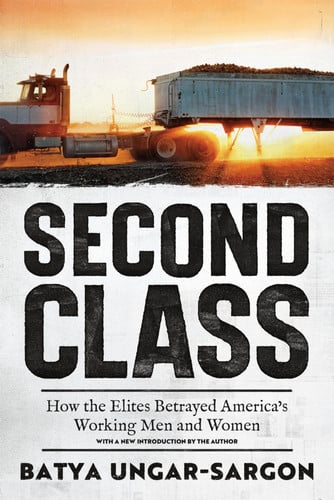
Second class: how the elite betrayed America's working men and women

Ungar-Sargon, Batya
A personal, journalistic ethnography of the modern American working class, based on the travels and interactions of the author through the American heartland. " Second Class is the most important book you will read all year. A political realignment is coming, and it's my hope that the end result will work in favor of our all-too-neglected American working class. When that realignment comes, Batya and her book will help lead the way." --Greg Lukianoff, CEO of the Foundation for Individual Rights in Education, and co-author of The Coddling of the American Mind Who is the American working class? Do they still have a fair shot at the American Dream? What do they think about their chances to secure the hallmarks of a middle-class life? While writing this book, Batya Ungar-Sargon visited states across the nation to speak with members of the American working class who are fighting tooth and nail to survive. In Second Class , working-class Americans of all races, political orientations, and occupations share their stories--cleaning ladies, health care aides, cops, truck drivers, fast food workers, electricians, and more. In their own words, these working-class Americans explain the struggles and triumphs of their increasingly precarious lives--as well as what policies they think would improve them. Second Class combines deep reporting with a look at the data and expert opinions on America's emergent class divide, in which the most basic elements of a secure and stable life are increasingly out of reach for those without a college education. America has broken its contract with its laboring class. So, how do we get back to the American Dream? How do we once again become the land of opportunity, the promised land, where hard work and commitment to family are enough to protect you from poverty? It's not that hard actually. All it would take, as this book illustrates, is for those in power to once again respect the dignity of work--and the American worker.
Encounter Books 2025 248 pages

Stone age economics

Sahlins, Marshall David
Stone Age Economics is a classic study of anthropological economics, first published in 1974. As Marshall Sahlins stated in the first edition, "It has been inspired by the possibility of 'anthropological economics,' a perspective indebted rather to the nature of the primitive economies than to the categories of a bourgeois science." Ambitiously tackling the nature of economic life and how to study it comparatively, the book includes six studies which reflect the author's ideas on revising traditional views of the hunter-gatherer and so-called primitive societies, revealing them to be the original affluent society. The book examines notions of production, distribution and exchange in early communities and examines the link between economics and cultural and social factors. It consists of a set of detailed and closely related studies of tribal economies, of domestic production for livelihood, and of the submission of domestic production to the material and political demands of society at large. Marshall Sahlins is one of the most prominent American anthropologists of our time. He holds the title of Charles F. Grey Distinguished Service Professor of Anthropology at the University of Chicago. His most recent book is How Natives Think: About Captain Cook, for Example.
Transaction Publishers 2011 348 pages

The spirit of green: the economics of collisions and contagions in a crowded world

Nordhaus, William D.
"From a Nobel Prize-winning pioneer in environmental economics, an innovative account of how and why "green thinking" could cure many of the world's most serious problems-from global warming to pandemics Solving the world's biggest problems-from climate catastrophe and pandemics to wildfires and corporate malfeasance-requires, more than anything else, coming up with new ways to manage the powerful interactions that surround us. For carbon emissions and other environmental damage, this means ensuring that those responsible pay their full costs rather than continuing to pass them along to others, including future generations. In The Spirit of Green, Nobel Prize-winning economist William Nordhaus describes a new way of green thinking that would help us overcome our biggest challenges without sacrificing economic prosperity, in large part by accounting for the spillover costs of economic collisions. In a discussion that ranges from the history of the environmental movement to the Green New Deal, Nordhaus explains how the spirit of green thinking provides a compelling and hopeful new perspective on modern life. At the heart of green thinking is a recognition that the globalized world is shaped not by isolated individuals but rather by innumerable interactions inside and outside the economy. He shows how rethinking economic efficiency, sustainability, politics, profits, taxes, individual ethics, corporate social responsibility, finance, and more would improve the effectiveness and equity of our society. And he offers specific solutions-on how to price carbon, how to pursue low-carbon technologies, how to design an efficient tax system, and how to foster international cooperation through climate clubs. The result is a groundbreaking new vision of how we can have our environment and our economy too"--
Princeton University Press 2021-05-18 355 pages

Decolonising my body: a radical exploration of rituals and beauty

Hirsch, Afua
A 2023 POLITICAL BOOK OF THE YEAR (WATERSTONES) 'GROUND-BREAKING' Bernardine Evaristo ' UNIVERSAL AND TIMELY ' Elif Shafak ' IMPORTANT' Sathnam Sanghera ' A GENEROUS OFFERING ' Nana Darkoa Sekiyamah ' QUIETLY RADICAL' Evening Standard ' INTIMATE ' Guardian 'I LEARNT A LOT' Gillian Anderson What can ancestral practices teach us about how to live fuller lives today? Upon turning forty, Afua Hirsch had an encounter that forever altered her preconceived notions of ancestry and body image, making her question everything from body-modification rituals such as tattoos and piercings to the foundations of sexuality, as well as attitudes towards puberty, ageing and death. This book charts her year-long journey of radical unlearning. Bringing together global scholarship, on-the-ground reportage, personal anecdotes and interviews with beauty experts, practitioners and service users, she reassesses notions of body image beyond those of the colonial, patriarchal gaze. Decolonising My Body is a powerful excavation of the Eurocentric beauty standards that have long shaped how, in particular, those from the Global Majority are perceived and view themselves. Taking us from puberty to end-of-life, Hirsch shows us that the ways in which we adorn and present ourselves have spiritual implications and shape the possibilities we see for ourselves in the world. These insights and discoveries will empower you to reconnect with your own ancestry, better understand the link between beauty, history and (respectability) politics, and liberate yourself from mainstream standards and systems that aren't serving you. *Co-host of the LOYALTY podcast with Peter Frankopan*
Vintage 2025 240 pages

In the time of the nations

Lévinas, Emmanuel
The 'nations' of the title are the 'seventy nations': in the Talmudic idiom, the whole of humanity surrounding Israel. In this major collection of essays, Levinas considers Judaism's uncertain relationship to European culture since the Enlightenment, problems of distance and integration. It also includes five Talmudic readings from between 1981 and 1986, essays on Franz Rosenzweig and Moses Mendelssohn, and a discussion with Francoise Armengaud which raises questions of central importance to Jewish philosophy in the context of general philosophy. This work brings to the fore the vital encounter between philosophy and Judaism, a hallmark of Levinas's thought.
Indiana University Press 1994-01-08 197 pages

Motherland: a feminist history of modern Russia, from revolution to autocracy

Ioffe, Julia
"Award-winning journalist Julia Ioffe tells the story of modern Russia through the history of its women, from revolution to utopia to autocracy. In 1990, seven-year-old Julia Ioffe and her family fled the Soviet Union. Nearly twenty years later, Ioffe returned to Moscow-only to discover just how much Russian society had changed while she had been living in America. The Soviet women she had known growing up-doctors, engineers, scientists-had seemingly been replaced with women desperate to marry rich and become stay-at-home moms. How had Russia gone from portraying itself as the vanguard of world feminism to the last bastion of conservative Christian values? In Motherland, Ioffe turns modern Russian history on its head, telling it exclusively through the stories of its women. From her own physician great-grandmothers to Lenin's lover, a feminist revolutionary; from the hundreds of thousands of Soviet girls who fought in World War II to the millions of single mothers who rebuilt and repopulated a devastated country; from the members of Pussy Riot to Yulia Navalnaya, wife of opposition leader Alexei Navalny, she chronicles one of the most audacious social experiments in history and how it failed the very women it was meant to liberate-and documents how that failure paved the way to the revanche of Vladimir Putin. Part memoir, part journalistic exploration, part history, Motherland paints a portrait of modern Russia through the women who shaped it. With deep emotion, Ioffe shows what it means to live through the cataclysms of revolution, war, idealism, and heartbreak-and reveals how the story of Russia today is inextricably tied to the history of its women"-- Provided by publisher.
Ecco, an imprint of Harper Collins Publishers 2025-10 489 pages