90 results for "History"

A boy from Georgia: coming of age in the segregated South

Jordan, Hamilton
When Hamilton Jordan died of peritoneal mesothelioma in 2008, he left behind a mostly finished memoir, a book on which he had been working for the last decade. Jordan's daughter, Kathleen - with the help of her brothers and mother - took up the task of editing and completing the book. A Boy from Georgia - the result of this posthumous father-daughter collaboration - chronicles Hamilton Jordan's childhood in Albany, Georgia, charting his moral and intellectual development as he gradually discovers the complicated legacies of racism, religious intolerance, and southern politics, and affords his readers an intimate view of the state's wheelers and dealers. Jordan's middle-class childhood was bucolic in some ways and traumatizing in others. As Georgia politicians battled civil rights leaders, a young Hamilton straddled the uncomfortable line between the southern establishment to which he belonged and the movement in which he believed. Fortunate enough to grow up in a family that had considerable political clout within Georgia, Jordan went into politics to put his ideals to work. Eventually he became a key aide to Jimmy Carter and was the architect of Carter's stunning victory in the presidential campaign of 1976; Jordan later served as Carter's chief of staff. Clear eyed about the triumphs and tragedies of Jordan's beloved home state and region, A Boy from Georgia tells the childhood story of a remarkable life in a voice that is witty, vivid, and honest. -- from dust jacket.
University of Georgia Press 2015 228 pages

Violation: justice, race and serial murder in the Deep South

Rose, David
Columbus, Georgia, has been run by the same tiny clique for over 100 years - the members of the all-white Big Eddy Club. This is the story of a fascinating and rotten community whose victims pay the ultimate price. Over eight terrifying months in the 1970s, seven elderly women were raped and murdered in Columbus, Georgia, a city of 200,000 people whose history and conservative values are typical of America's Deep South. The victims, who were strangled in their beds with their own stockings, were affluent and white, while the police believed from an early stage that the killer was black. In 1986, eight years after the last murder, an African-American, Carlton Gary, was convicted and sentenced to death. Though many in Columbus doubt his guilt, he is still on death row. Award-winning reporter David Rose has followed this case for almost a decade, while Gary and his lawyers have fought his legal appeals. He has uncovered important fresh evidence that was hidden from Gary's trial and that suggests that he is innocent, including a cast of the killer's teeth, made from a savage bite wound in the last victim's breast. However, as Rose's investigation proceeded, he came to realise that the dark saga of the Columbus stocking stranglings only makes sense against the background of the city's bloodstained history of racism, lynching and unsolved, politically motivated murder. 'Violation' is a tense and gripping drama, its pages filled with evocatively drawn characters, insidious institutions and the extraordinary connections that bind the past and present. A unique mélange of investigative journalism, true crime mystery, personal travelogue and historical scoop, the book is also a compelling, accessible and timely exploration of America's approach to race and criminal justice, addressing the corruption of legal due process as a tool of racial oppression.
Harper Perennial 2008 352 pages

Redemption: the last battle of the Civil War

Lemann, Nicholas
A century after Appomattox, the civil rights movement won full citizenship for black Americans in the South. It should not have been necessary: by 1870 those rights were set in the Constitution. This is the story of the terrorist campaign that took them away. Nicholas Lemann opens his extraordinary new book with a riveting account of the horrific events of Easter 1873 in Colfax, Louisiana, where a white militia of Confederate veterans-turned-vigilantes attacked the black community there and massacred hundreds of people in a gruesome killing spree. This was the start of an insurgency that changed the course of American history: for the next few years white Southern Democrats waged a campaign of political terrorism aiming to overturn the Fourteenth and Fifteenth Amendments and challenge President Grant'ssupport for the emergent structures of black political power. The remorseless strategy of well-financed "White Line" organizations was to create chaos and keep blacks from voting out of fear for their lives and livelihoods. "Redemption" is the first book to describe in uncompromising detail this organized racial violence, which reached its apogee in Mississippi in 1875. Lemann bases his devastating account on a wealth of military records, congressional investigations, memoirs, press reports, and the invaluable papers of Adelbert Ames, the war hero from Maine who was Mississippi's governor at the time. When Ames pleaded with Grant for federal troops who could thwart the white terrorists violently disrupting Republican political activities, Grant wavered, and the result was a bloody, corrupt election in which Mississippi was "redeemed"--that is, returned to white control. """Redemption "makes clear that this is what led to the death of Reconstruction--and of the rights encoded in the Fourteenth and Fifteenth Amendments. We are still living with the consequences.
Farrar, Straus and Giroux 2006 257 pages

For all the world to see: visual culture and the struggle for civil rights

Berger, Maurice
In 1955, shortly after Emmett Till was murdered by white supremacists in Mississippi, his grieving mother distributed to the press a gruesome photograph of his mutilated corpse. Asked why she would do this, she explained that by witnessing with their own eyes the brutality of segregation and racism, Americans would be more likely to support the cause of racial justice. "Let the world see what I've seen," was her reply. The publication of the photograph inspired a generation of activists to join the civil rights movement. Despite this extraordinary episode, the story of visual culture's role in the modern civil rights movement is rarely included in its history. This is the first comprehensive examination of the ways images mattered in the struggle, and it investigates a broad range of media including photography, television, film, magazines, newspapers, and advertising. These images were ever present and diverse: the startling footage of southern white aggression and black suffering that appeared night after night on television news programs; the photographs of black achievers and martyrs in Negro periodicals; the humble snapshot, no less powerful in its ability to edify and motivate. In each case, the war against racism was waged through pictures, millions of points of light, millions of potent weapons that forever changed a nation. This book allows us to see and understand the crucial role that visual culture played in forever changing a nation.
Yale University Press 2010-04-20 207 pages

Race and slavery in the Middle East: an historical enquiry

Lewis, Bernard
From before the days of Moses up through the 1960s, slavery was a fact of life in the Middle East. Pagans, Jews, Christians, and Muslims bought and sold at the slave markets for millennia, trading the human plunder of wars and slave raids that reached from the Russian steppes to the African jungles. But if the Middle East was one of the last regions to renounce slavery, how do we account for its--and especially Islam's--image of racial harmony? How did these long years of slavery affect racial relations? In Race and Slavery in the Middle East, Bernard Lewis explores these questions and others, examining the history of slavery in law, social thought, and practice over the last two millennia. With 24 rare and intriguing full-color illustrations, this fascinating study describes the Middle East's culture of slavery and the evolution of racial prejudice. Lewis demonstrates how nineteenth century Europeans mythologized the region as a racial utopia in debating American slavery. Islam, in fact, clearly teaches non-discrimination, but Lewis shows that prejudice often won out over pious sentiments, as he examines how Africans were treated, depicted, and thought of from antiquity to the twentieth century. "If my color were pink, women would love me/But the Lord has marred me with blackness," lamented a black slave poet in Arabia over a millennium ago--and Lewis deftly draws from these lines and others the nuances of racial relations over time. Islam, he finds, restricted enslavement and greatly improved the lot of slaves--who included, until the early twentieth century, some whites--while blacks occasionally rose to power and renown. But abuses ring throughout the written and visual record, from the horrors of capture to the castration and high mortality which, along with other causes, have left few blacks in many Middle Eastern lands, despite centuries of importing African slaves. Race and Slavery in the Middle East illuminates the legacy of slavery in the region where it lasted longest, from the days of warrior slaves and palace eunuchs and concubines to the final drive for abolition. Illustrated with outstanding reproductions of striking artwork, it casts a new light on this critical part of the world, and on the nature and interrelation of slavery and racial prejudice.
Oxford University Press 1990-08-02 184 pages

Mixing races: from scientific racism to modern evolutionary ideas

Farber, Paul Lawrence
This book explores changing American views of race mixing in the twentieth century, showing how new scientific ideas transformed accepted notions of race and how those ideas played out on college campuses in the 1960s. In the 1930s, it was not unusual for medical experts to caution against miscegenation, or race mixing, espousing the common opinion that it would produce biologically dysfunctional offspring. By the 1960s the scientific community roundly refuted this theory. The author traces this revolutionary shift in scientific thought, explaining how developments in modern population biology, genetics, and anthropology proved that opposition to race mixing was a social prejudice with no justification in scientific knowledge. In the 1960s, this new knowledge helped to change attitudes towards race and discrimination, especially among college students. Their embrace of social integration caused tension on campuses across the country. Students rebelled against administrative interference in their private lives, and university regulations against interracial dating became a flashpoint in the campus revolts that revolutionized American educational institutions. The author's provocative study is a personal one, featuring interviews with mixed-race couples and stories from the author's student years at the University of Pittsburgh. As such, this book offers a unique perspective on how contentious debates taking place on college campuses reflected shifts in race relations in the larger society. -- from Back Cover
Johns Hopkins University Press 2011-02-01 120 pages

Race and mixed race

Zack, Naomi
Race and Mixed Race is an exploration of the philosophical, social, and historical problems related to racial identity - from the perspectives of individuals of "pure" and mixed race. Tracing the history of racial designations in the United States, Naomi Zack uses philosophical methods to criticize the logic of American racial categories. She discusses why racial identity is a matter of importance; examines the treatment of mixed race in law, society, and literature; and addresses philosophical questions related to the designation of someone as belonging to a given race. In this first philosophical challenge to accepted racial classifications in the United States, Zack argues that black and white designations are themselves racist because the concept of race does not have an adequate scientific foundation. The "one drop" rule, which originally was a rationalization for slavery, persists to this day despite the fact that there have never been "pure" races and that most American blacks have "white" genes. Challenging the equation that black plus white always results in black, the author explores the existential problems of mixed race identity. The stringent bi-racial system in this country does not recognize mixed racial heritage, which generates a special racial alienation for many Americans. Discussing the possibility of eliminating all racial identities for their lack of scientific or moral underpinning, Zack analyzes American racial words to reveal their metaphorical nature. Ironically suggesting the inclusion of "gray" into the vocabulary as a designation for mixed black and white race, she concludes that any racial identity, based as it must be on false and unjust racial identification, is an expression of bad faith.
Temple University Press 1993 215 pages

Racial subjects: writing on race in America

Goldberg, David Theo
Racial Subjects heralds the next wave of writing about race and moves discussions about race forward as few other books recently have. Arguing that racism is best understood as exclusionary relations of power rather than simply as hateful expressions, David Theo Goldberg analyzes contemporary expressions of race and racism. He engages political economy, culture, and everyday material life against a background analysis of profound demographic shifts and changing class formation and relations. Issues covered in Racial Subjects include the history of changing racial categories over the last two hundred years of U.S. census taking, multiculturalism, the experience of being racially mixed, the rise of new black public intellectuals, race and the law in the wake of the O. J. Simpson verdict, relations between blacks and Jews, and affirmative action.
Routledge 1997 259 pages

The rediscovery of Black nationalism

Draper, Theodore
"For many citizens, black nationalist movements appear to be insurgent forces without precedent in American history. In this provocative analysis, Theodore Draper shows that, on the contrary, they have been with us since the founding of the republic. Mr. Draper traces the complicated and often tragic development of black nationalist themes from their realy beginnings to provide an authoritative and fair-minded account of America's most intransigent political problem"--Back cover.
Viking Press 1970-06-23 211 pages

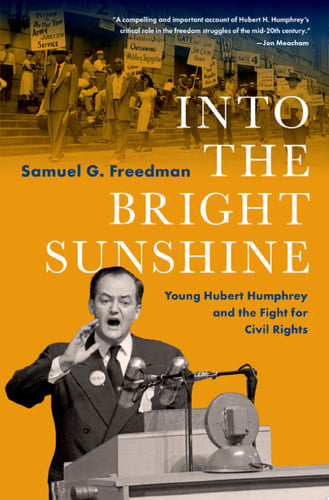
Into the bright sunshine: young Hubert Humphrey and the fight for civil rights

Freedman, Samuel G.
"Hubert Humphrey, a fallen hero and a dying man, rose on rickety legs to approach the podium of the Philadelphia Convention Hall, his pulpit for the commencement address at the University of Pennsylvania. He clutched a sheaf of paper with his speech for the occasion, typed and double-spaced by an assistant from his extemporaneous dictation, and then marked up in pencil by Humphrey himself. A note on the first page, circled to draw particular attention, read simply, "30 years ago--Here." In this place, at that time, twenty-nine years earlier to be precise, he had made history. From the dais now, Humphrey beheld five thousand impending graduates, an ebony sea of gowns and mortarboards, broken by one iconoclast in a homemade crown, two in ribboned bonnets, and another whose headgear bore the masking-tape message HI MA PA. In the horseshoe curve of the arena's double balcony loomed eight thousand parents and siblings, children, and friends. Wearing shirtsleeves and cotton shifts amid the stale heat, they looked like pale confetti from where Humphrey stood, and their flash cameras flickered away, a constellation of pinpricks"--
Oxford University Press 2023 488 pages

Race, space, and riots in Chicago, New York, and Los Angeles

Abu-Lughod, Janet L.
"This study is the first attempt to compare six major race riots that occurred in the three largest American urban areas during the course of the twentieth century: in Chicago in 1919 and 1968; in New York in 1935/1943 and 1964; and in Los Angeles in 1965 and 1992. Race, Space, and Riots in Chicago, New York, and Los Angeles weaves together detailed narratives of each riot, placing them in their changing historical contexts and showing how urban space, political regimes, and economic conditions - not simply an abstract "race conflict"--Have structured the nature and extent of urban rebellions. Building on her previous comparative history of these three cities, Janet Abu-Lughod draws upon archival research, primary sources, case studies, and personal observations to reconstruct events - especially for the 1964 Harlem-Bedford Stuyvesant uprising and Chicago's 1968 riots where no documented studies are available. By focusing on the similarities and differences in each city, identifying the unique and persisting issues, and evaluating the ways political leaders, law enforcement, and the local political culture have either defused or exacerbated urban violence, this book points the way toward alleviating long-standing ethnic and racial tensions." "Race, Space, and Riots In Chicago, New York, and Los Angeles offers a deeper understanding of past - and future - urban race relations while emphasizing that until persistent racial and economic inequalities are meaningfully resolved, the tensions leading to racial violence will continue to exist in America's cities and betray our professed democratic values"--OCLC
Oxford University Press 2007-01 344 pages

White boy: a memoir

Naison, Mark
How does a Jewish boy who spent the bulk of his childhood on the basketball courts of Brooklyn wind up teaching in one of the city's pioneering black studies departments? Naison's odyssey begins as Brooklyn public schools respond to a new wave of Black migrants and Caribbean immigrants, and established residents flee to virtually all-white parts of the city or suburbs. Already alienated by his parents' stance on race issues and their ambitions for him, he has started on a separate ideological path by the time he enters Columbia College. Once he embarks on a long-term interracial relationship, becomes a member of SDS, focuses his historical work on black activists, and organizes community groups in the Bronx, his immersion in the radical politics of the 1960s has emerged as the center of his life. Determined to keep his ties to the Black community, even when the New Left splits along racial lines, Naison joined the fledgling African American studies program at Fordham, remarkable then as now for its commitment to interracial education.This memoir offers more than a participant's account of the New Left's racial dynamics; it eloquently speaks to the ways in which political commitments emerge from and are infused with the personal choices we all make.
Temple University Press 2002-03-08 225 pages

A legacy of liberation: Thabo Mbeki and the future of the South African dream

Gevisser, Mark
In this gripping social history of South Africa, award-winning journalist Mark Gevisser follows the family of former South African President Thabo Mbeki to make sense of his legacy and understand the future of the country under new President Jacob Zuma. With unparalleled access to Mbeki and Zuma, as well as other key players in the ANC, Gevisser presents an intimate yet accessible account of South Africa's past, present and future. With his stunning account of the Mbeki family's history as a backdrop, Gevisser fleshes out a monumental period in world history that will continue to shape African politics for years to come.
Palgrave Macmillan 2010-06-08 376 pages

Dangerous liaisons: gender, nation, and postcolonial perspectives

Anne McClintock,Aamir Mufti,Ella Shohat
The first collection to emphasize the complex interaction between gender and postcoloniality. Most people in the world, from Africa to Asia and beyond, live in the aftermath of colonialism. Their day-to-day lives are defined by their past history as colonized peoples, often in ways that are subtle or hard to define. In Dangerous Liaisons, eminent contributors address the issues raised by the postcolonial condition, considering nationhood, history, gender, and identity from an inter-disciplinary perspective. Among the questions they address are: What are the boundaries of race and ethnicity in a diasporic world? How have women been so effectively excluded from national power? What have been the historical aftermaths of different forms of colonialism? What are the cultural and political consequences of colonial partitions of the nation-state? Representing an essential intervention, Dangerous Liaisons is a crucial guidebook for those concerned with understanding postcoloniality at the moment when it is becoming more and more widely discussed.
University of Minnesota Press 1997 551 pages

Antisemitism: an American tradition

Nadell, Pamela Susan
"Jews experienced antisemitism the moment they landed on what would become the United States. When they first arrived in New Amsterdam in 1654, Peter Stuyvesant tried but failed to deport them. As historian Pamela S. Nadell tells in Antisemitism, an American Tradition, this was only antisemitism's beginning on our shores, as negative European stereotypes about Jews rooted into American soil. Compared with the Old World, with its expulsions, Inquisitions, ghettos, and Holocaust, America's Jews have a different history -- but one where antisemitism, even if it has had fewer dramatic eruptions, is deeply embedded. Jews in America faced restrictions on holding office and getting financial credit. Universities set quotas to limit the number of Jews attending and businesses refused to hire them. Jews endured verbal and physical attacks, and their synagogues and cemeteries, continuing to this day, were vandalized and desecrated. Antisemitism, an American Tradition investigates the depths of this fraught history and its recent manifestations: white nationalists chanting "Jews will not replace us" in Charlottesville, Virginia, and a gunman murdering eleven worshipers of Pittsburgh's Tree of Life synagogue building. Nadell also shows Jews responding to prejudice and hate. America's Jews created advocacy organizations. They turned to the courts to safeguard their constitutional rights. They made common cause with allies to confront all types of hate. They even used their fists when needed. At a time when prejudice, discrimination, and hate against Jews is flaring across the country, Antisemitism, an American Tradition argues that we must understand the past. This momentous work reveals how antisemitism -- and resistance to that hatred -- endures, representing not a rupture from America's history, but a centuries-old legacy." -- Book jacket.
W. W. Norton & Company 2025-10-14 332 pages