192 results for "History"

Reflections on gender and science

Keller, Evelyn Fox
Why are objectivity and reason characterized as male and subjectively and feeling as female? How does this characterization affect the goals and methods of scientific enquiry? This groundbreaking work explores the possibilities of a gender-free science and the conditions that could make such a possibility a reality. "Keller’s book opens up a whole new range of ideas for anyone who cares to think about the history of science, that is, the history of the modern world. . . Let us be glad to be in times when such a sparkling, innovative. . . book can be produced, a book to start all of us thinking in new directions.”--Ian Hacking, New Republic "A brilliant and sensitive undertaking that does credit not only to feminist scholarship but, in the end, to science as well.”--Barbara Ehrenreich, Mother Jones "This book represents the expression of a particular feminist perspective made all the more compelling by Keller’s evident commitment to and understanding of science. As a lively and important contribution to the scholarship of science, it will undoubtedly stimulate argument and controversy.”--Helen Longino, Texas Humanist "Provocative arguments, presented with authority.”-- Kirkus Reviews "Consistently thoughtful, provocative, and interconnected. . . A well-made book that will be useful in upper-level undergraduate and graduate women’s studies, philosophy, and history of science.”--E.C. Patterson, Choice "Written with grace and clarity, [this book] will stand as an important contribution to feminist theory, to the sociology of knowledge and to the continuing critique of the established scientific method.”--Lillian B. Rubin "A powerful book.”--Jessie Bernard
Yale University Press 1985 193 pages

Debating Darwin's Doubt A Scientific Controversy that Can No Longer be Denied

David Klinghoffer
In 2013 Stephen Meyer's book Darwin's Doubt: The Explosive Origin of Animal Life and the Case for Intelligent Design became a national bestseller, provoking a wide-ranging debate about the adequacy of Darwinian theory to explain life's history. In Debating Darwin's Doubt: A Scientific Controversy that Can No Longer Be Denied , leading scholars in the intelligent design community respond to critiques of Meyer's book and show that the core challenge posed by Meyer remains unanswered: Where did the influx of information essential to the creation of new body plans come from? In addition to ten chapters by Stephen Meyer, Debating Darwin's Doubt also includes contributions from biologists Richard Sternberg, Douglas Axe, and Ann Gauger; philosopher of biology Paul Nelson; mathematicians William Dembski and David Berlinski; and Center for Science and Culture research coordinator Casey Luskin. In forty-four chapters, these contributing authors explore topics such as orphan genes, cladistics, small shelly fossils, protein evolution, the length of the Cambrian explosion, the God-of-the-Gaps objection to intelligent design, and criticisms raised by proponents of theistic evolution. Anyone who wants to understand the cutting-edge of current scientific debates over modern Darwinian theory needs to read this book.
Discovery Institute Press 2015 350 pages

Diamond Design A Study of the Reflection and Refraction and Refraction of Light in a Diamond (Classic Reprint)

Marcel Tolkowsky
Excerpt from Diamond Design: A Study of the Reflection and Refraction and Refraction of Light in a Diamond This book is written principally for students of precious stones and jewellers, and more particularly, for' diamond manufacturers and diamond cutters and polishers. The author will follow the evolution of the shape given to a cut diamond, and discuss the values of the various shapes and the reason for' the discarding of the old shapes and the practically universal adoption of the brilliant.' About the Publisher Forgotten Books publishes hundreds of thousands of rare and classic books. Find more at www.forgottenbooks.com This book is a reproduction of an important historical work. Forgotten Books uses state-of-the-art technology to digitally reconstruct the work, preserving the original format whilst repairing imperfections present in the aged copy. In rare cases, an imperfection in the original, such as a blemish or missing page, may be replicated in our edition. We do, however, repair the vast majority of imperfections successfully; any imperfections that remain are intentionally left to preserve the state of such historical works.
LULU Press 2018-04-19 114 pages

All life is problem solving

Popper, Karl R.
'Never before has there been so many and such dreadful weapons in so many irresponsible hands.' - Karl Popper, from the Preface All Life is Problem Solving is a stimulating and provocative selection of Popper's writings on his main preoccupations during the last twenty-five years of his life. This collection illuminates Popper's process of working out key formulations in his theory of science, and indicates his view of the state of the world at the end of the Cold War and after the collapse of communism.
Routledge 1999 171 pages

Science And Human Values

Jacob Bronowski
Science and Human Values is a thought-provoking book by Jacob Bronowski that explores the relationship between science and human values. The author argues that science is not just a collection of facts and theories, but a way of thinking that shapes our understanding of the world and our place in it. He contends that science and human values are intimately connected, and that science has the power to transform our understanding of ourselves and the world around us.The book is divided into five chapters, each of which explores a different aspect of the relationship between science and human values. The first chapter discusses the nature of scientific inquiry and the role of imagination in scientific discovery. The second chapter examines the relationship between science and art, arguing that both are essential to our understanding of the world. The third chapter explores the ethical implications of scientific research, particularly in the areas of genetics and nuclear physics.The fourth chapter examines the role of science in shaping our understanding of human nature, while the final chapter discusses the implications of scientific progress for our future as a species. Throughout the book, Bronowski emphasizes the importance of human values in shaping scientific research and the need for scientists to be mindful of the ethical implications of their work.Overall, Science and Human Values is a thought-provoking and insightful book that challenges readers to think deeply about the relationship between science and human values. It is a must-read for anyone interested in the role of science in our lives and the ethical implications of scientific research.The Impact Of Science On Ethics And Human Values.This scarce antiquarian book is a facsimile reprint of the old original and may contain some imperfections such as library marks and notations. Because we believe this work is culturally important, we have made it available as part of our commitment for protecting, preserving, and promoting the world's literature in affordable, high quality, modern editions, that are true to their original work.
Literary Licensing, LLC 2011-09 98 pages

Time and Free Will

Henri Bergson
"Time and Free Will" is Henri Bergson's doctoral thesis, which was first published in French in 1889. In the work French philosopher Bergson introduces us to his theory of duration, a response to Immanuel Kant's ideas regarding free will as something only possible outside of time and space. Bergson argues that the traditional concept of free will is merely confusion among philosophers caused by an illegitimate translation of the unextended into the extended and a lack of understanding of mechanics. He contends instead that free will is bound to causality and could only be understood in reference to first-person experience and perception. Duration was a way of understanding free will as it referred to each individual person's experience of time, not as a linear mathematical progression, but as something that slows down or speeds up as the person experiences and reflects upon life events. Bergson was one of the most influential philosophers of his day and his ideas, beginning with the publication of "Time and Free Will", profoundly changed the direction of modern European philosophy in the late nineteenth and early twentieth century. This edition is printed on premium acid-free paper and follows the translation of F. L. Pogson.
Digireads.com Publishing 2021-11-28 122 pages

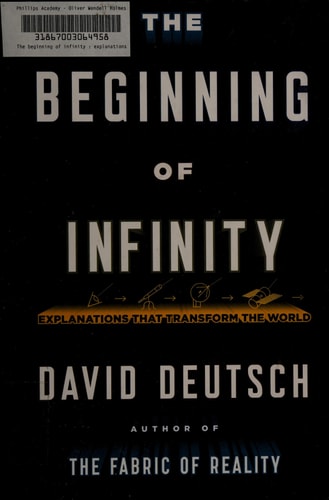
The beginning of infinity: explanations that transform the world

Deutsch, David
"A bold and all-embracing exploration of the nature and progress of knowledge from one of today's great thinkers. Throughout history, mankind has struggled to understand life's mysteries, from the mundane to the seemingly miraculous. In this important new book, David Deutsch, an award-winning pioneer in the field of quantum computation, argues that explanations have a fundamental place in the universe. They have unlimited scope and power to cause change, and the quest to improve them is the basic regulating principle not only of science but of all successful human endeavor. This stream of ever improving explanations has infinite reach, according to Deutsch: we are subject only to the laws of physics, and they impose no upper boundary to what we can eventually understand, control, and achieve. In his previous book, The Fabric of Reality, Deutsch describe the four deepest strands of existing knowledge-the theories of evolution, quantum physics, knowledge, and computation-arguing jointly they reveal a unified fabric of reality. In this new book, he applies that worldview to a wide range of issues and unsolved problems, from creativity and free will to the origin and future of the human species. Filled with startling new conclusions about human choice, optimism, scientific explanation, and the evolution of culture, The Beginning of Infinity is a groundbreaking book that will become a classic of its kind"--
Viking 2011 487 pages

Words of science and the history behind them

Asimov, Isaac
What’s in a word? Did you know that a lens is named for the lentil seed it resembles? That a straight line actually comes from the words stretched linen? or that a hippopotamus is literally a “river horse”? That oxygen means “giving birth to sharpness” because Lavoisier, who named it, mistakenly thought it was in all acids? (And acid, by the way, comes from the Latin word for vinegar). That alcohol is the word for an ancient Arabic cosmetic? That petroleum in Latin is “olive oil from a rock”? That a nucleus is a "little nut” or that deoxyribonucleic acid simply means . . . ? Well, read the book and see. The vocabulary of Science has always been a forbidding one, bristling with many-syllabled words and odd, unfamiliar terms. Now Professor Asimov has opened up this language to the ordinary reader by conducting an informal exploration into the roots and histories of hundreds of scientific terms. The result is a really fascinating book that combines a vast quantity of scientific information with an equal amount of language history. Even the longest tongue-twisters have simple origins if you go back far enough; and Professor Asimov makes each discovery of the origins of a word a sort of detective story that can’t fail to stimulate the reader’s interest. This is a perfect book to dip into again and again. Not only is it entertaining in its own right, but it is also a wonderful introduction to what should become the popular indoor sport of word-chasing. A complete index to the more than 1500 terms covered makes it a unique reference book as well.
Harrap 1974 416 pages

Idea makers: personal perspectives on the lives & ideas of some notable people

Wolfram, Stephen
This book of thoroughly engaging essays from one of today's most prodigious innovators provides a uniquely personal perspective on the lives and achievements of a selection of intriguing figures from the history of science and technology. Weaving together his immersive interest in people and history with insights gathered from his own experiences, Stephen Wolfram gives an ennobling look at some of the individuals whose ideas and creations have helped shape our world today. Contents includes biographical sketches of: Richard Feynman Kurt Godel Alan Turing John von Neumann George Boole Ada Lovelace Gottfried Leibniz Benoit Mandelbrot Steve Jobs Marvin Minsky Russell Towle Bertrand Russell Alfred Whitehead Richard Crandall Srinivasa Ramanujan Solomon Golomb
Wolfram Media, Inc 2016 239 pages

The Jesuit and the Skull Teilhard de Chardin, Evolution, and the Search for Peking Man

Amir Aczel
From the New York Times bestselling author of Fermat?s Last Theorem , ?an extraordinary story?( Philadelphia Inquirer ) of discovery, evolution, science, and faith. In 1929, French Jesuit priest Pierre Teilhard de Chardin was a part of a group of scientists that uncovered a skull that became known as Peking Man, a key evolutionary link that left Teilhard torn between science and his ancient faith, and would leave him ostracized by his beloved Catholic Church. His struggle is at the heart of The Jesuit and the Skull , which takes readers across continents and cultures in a fascinating exploration of one of the twentieth century?s most important discoveries, and one of the world?s most provocative pieces of evidence in the roiling debate between creationism and evolution.
Penguin 2008-11-04 320 pages

Voices from the Pandemic Americans Tell Their Stories of Crisis, Courage and Resilience

Eli Saslow
From Pulitzer Prize-winning Washington Post reporter Eli Saslow, a powerful portrait of a country grappling with the pandemic, told through voices of people from all across America The Covid-19 pandemic was a world-shattering event, affecting everyone in the nation. From its first ominous stirrings, renowned journalist Eli Saslow began interviewing a cross-section of Americans, capturing their experiences in real time: An exhausted and anguished EMT risking his life in New York City; a grocery store owner feeding his neighborhood for free in locked-down New Orleans; an overwhelmed coroner in Georgia; a Maryland restaurateur forced to close his family business after forty-six years; an Arizona teacher wrestling with her fears and her obligations to her students; rural citizens adamant that the whole thing is a hoax, and retail workers attacked for asking people to wear masks; patients struggling to breathe and doctors desperately trying to save them. Through Saslow's masterful, empathetic interviewing, we are given a kaleidoscopic picture of a people dealing with the unimaginable. These deeply personal accounts make for cathartic reading, as we see Americans at their worst, and at their resilient best.
Random House Large Print 2021 304 pages

Bad Ideas? An Arresting History of Our Inventions

Robert Winston,Robert M. L. Winston
We are born with the instinct to create and invent. Indeed our ability to do so is what separates we humans from the rest of the animal world. The moment man first converted a stone to a useful tool set him on a relentless path toward greater control and power over his environment. But have our creative ideas always produced desirable results in line with their original good intention? How many ill-effects and dangers have they brought about along the way? And have they really served us well? Bad Ideas? traces the fascinating history of our attempts at self-improvement but also questions their value. The dubious consequences of the development of weaponry, for example, is self-evident from the primitive but lethal sling to the devastating nuclear bomb. But what of apparently more innocuous inventions such as farming, writing or medicine? All were initiated for the greater good but have nonetheless produced unforeseen fallout that continues to this day. What are their undesirable side-effects, how did they emerge over the years and where will they take us in the future? Written against a huge historical canvas, we join Robert Winston on a thrilling and inspiring journey from our earliest days to the present. We learn about the history of modern science, engineering, IT and much more, following the unexpected twists and turns of their progress. We meet the individuals who played a key role in their development, and share quirky anecdotes about their lives and brainwaves. Inspiring, unusual, and at times controversial, Bad Ideas? enables us by appreciating the past to look forward to the technological opportunities and ethical challenges of the future. In so doing it celebrates man's extraordinary capacity for achievement whilst warning us that his good intentions can sometimes end up as thoroughly bad ideas.
Bantam 2010 417 pages

The Greatest Story Ever Told--So Far Why Are We Here?

Lawrence M. Krauss
From award-winning physicist, public intellectual, and the bestselling author of A Universe from Nothing Lawrence Krauss, comes “a masterful blend of history, modern physics, and cosmic perspective that empowers the reader to not only embrace our understanding of the universe, but also revel in what remains to be discovered” (Neil deGrasse Tyson, American Museum of Natural History). In this grand poetic vision of the universe, Lawrence Krauss tells the dramatic story of the discovery of the hidden world that underlies reality—and our place within it. Reality is not what you think or sense—it’s weird, wild, and counterintuitive, and its inner workings seem at least as implausible as the idea that something can come from nothing. With his trademark wit and accessible style, Krauss leads us to realms so small that they are invisible to microscopes, to the birth and rebirth of light, and into the natural forces that govern our existence. His unique blend of rigorous research and engaging storytelling invites us into the lives and minds of remarkable scientists who have helped unravel the unexpected fabric of reality with reasoning rather than superstition and dogma, and to explain how everything we see—and can’t see—came about. A passionate advocate for reason, Krauss gives the rationale for the seemingly irrational—and the mysteries and apparent contradictions of quantum physics, and explores what that means for our lives here on Earth—and beyond. At its core, The Greatest Story Ever Told—So Far is about the best of what it means to be human—an epic history of our ultimately purposeless universe that addresses the question, “Why are we here?”
Atria Books 2018-02-27 336 pages

Conscious Choice The Origins of Slavery in America and Why it Matters Today and for Our Future in Outer Space

Robert Zimmerman
Robert Zubrin: "Zimmerman's ground-breaking history provides every future generation the basic framework for establishing new societies on other worlds. We would be wise to heed what he says." The human race is about to go to the stars. Big rockets are being built, and nations and private citizens worldwide are planning the first permanent settlements in space. When we get there, will we know what to do to make those first colonies just and prosperous places for all humans? Conscious Choice answers this question, by telling a riveting and accurate history of the first century of British settlement in North America. That was when those settlers were building their own new colonies, and had to decide whether to include slaves from Africa. In New England slavery was vigorously rejected. The Puritans wanted nothing to do with this institution, desiring instead to form a society of free religious families, a society that became the foundation of the United States of American, dedicated to life, liberty, and pursuit of happiness. In Virginia however slavery was gladly embraced, resulting in a corrupt social order built on power, rule, and oppression. Why the New England citizens were able to reject slavery, and Virginians were not, is the story that Conscious Choice tells, a story with direct implications for all human societies, whether they are here on Earth or on the farflung planets across the universe. What others are saying: Rand Simberg: "In its '1619 Project, ' a false and libelous narrative of America's past has recently been promoted by the New York Times. In a useful corrective, Zimmerman's book provides well-documented and new historical insights into the true history of slavery in colonial English America, with a cautionary warning for future settlers off the planet." Douglas Mackinnon "When humankind finally does venture forth to colonize the moon, Mars, and beyond, it is essential that each colonist have this book downloaded onto their tablet. It will guide them and most likely save them." James Bennett: "How was slavery born in the deep south of the United States? Robert Zimmerman's book Conscious Choice provides the answer, in a well-researched, detailed, but readable book free of academic jargon. He shows that slavery was not predetermined but was instead a series of conscious choices made by key individuals of that day. He also shows that it was not necessary, as demonstrated by the decision of the northern British colonies to reject it. "Zimmerman then uses this history to show how it provides lessons to future explorers when they found their own new colonies in space."
ebookit.com 2022-07-07 312 pages

Global Brain The Evolution of Mass Mind from the Big Bang to the 21st Century

Howard Bloom
"As someone who has spent forty years in psychology with a long-standing interest in evolution, I'll just assimilate Howard Bloom's accomplishment and my amazement." --DAVID SMILLIE, Visiting Professor of Zoology, Duke University In this extraordinary follow-up to the critically acclaimed The Lucifer Principle, Howard Bloom--one of today's preeminent thinkers--offers us a bold rewrite of the evolutionary saga. He shows how plants and animals (including humans) have evolved together as components of a worldwide learning machine. He describes the network of life on Earth as one that is, in fact, a "complex adaptive system," a global brain in which each of us plays a sometimes conscious, sometimes unknowing role, and he reveals that the World Wide Web is just the latest step in the development of this brain. These are theories as important as they are radical. Informed by twenty years of interdisciplinary research, Bloom takes us on a spellbinding journey back to the big bang to let us see how its fires forged primordial sociality. As he brings us back via surprising routes, we see how our earliest bacterial ancestors built multitrillion-member research and development teams a full 3.5 billion years ago. We watch him unravel the previously unrecognized strands of interconnectedness woven by crowds of trilobites, hunting packs of dinosaurs, feathered flying lizards gathered in flocks, troops of baboons making communal decisions, and adventurous tribes of protohumans spreading across continents but still linked by primitive forms of information networking. We soon find ourselves reconsidering our place in the world. Along the way, Bloom offers us exhilarating insights into the strange tricks of body and mind that have organized a variety of life forms: spiny lobsters, which, during the Paleozoic age, participated in communal marching rituals; and bees, which, during the age of dinosaurs, conducted collective brainwork. This fascinating tour continues on to the sometimes brutal subculture wars that have spurred the growth of human civilization since the Stone Age. Bloom shows us how culture shapes our infant brains, immersing us in a matrix of truth and mass delusion that we think of as reality. Global Brain is more than just a brilliantly original contribution to the ongoing debate on the inner workings of evolution. It is a "grand vision," says the eminent evolutionary biologist David Sloan Wilson, a work that transforms our very view of who we are and why.
Turner Publishing Company 2001-08 384 pages