50 results for "History"

Freedom and terror: reason and unreason in politics

Kaplan, Abraham
This book examines reason and unreason in the legal and political responses to terrorism. Terrorism is often perceived as sheer madness, unreasonable use of extreme violence and senseless, futile political action. These assertions are challenged by this book. Combining traditional " thought (by Kaplan) on reason and unreason in terrorism with empirical explorations of post-modern terrorism and its use of communication platforms (by Weimann) the work uses interdisciplinary and cross disciplinary dimensions to provide a multidimensional picture of critical issues in current politics and a deeper examination of their implications than previously available. The book looks at various aspects of modern politics, from terrorism to protest, from decision-making to political discourse, applying the perspective of philosophical thought. To do so, political issues and actions are examined by using concepts such as reason, emotions, madness, magic, morality, absolutism, extremism, psychopathology, rationality and others. The analysis is rooted in theories and concepts derived from history, philosophy, religion, art, sociology, psychology, and political science. This book, which was mostly written by the late Abraham Kaplan, an American philosopher, and edited and updated by Gabriel Weimann, will be of much interest to students of political violence/terrorism, philosophy, war and conflict studies and political science in general.
Routledge 2011 189 pages

Harvest of a decade: Disraelia and other essays

Laqueur, Walter
This is a selection of essays written during the first decade of the twenty-first century, by a figure widely acknowledged as the conscience of European liberalism. In Walter Laqueur's lifetime, there have been more acutely dangerous situations, such as the coming of a world war or the seemingly unstoppable march to victory of totalitarian regimes, than in any other previous epoch. Such immediate dangers may not exist at the present time. But long-term trends are equally or even more threatening, as we now see in the ability of small groups of people, unprecedented in history, to inflict enormous damage. This is the underlying essence of Laqueur's thinking, as expressed in this new volume. As Laqueur observes, one learns from long experience that the worst does not always happen, and if it does, probably not in one's lifetime. Ideas and intellectual fashions emerging from the groves of academe, particularly in America can seem wrongheaded and often out of touch with the real world. This growing isolation causes growing bitterness, alienation, and a feeling of impotence on the part of intellectuals, which turns into greater radicalization and farfetched thinking. Laqueur fortunately does not fall into this trap. The articles and essays selected for this volume deal with a variety of topics. They do not entirely reflect Laqueur's interests, which during this period were more in the cultural field than in politics. However, politics intrude irrespective of the author's predilections. Laqueur deals with unpleasant truths in concrete geopolitical settings, but poignantly takes his stand with the men and women who strive to overcome self-censorship in the search for accurate judgment.
Transaction Publishers 2012 255 pages

The making of terrorism

Wieviorka, Michel
In this innovative study, Michel Wieviorka applies interventionist sociology to a comparative analysis of Italian, Peruvian, Basque, and Middle Eastern terrorist groups. Through staged confrontations between terrorists and their targets, and extensive interviews with both parties, he throws new light on the terrorists and their relationships both to the movements they represent and the social institutions they attempt to destroy. Wieviorka demonstrates that the truly terrorist actor has become alienated both from the collective movement and society. The actor turns to the blind violence when he finds himself cut off from the very ideology which legitimates his actions. Pure terrorism, Wieviorka concludes, is more than simply a break between those who use it and those it targets; it is also a relationship—between the individual and the collective he represents—which has been rendered unrealistic or artificial. Thus, terrorist violence should be understood not as the desperate act of a faltering movement but as a substitute for a movement which has fallen away from the ideology in which it was forged. For the revelations it offers on the roots and motivations of terrorism, for its innovative methods, and for its useful comparative analysis of terrorist groups in recent history, The Making of Terrorism will be an important resource across many disciplines for anyone interested in terrorism or political violence.
University of Chicago Press 1993-12-15 370 pages

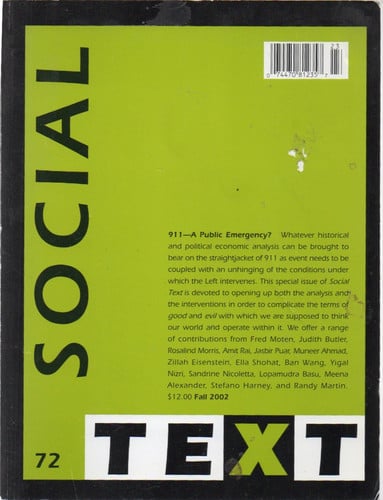
911 a Public Emergency?

Brent Hayes Edwards,Stefano Harney,Randy Martin,Ella Shohat,Timothy Mitchell,Fred Moten
Since September 11, public discourse has often been framed in terms of absolutes: an age of innocence gives way to a present under siege, while the United States and its allies face off against the Axis of Evil. This special issue of Social Text aims to move beyond these binaries toward thoughtful analysis. The editors argue that the challenge for the Left is to develop an antiterrorism stance that acknowledges the legacy of U.S. trade and foreign policy as well as the diversity of the Muslim faith and the dangers presented by fundamentalism of all kinds. Examining the strengths and shortcomings of area, race, and gender studies in the search for understanding, this issue considers cross-cultural feminism as a means of combating terrorism; racial profiling of Muslims in the context of other racist logics; and the homogenization of dissent. The issue includes poetry, photographic work, and an article by Judith Butler on the discursive space surrounding the attacks of September 11. This impressive range of contributions questions the meaning and implications of the events of September 11 and their aftermath. Contributors . Muneer Ahmad, Meena Alexander, Lopamudra Basu, Judith Butler, Zillah Eisenstein, Stefano Harney, Randy Martin, Rosalind C. Morris, Fred Moten, Sandrine Nicoletta, Yigal Nizri, Jasbir K. Puar, Amit S. Rai, Ella Shohat, Ban Wang
Duke University Press 2002-09-20 208 pages

The sergeants' tale

Rubens, Bernice
It is 1947, and in the British Mandate of Palestine the political pressure is rising. Jewish immigrants are arriving from Europe in their thousands, smuggled ashore past the armed patrols. The Wertman family, like the Jewish community, is divided: Avram is a member of the Irgun, a terrorist group fighting to end occuption; his daughter Hannah works for the Haganah, peacefully campaigning for a Jewish state. David Millar and Will Griffiths are two English sergeants, reluctant conscripts, who transfer to Intelligence. Half-Catholic, half-Jewish, David has mixed feelings about his work, more so when he becomes close to Hannah. Will, meanwhile, is finding trouble at the Jerusalem jazz bar where he plays his saxophone...
Charnwood 2005 290 pages