339 results for "Innovation"

Aspects of the theory of syntax

Chomsky, Noam
Noam Chomsky's 'Aspects of the theory of syntax', published in 1965, was a landmark work in generative grammar that introduced certain technical innovations still drawn upon in contemporary work. The fiftieth anniversary edition of this influential book includes a new preface by the author that identifies proposals that seem to be of lasting significance, reviews changes and improvements in the formulation and implementation of basic ideas, and addresses some of the controversies that arose over the general framework. Beginning in the mid-fifties and emanating largely from MIT, linguists developed an approach to linguistic theory and to the study of the structure of particular languages that diverged in many respects from conventional modern linguistics. Although the new approach was connected to the traditional study of languages, it differed enough in its specific conclusions about the structure of language to warrant a name, 'generative grammar'. Various deficiencies were discovered in the first attempts to formulate a theory of transformational generative grammar and in the descriptive analysis of particular languages that motivated these formulations. At the same time, it became apparent that these formulations can be extended and deepened. In this book, Chomsky reviews these developments and proposes a reformulation of the theory of transformational generative grammar that takes them into account. The emphasis in this study is syntax; semantic and phonological aspects of the language structure are discussed only insofar as they bear on syntactic theory.
The MIT Press 2015 270 pages

Left back: a century of battles over school reform

Ravitch, Diane
Recounts efforts by education reformers to use the schools to promote social and political goals, even when they diminished the schools' ability to educate children. Shows how generations of reformers have engaged in social engineering, advocating such innovations as industrial education, intelligence testing, curricular differentiation, and life-adjustment education. These reformers, the author demonstrates, simultaneously mounted vigorous campaigns against academic studies. In describing the wars between competing traditions of education, Ravitch points the way to reviving American education. She argues that all students have the capacity to learn and that all are equally deserving of a solid liberal arts education. Left Back addresses issues of the utmost importance and urgency. It is a large work of history that by recovering the past illuminates a future.
Simon & Schuster 2001-07-31 555 pages

Who we are and how we got here: ancient DNA and the new science of the human past

Reich, David (Of Harvard Medical School)
"A groundbreaking book about how technological advances in genomics and the extraction of ancient DNA have profoundly changed our understanding of human prehistory while resolving many long-standing controversies. Massive technological innovations now allow scientists to extract and analyze ancient DNA as never before, and it has become clear--in part from David Reich's own contributions to the field--that genomics is as important a means of understanding the human past as archeology, linguistics, and the written word. Now, in The New Science of the Human Past, Reich describes with unprecedented clarity just how the human genome provides not only all the information that a fertilized human egg needs to develop but also contains within it the history of our species. He delineates how the Genomic Revolution and ancient DNA are transforming our understanding of our own lineage as modern humans; how genomics deconstructs the idea that there are no biologically meaningful differences among human populations (though without adherence to pernicious racist hierarchies); and how DNA studies reveal the deep history of human inequality--among different populations, between the sexes, and among individuals within a population"--
Oxford University Press 2018 335 pages

The jobless future

Aronowitz, Stanley
High technology will destroy more jobs than it creates . This grim prediction was first published in the 1994 edition of The Jobless Future , an eerily accurate title that could have been written for today's dismal economic climate. Fully updated and with a new introduction by Stanley Aronowitz and William DiFazio, The Jobless Future warns that jobs as we know them-long-term, with benefits-are an endangered species.
University of Minnesota Press 2010 410 pages

Roll over Beethoven: the return of cultural strife

Aronowitz, Stanley
Product Description The question of culture has become central for a new generation of scholars raised in a world of television and mass production. At the same time debates about culture have become a point of reference for criticism of current trends in academia and society, variously defended or derided on the grounds of "multiculturalism," "canonicity," and political correctness." In his re-examination off these debates, Stanley Aronowitz traces the history of the cultural issue - in both its British and American manifestations - and relates it to the contemporary rethinking of the nature of knowledge and culture. Roll Over Beethoven analyzes topics as diverse as the history of American radicalism, the sociology if science, the impact of the Library of Congress on the organization of knowledge, and the institutionalization of film studies. Aronowitz's account of recent controversies over "political correctness" reveals that the current culture wars reflect profound differences among scholars over the proper role of the university and the character of legitimate intellectual knowledge. Within this broad reappraisal of the cultural question, which is embedded in the intellectual history of the 20th century, Aronowitz offers an "interpretive genealogy" of cultural studies that describes both the evolution of the field and the political and social contexts in which it developed. He argues that cultural studies exhibit a tendency toward transgression that is rarely explicit but always present and, at its best, not merely interdisciplinary but anti-disciplinary. From Publishers Weekly In this "interpretive genealogy of cultural studies," sociologist Aronowitz ( The Politics of Identity ) offers a history of this field with an eye toward examining how the nature of intellectual knowledge is defined. Though the book meanders from present-day politics to the historical debate over "high" and "low" culture to the role of the New Left in popular culture, Aronowitz's style is fairly accessible. Some arguments are undeveloped, as when he urges the Left to vigorously support the First Amendment but then suggests that "any community has a right to set limits on what it considers acceptable speech." In a chapter on the cultural politics of the Popular Front, Aronowitz offers an engaging memoir of his Bronx boyhood, recalling his rich encounters with classical and popular music and his study of political economy at a Communist Party school; he then analyzes novels and plays of the era, defending them against charges of populist oversimplification. After addressing current debates over the idea of an academic "canon," he notes that "virtually any significant educational innovation already has a history somewhere in the annals of the American academic system." Copyright 1993 Reed Business Information, Inc. From Library Journal Through his books on the labor movement, social theory, education theory, and the politics of science, Aronowitz has become one of the most interesting intellectuals on the contemporary scene. His latest work traces the emergence of "Cultural Studies" and emphasizes its invigorating impact on the humanities and social sciences. Written in an entertaining and informative style, Roll Over Beethoven could become the book that helps introduce large numbers of readers to the exciting new field of cultural interpretation. Individual chapters explore such topics as "high" versus "low" culture, culture and politics in the 1930s, the state of popular culture in contemporary America, and the relationship of cultural studies to the literary and philosophical canon. Along the way, Aronowitz offers a sophisticated critique of the revanchist critics of the modern university (Allan Bloom, William Bennett, et al.). This is a first-rate text that deserves the widest possible readership. - Kent Worcester, Social Science Research Council, New York Copyright 1993 Reed Business Information, Inc.
Wesleyan University Press 1993 277 pages

The Games That Changed the Game The Evolution of the NFL in Seven Sundays

Ron Jaworski,David Plaut,Greg Cosell
A gift for sports fans and football afficianados Professional football in the last half century has been a sport marked by relentless innovation. For fans determined to keep up with the changes that have transformed the game, close examination of the coaching footage is a must. In The Games That Changed the Game, Ron Jaworski—pro football’s #1 game-tape guru—breaks down the film from seven of the most momentous contests of the last fifty years, giving readers a drive-by-drive, play-by-play guide to the evolutionary leaps that define the modern NFL. From Sid Gillman’s development of the Vertical Stretch, which launched the era of wide-open passing offenses, to Bill Belichick’s daring defensive game plan in Super Bowl XXXVI, which enabled his outgunned squad to upset the heavily favored St. Louis Rams and usher in the New England Patriots dynasty, the most cutting-edge concepts come alive again through the recollections of nearly seventy coaches and players. You’ll never watch NFL football the same way again.
Random House Publishing Group 2011-08-30 352 pages

The language of new media

Manovich, Lev
A stimulating, eclectic accountof new media that finds its origins in old media, particularly the cinema. In this book Lev Manovich offers the first systematic and rigorous theory of new media. He places new media within the histories of visual and media cultures of the last few centuries. He discusses new media's reliance on conventions of old media, such as the rectangular frame and mobile camera, and shows how new media works create the illusion of reality, address the viewer, and represent space. He also analyzes categories and forms unique to new media, such as interface and database. Manovich uses concepts from film theory, art history, literary theory, and computer science and also develops new theoretical constructs, such as cultural interface, spatial montage, and cinegratography. The theory and history of cinema play a particularly important role in the book. Among other topics, Manovich discusses parallels between the histories of cinema and of new media, digital cinema, screen and montage in cinema and in new media, and historical ties between avant-garde film and new media.
MIT 2002-02-22 354 pages

The Correspondent Breeze Essays on English Romanticism

M. H. Abrams
One of the deans of literary criticism in America, M. H. Abrams is Class of 1916 Professor of English at Cornell University. He is the author of two landmark books, The Mirror and the Lamp and Natural Supernaturalism, and general editor of the Norton Anthology of English Literature. This volume collects the essays, written over three decades, which—together with his books—testify to his preeminence. The essays examine Wordsworth's and Coleridge's innovations in their theories about the language of poetry; the prevalence, sources, and significance of a key Romantic image, the “correspondent breeze”; the pervasive revolutionary spirit of Romanticism; the defining characteristics and chief exemplars of the most distinctive poetic genre of the age, the “greater Romantic lyric”; the relation of Coleridge and Wordsworth to modernist poetics and literature; the philosophic and scientific backgrounds of Coleridge's thinking; and the numerous manifestations of apocalypticism in the Romantic period.
W. W. Norton 1986-08 312 pages

Merchants of truth: inside the news revolution

Abramson, Jill
The gripping and definitive in-the-room account of the revolution that has swept the news industry over the last decade and reshaped our world. The last decade has seen the News industry face unprecedented change. The sometimes-century old institutions which were once the bastions of truth have had their dominance eroded by vast innovations in viral technology and, as millennial appetites force the industry to choose between principles of objectivity and impartiality, the survivors must confront the horrifying cost of their success- sexual scandal, fake news, the election of President Trump and the shaking of democracy. Taking us behind the scenes at four media titans - BuzzFeed , VICE , The New York Times and The Washington Post - Abramson reveals the human drama behind this shift- one involving deal-making tycoons, thrusting reporters, hard-bitten editors, egomaniacs, bullshitters, provocateurs and bullies, with some surfing and others drowning in the breaking wave of change. 'A cracking, essential read... Abramson knows where most of the bodies are buried and is prepared to draw the reader a detailed map' Guardian
Vintage Books 2020 534 pages

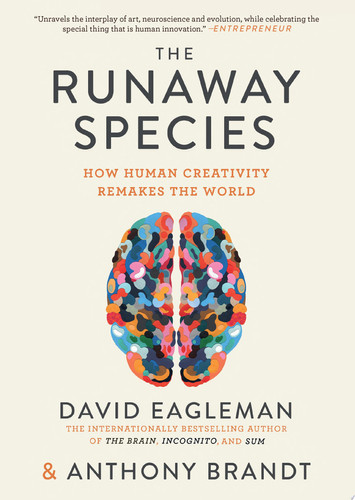
The Runaway Species How Human Creativity Remakes the World

David Eagleman,Anthony Brandt
This enlightening examination of creativity looks “at art and science together to examine how innovations . . . build on what already exists and rely on three brain operations: bending, breaking and blending” ( The Wall Street Journal ) The Runaway Species is a deep dive into the creative mind, a celebration of the human spirit, and a vision of how we can improve our future by understanding and embracing our ability to innovate. David Eagleman and Anthony Brandt seek to answer the question: what lies at the heart of humanity’s ability—and drive—to create? Our ability to remake our world is unique among all living things. But where does our creativity come from, how does it work, and how can we harness it to improve our lives, schools, businesses, and institutions? Eagleman and Brandt examine hundreds of examples of human creativity through dramatic storytelling and stunning images in this beautiful, full–color volume. By drawing out what creative acts have in common and viewing them through the lens of cutting–edge neuroscience, they uncover the essential elements of this critical human ability, and encourage a more creative future for all of us. “ The Runaway Species approach[es] creativity scientifically but sensitively, feeling its roots without pulling them out.” — The Economist
Catapult 2018-06-19 304 pages

The cluetrain manifesto

Rick Levine,Christopher Locke,Doc Searls,David Weinberger
Ten years after Cluetrain's original publication, too many companies still ignore the idea that markets are really made up of people. In our rapidly changing world, this book's message is more vital than ever. Companies may be wired for business, but they still struggle with how to talk to their customers like human beings.The 10th Anniversary Edition features extensive new commentaries by industry leaders, but the core message of this modern business classic remains intact.
Basic Books 2011-04-05 298 pages

Tailspin: the people and forces behind America's fifty-year fall--and those fighting to reverse it

Brill, Steven
"From the award-winning journalist and best-selling author of America's Bitter Pill: a tour de force examination of 1) how and why major American institutions no longer serve us as they should, causing a deep rift between the vulnerable majority and the protected few, and 2) how some individuals and organizations are laying the foundation for real, lasting change. In this revelatory narrative covering the years 1967 to 2017, Steven Brill gives us a stunningly cogent picture of the broken system at the heart of our society. He shows us how, over the last half-century, America's core values--meritocracy, innovation, due process, free speech, and even democracy itself--have somehow managed to power its decline into dysfunction. They have isolated our best and brightest, whose positions at the top have never been more secure or more remote. The result has been an erosion of responsibility and accountability, an epidemic of shortsightedness, an increasingly hollow economic and political center, and millions of Americans gripped by apathy and hopelessness. By examining the people and forces behind the rise of big-money lobbying, legal and financial engineering, the demise of private-sector unions, and a hamstrung bureaucracy, Brill answers the question on everyone's mind: How did we end up this way? Finally, he introduces us to those working quietly and effectively to repair the damages. At once a diagnosis of our national ills, a history of their development, and a prescription for a brighter future, Tailspin is a work of riveting journalism--and a welcome antidote to political despair"--
Alfred A. Knopf 2018-05-29 441 pages

The case for space: how the revolution in spaceflight opens up a future of limitless possibility

Zubrin, Robert
"In his new book, The Case For Space: How the Revolution in Spaceflight Opens Up a Future of Limitless Possibility, famed astronautical engineer Bob Zubrin talks about the how and the why of our new exploratory era. It's a must-read for anyone interested in the subject, and will probably be read by historians of our era centuries hence. I find Zubrin's arguments compelling, and I think you just might, too. I highly recommend his book, not only for its excellent analysis, but also as a source of perspective on today's news. " -- Glenn Harlan Reynolds, Opinion columnist, USA Today A new space race has begun. But the rivals in this case are not superpowers but competing entrepreneurs. These daring pioneers are creating a revolution in spaceflight that promises to transform the near future. Astronautical engineer Robert Zubrin spells out the potential of these new developments in an engrossing narrative that is visionary yet grounded by a deep understanding of the practical challenges. Fueled by the combined expertise of the old aerospace industry and the talents of Silicon Valley entrepreneurs, spaceflight is becoming cheaper. The new generation of space explorers has already achieved a major breakthrough by creating reusable rockets. Zubrin foresees more rapid innovation, including global travel from any point on Earth to another in an hour or less; orbital hotels; moon bases with incredible space observatories; human settlements on Mars, the asteroids, and the moons of the outer planets; and then, breaking all limits, pushing onward to the stars. Zubrin shows how projects that sound like science fiction can actually become reality. But beyond the how, he makes an even more compelling case for why we need to do this--to increase our knowledge of the universe, to make unforeseen discoveries on new frontiers, to harness the natural resources of other planets, to safeguard Earth from stray asteroids, to ensure the future of humanity by expanding beyond its home base, and to protect us from being catastrophically set against each other by the false belief that there isn't enough for all.
Prometheus Books 2019 395 pages

New York 2000: architecture and urbanism between the Bicentennial and the Millennium

Stern, Robert A. M.
"New York 2000 is the culmination of an award-winning series documenting the history of architecture and urbanism in New York City from the Civil War to the present. The previous books, New York 1880, New York 1900, New York 1930, and New York 1960, provide comprehensive coverage on the architects and urban planners who defined New York since the mid-nineteenth century. This volume chronicles milestones in the city's history over the past thirty years, with more than 1,800 color illustrations to complement the text." "Featuring insightful discussions on the development of Battery Park City, the rebirth of Harlem and Times Square, the creation of the cultural precinct around the new MoMA, and the reclaiming of the waterfront along the East and Hudson Rivers as recreational parkland, New York 2000 documents ongoing commitments to innovation and renovation and celebrates the achievements of internationally recognized architects, including Sir Norman Foster, Cesar Pelli, Richard Meier, and Renzo Piano." "The survey of organized geographically, beginning in Lower Manhattan and moving north through Harlem and to the outer boroughs including the Bronx, Queens, Brooklyn, and Staten Island. Woven throughout is commentary on the repercussions of September 11, 2001, New York 2000 is a thorough study of how a world-class metropolis preserves, showcases, and constructs an architectural heritage that endures over the course of two centuries."--BOOK JACKET
Monacelli Press 2006-11-01 1520 pages

Leaning Forward Surviving/Winning in the Future of Interactive Marketing

Josh Linkner
"Josh Linkner, CEO of ePrize, is a tremendous business leader who has established a successful and sustainable company, as well as a culture that nurtures employees to help them maximize their potential." - Jennifer M. Granholm, Governor, State of Michigan "Leaning Forward is a deep and highly aware look into the future of interactive marketing. A must-read for anybody who plans to compete and win in the brain age." - Dan Gilbert, Chairman and Founder, Quicken Loans and Majority Owner, Cleveland Cavaliers "Josh has given you reason to fear the programmed nature of obsolescence but more importantly his deep consumer knowledge will give you hope This book will never be obsolete " - David Sable, Vice Chairman/Chief Operating Officer, Wunderman (largest direct marketing company in the world) Leaning Forward takes a penetrating look at the future of Interactive marketing. Major brands throughout the world have embraced the 'Digital Revolution', and have fundamentally changed the way they interact with their consumers. As a marketer, you will learn what you need to know to stay ahead of the curve and compete in this dramatically changed landscape. Renowned entrepreneur Josh Linkner shows you real world examples of what the best marketers are doing today and where the trends are heading. You'll learn how the most savvy marketers: . Establish and nurture direct, one-to-one relationships . Motivate specific consumer behavior . Get marketing messages heard above the non-stop "noise" . Combine brand immersive experiences with proven direct-marketing techniques . Generate "hand-raisers" . Increase relevancy, response-rates, and overall performance . Drive immediate and measurable results By examining the major sea of change that has happened over the last ten years, Linkner shares best practices, trends, and helps readers avoid common pitfalls. A must-read for today's marketing professional, business owner, or aspiring entrepreneur. Josh Linkner --Founder and CEO, ePrize As a pioneer in interactive marketing and promotions, Josh has been involved in the development of thousands of digital marketing strategies over the last 14 years. As the founder and CEO of ePrize, he has led the firm from inception to being ranked the #1 fastest growing and #3 overall promotion agency by PROMO Magazine. ePrize has produced an industry-leading 4,000 interactive promotions for clients including Coca-Cola, American Express, The Gap, Procter & Gamble, Warner Bros. Dell, adidas, Citibank and General Motors. Josh has been featured in the Wall Street Journal, Fast Company, AdAge, Inc. magazine, Entrepreneur, and Adweek, and is a regular keynote speaker at industry events and conferences. Josh has won several business, technology, and design awards. He is also an accomplished and well-respected Jazz musician from which he draws the same passion and excitement toward business, and creating a culture of innovation, discipline, and creativity.
Dog Ear Publishing 2007-11 120 pages

The signals are talking: why today's fringe is tomorrow's mainstream

Webb, Amy
Amy Webb is a noted futurist who combines curiosity, skepticism, colorful storytelling, and deeply reported, real-world analysis in this essential book for understanding the future. The Signals are Talking reveals a systematic way of evaluating new ideas bubbling up on the horizon--distinguishing what is a real trend from the merely trendy. This book helps us hear which signals are talking sense, and which are simply nonsense, so that we might know today what developments--especially those seemingly random ideas at the fringe as they converge and begin to move toward the mainstream--have long-term consequence for tomorrow. With the methodology developed here, we learn how to think like a futurist and answer vitally important questions: How will a technology--like artificial intelligence, machine learning, self-driving cars, biohacking, bots, and the Internet of Things--affect us personally? How will it impact our businesses and workplaces? How will it eventually change the way we live, work, play, and think--and how should we prepare for it now?--Adapted from dust jacket.
PublicAffairs 2016-12-06 322 pages

John Maynard Keynes

Minsky, Hyman P.
â Today, Mr. Minsky's view [of economics] is more relevant than ever.â - The New York Times â Indeed, the Minsky moment has become a fashionable catch phrase on Wall Street.â -The Wall Street Journal John Maynard Keynes offers a timely reconsideration of the work of the revered economics icon. Hyman Minsky argues that what most economists consider Keynesian economics is at odds with the major points of Keynes's The General Theory of Employment, Interest, and Money. Keynes and Minsky refuse to ignore pervasive uncertainty. Once uncertainty is given center stage, recurring episodes of financial system crises are all but inescapable. As Robert Barbera notes in a new preface, â Benign economic circumstancesâ ¦invite increasingly aggressive financial market wagers. Innovation in finance is a signature development in a capitalist economy. Once leveraged wagers are in place, small disappointments can have exaggerated consequences.â Thus for Minsky economic calm on Main Street engenders financial system fragility which, in turn, ensures a perpetuation of boom and bust cycles. Minsky colleagues Dimitri B. Papadimitriou and L. Randall Wray write in a new introduction, â We offer this new edition, in the hope that it will contribute to the reformation of economic theory so that it can address the world in which we actually live-the world that was always the topic of Minsky's analysis.â
Columbia University Press 1975 181 pages

Evolutionary Psychology in the Business Sciences

Gad Saad
All individuals who operate in the business sphere, whether as consumers, employers, employees, entrepreneurs, or financial traders to name a few constituents, share a common biological heritage and are defined by a universal human nature. As such, it is surprising that so few business scholars have incorporated biological and evolutionary-informed theories within their conceptual toolboxes. This edited book addresses this lacuna by culling chapters at the intersection of the evolutionary behavioral sciences and specific business contexts including in marketing, consumer behavior, advertising, innovation and creativity, intertemporal choice, negotiations, competition and cooperation in organizational settings, sex differences in workplace patterns, executive leadership, business ethics, store design, behavioral decision making, and electronic communication. To reword the famous aphorism of T. G. Dobzhansky, nothing in business makes sense except in the light of evolution.
Springer Berlin Heidelberg 2014-09-28 371 pages

The volatility smile

Derman, Emanuel
"The Volatility Smile: An Introduction for Students and Practitioners The Black-Scholes-Merton options model was the greatest innovation of 20th Century finance, and remains the most widely applied theory in all of finance. Despite this success, the model is fundamentally at odds with the observed behavior of option markets: a graph of implied volatilities against strike will typically display a curve or skew, which practitioners refer to as the smile, and which the model cannot explain. Option valuation is not a solved problem, and the past forty years have witnessed an abundance of new models that try to reconcile theory with markets. The Volatility Smile presents a unified treatment of the Black-Scholes-Merton model and the more advanced models that have replaced it. It is also a book about the principles of financial valuation and how to apply them. Celebrated author and quant Emanuel Derman and Michael B. Miller explain not just the mathematics but the ideas behind the models. By examining the foundations, the implementation, and the pros and cons of various models, and by carefully exploring their derivations and their assumptions, readers will learn not only how to handle the volatility smile but how to evaluate and build their own financial models. Topics covered include: The principles of valuation Static and dynamic replication The Black-Scholes-Merton model Hedging strategies Transaction costs The behavior of the volatility smile Implied distributions Local volatility models Stochastic volatility models Jump-diffusion models"--
John Wiley & Sons 2016 512 pages

Stanford R. Ovshinsky: the science and technology of an American genius

Ovshinsky, Stanford R.
This book highlights the achievements of the self-taught inventor, scientist, manufacturer and entrepreneur, Stanford R Ovshinsky. This remarkable individual could, without special training, compete with the well-funded establishments of learning and industry in the second half of the last century and leave us an incredible legacy of brilliant innovations with a lasting impact on our lives. His achievements extend over amazingly diverse fields and have or are prone to create new industries of great societal value. The phase change memories of commonly used rewritable CDs and DVDs as well as of new flash memories are his invention; so are the Ni Metal hydride batteries which are the enabling batteries for electric and hybrid/electric vehicles. The future hydrogen economy will utilize his efficient and safe hydrogen storage alloys. He has developed light and ultralight photovoltaic solar panels for converting sunlight into electricity and built the largest manufacturing facility for thin film flexible solar roofing materials. A common theme of his inventions is the synthesis of new materials utilizing novel aspects of structural and compositional disorder.The book explains for each of Ovshinsky's innovations the essence of his pioneering ideas and inventions. These introductions are followed by a selection of Ovshinsky's seminal publications and, for each subject category, a list of his patents which reveal the inventive mind of this unusually creative person. Ovshinsky's example of gaining a deep understanding of the science underlying his inventions, his perseverance as well as his ability to attract and inspire talented collaborators will be a role model for entrepreneurs of this century.
World Scientific 2008 380 pages