62 results for "Internet"

The Jewish Defense Organization's A History of Islamist Terrorism in America

Jewish Organization
Secret history of Islamist terrorism in America from Sirhan Sirhan to Major Hasan and how the JDO fights it. The JDO was founded in March 1982 in reaction to the demise of the Jewish Defense League (JDL). The JDO was never and never will be a Kahanist organization; instead it is based on principles first set forth by the Honorable Zev Jabotinsky, the founder of Revisionist Zionism. Jabotinsky, poet, statesman and militarist told Jewish audiences prior to the Holocaust to leave Europe. In 2010 JDO was able to get a meeting of the American Renaissance Party that was to be held at the Skyline Motel in Washington, D.C. cancelled despite the insistence of its manager that it take place. In February 2011 JDO quashed another meeting of this racist group with the help of the NAACP and City Council members Patrick Cannon and Councilman Warren Turner. These men had enough self-respect to stop these KKK jackasses from spewing their racial-hatred in Charlotte, North Carolina. Look what happened in Greensboro, North Carolina in 1979 when the Klan mowed down a "Death to the Klan" march staged by Communists. Declassified FBI documents revealed that JDO Chairman Mordechai Levy warned the FBI that the Klan was planning a violent attack but his intelligence was ignored due to his status as a Jewish militant. Just the opposite should have been true. In March 2011 the JDO was able to convince the landlord of the the Nazi-Holocaust revisionist scumy group The Institute of Historical Review not to renew their lease. In May 2011 the JDO held a demonstration in front of Nazi Headquarters on the Upper East Side of Manhattan. These are our latest actions - we've been staging these events and others for years and years. It is from this militant / activist point of view that the JDO research team studied the history of Islamist terrorism on American soil within certain parameters of interest. Rather than using a shotgun approach we zeroed in on terrorist plots in which bombs were actually constructed or shots were fired and excluded numerous conspiracies that the FBI nipped in the bud. Our researchers obtained the documents from every terrorism court case in the United States, conducted interviews, scoured the Internet in all languages, studied declassified government documents, filed FOIA requests then put the puzzle pieces together. We even collected the trash in front of the Permanent Observer Mission of Palestine to the United Nations at 115 East 65th Street in Manhattan and discovered cable traffic that indicated the PLO was using Syrian diplomatic pouches to smuggle bomb parts to various locations throughout the world. JDO turned these cables over to Israeli intelligence who cautioned JDO not to reveal its methodology as it was going to be applied to other hostile diplomatic installations. JDO waited for a year before revealing its discovery on local television. Shortly thereafter a car with two Arabic looking men parked outside JDO headquarters at 6 Bleecker Street in Manhattan. A JDO member displayed his semi-auto Uzi and invited the thugs upstairs. It was just another day in the 1980's at JDO Headquarters.
Jewish Defense Organization Press 2011 465 pages

Madison's metronome: the Constitution, majority rule, and the tempo of American politics

Weiner, Greg
In the wake of national crises and sharp shifts in the electorate, new members of Congress march off to Washington full of intense idealism and the desire for instant change—but often lacking in any sense of proportion or patience. This drive for instant political gratification concerned one of the key Founders, James Madison, who accepted the inevitability of majority rule but worried that an inflamed majority might not rule reasonably. Greg Weiner challenges longstanding suppositions that Madison harbored misgivings about majority rule, arguing instead that he viewed constitutional institutions as delaying mechanisms to postpone decisions until after public passions had cooled and reason took hold. In effect, Madison believed that one of the Constitution's primary functions is to act as a metronome, regulating the tempo of American politics. Weiner calls this implicit doctrine "temporal republicanism" to emphasize both its compatibility with and its contrast to other interpretations of the Founders' thought. Like civic republicanism, the "temporal" variety embodies a set of values—public-spiritedness, respect for the rights of others-broader than the technical device of majority rule. Exploring this fundamental idea of time-seasoned majority rule across the entire range of Madison's long career, Weiner shows that it did not substantially change over the course of his life. He presents Madison's understanding of internal constitutional checks and his famous "extended republic" argument as different and complementary mechanisms for improving majority rule by slowing it down, not blocking it. And he reveals that the changes we see in Madison's views of majority rule arise largely from his evolving beliefs about who, exactly, was behaving impulsively—whether abusive majorities in the 1780s, the Adams regime in the 1790s, the nullifiers in the 1820s. Yet there is no evidence that Madison's underlying beliefs about either majority rule or the distorting and transient nature of passions ever swayed. If patience was a fact of life in Madison's day—a time when communication and travel were slow—it surely is much harder to cultivate in the age of the Internet, 24-hour news, and politics based on instant gratification. While many of today's politicians seem to wed supreme impatience with an avowed devotion to original constitutional principles, Madison's Metronome suggests that one of our nation's great luminaries would likely view that marriage with caution.
University Press of Kansas 2012 194 pages

Choose your own disaster: A. a memoir, B. a personality quiz, C. a mostly true and completely honest look at one young woman's attempt to find herself, D. all of the above

Schwartz, Dana
A hilarious, quirky, and unflinchingly honest memoir about one young woman's terrible and life-changing decisions while hoping (and sometimes failing) to find herself, in the style of Never Have I Ever and Adulting. Join Dana Schwartz on a journey revisiting all of the terrible decisions she made in her early twenties through the internet's favorite method of self-knowledge: the quiz. Part-memoir, part-VERY long personality test, CHOOSE YOUR OWN DISASTER is a manifesto about the millennial experience and modern feminism and how the easy advice of "you can be anything you want!" is actually pretty fucking difficult when there are so many possible versions of yourself it seems like you could be. Dana has no idea who she is, but at least she knows she's a Carrie, a Ravenclaw, a Raphael, a Belle, a former emo kid, a Twitter addict, and a millennial just trying her best.--Amazon.com.
Grand Central Publishing 2018-06-19 260 pages

Bookends: two women, one enduring friendship

Rostenberg, Leona
The rare book dealers who delighted readers with the history of their bookselling days in "Old Books, Rare Friends" now offer the other side of their story -- an intimate look at the joys of a relationship that has lasted more than half a century. When their friendship and business partnership began in the 1940s, Leona Rostenberg and Madeleine Stern were pioneers in a man's world. Now approaching their nineties, the duo, who -- among their many discoveries -- unearthed Louisa May Alcott's pseudonymous blood-and-thunder stories, remains a vibrant institution in the rare book trade, even as the Internet changes their field -- and their community -- forever. After publishing "Old Books, Rare Friends," Rostenberg and Stern received a flood of fan mail asking about their personal lives, and they have responded with poignant honesty and the warmth for which they are famous, as they reflect on their lives and their remarkable partnership. "Bookends" recounts their fascinating histories: family backgrounds, business adventures, the men they did not marry, and their approach to the bittersweet trials of aging. More than just a dual memoir, "Bookends" is also a chronicle of the cultural changes of twentieth-century American life and a loving farewell to the golden age of book collecting. Filled with wisdom and humor, this volume is a tribute to Rostenberg and Stern's passion for the written word -- and for life itself. Catching us off guard with their candor, they offer their insights regarding their business, their way of life, and their worldview. Above all, they present the story of a special relationship. At a time when people find it increasingly difficult to connect, here wehave the seamless story of a shared life. It is the unique product of an earlier time, yet it is a timeless reflection on the very nature of friendship. Though their fantastic partnership is un-reproducible, the ideal they have established, for the integration of one life so completely with another, contains lessons for all of us. Without husband or children they created a loving home when this was uncharted territory for women. They nurtured a business and life partnership that has lasted more than half a century and has only gotten stronger with time. When the passing years began to claim one's hearing and the other's sight, they became each other's eyes and ears. A meditation on aging and togetherness, this book is also the narrative of two pioneering single, Jewish women making their way in tandem through a world largely organized to keep them in their place. It is a gentle, wise story, told in their inimitable style, sparse, unadorned, and honest. Their affirmations supersede their uncertainties. As they write, "Bookends support books and come in pairs...If the word encapsulates our past, it looks also to the future, and to the books -- lived together, written together -- that will follow." They confront the challenges of aging in a no-nonsense tone, and, in facing them, give us an ideal of enduring human friendship that can't help but touch the heart.
Free Press 2001 246 pages

Google me: one-click democracy

Cassin, Barbara
"Google is a champion of cultural democracy, but without culture and without democracy." In this witty and polemical critique the philosopher Barbara Cassin takes aim at Google and our culture of big data. While impressed by the search engine's brilliance, Cassin enlists her formidable knowledge of the rhetorical tradition to challenge on the Google myth of a "good" tech company and its "democracy of clicks," laying bare the philosophical poverty and political naiveté ́hat underwrites its founding slogans: "Organize the world's information," and "Don't be evil." For Cassin, this conjunction of globalizing knowledge and moral imperative is frighteningly similar to the way American demagogues justify their own universalizing mission before the world. While sensitive to the possibilities of technology and to Google's playful appeal, Cassin shows what is lost when a narrow worship of information becomes dogma, such that research comes to mean data mining and other languages become provincial "flavors" folded into an impoverished Globish, or global English. As the Internet continues to intensify the neoliberal effacement of difference and corporate reduction of the common, Cassin's refreshing polemic takes technology seriously enough to scrutinize the beliefs upon which it operates.
Fordham University Press 2018 148 pages

Big deal

Wasserstein, Bruce
"Wasserstein moves from the historical to the human dramas behind the headlines. He asks, and answers, the important questions that every financial watcher - and investor - needs to know. Are companies overpaying for their corporate acquisitions? What's the impact of the rise in Internet stock prices and the boom in IPOs? And, in assessing the big picture, Wasserstein makes a persuasive argument that the explosion of corporate alliances will have an effect as dramatic as the industrial revolution."--Jacket.
Warner 2000 927 pages

Running on empty? political discourse in congressional elections

L Sandy Maisel,Darrell M. West
The level of discourse in campaigns and elections ideally should elevate citizens' knowledge about the candidates and the issues that face the polity. But elections today are often beset by negative campaigns and an emphasis on the "horse race" over issues of substance. Running on Empty? looks at sixteen carefully selected, highly competitive races in the House and Senate during the 2002 midterm elections. Measuring various aspects of campaign discourse throughout a wide variety of paid and unpaid media coverage-including radio, TV, newspapers, direct mail, and the Internet-the authors arrive at some arresting conclusions about the quality of the messages conveyed, whether positive or negative. In all, this impressive set of original essays by political experts provides a timely assessment of the effectiveness of media reform and the democratization of campaign discourse in theory compared to practice.
Rowman & Littlefield 2004-03-19 264 pages

The offensive Internet: speech, privacy, and reputation

Saul Levmore,Martha C. Nussbaum
The Internet has been romanticized as a zone of freedom. The alluring combination of sophisticated technology with low barriers to entry and instantaneous outreach to millions of users has mesmerized libertarians and communitarians alike. Lawmakers have joined the celebration, passing the Communications Decency Act, which enables Internet Service Providers to allow unregulated discourse without danger of liability, all in the name of enhancing freedom of speech. But an unregulated Internet is a breeding ground for offensive conduct. At last we have a book that begins to focus on abuses made possible by anonymity, freedom from liability, and lack of oversight. The distinguished scholars assembled in this volume, drawn from law and philosophy, connect the absence of legal oversight with harassment and discrimination. Questioning the simplistic notion that abusive speech and mobocracy are the inevitable outcomes of new technology, they argue that current misuse is the outgrowth of social, technological, and legal choices. Seeing this clearly will help us to be better informed about our options. In a field still dominated by a frontier perspective, this book has the potential to be a real game changer. Armed with example after example of harassment in Internet chat rooms and forums, the authors detail some of the vile and hateful speech that the current combination of law and technology has bred. The facts are then treated to analysis and policy prescriptions. Read this book and you will never again see the Internet through rose-colored glasses.
Harvard University Press 2010 299 pages

The Oxford handbook of American folklore and folklife studies

Simon J. Bronner
"This handbook surveys the materials, approaches, contexts, and applications of American folklore and folklife studies to guide students and scholars of American folklore, culture, history, and society in the future. In addition to longstanding areas in the 350-year legacy of the subject's study and applications such as folktales and speech, the handbook includes exciting fields that have emerged in the twenty-first century such as the Internet, bodylore, folklore of organizations and networks, sexual orientation, neurodiverse identities, and disability groups. These studies encompass cultural traditions in the United States ranging from bits of slang in private conversations to massive public demonstrations, ancient beliefs to contemporary viral memes, and a simple handshake greeting to festivals encompassing multiple genres and groups. Folklore and folklife studies include material traditions such as buildings and crafts as well as oral and social genres of dance, ritual, drama, and play. Whereas the use of lore often emphasizes speech, song, and story that all people express, the rhetoric of life draws attention to tradition-centered communities such as the Amish and Hasidim, occupational groups and their workaday worlds, and children and other age groups. Significant to the American context has been the cultural diversity and changing national boundaries of the United States, relative youth of the nation and its legacy of mass immigration, mobility of residents and their relation to an indigenous and racialized population, and a varied landscape and settlement pattern. The handbook is a reference, therefore, to American studies as well as the global study of tradition, folk arts, and cultural practice"--
Oxford University Press 2019 1010 pages

Inside the Presidential Debates Their Improbable Past and Promising Future

Newton N. Minow,Craig L. LaMay
Newton Minow’s long engagement with the world of television began nearly fifty years ago when President Kennedy appointed him chairman of the Federal Communications Commission. As its head, Minow would famously dub TV a “vast wasteland,” thus inaugurating a career dedicated to reforming television to better serve the public interest. Since then, he has been chairman of PBS and on the board of CBS and elsewhere, but his most lasting contribution remains his leadership on televised presidential debates. He was assistant counsel to Illinois governor Adlai Stevenson when Stevenson first proposed the idea of the debates in 1960; he served as cochair of the presidential debates in 1976 and 1980; and he helped create and is currently vice chairman of the Commission on Presidential Debates, which has organized the debates for the last two decades. Written with longtime collaborator Craig LaMay, this fascinating history offers readers for the first time a genuinely inside look into the origins of the presidential debates and the many battles—both legal and personal—that have determined who has been allowed to debate and under what circumstances. The authors do not dismiss the criticism of the presidential debates in recent years but do come down solidly in favor of them, arguing that they are one of the great accomplishments of modern American electoral politics. As they remind us, the debates were once unique in the democratic world, are now emulated across the globe, and they offer the public the only real chance to see the candidates speak in direct response to one another in a discussion of major social, economic, and foreign policy issues. Looking to the challenges posed by third-party candidates and the emergence of new media such as YouTube, Minow and LaMay ultimately make recommendations for the future, calling for the debates to become less formal, with candidates allowed to question each other and citizens allowed to question candidates directly. They also explore the many ways in which the Internet might serve to broaden the debates’ appeal and informative power. Whether it’s Clinton or Obama vs. McCain, Inside the Presidential Debates will be welcomed in 2008 by anyone interested in where this crucial part of our democracy is headed—and how it got there.
University of Chicago Press 2016-07-28 237 pages

The uprising: an unauthorized tour of the populist revolt scaring Wall Street and Washington

Sirota, David
An all-access pass to the populist insurrection brewing across the country. Job outsourcing. Slashed paychecks. A war without end, fatally mismanaged. Americans on both the Right and Left are tired of being disenfranchised by corrupt politicians and are organizing to change the status quo. In his invigorating new book, David Sirota investigates this uprising, taking us into the trenches where real change is happening–in the headquarters of the most powerful third party in America, at an ExxonMobil shareholder meeting, and on the quasi-military staging area of a vigilante force on the Mexican border. The Uprising is essential reading for anyone who wants to look beyond presidential politics at the new populism that is reshaping the American political landscape.
Three Rivers Press 2008 385 pages

Jordan Wolfson: California

Wolfson, Jordan
Initially conceived to document the artist’s 2014 exhibition at David Zwirner in New York—his first with the gallery, debuting new sculptural work, a critically acclaimed video, and a much-discussed animatronic sculpture—the publication ultimately exists as a hybrid between an exhibition catalogue and a stand-alone expression of Wolfson’s vision. Over the past decade, Jordan Wolfson has become known for his thought-provoking works in a wide range of media, including video, sculpture, installation, photography, and performance. He pulls intuitively from the world of advertising, the Internet, and the technology industries to produce ambitious and enigmatic narratives. However, instead of simply appropriating found material, the artist creates his own unique content, which frequently revolves around a series of invented, animated characters. This artist’s book is the product of close collaboration between Wolfson and the book designer Joseph Logan. Featuring a dynamic layout and large color plates, the book is anchored by extensive photo documentation of Wolfson’s bewitching (Female figure) 2014 , which combines elements of installation and performance in the figure of a curvaceous, scantily clad woman covered in dirt marks and wearing a witch mask. Presented are photographs by Andreas Laszlo Konrath, who documented many aspects of the exhibition, including behind-the-scenes images of its installation. Also included are reproductions of Wolfson’s new series of wall-mounted sculptures comprised of bumper stickers overlaid on inkjet prints, candid photographs of the artist taken by Gaea Woods, and a text by the artist providing context for the visual material.
David Zwirner Books 2015-11-24 135 pages

Nominating the President: evolution and revolution in 2008 and beyond

Jack Citrin,David Karol
The 2008 presidential nominations were unprecedented in many ways. Marking another step in the democratization of the selection process and a surprising loss of control by party elites, the contests in both parties were unusually competitive and the outcomes belied the predictions of experts. This book offers a fresh look at the role of parties, the constraints of campaign finance, the status of front-runners, and the significance of rules, race, and gender in the post-reform era. In this volume, leading scholars assess the state of the process with original research about money, scheduling, superdelegates, and the role of race and gender in voting. Original analyses show how changes in campaign finance and the scheduling of primaries and caucuses helped determined the outcomes in both parties. Race, once thought of as a handicap, proved an asset for the Obama campaign. 2008 marked another milestone in the democratization of the nominations process with expanded participation by rank and file voters in donating money, voting, and using the Internet. This timely book provides a glimpse into the future of party nominations and elections.
Rowman & Littlefield Publishers 2009-09-16 167 pages

My life with Benjamin Franklin

Lopez, Claude-Anne
This delightful book is a collection of incidental pieces that reveal little-known aspects of the life and personality of Benjamin Franklin. Written by the doyenne of Franklin scholars, it conveys Franklin's humor, resiliency, courage, and intelligence, and his faith in a better future. The selections are based on Claude-Anne Lopez's research in the treasure trove of nearly thirty thousand documents on Franklin assembled at Yale University. They include a detailed refutation of an anti-Semitic forgery attributed to Franklin and currently circulating on the Internet; three mini-detective stories showing Franklin on the fringes of the espionage world; discussions of Franklin's efforts to outfit Washington's army and to choose the first dinner set for the Foreign Service; and the tale of the misadventures of a French utopian scheme he sponsored. The only piece of fiction in the book is an imaginary party during which, on the first anniversary of his death, six illustrious Frenchmen discuss Franklin's influence on their country. Lopez has provided brief personal introductions to each of the pieces, giving her reasons for writing them and in the process threading the essays together.
Yale University Press 2000 261 pages

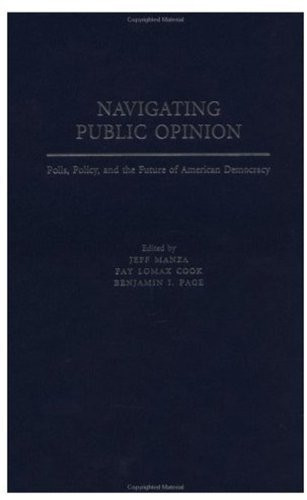
Navigating public opinion: polls, policy, and the future of American democracy

Professor of Sociology Jeff Manza,Jeff Manza,Fay Lomax Cook,Professor of Human Development and Social Policy in the School of Education and Social Policy Fay Lomax Cook,Benjamin I. Page,Gordon Scott Fulcher Professor of Decision Making in the Department of Political Science Benjamin I Page
Do politicians listen to the public? How often and when? Or are the views of the public manipulated or used strategically by political and economic elites? Navigating Public Opinion brings together leading scholars of American politics to assess and debate these questions. It describes how the relationship between opinion and policy has changed over time; how key political actors use public opinion to formulate domestic and foreign policy; and how new measurement techniques might improve our understanding of public opinion in contemporary polling and survey research. The distinguished contributors shed new light on several long-standing controversies over policy responsiveness to public opinion. Featuring a new analysis by Robert Erikson, Michael MacKuen, and James Stimson that builds from their pathbreaking work on how public mood moves policy in a macro-model of policymaking, the volume also includes several critiques of this model by Lawrence Jacobs and Robert Shapiro, another critique by G. William Domhoff, and a rejoinder by Erikson and his coauthors. Other highlights include discussions of how political elites, including state-level policymakers, presidents, and makers of foreign policy, use (or shape) public opinion; and analyses of new methods for measuring public opinion such as survey-based experiments, probabilistic polling methods, non-survey-based measures of public opinion, and the potential and limitations of Internet polls and surveys. Introductory and concluding essays provide useful background context and offer an authoritative summary of what is known about how public opinion influences public policy. A must-have for all students of American politics, public opinion, and polling, this state-of-the-art collection addresses issues that lie at the heart of democratic governance today.
Oxford University Press 2002 376 pages

Extravagant expectations: new ways to find romantic love in America

Hollander, Paul
The proliferation of dating websites, printed personals, and self-help relationship books reflects the new ways Americans seek close, personal relationships. Exposed to changing and often conflicting values, trends, and fashions--disseminated by popular culture, advertising, and assorted "experts"--Americans face uncertainties about the best ways to meet important emotional and social needs. How do we establish lasting and intimate personal relationships, including marriage? In Extravagant Expectations Paul Hollander investigates how Americans today pursue romantic relationships, with special reference to the advantages and drawbacks of Internet dating compared to connections made in school, college, and the workplace. By analyzing printed personals, dating websites, and advice offered by pop psychology books, he examines the qualities that people seek in a partner and also assesses the influence of the remaining conventional ideas of romantic love. Hollander suggests that notions of romantic love have changed due to conflicting values and expectations and the impact of pragmatic considerations. Individualism, high expectations, social and geographic mobility, changing sex roles, and the American national character all play a part in this fascinating and finally sobering exploration of the efforts of men and women to find love and meaning in life. --Book Jacket.
Ivan R. Dee 2011 251 pages

Explaining traditions: folk behavior in modern culture

Bronner, Simon J.
Why do humans hold onto traditions? Many pundits predicted that modernization and the rise of a mass culture would displace traditions, especially in America, but cultural practices still bear out the importance of rituals and customs in the development of identity, heritage, and community. In Explaining Traditions: Folk Behavior in Modern Culture , Simon J. Bronner discusses the underlying reasons for the continuing significance of traditions, delving into their social and psychological roles in everyday life, from old-time crafts to folk creativity on the Internet. Challenging prevailing notions of tradition as a relic of the past, Explaining Traditions provides deep insight into the nuances and purposes of living traditions in relation to modernity. Bronner's work forces readers to examine their own traditions and imparts a better understanding of raging controversies over the sustainability of traditions in the modern world.
University Press of Kentucky 2011-07-22 530 pages