77 results for "Poetry"

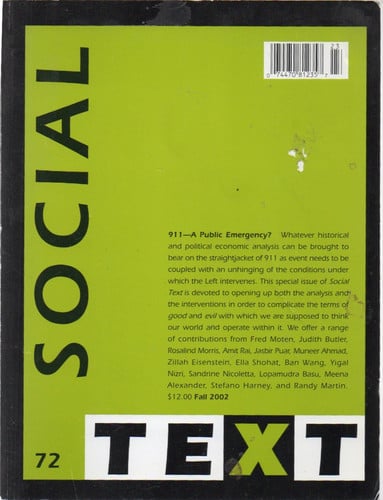
911 a Public Emergency?

Brent Hayes Edwards,Stefano Harney,Randy Martin,Ella Shohat,Timothy Mitchell,Fred Moten
Since September 11, public discourse has often been framed in terms of absolutes: an age of innocence gives way to a present under siege, while the United States and its allies face off against the Axis of Evil. This special issue of Social Text aims to move beyond these binaries toward thoughtful analysis. The editors argue that the challenge for the Left is to develop an antiterrorism stance that acknowledges the legacy of U.S. trade and foreign policy as well as the diversity of the Muslim faith and the dangers presented by fundamentalism of all kinds. Examining the strengths and shortcomings of area, race, and gender studies in the search for understanding, this issue considers cross-cultural feminism as a means of combating terrorism; racial profiling of Muslims in the context of other racist logics; and the homogenization of dissent. The issue includes poetry, photographic work, and an article by Judith Butler on the discursive space surrounding the attacks of September 11. This impressive range of contributions questions the meaning and implications of the events of September 11 and their aftermath. Contributors . Muneer Ahmad, Meena Alexander, Lopamudra Basu, Judith Butler, Zillah Eisenstein, Stefano Harney, Randy Martin, Rosalind C. Morris, Fred Moten, Sandrine Nicoletta, Yigal Nizri, Jasbir K. Puar, Amit S. Rai, Ella Shohat, Ban Wang
Duke University Press 2002-09-20 208 pages

What use is poetry, the poet is asking

Back, Rachel Tzvia
"Rachel Tzvia Back transmutes the hard and sharp facts of the world into green and gold in these poems that bristle with desperate hope. She's always biblical to me, not just because the Galilean landscape she lives in is so like that of those old psalms, but also because she too was a mother who sent her son to war, though she sees in that son another's son--a boy killed on a beach in far Gaza, while playing. The poet here becomes mother to both, she rises up in need to save both, to spin these new and much needed Psalms. Shone upon by a tradition of humanism and compassion, Back dares to ask the famous questions first articulated by Fanny Howe: 'Where did the days go? Where to now?' And the last one, the one that always haunts her, throughout all the poems in this painful and wise book: 'Are my children safe?' 'We will need a new language, ' Back warns. Good then that she's giving it to us."--Kazim Ali "'What Use Is Poetry, the Poet Is Asking, ' and the book itself is the answer: Poetry --this poetry--is necessary, irreplaceable, urgent. This is the best work of an important Israeli-American poet, translator, peace activist and scholar who reminds us, through the courageous beauty of her poems, that not to be political in these times is to collaborate with the forces of darkness. And what is political for Back couldn't be more intensely personal, as the mother of an air-force paramedic who suffers from PTSD. Narrating the endless cycle of violence of her region, Back's poems protest, grieve, and rescue language from its political and commercial appropriations. Throughout she adopts the irreverent tradition of textual allusion in Jewish poetry, allowing herself to radically rewrite the Hebrew Bible, from Genesis to Psalms, and feminize the Jewish liturgy. This is one of the best new books of poetry I have read in recent years!"--Chana Kronfeld "Poetry may make nothing happen, as Auden infamously wrote, but Rachel Tzvia Back's poetry makes something delicately yet fiercely come forth: the grief of mothers, the fear of soldiers, the tenderness of a younger brother's hand, the stones and sand against which cyclamens struggle to flower in Israel/Palestine. This is a poetry that honors the vast silence out of which and into which we go, and the silences before and after extreme violence. Drawing on ancient epic and myth, alert to the rhythms of land- and sea-scapes, Back's poems arise from a background of unending war, refugee crises, the 'sea of small feathered/things' and 'of mortar fire fired.' These are incantations offered in part to heal a son, to recognize injury, to sound out grief and guilt, but also to register difficult flashes of beauty and the presiding elemental forces of "eastern winds," sun, moon, season, and sea. Back's lyrics are as purposive, stealthy, and precise as the step of the tutelary cat in some of her poems. Her beautifully spare lines offer 'a narrow bridge and all the world'." --Maureen McLane
Shearsman Books 2019 101 pages

The house that hijack built

Karasick, Adeena
The House That Hijack Built explores the possibilities of meaning production when language is pushed to its limits of “logical” or normative semantic patterns. If “to hijack” is “to steal in transit,” this text focuses on how language, with its idioms and ideologies, is appropriated―hijacked and transported―to unknown destinations in the act of its transmission. In her fifth collection of poems / collages, Karasick explores the intersection between das Wahre (the true) and die Wahrheit (the truth), as a language at war with itself re-presents a “real world” reworded between narrations of “the real”―inscribed in ruptures, betrayals and unfulfilled promises―and speaks to a ‘real world’ that wreaks havoc with the very truth it seeks to inhabit. Included in this collection is a homolinguistic “trans’elation” of the first chapter of the Sefer Yetzirah. Known as The Book of Creation or The Book of the Letters, it is the oldest and most mysterious of all Kabalistic texts, dating back to 100 BCE. Its focus is on the 22 letters of the Hebrew alphabet―how they were formed, how they inter-relate, how they make meaning―the text itself inscribed through slippage, elision, rupture and undecideability, foregrounding language as a continuum of letters, names, mathematical equations and gates of meaning. By a technique of slight displacement, slipping one word under another, Karasick mimics Nietzsche’s Geschichte Eines Irrtums History of an Error, announcing the narration of a fabrication: how the “true world” finally becomes a fable.
Talonbooks 2004-09-15 128 pages

Battles & lullabies: poems

Michelson, Richard
With his father gunned down in a petty robbery and his aunt haunted by the threats of the Gestapo, Richard Michelson's experiences growing up in Brooklyn were far from ordinary, yet they remain all too common--too much a part of ongoing violence--to be dismissed as merely private events, safely past. In Counting to Six Million he writes out memory, anxiety, and grief, worry over his wife and children, and the recurring clashes between love and cruelty that test wisdom with suffering, day after day.
University of Illinois Press 2006 71 pages

The engineers

Lederer, Katy
In her long-anticipated fourth collection, The Engineers , Katy Lederer draws on the newfangled languages of reproductive technology, genetic engineering, and global warming to ask the age-old questions: What is "the self"? What is "the other"? And how to reproduce "one's self"? In poems that are both lyrical and playfully autobiographical, Lederer imagines form as a kind of genetics, synthesizing lines out of a rigorous constraint. Things can go wrong. The body--or poem--malfunctions, evacuating crucial parts of itself (miscarriage), or growing too aggressively or quickly (cancer). The body--or poem--attacks or even eats itself (autoimmune dysfunction; autophagy). Written almost entirely in the choral "we," the poems move among the perspectives of the bewildered parent, the unborn child, and the inscrutable God who looks down upon the human world. In a post-Roe landscape, the poems complicate and ultimately refashion our pre-conceived notions of the self--and of life. Radical, uncanny, and stunningly original, The Engineers takes us on a journey to a place we've never been, but that is hauntingly familiar.
Saturnalia Books 2023 83 pages

Checking in

Karasick, Adeena
"Checking In comprises a long poem and a series of other post-conceptual pieces - concrete poems, homolinguistic translations, Yiddish aphorisms - that offer exuberant commentary on the timelessness of digital information and our ravenous appetite for data and connection. The title poem, composed as a series of faux social-media updates, is a parodic investigation of contemporary literary and pop culture. As a euphoric parade of "alternative facts" or "fake news," "Checking In" offers satiric comment on the state of American politics. Each ironically investigative line erupts as a self-reflexive mash-up, speaking to our seemingly insatiable desire for information while acknowledging how fraught that information can be. The Internet is not only voyeuristic but a mirage. We seek fulfillment but enter an unsettling, uninhibited flow of information in which every data point refers to itself and reinforces a techno-capitalist culture. Checking In founds a site of radical, grafted linkages, codes, indices, ludic identities. An interdisciplinary and paradoxical repository of fragments, analyses, echoes, and provocations, (re)presented in a slippery ellipsis of contexts and possibilities, its poems are inter-subjective theatres of infinite re-framing. From Gargantua and Pantagruel listening to They Might Be Giants to bill bissett and Slavoj i̓ ek Awake in the Red Desert of the Real, Checking In tours the shards of post-consumerist culture and reminds us we are living in a resonant present, where the past is always with us, and our icons, idols, and ideologies are posting, poking, sharing, and liking ̥Karasick's words luxuriate in the materiality of language and the production of meaning. She checks in with pop culture, media studies, semiotics, critical theory, feminist theory, and contemporary Canadian and American literature. The lover of language play, the poetry reader, and the academic alike will drink in this poet-performer's concoctions; as ever, they're fun, smart, and topical. With full-colour Vispo video stills by Jim Andrews."--
Talonbooks 2018 85 pages

The thousand wells: poems

Kirsch, Adam
In 2001, Ivan R. Dee began publication of the annual New Criterion Poetry Prize–winner with the appearance of Donald Petersen’s Early and Late. The New Criterion, which has published poetry since 1984, is recognized as one of the foremost contemporary venues for poetry with a regard for traditional meter and poetic form. The magazine was thus an early leader in that poetic renaissance that has come to be called the New Formalism. For 2002 The New Criterion Poetry Prize was awarded to Adam Kirsch. His first book of poems, The Thousand Wells, is now published. Combining a passionate lyricism with commanding technical skill, Mr. Kirsch offers a beguiling and memorable sequence of poems that are deeply alive to the enchantments of nature and the chastenings of history. This is a remarkable debut by a notable young poet.
I.R. Dee 2002-07-12 76 pages

Azimuth

Back, Rachel Tzvia
With grace and gravity, with a gentle, quiet tenacity, Rachel Tzvia Back brings the poetics of indeterminacy to bear on Israel's over-determined landscape. Her verse hurts as the land itself has been hurt: its rippling music is delicate and achieved, its evocation of intimacy stunning. As political as it is personal, Azimuth shows us again, how history and linguistic horizons meet, and who we are or might be before them. (-Peter Cole)
Sheep Meadow Press 2001-09-01 104 pages

Camera

Chernoff, Maxine
Poetry. CAMERA is both paean and lament for a world in flux. To render such a world with its unresolvable tensions between time's embodiment and erasure is the focus of the collection. What does it mean to hold many irreconcilable presences? The task is to measure small changes, arrivals and departures. The work is a border between existence and disappearance. Moments named and described are "framed." Though the created world with its emotional truths will not last, it is a topography of words and a realm of heightened scrutiny. To hold and revere its presence is the poem's agency. A world is predicated by representation of nature, seasons, ritual, location, and the arts. Loss looming, love is attention given and the human bond holding writer and reader. "'I lifted to mind a piece of bright blue air, ' wrote Robert Creeley, in a line Maxine Chernoff quotes in CAMERA. It's apt: this is a book full of air and breezes, populated with doves and thrushes, swallows and crows. It's an earthy book, too, where tender roots push through an eroticized earth ('thigh of hill/breast of leaves/belly of witness'). It's never just a book of the body, though, or of the material world: each sharply sensed moment spirals out into history, geography, biology, or grief. It is a book where the world aspires to be voiced, and where words 'send their tendrils toward the next refrain.' CAMERA lifts a world to mind, and holds it there." --Robert Archambeau
Subito Press 2017 76 pages

Ouvert oeuvre: openings & Touching in the wake of the virus

Karasick, Adeena
An ecstatically wrought, never quite post-Covid celebration/trepidation of openings. Inscribing what Levinas might call "espace vital" (the space we can survive), OUVERT OEUVRE: OPENINGS is an ecstatically wrought, never quite post-Covid celebration/trepidation of openings. Written by Adeena Karasick and visualized by Warren Lehrer, the two poems track the pain of openings read through socio-economic, geographic and bodily space. They explore a range of intralingual etymologies of the word opening, laced with post-consumerist and erotic language, theoretical discourse, philosophical and Kabbalistic aphorisms. The poems foreground language as an organism of hope--highlighting the concept of opening as an ever-swirling palimpsest of spectral voices, textures, whispers and codes transported through passion, politics and pleasure as we negotiate loss and light. This book is the first collaboration between poet, performer, cultural theorist and media artist Adeena Karasick, and pioneer designer/author and vis lit practitioner Warren Lehrer. The poems, written by Karasick, speak-sing to re-entering the world after a long period in quarantine. Lehrer choreographs Karasick's words on the stage of the page and through the pages of this volume. His typographic compositions give form to the interior, emotional, metaphorical, historical and performative underpinnings of the poems. Together, the writing and visuals create a new whole that engages the reader to become an active participant in the experience/performance of the poems."A twined virtuosity of mind and ear which leaves the reader deliciously lost in Karasick's signature syllabic labyrinth."--Craig Dworkin"Karasick's poetry jolts and challenges us out of our notion of what poetry is, or could be."--Tablet"In Lehrer's books, words take on thought's very form, bringing sensory experience to the reader as directly as ink on paper can allow." --The New York Times Book ReviewPoetry. Hybrid. Art. Jewish Studies. Women's Studies.
Lavender Ink 2023 96 pages

Circling the square: poems, 2004-2006

Hamburger, Michael
"Michael Hamburger's fifth collection since the publication of Collected Poems 1941-1994 gathers his poems written during 2004-2006, a productive period in which he has set aside translation work to concentrate on his own poetry. His intimate knowledge of the English landscape and wildlife underpins his meditations on mortality and the passing of time in these subtle and compelling poems"--Publisher.
Anvil Press Poetry 2007 85 pages

Letter to poetry

Mandel, Tom
"Titled Letter to Poetry, the book is a single coherent poem in many sections. Jean Day writes of it, In Letter to Poetry, Tom Mandel finds both Rhyme and Reason under the hood of his Coupe de Ville. Rhyme is sometimes played for winks and Reason cloaked in gentle humor ("Maybe more hot air would make it / safe to cross the brink of this thin ice?"), but the undertones are stoic, Talmudic, and wise. Poetry offers Mandel a vast formal, historical, and even autobiographical toolkit. When he writes that a metaphor is "like a noun no longer / used on that occasion," his words are both wistful and transporting. Poetry was built to perform this task"--
Chax Press 2021 130 pages

The sky is a sky in the sky

Ross, Stuart
"The Sky Is a Sky in the Sky is a laboratory of poetic approaches and experiments. It mines the personal and imaginary lives of Stuart Ross and portraits of his grief and internal torment, while paying homage to many of the poet’s literary heroes. It contains new entries in Ross’s ongoing Razovsky poems, prose poems, a remix of an entire poetry book by dear friend Nelson Ball, a couple of collaborative poems, some one-line poems, and lots more. In an era of thematic poetry and conceptual poetry books, this collection is a celebration of possibilities and miscellany."--
Coach House Books 2024-09-10 125 pages