
166 results for "Science"

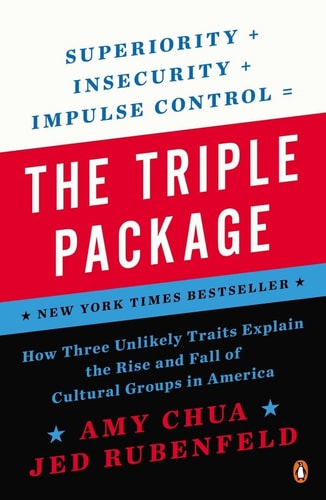
The Triple Package How Three Unlikely Traits Explain the Rise and Fall of Cultural Groups in America

Amy Chua,Jed Rubenfeld
"That certain groups do much better in America than others — as measured by income, occupational status, test scores, and so on — is difficult to talk about. In large part this is because the topic feels racially charged. The irony is that the facts actually debunk racial stereotypes. There are black and Hispanic subgroups in the United States far outperforming many white and Asian subgroups. Moreover, there’s a demonstrable arc to group success — in immigrant groups, it typically dissipates by the third generation — puncturing the notion of innate group differences and undermining the whole concept of 'model minorities.'" Mormons have recently risen to astonishing business success. Cubans in Miami climbed from poverty to prosperity in a generation. Nigerians earn doctorates at stunningly high rates. Indian and Chinese Americans have much higher incomes than other Americans; Jews may have the highest of all. Why do some groups rise? Drawing on groundbreaking original research and startling statistics, The Triple Package uncovers the secret to their success. A superiority complex, insecurity, impulse control—these are the elements of the Triple Package, the rare and potent cultural constellation that drives disproportionate group success. The Triple Package is open to anyone. America itself was once a Triple Package culture. It’s been losing that edge for a long time now. Even as headlines proclaim the death of upward mobility in America, the truth is that the old-fashioned American Dream is very much alive—but some groups have a cultural edge, which enables them to take advantage of opportunity far more than others. • Americans are taught that everyone is equal, that no group is superior to another. But remarkably, all of America’s most successful groups believe (even if they don’t say so aloud) that they’re exceptional, chosen, superior in some way. • Americans are taught that self-esteem—feeling good about yourself—is the key to a successful life. But in all of America’s most successful groups, people tend to feel insecure, inadequate, that they have to prove themselves. • America today spreads a message of immediate gratification, living for the moment. But all of America’s most successful groups cultivate heightened discipline and impulse control. But the Triple Package has a dark underside too. Each of its elements carries distinctive pathologies; when taken to an extreme, they can have truly toxic effects. Should people strive for the Triple Package? Should America? Ultimately, the authors conclude that the Triple Package is a ladder that should be climbed and then kicked away, drawing on its power but breaking free from its constraints. Provocative and profound, The Triple Package will transform the way we think about success and achievement.
Penguin 2015-01-27 352 pages

No Excuses Nine Ways Women Can Change How We Think About Power

Gloria Feldt
An invaluable guidebook, which contends that the most vexing problems facing women today isn't that doors of opportunity aren't open but that not enough women are walking through them Feminist icon Gloria Feldt pulls no punches in this new book, which argues that the most confounding problem facing women today isn't that doors of opportunity aren't open, but that not enough women are walking through them. From the boardroom to the bedroom, public office to personal relationships, she asserts that nobody is keeping women from parity-except themselves. Feldt puts women's power into an historical context, showing the ways in which women have made huge leaps forward in the past, only to pull back right when they were at the threshold. Feldt argues that there's no excuse-whether it's the way women are socialized, or pressure to conform, or work/life balance issues-for women today not to own their power. Women are still facing unequal pay, being passed over for promotions, entering public office at a much lesser rate than men, and oftentimes still struggling with traditional power dynamics in their interpersonal relationships. Feldt's solution to all these places where women face inequality is the same: we need to shift the way we think to achieve true parity with our male counterparts. No Excuses is divided into nine chapters that organized around how women can change the way they think, and therefore the way they act. These include: Know Your History and You Can Create the Future of Your Choice; Define the Terms-First; Embrace Controversy; Employ Every Medium; and other helpful ideas for using the tools and resources women already have to create the changes they want to see. No Excuses is a timely and invaluable book to help women equalize gender power in politics, work, and love.
Basic Books 2012-02-28 384 pages

Raising the Floor How a Universal Basic Income Can Renew Our Economy and Rebuild the American Dream

Andy Stern
Raising the Floor confronts America's biggest economic challenge--the fundamental restructuring of the economy and the emerging disruptive technology that threaten secure jobs and income. Andy Stern convincingly shows why it is time to consider a universal basic income as the nation's twenty-first-century solution to increasing inequality. In 2010, troubled by watching families chase the now-elusive American Dream, Andy Stern began a five-year journey to investigate how technology will impact jobs and the future of work. Stern, formerly the head of the nation's most influential and fastest-growing union, the Service Employees International Union, investigated these issues with a wide range of CEOs, futurists, economists, workers, entrepreneurs, and investment bankers who are shaping the future. The sobering assessment that emerged from his research across the political spectrum, from libertarians at the CATO Institute to the leaders of the progressive left, is that this time is different: there will be meager benefits that come with full-time work and fewer good jobs overall. Facing such a challenging moment, Stern's solution is fittingly bold: to establish a universal basic income by eliminating many current government programs and adding new resources. At once vivid, provocative, and pragmatic, Raising the Floor will spark a national conversation about creating the new American Dream.
PublicAffairs 2020-12-01 272 pages

Biotechnology in the time of COVID-19: commentaries from the front line

Jeremy M. Levin
"A collection of diverse viewpoints from over 45 thought leaders in the biotechnology industry and their efforts going forward during the COVID-19 pandemic. Biotechnology in the Time of COVID-19 is the opening chapter of a story of how the biotechnology industry rose to battle the COVID-19 virus-told by the leaders of that industry in their own words. The industry has built over more than forty years, an ecosystem of scientists, entrepreneurs, doctors, investors, venture capitalists, analysts, media, and bankers, all committed to advancing global health. In two months, leaders and companies from this ecosystem pivoted from the work they were carrying on pre-COVID-19 to face the virus. Forty-six seven contributors offer historical, personal, and investor perspectives, views from inside the biotech companies, broad lessons, leadership, and a look to the future. COVID-19 was a crisis anticipated by many, but one for which we were inadequately prepared. That has led to an unnecessary catastrophe. Now is the time to shine a light on those who bring hope that we will push back the virus with science and medicine. This book is a collection of the voices from the front of that fight. All share the commitment to fight and the conviction that science and medicine will prevail. The editor royalties and a portion of publisher revenues will be donated to two nonprofits focused on rare disease research: Global Genes (globalgenes.org) and The Institute for Life Changing Medicines (lifechangingmedicines.org)"--
RosettaBooks 2020-05-31 285 pages

Sugar Changed the World A Story of Magic, Spice, Slavery, Freedom, and Science

Marc Aronson,Marina Tamar Budhos
This globe-spanning history of sugar is "an epic story on a broad canvas that never loses sight of individual moments of human drama; a historical methodology infused with political, intellectual, cultural, and social strands; a complex sequence of cause and effect; an illuminating synthesis of primary and secondary sources; and a thoughtful marriage of words, picture, and design." (Horn Book starred review) Here is the story of how one product allows us to see the grand currents of world history in new ways. Using songs, oral histories, maps, and over 80 archival illustrations, Marc Aronson and Marina Budhos put a human face on this vast pageant. Time line, source notes, bibliography, and index included. The history of sugar runs like a bright band from religious ceremonies in India to Europe's Middle Ages, then on to Columbus, who brought the first cane cuttings to the Americas. Sugar caused the loss of countless lives, but it also planted the seeds of revolution that led to freedom in the American colonies, Haiti, and France. Cane, not cotton or tobacco, drove the bloody Atlantic slave trade and took the lives of countless Africans who toiled on vast sugar plantations under cruel overseers. And yet the very popularity of sugar gave abolitionists in England the one tool that could finally end the slave trade. Sugar moved, murdered, and freed millions; sugar changed the world.
Clarion Books 2010 166 pages

Money and Government The Past and Future of Economics

Robert Skidelsky
A critical examination of economics's past and future, and how it needs to change, by one of the most eminent political economists of our time The dominant view in economics is that money and government should play only a minor role in economic life. Economic outcomes, it is claimed, are best left to the "invisible hand" of the market. Yet these claims remain staunchly unsettled. The view taken in this important new book is that the omnipresence of uncertainty makes money and government essential features of any market economy. Since Adam Smith, classical economics has espoused nonintervention in markets. The Great Depression brought Keynesian economics to the fore, but stagflation in the 1970s brought a return to small-state orthodoxy. The 2008 global financial crash should have brought a reevaluation of that stance; instead the response has been punishing austerity and anemic recovery. This book aims to reintroduce Keynes's central insights to a new generation of economists, and embolden them to return money and government to the starring roles in the economic drama that they deserve.
Yale University Press 2018 491 pages

Inevitable surprises: thinking ahead in a time of turbulence

Peter Schwartz
The world we live in today is more volatile than ever. The security of free nations is threatened by rogue states, the global economy is in flux, and the rapid advance of technology forces constant reevaluation of our society. With so many powerful forces at work and seemingly unpredictable events occurring, to many the future seems dark, and its possibilities frightening. Peter Schwartz disagrees. A world-renowned visionary in the field of scenario planning, Schwartz’s startling—and accurate— predictions have been employed by government agencies and major corporations for more than twenty-five years. He argues that the future is foreseeable, and that by examining the dynamics at work today we can predict the “inevitable surprises” of tomorrow. Timely and thought-provoking, Inevitable Surprises is a book that no one with an interest in business—or the future of our society—can afford to miss.
Gotham Books 2004-05-24 247 pages

Trade Is Not a Four-Letter Word How Six Everyday Products Make the Case for Trade

Fred P. Hochberg
“A sprightly and clear-eyed testimonial to the value of globalization” ( The Wall Street Journ al ) as seen through six surprising everyday goods—the taco salad, the Honda Odyssey, the banana, the iPhone, the college degree, and the blockbuster HBO series Game of Thrones. Trade allows us to sell what we produce at home and purchase what we don’t. It lowers prices and gives us greater variety and innovation. Yet understanding our place in the global trade network is rarely simple. Trade has become an easy excuse for struggling economies, a scapegoat for our failures to adapt to a changing world, and—for many Americans on both the right and the left—nothing short of a four-letter word. But as Fred P. Hochberg reminds us, trade is easier to understand than we commonly think. In Trade Is Not a Four-Letter Word , you’ll learn how NAFTA became a populist punching bag on both sides of the aisle. You’ll learn how Americans can avoid the grim specter of the $10 banana. And you’ll finally discover the truth about whether or not, as President Trump has famously tweeted, “trade wars are good and easy to win.” (Spoiler alert—they aren’t.) Hochberg debunks common trade myths by pulling back the curtain on six everyday products, each with a surprising story to tell: the taco salad, the Honda Odyssey, the banana, the iPhone, the college degree, and the smash hit HBO series Game of Thrones . Behind these six examples are stories that help explain not only how trade has shaped our lives so far but also how we can use trade to build a better future for our own families, for America, and for the world. Trade Is Not a Four-Letter Word is the antidote to today’s acronym-laden trade jargon pitched to voters with simple promises that rarely play out so one-dimensionally. Packed with colorful examples and highly digestible explanations, Trade Is Not a Four-Letter Word is “an accessible, necessary book that will increase our understanding of trade and economic policies and the ways in which they impact our daily lives” ( Library Journal , starred review).
Simon and Schuster 2021-01-26 336 pages

Price Theory

Milton Friedman
Economics is sometimes divided into two parts: positive economics and normative economics. The former deals with how the economic problem is solved, while the latter deals with how the economic problem should be solved. The effects of price or rent control on the distribution of income are problems of positive economics. The desirability of these effects on income distribution is a problem of normative economics. Within economics, the major division is between monetary theory and price theory. Monetary theory deals with the level of prices in general, with cyclical and other fluctuations in total output, total employment, and the like. Price theory deals with the allocation of resources among different uses, the price of one item relative to another. Prices do three kinds of things. They transmit information, they provide an incentive to users of resources to be guided by this information, and they provide an incentive to owners of resources to follow this information. Milton Friedman's classic book provides the theoretical underpinning for and understanding of prices. Economics is not concerned solely with economic problems. It is a social science, and is therefore concerned primarily with those economic problems whose solutions involve the cooperation and interaction of different individuals. It is concerned with problems involving a single individual only insofar as the individual's behavior has implications for or effects upon other individuals. "Price Theory" is concerned not with economic problems in the abstract, but with how a particular society solves its economic problems.
Richest Man in Babylon Publ. 2009-06 288 pages

Managing the Global Commons The Economics of Climate Change

William D. Nordhaus
Provides a detailed analysis of the DICE model (Dynamic Integrated model of Climate and the Economy) as well as an extensive analysis of the model's results. Coping with the challenges of global warming is a daunting task for both scientists and economists, who must understand future changes, and for policy makers, who must ultimately choose policies to balance risks and costs. Managing the Global Commons presents a unique effort to encompass economic, scientific, and policy aspects of this great geophysical experiment. Managing the Global Commons provides a detailed analysis of the DICE model (Dynamic Integrated model of Climate and the Economy) as well as an extensive analysis of the model's results. DICE is the first dynamic model to include a closed-loop system that includes emissions, concentrations, climate change, damages, and emissions controls. The model is useful for estimating the costs and benefits of different paths for slowing climate change and for analyzing the impact of control strategies over time. The analysis contains a number of methodological advances and major findings - most importantly the construction of a small model to encompass the primary components of the climate and economic system within an optimization framework. Also included are new techniques and results concerning the role of uncertainty and the risk premium involved in policies to slow global warming. In addition, the analysis derives a set of uncertain representative scenarios that summarize the large number of potential outcomes into a manageable number to be used within an optimization framework and incorporated into a contingent-commodity framework. Nordhaus examines several different approaches to climate-change policy: no controls, economic optimization, geoengineering, stabilization of emissions and climate, and a ten-year delay in undertaking climate-change policies. Among these, there is a modest advantage of an efficient policy over no controls or a ten-year delay, while the three stabilization options would impose significant net costs. Overall, Nordhaus observes, the analysis reveals that even with major technological breakthroughs and stringent controls, the momentum of past greenhouse gas emissions coupled with great inertia in climate change policy will lead to an inevitable rendezvous with massive climate change.
MIT Press 1994 224 pages

Work and Authority in Industry: Managerial Ideologies in the Course of Industrialization

Bendix, Reinhard
Work and Authority in Industry analyzes how the entrepreneurial class responded to the challenge of creating, and later managing, an industrial work force in widely differing types of industrial societies: the United States, England, and Russia. Bendix's penetrating re-examination of an aspect of economic history largely taken for granted was first published in 1965. It has become a classic. His central notion, that the behavior of the capitalist class may be more important than the behavior of the working class in determining the course of events, is now widely accepted. The book explores industrialization, management, and ideological appeals; entrepreneurial ideologies in England's early phase of industrialization; entrepreneurial ideologies in eighteenth- and nineteenth-century Russia; the bureaucratization of economic enterprises; and the American experience with -industrialization. This essential text will interest those in the fields of political science, industrial relations, management studies, as well as comparative sociologists and historians.
Routledge 2018 464 pages

Marxism and the French Left Studies on Labour and Politics in France, 1830-1981

Tony Judt
During the 1970s radical politics in France underwent major changes, transformed by the rise of the Socialist Party, the decline of the Communists, and the loss of faith in Marxism. These changes, together with the lessened impact of the industrial proletariat and the problems presented by Mitterrand's sweeping Socialist victory in 1981, signalled a veritable turning point in modern French history. This book offers a historical and political analysis of the history of labor, Socialism, and Communism in France since the Revolution, an analysis that is essential for understanding recent French political developments. Unlike most books, which treat labor, Socialist and Communist history separately and view French Marxism as a self-contained philosophical phenomenon, Marxism and the French Left offers a refreshingly different approach to the subject. Judt emphasizes the complex and interwoven themes that unify the topics of his essays to construct a distinctive and original interpretation of French left-wing politics over the past 150 years.
Oxford University Press, Incorporated 1989 350 pages

Greedy Bastards How We Can Stop Corporate Communists, Banksters, and Other Vampires from Sucking America Dry

Dylan Ratigan
DYLAN RATIGAN’S mission is to uncover never-before-seen solutions to the most pressing issues of our time: government corruption, corporate communism, an ailing health care system, an age-old dependency on foreign oil, and a broken educational system. In this groundbreaking book, Ratigan makes a case that America has the opportunity to prosper, but only by setting clear goals. Ratigan believes that this country, now more than ever, needs passionate debate and smart policy, a brazen willingness to scrap what doesn’t work, and the entrepreneurial spirit to try what does. Ratigan has compiled brash and fresh solutions for building a new and better America, and with this book he has started the debate America deserves.
Simon and Schuster 2012-08-21 256 pages

The End of Marketing as We Know It

Sergio Zyman
Marketing today doesn't work. Or so says the "Aya Cola," Sergio Zyman, former marketing czar of Coca-Cola and quite possibly the most famous marketing gadfly in the world. Brilliant, irascible, unconventional, Zyman is best known for reinventing the Coca-Cola Company's marketing approach by spearheading the global launches of Diet Coke, New Coke, Classic Coke, Fruitopia, and Sprite. Now, in this brisk and revolutionary book, Zyman shows why old approaches to marketing have lost their fizz--and how to get a jump on the strateies that will work in the twenty-first century. Zyman explores such topics as: Why feel-good marketing is pointless unless it results in sales Why marketing is a science not an art How a well-honed strategy is more important to success than what ads say And much more
Harper Collins 2000-11-07 272 pages

The Hollywood Economist 2.0

Edward Jay Epstein
A fully revised edition of the popular guide to Hollywood finances, updated to reflect even newer films and trends In a Freakonomics-meets-Hollywood saga, veteran investigative reporter Edward Jay Epstein goes undercover to explore Hollywood’s “invisible money machine,” probing the dazzlingly complicated finances behind the hits and flops, while he answers a surprisingly difficult question: How do the studiosmake their money? We also learn: + How and why the studios harvest silver from old film prints ... + Why stars do—or don’t do—their own stunts ... + The future of Netflix: Why the “next big thing” now seems in such deep trouble... + What it costs to insure Nicole Kidman’s right knee… + How Hollywood manipulates Wall Street: including the story of the acquisition of MGM… wherein a consortium of banks and hedge funds lost some $5 billion… while Hollywood made millions. + Why Arnold Schwarzenegger is considered a contract genius… + The fate of serious fare: How HBO, AMC, and Showtime have found ways to make money offer adult drama, while the Hollywood studios prefer to cater to teen audiences. + Why Lara Croft: Tomb Raider is considered a “masterpiece” of financing ...
Random House Publishing Services 2012-01-24 240 pages

Internet of things: cases and studies

Fausto Pedro García Márquez,Benjamin Lev
This book provides relevant theoretical frameworks and the latest empirical research findings of Operations Research/Management Science applied to Internet of Things. This book identifies and describes ways in which OR and MS have been applied and influenced the development of IoT. Examples are from smart industry; city; transportation; home and smart devices. It discusses future applications, trends, and potential benefits of this new discipline. It is written for professionals who want to improve their understanding of the strategic role of IoT at various levels of the organization, that is, IoT at the global economy level, at networks and organizations level, at teams and work groups, at information systems and, finally, IoT at the level of individuals, as players in the networked environments.
Springer 2021-07-14 304 pages

Transaction Man Traders, Disrupters, and the Dismantling of Middle-Class America

Nicholas Lemann
An Amazon Best History Book of 2019 "A splendid and beautifully written illustration of the tremendous importance public policy has for the daily lives of ordinary people." —Ryan Cooper, Washington Monthly Over the last generation, the United States has undergone seismic changes. Stable institutions have given way to frictionless transactions, which are celebrated no matter what collateral damage they generate. The concentration of great wealth has coincided with the fraying of social ties and the rise of inequality. How did all this come about? In Transaction Man , Nicholas Lemann explains the United States’—and the world’s—great transformation by examining three remarkable individuals who epitomized and helped create their eras. Adolf Berle, Franklin Delano Roosevelt’s chief theorist of the economy, imagined a society dominated by large corporations, which a newly powerful federal government had forced to become benign and stable institutions, contributing to the public good by offering stable employment and generous pensions. By the 1970s, the corporations’ large stockholders grew restive under this regime, and their chief theoretician, Harvard Business School’s Michael Jensen, insisted that firms should maximize shareholder value, whatever the consequences. Today, Silicon Valley titans such as the LinkedIn cofounder and venture capitalist Reid Hoffman hope “networks” can reknit our social fabric. Lemann interweaves these fresh and vivid profiles with a history of the Morgan Stanley investment bank from the 1930s through the financial crisis of 2008, while also tracking the rise and fall of a working-class Chicago neighborhood and the family-run car dealerships at its heart. Incisive and sweeping, Transaction Man is the definitive account of the reengineering of America and the enormous impact it has had on us all.
Picador 2020-11-10 320 pages