244 results for "Science"

Why Does My Dog Act That Way? A Complete Guide to Your Dog's Personality

Stanley Coren
We've shared our lives with dogs for thousands of years, but they still act in ways that baffle us. To help us understand them better, Dr. Stanley Coren, the undisputed expert on dog behavior, intelligence, and training, tells the story of how dogs evolved over time into the myriad forms and breeds we love today. Not simply domesticated wolves, dogs are actually much more complex than wild canines; their ability to adapt to a man-made world is far more flexible, their personalities far more diverse. Fascinating findings reveal which breeds were bred to become more dominant, affectionate, cooperative, or even dangerous. This practical, surprising book also presents -- for the first time -- the "Dog Behavior Inventory," a simple, fun test based on the personality-profiling questionnaires used in human psychological studies that you can administer to your own dog to get a detailed picture of his personality and how he compares to other members of his breed. Then, using the findings of the U.S. Army's once- classified studies of "Superdogs," you can train your pet to become a real-life equivalent of Lassie and Rin Tin Tin -- a dog who is not disturbed, angered, or frightened by anything. Filled with the entertaining anecdotes and scientific data that Dr. Coren's avid followers have come to expect and enjoy, this uniquely complete guide to dog psychology can help you to select a new companion and to understand and communicate better with your old friend.
Simon and Schuster 2007-12-04 304 pages

Hope Dies Last Keeping the Faith in Troubled Times

Studs Terkel
America's most inspirational voices, in their own words: "If you're looking for a reason to act and dream again, you'll find it in the pages of this book" ( Chicago Tribune ). Published when Studs Terkel was ninety-one years old, this astonishing oral history tackles one of the famed journalist's most elusive subjects: Hope. Where does it come from? What are its essential qualities? How do we sustain it in the darkest of times? An alternative, more personal chronicle of the "American century," Hope Dies Last is a testament to the indefatigable spirit that Studs has always embodied, and an inheritance for those who, by taking a stand, are making concrete the dreams of today. A former death row inmate who served nearly twenty years for a crime he did not commit discusses his never-ending fight for justice. Tom Hayden, author of The Port Huron Statement , contemplates the legacy of 1960s student activism. Liberal economist John Kenneth Galbraith reflects on the enduring problem of corporate malfeasance. From a doctor who teaches his young students compassion to the retired brigadier general who flew the Enola Gay over Hiroshima, these interviews tell us much about the power of the American dream and the force of individuals who advocate for a better world. With grace and warmth, Terkel's subjects express their secret hopes and dreams. Taken together, this collection of interviews tells an inspiring story of optimism and persistence, told in voices that resonate with the eloquence of conviction. "The value of Hope Dies Last lies not in what it teaches readers about its narrow subject, but in the fascinating stories it reveals, and the insight it allows into the vast range of human experience." -- The A.V. Club "Very Terkelesque--by now the man requires an adjective of his own." --Margaret Atwood, The New York Times Review of Books "An American treasure." --Cornel West
The New Press 2004-11 360 pages

The making of memory: [from molecules to mind]

Rose, Steven
The human brain weighs, on average, just over two pounds, is wrinkled like a walnut and has the colour and something of the consistency of porridge. Yet somehow the interactions of the ten billion cells that comprise it produce our capacity to think, hope, believe, imagine, and also to remember - to learn and recall, perhaps years later, a face, a tune, a poem or a telephone number. Are there molecules of memory? Can we understand the brain best as a computer? What light do diseases of memory shed on its mechanism? What is it, locked into the interactions of the brain cells and the molecules composing them, that carries the memories which make each person unique? Deciphering this, Steven Rose argues, is the key to interpreting the links between brain and mind. In this book he traces the road to a new understanding of memory that he and other researchers have followed, with all its false turnings and misleading signposts. One of the aims of the book is to explore, through a description of the laboratory life of memory researchers, how scientists, in a world not free from political rivalry, ideology and self-deception, nevertheless strive to answer an important and fascinating question. The winner of the Rhone-Poulenc Science Prize 1993.
Bantam Books 1993 355 pages

Toward a Meaningful Life The Wisdom of the Rebbe Menachem Mendel Schneerson

Simon Jacobson
Toward a Meaningful Life is a spiritual road map for living based on the teachings of one of the foremost religious leaders of our time: Rabbi Menachem Mendel Schneerson. Head of the Lubavitcher movement for forty-four years and recognized throughout the world simply as "the Rebbe," Menachem Mendel Schneerson, who passed away in June 1994, was a sage and a visionary of the highest order. Toward a Meaningful Life gives people of all backgrounds fresh perspectives on every aspect of their lives--from birth to death, youth to old a≥ marriage, love, intimacy, and family; the persistent issues of career, health, pain, and suffering; and education, faith, science, and government. We learn to bridge the divisions between accelerated technology and decelerated morality, between unprecedented worldwide unity and unparalleled personal disunity. Although the Rebbe's teachings are firmly anchored in more than three thousand years of scholarship, the urgent relevance of these old-age truths to contemporary life has never been more manifest. At the threshold of a new world where matter and spirit converge, the Rebbe proposes spiritual principles that unite people as opposed to the materialism that divides them. In doing so, he continues to lead us toward personal and universal redemption, toward a meaningful life, and toward God.
HarperCollins Publishers 2019 336 pages

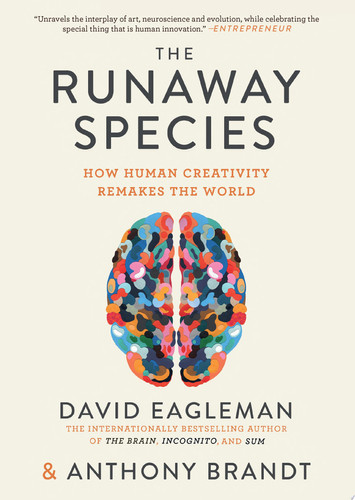
The Runaway Species How Human Creativity Remakes the World

David Eagleman,Anthony Brandt
This enlightening examination of creativity looks “at art and science together to examine how innovations . . . build on what already exists and rely on three brain operations: bending, breaking and blending” ( The Wall Street Journal ) The Runaway Species is a deep dive into the creative mind, a celebration of the human spirit, and a vision of how we can improve our future by understanding and embracing our ability to innovate. David Eagleman and Anthony Brandt seek to answer the question: what lies at the heart of humanity’s ability—and drive—to create? Our ability to remake our world is unique among all living things. But where does our creativity come from, how does it work, and how can we harness it to improve our lives, schools, businesses, and institutions? Eagleman and Brandt examine hundreds of examples of human creativity through dramatic storytelling and stunning images in this beautiful, full–color volume. By drawing out what creative acts have in common and viewing them through the lens of cutting–edge neuroscience, they uncover the essential elements of this critical human ability, and encourage a more creative future for all of us. “ The Runaway Species approach[es] creativity scientifically but sensitively, feeling its roots without pulling them out.” — The Economist
Catapult 2018-06-19 304 pages

Uncle Tungsten

Sacks, Oliver
In this memoir, Oliver Sacks evokes, with warmth and wit, his upbringing in wartime England, telling of the large science-steeped family who fostered his early fascination with chemistry. There follow his years at boarding school where, though unhappy, he developed the intellectual curiosity that would shape his later life. And we hear of his return to London, an emotionally bereft 10-year-old who found solace in his passion for learning. 'Uncle Tungsten' radiates all the delight and wonder of a boy's adventures, and provides an unforgettable portrait of an extraordinary young mind.
Picador 2016-02-25 337 pages

The Evolution of Fatherhood

Jeffrey Moussaieff Masson
Inspired by the wonder of his own parental experiences, former psychoanalyst and New York Times best-selling author Jeffrey Masson offers a remarkable look at one of the most fulfilling roles in the animal world: fatherhood. In The Evolution of Fatherhood , he explores the extraordinary dedication and behavior of nature's most outstanding dads. Discover the male emperor penguin incubating his egg through Antarctic blizzards, prairie dog dads teaching their pups vital life skills through play, and the South American tamarin monkey who actively "coaches" his mate through labor. Learn why wolves make devoted fathers, while their close relatives, dogs, often don't display the same level of paternal care. With captivating writing and impeccable research, Masson celebrates the unique and often surprising role males play in the lives of their young. He contrasts these heroes with nature's less involved fathers--like lions, langurs, and bears--and challenges the notion that paternal care is purely biological. Masson passionately demonstrates that for many animals, fatherhood is a profound, all-encompassing emotional experience. Compelling and inspirational, The Evolution of Fatherhood is a book that will forever change how you perceive parenthood, family bonds, and the rich emotional lives of the animals who share our world.
Histria Books 2024-02-06 242 pages

The Sweet Spot The Pleasures of Suffering and the Search for Meaning

Paul Bloom
"This book will challenge you to rethink your vision of a good life. With sharp insights and lucid prose, Paul Bloom makes a captivating case that pain and suffering are essential to happiness. It's an exhilarating antidote to toxic positivity." --Adam Grant, #1 New York Times bestselling author of Think Again and host of the TED podcast WorkLife One of Behavioral Scientist's "Notable Books of 2021" From the author of Against Empathy, a different kind of happiness book, one that shows us how suffering is an essential source of both pleasure and meaning in our lives Why do we so often seek out physical pain and emotional turmoil? We go to movies that make us cry, or scream, or gag. We poke at sores, eat spicy foods, immerse ourselves in hot baths, run marathons. Some of us even seek out pain and humiliation in sexual role-play. Where do these seemingly perverse appetites come from? Drawing on groundbreaking findings from psychology and brain science, The Sweet Spot shows how the right kind of suffering sets the stage for enhanced pleasure. Pain can distract us from our anxieties and help us transcend the self. Choosing to suffer can serve social goals; it can display how tough we are or, conversely, can function as a cry for help. Feelings of fear and sadness are part of the pleasure of immersing ourselves in play and fantasy and can provide certain moral satisfactions. And effort, struggle, and difficulty can, in the right contexts, lead to the joys of mastery and flow. But suffering plays a deeper role as well. We are not natural hedonists--a good life involves more than pleasure. People seek lives of meaning and significance; we aspire to rich relationships and satisfying pursuits, and this requires some amount of struggle, anxiety, and loss. Brilliantly argued, witty, and humane, Paul Bloom shows how a life without chosen suffering would be empty--and worse than that, boring.
HarperCollins Publishers 2021-11-02 304 pages

Love at Goon Park Harry Harlow and the Science of Affection

Deborah Blum
In the early twentieth century, affection between parents and their children was discouraged—psychologists thought it would create needy kids, and doctors thought it would spread infectious disease. It took a revolution in psychology to overturn these beliefs and prove that touch ensures emotional and intellectual health. In Love at Goon Park, Pulitzer Prize winner Deborah Blum charts this profound cultural shift by tracing the story of Harry Harlow—the man who studied neglect and its life-altering consequences on primates in his lab. The biography of both a man and an idea, Love at Goon Park ultimately invites us to examine ourselves and the way we love.
Basic Books 2011-07-05 368 pages

Mesmerized How Ben Franklin Solved a Mystery that Baffled All of France

Mara Rockliff
“Together, Rockliff and Bruno make the scientific method seem exciting, and kids interested in science and history will likely be, well, mesmerized.” — Booklist (starred review) When American inventor Benjamin Franklin arrives in Paris, he is upstaged by a compelling and enigmatic figure: Dr. Mesmer. In elaborately staged shows, Mesmer has Parisians believing he can control a magic force that changes the taste of water, cures illness, and controls thoughts! Can Ben Franklin’s approach of observing, hypothesizing, and testing get to the bottom of Mesmer’s tricks? A rip-roaring, lavishly illustrated peek into a fascinating moment in history shows the development of the scientific method — and reveals the amazing power of the human mind.
National Geographic Books 2017-09-12 48 pages

Five Lectures on Psycho-Analysis

Sigmund Freud
There exist, of course, few more famous figures in the field of psychology than Sigmund Freud. As the founding father of psychoanalysis, or the clinical method for treating psychopathology through dialogue between a patient and a psychoanalyst, his impact on the field of psychology cannot be overstated. This short work, "Five Lectures on Psycho-Analysis", is a collection of a series of lectures given by Freud at the 20th Anniversary Celebration of the founding of Clark University in Worcester, Massachusetts during September 1909 and was published as a collection in 1910. This event, at which Freud was awarded an honorary doctorate, received widespread media attention and marked the beginning of public popularity for Freud and his ideas. The publication of the lectures brought an even greater public attention to his theories. "Five Lectures on Psycho-Analysis" predates the more extensive collection "Introductory Lectures on Psychoanalysis", which is a series of lectures given by Freud from 1915 to 1917 and which delve more deeply into the topics of dreams, the unconscious mind, and the source of neuroses. "Five Lectures on Psycho-Analysis" is an excellent and accessible introduction to Freud's influential work in which he summarizes his basic ideas and speaks on the foundations of psychoanalysis. This edition is printed on premium acid-free paper and follows the translation of Harry W. Chase.
www.bnpublishing.com 2008-11-10 84 pages

Transcendence

Rosenthal, Norman E
"Dr. Norman Rosenthal's Transcendence is the best-ever book on Transcendental Meditation: accessible and substantive, engaging and scientific, practical and profound. A very enjoyable read that can change your life, for good." —David Lynch "I have been meditating for over 10 years, and I found Transcendence to be a uniquely compelling introduction to the art and science of Transcendental Meditation. Dr. Norman Rosenthal's book will propel TM into the mainstream where it belongs." —Russell Simmons In this definitive book on the scientifically proven health and stress-relieving benefits of Transcendental Meditation, a renowned psychiatrist and researcher explores why TM works, what it can do for you, and how to use it for maximum effect. This New York Times bestselling paperback edition includes a new afterword by the author on the latest research and breakthroughs. Norman E. Rosenthal, M.D., a twenty-year researcher at the National Institute of Mental Health and the celebrated psychiatrist who pioneered the study and treatment of Season Affective Disorder (SAD), brings us the most important work on Transcendental Meditation since the Maharishi Mahesh Yogi's Science of Being and Art of Living -- and one of our generation's most significant books on achieving greater physical and mental health and wellness. Transcendence demystifies the practice and benefits of Transcendental Meditation for a general audience who may have heard about the method but do not necessarily know what it is, how it is learned, or what they stand to gain, physically and emotionally, from achieving transcendence. Dr. Rosenthal clearly and practically explains the basic ideas behind Transcendental Meditation: It is a nonreligious practice that involves sitting comfortably for twenty minutes twice a day while using a silent mantra, or nonverbal sound, to attain a profound state of aware relaxation. Alongside exclusive celebrity interviews-where figures like Paul McCartney, Ringo Starr, Martin Scorsese, Russell Brand, Laura Dern, Moby , and David Lynch openly discuss their meditation-Dr. Rosenthal draws upon experience from the lives of his patients and a wealth of clinical research amassed on TM over the past generation (340 peer-reviewed published articles). He provides the fullest and most accessible book ever on the broad range of benefits of this remarkably simple practice, from relief of anxiety, stress and depression to new hope for those experiencing addiction, attention-deficit disorder, or post-traumatic stress disorder.
Penguin Random House 2012-08-30 336 pages

Mapping the moral domain

Gilligan, Carol, ed
In the fourteen articles collected in this volume, Carol Gilligan and her colleagues expand the theoretical base of In a Different Voice and apply their research methods to a variety of life situations. The contrasting voices of justice and care clarify different ways in which women and men speak about relationships and lend different meanings to connection, dependence, autonomy, responsibility loyalty, peer pressure, and violence. By examining the moral dilemmas and self-descriptions of children, high school students, urban youth, medical students, mothers, lawyers, and others, the authors chart a new terrain: a mapping of the moral domain that includes the voices of women. In this new terrain the authors trace far-reaching implications of the inclusion of women’s voices for developmental psychology, for education, for women, and for men.
Center for the Study of Gender, Education and Human Development, Harvard University Graduate School of Education 1988 324 pages

The Mind's Eye

Oliver W. Sacks
From the author of the #1 national bestselling Musicophilia comes a truly visionary book: an exploration of the remarkable, unpredictable ways that our brains cope with the loss of sight by finding new forms of perception to create worlds as complete and rich as the no-longer-visible world. Following the phenomenal success of his international bestseller Musicophilia , the inimitable Oliver Sacks returns with another book on the extraordinary interaction between our brain and our senses -- in this case, vision. In The Mind's Eye , Sacks examines questions ranging from the primary experiences of how we perceive depth or color or motion to the complex matter of how different individuals have varied ways of thinking and experiencing or recreating the visual world. Like The Man Who Mistook His Wife for a Hat and An Anthropologist on Mars , Sacks's new book is based primarily on individual stories -- including Sacks's own experience of an ocular tumor that left him unable to perceive depth. As always, he embeds these case histories in a rich historical and scientific context. Sacks goes beyond basic vision to explore perception, hallucination and the power of visualization, as well as the ocular effects of migraine, epilepsy and other conditions. Oliver Sacks is our perfect guide to the visual world, a realm that, it turns out, is much, much more complicated than we could have imagined.
Alfred A. Knopf 2010 263 pages

This is your brain on sports: the science of underdogs, the value of rivalry, and what can we learn from the T-shirt cannon

Wertheim, L. Jon,Sommers, Sam
This is Your Brain on Sports is the book for sports fans searching for a deeper understanding of the games they watch and the people who play them. Sports Illustrated executive editor and bestselling author L. Jon Wertheim teams up with Tufts psychologist Sam Sommers to take readers on a wild ride into the inner world of sports. Through the prism of behavioral economics, neuroscience, and psychology, they reveal the hidden influences and surprising cues that inspire and derail us—on the field and in the stands—and by extension, in corporate board rooms, office settings, and our daily lives. In this irresistible narrative romp, Wertheim and Sommers usher us from professional football to the NBA to Grand Slam tennis, from the psychology of athletes self-handicapping their performance in the boxing ring or the World Series, to an explanation of why even the glimpse of a finish line can lift us beyond ordinary physical limits. They explore why Tom Brady and other starting NFL quarterbacks all seem to look like fashion models; why fans of teams like the Cubs, Mets, and any franchise from Cleveland love rooting for a loser; why the best players make the worst coaches; why hockey goons (and fans) would rather fight at home than on the road; and why the arena t-shirt cannon has something to teach us about human nature. In short, this book is an entertaining and thought-provoking journey into how psychology and behavioral science collide with the universe of wins-and-losses, coaching changes, underdogs, and rivalry games. — Boston Globe, Best Books of 2016, Sports
Three Rivers Press 2017-02-07 288 pages

Psychobabble and biobunk: using psychological science to think critically about popular psychology

Tavris, Carol
This revised and updated handbook features a selection of essay-style book reviews by Carol Tavris , written for the Times Literary Supplement, The Chronicle of Higher Education, American Scientist, and The New York Times Book Review. These reviews apply psychological research and principles of scientific thinking to ideas presented in the books. They aim to show how critical thinking can help people assess arguments promoted in the popular culture, and how to separate those that are scientifically sound from those based on "psychobabble"-pop-psych notions dressed up in fancy, sciency-sounding language. These essays may be used to encourage debate in the classroom or as a basis for student papers. Students can be asked to write or present their own points of view on a topic, drawing on other research and the guidelines of critical thinking (defined and described in a prefatory "Note to the Reader") to support their conclusions. Although these reviews can be used in many social science and composition courses, the topics covered and the critical-thinking guidelines that apply to them correspond to specific material in Carole Wade and Carol Tavris's Psychology and Invitation to Psychology .
Prentice Hall 2011 101 pages

Alfred Adler Vol. 1 (4 Books) What Life Could Mean to You, the Pattern of Life, the Science of Living, Problems of Neurosis

Alfred Adler
This first volume of the Alfred Adler works collect four very important works, a must have for anybody interested in psychology: -What Life Could Mean to You-The Pattern of Life-The Science of Living-Problems of Neurosis In collaboration with Sigmund Freud and a small group of Freud's colleagues, Adler was among the co-founders of the psychoanalytic movement and a core member of the Vienna Psychoanalytic Society: indeed, to Freud he was "the only personality there" What life could mean to you is one of Adler's most popular books. On the meaning of life, he begans: "Human beings live in the realm of meanings. We do not experience pure circumstances; we always experience circumstances in their significance for men. Even at its source our experience is qualified by our human purposes. " Wood " means " wood in its relation to mankind ", and " stone " means " stone as it can be a factor in human life." If a man should try to escape meanings and devote himself only to circumstances he would be very unfortunate: he would isolate himself from others: his actions would be useless to himself or to any one; in a word, they would be meaningless. But no human being can escape meanings. We experience reality always through the meaning we give it; not in itself, but as something interpreted. It will be natural to suppose, therefore, that this meaning is always more or less unfinished, incomplete; and even that it is never altogether right. The realm of meanings is the realm of mistakes."
CreateSpace Independent Publishing Platform 2018-02-06 568 pages

Thought Reform and the Psychology of Totalism A Study of Brainwashing in China

Robert Jay Lifton
2014 Reprint of 1961 Edition. Full facsimile of the original edition, not reproduced with Optical Recognition Software. Lifton's research for the book began in 1953 with a series of interviews with American servicemen who had been held captive during the Korean War. In addition to interviews with 25 Americans, Lifton also interviewed 15 Chinese who had fled their homeland after having been subjected to indoctrination in Chinese universities. From these interviews, which in some cases occurred regularly for over a year, Lifton identified the tactics used by Chinese communists to cause drastic shifts in one's opinions and personality and "brainwash" American soldiers into making demonstrably false assertions. This work has become a classic text in the field and continues to serve as a fundamental guide in the debriefing of former cult members. Lifton's famous eight criteria for thought control are: Milieu Control. This involves the control of information and communication both within the environment and, ultimately, within the individual, resulting in a significant degree of isolation from society at large. Mystical Manipulation. There is manipulation of experiences that appear spontaneous but in fact were planned and orchestrated by the group or its leaders in order to demonstrate divine authority or spiritual advancement or some special gift or talent that will then allow the leader to reinterpret events, scripture, and experiences as he or she wishes. Demand for Purity. The world is viewed as black and white and the members are constantly exhorted to conform to the ideology of the group and strive for perfection. The induction of guilt and/or shame is a powerful control device used here. Confession. Sins, as defined by the group, are to be confessed either to a personal monitor or publicly to the group. There is no confidentiality; members' "sins," "attitudes," and "faults" are discussed and exploited by the leaders. Sacred Science. The group's doctrine or ideology is considered to be the ultimate Truth, beyond all questioning or dispute. Truth is not to be found outside the group. The leader, as the spokesperson for God or for all humanity, is likewise above criticism. Loading the Language. The group interprets or uses words and phrases in new ways so that often the outside world does not understand. This jargon consists of thought-terminating clichés, which serve to alter members' thought processes to conform to the group's way of thinking. Doctrine over person. Member's personal experiences are subordinated to the sacred science and any contrary experiences must be denied or reinterpreted to fit the ideology of the group. Dispensing of existence. The group has the prerogative to decide who has the right to exist and who does not. This is usually not literal but means that those in the outside world are not saved, unenlightened, unconscious and they must be converted to the group's ideology. If they do not join the group or are critical of the group, then they must be rejected by the members. Thus, the outside world loses all credibility. In conjunction, should any member leave the group, he or she must be rejected also.
Martino Fine Books 2014-07-24 522 pages

Rising Out of Hatred The Awakening of a Former White Nationalist

Eli Saslow
From a Pulitzer Prize-winning reporter, the powerful story of how a prominent white supremacist changed his heart and mind. This is a book to help us understand the American moment and to help us better understand one another. "The story of Derek Black is the human being at his gutsy, self-reflecting, revolutionary best, told by one of America's best storytellers at his very best. Rising Out of Hatred proclaims if the successor to the white nationalist movement can forsake his ideological upbringing, can rebirth himself in antiracism, then we can too no matter the personal cost. This book is an inspiration." --Ibram X. Kendi, National Book Award-winning author of Stamped from the Beginning: The Definitive History of Racist Ideas in America Derek Black grew up at the epicenter of white nationalism. His father founded Stormfront, the largest racist community on the Internet. His godfather, David Duke, was a KKK Grand Wizard. By the time Derek turned nineteen, he had become an elected politician with his own daily radio show--already regarded as the the leading light of the burgeoning white nationalist movement. We can infiltrate, Derek once told a crowd of white nationalists. We can take the country back. Then he went to college. At New College of Florida, he continued to broadcast his radio show in secret each morning, living a double life until a classmate uncovered his identity and sent an email to the entire school. Derek Black ... white supremacist, radio host ... New College student The ensuing uproar overtook one of the most liberal colleges in the country. Some students protested Derek's presence on campus, forcing him to reconcile for the first time with the ugliness of his beliefs. Other students found the courage to reach out to him, including an Orthodox Jew who invited Derek to attend weekly Shabbat dinners. It was because of those dinners--and the wide-ranging relationships formed at that table--that Derek started to question the science, history, and prejudices behind his worldview. As white nationalism infiltrated the political mainstream, Derek decided to confront the damage he had done. Rising Out of Hatred tells the story of how white-supremacist ideas migrated from the far-right fringe to the White House through the intensely personal saga of one man who eventually disavowed everything he was taught to believe, at tremendous personal cost. With great empathy and narrative verve, Eli Saslow asks what Derek Black's story can tell us about America's increasingly divided nature.
Diversified Publishing 2018-09-18 368 pages